Showing posts with label arthur hobart. Show all posts

Sunday, August 28, 2011

Lady Dorothy Mills Turns 50


This is just a relative quickie today, based on our previous entry (below). While searching for events occurring at the address of the family of George Mills in Kensington, I also stumbled upon this classified advertisement in the 3 November 1938 issue of The Times:


LADY DOROTHY MILLS wishes to DISPOSE of eight remaining years' lease of attractive, modern, convenient, non-basement ; CHELSEA COTTAGE ; parquet ; five good rooms, kitchen, bath ; Ideal boiler ; gas and electric fires ; good cupboards. Rent £165. Premium £50. Rates about £50. Semi-fitments, &c., available for cheap purchase. View between 11 and 6. — 17, Burnsall Street, S.W.3. Flaxman 2476.


Lady Dorothy, ever one to stretch a dollar after her estrangement from her family upon the occasion of her marriage to Captain Arthur F. H. Mills, D.C.L.I., in 1916, would have been turning 50 years of age on the 11th of March the following spring, and must have had an one eye looking toward retirement and the other on making a few extra quid by subletting her desirable Chelsea home [above, left; click to enlarge] for a premium while taking up less expensive residence elsewhere.

We already know that Lady D. spent the rest of her life living in Steyning Mansions Hotel at Eastern Terrace in Brighton. In 1958, the hotel was offering rooms with a private bath, telephone, and TV at the following rates: "Winter from 9 gns., Summer from 10½ gns."

Those rates presumably were far lower before the Second World War, at the tail end of the Great Depression, when she arrived. Eight years of rent from her Burnsall Street flat must have paid for a good many of her subsequent summers and winters in beautiful, seaside Brighton.


Saturday, July 30, 2011

A Hodge Podge of Mills Miscellany


The temperature here in steamy Florida—and across the U.S. for that matter—simply has been sweltering! I should be out finishing the task of painting the house, but it has been easier just to stay indoors, enjoy the air conditioning, and work at cleaning out the George Mills-related folders that have been squirreled in and all around this computer, I have some miscellaneous items that I want to post before we wrap things up here at Who Is George Mills?

Here they are, in no particular order:


WWII R.A.P.C. Regimental Pay Office:


First up, Part I of the April 1944 edition of the Quarterly Army List provides a snippet of information that may help us understand one aspect of the life of George Mills a bit better.
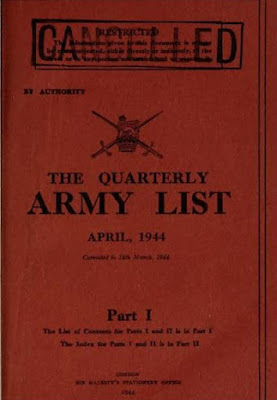
In October 1940, Mills rejoined the army and was named an officer in the Royal Army Pay Corps. I have been unable to locate information regarding where he was assigned after that. We do know that M ills had family that at one time owned much of Devon—the Aclands—but there's no reason to suspect that the army would have given much care to that in assigning him.

However, we do know that Vera Mills, George's wife, passed away at Minehead, Somerset, on 6 January 1942. Why she may have been residing at Minehead in January is unknown, but the Quarterly Army List does contain this, in a list of APC Regimental Pay Offices:

Exeter

Regimental Paymaster —
Booth, Lt.-Col. E. W., O.B.E., M.C., R.A.P.C.

Second in Command —
Coate, Maj. (war subs. 1/7/42) R. D., R.A.P.C.


It may simply be a coincidence, but the second in command at the Exeter pay office in 1944 had drawn his assignment there on 7 January 1942—the day after Vera's death.

Mills may not have been there at all, and Major Coate may have taken over as second in command at Exeter in an unrelated transaction. Still, it is a clue as to where George may have been between late 1940 and early 1942.


Manifests and Paperwork, 1913 and 1919:


We know that it is extremely likely that Vera Mills (née Beauclerk) had been abroad (in Canada or the United States) with her mother and sister during most of the First World War before returning to England and later marrying George Mills.

Found are a couple of indices recording the entrance of 19 year old Vera Louise Beauclerk into Honolulu, Hawaii, on both 26 March 1913 (arriving aboard the Marama) and again on 16 June 1913 (aboard the Chiyo Maru).


You can see the records above. [Click to enlarge any image in a new window.]


Warren Hill in 1896:


George Mills was born in Bude, Cornwall, in 1896. At the same time, across England, A. Max Wilkinson, Head Master of Warren Hill School in Meads, Eastbourne, had had a telephone installed at the school. You can see pages from that seemingly ancient 1896 directory.
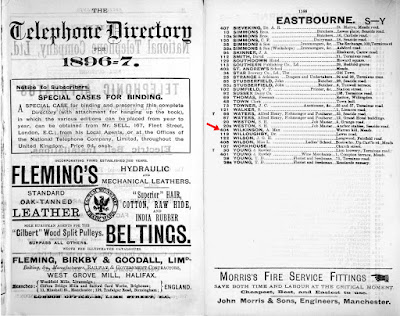


George would be grown and working at Warren Hill by 1930.


We also recently located the master's residence across Beachy Head Road from the school, circa 1901. Thanks to the yeoman work (yeoperson?) of the resourceful Jennifer M., we also know who lived there during the 1911: Charles Ridley Witherall and Robert Mervyn Powys Druce, both "schoolmasters" at a "private" school. Also on the census form are Scottish sisters Mary and Janet Robb, the housekeeper and cook respectively.
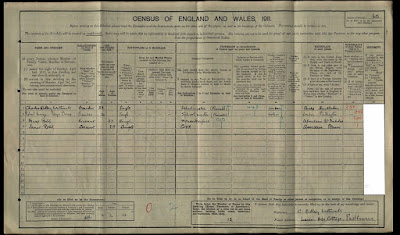


This is the residence in which George Mills would have lived while he was teaching at Warren Hill, and is likely the one described in his first novel, Meredith and Co.

And, before we leave a subject that concerns A. Max Wilkinson, his Times obituary card has been located: It reads: "WILKINSON.—On Oct. 27, 1948, at Exmouth, very peacefully, A. MAX WILKINSON, sometime of Warren Hill, Eastbourne, and Wittersham, Kent, aged 92 years. Cremation, private."


Monica Cecil Grant Mills (née Wilks):


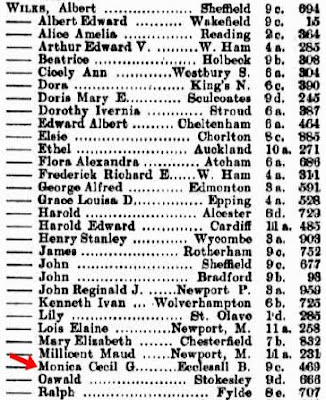
There are dual listings for the second marriage of George's half-brother, Arthur Frederick Hobart Mills, born 1887: His second wife in one place a Monica Wilson, and in another she is a Monica Wilks. The correct one is clearly Monica Wilks, and here is her birth record from 1902 at Ecclesall Bierlow:


There is also a record of her death—the only one I can find—in the London Gazette dated 17th August 1981 on page 10642. After her name, Monica Cecil Grant Mills, in a column labeled "Address, description, and date of death of Deceased," it reads: "Rivlyn Lodge, Shorefield Road, Downton, Lymington, Hampshire, Widow. 5th August 1981."
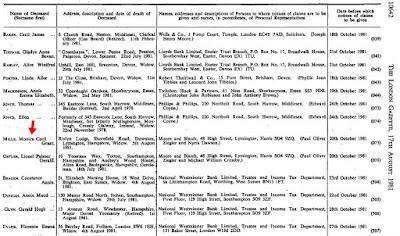


Winds Cottage, Downton, is where Monica lived with Arthur Mills until his death in 1955. I am still unsure whether or not Monica—15 years younger than Arthur—bore him children. If so, they are not among the records at ancestry.com.


Arthur Frederick Hobart Mills in China:


We have had only one image of Arthur Mills here, and the on-line caption I found with the photograph makes reference to Arthur having returned with relics from a trip to China "circa 1925," pictired, left.

We now know that trip occurred during 1928. While I cannot find a record of him arriving in England, there is a record of him steaming into Los Angeles, California, aboard the S.S. President Cleveland on 23 February 1928, having departed Hongkong [sic], China, on 30 January. He is listed a 40 year old "writer," who had obtained his visa on 26 January in Hongkong.

There are oddities: Mills lists his birthplace as "Woltexton, England," although his birth took place in Stratton, Cornwall, and he was raised in Bude.

Incredibly, is it possible that this was simply a mistake, and that the typist simply placed an "x" where Mills had wanted an "r"? Wolterton is the ancestral family home of his wife, Lady Dorothy Mills, who was estranged from her family because of her marriage to Mills. Was this simply a perverse joke on the part of Arthur, or did he think listing his birthplace as the estate of peerage—the Walpoles—would gain him some shipboard advantage?
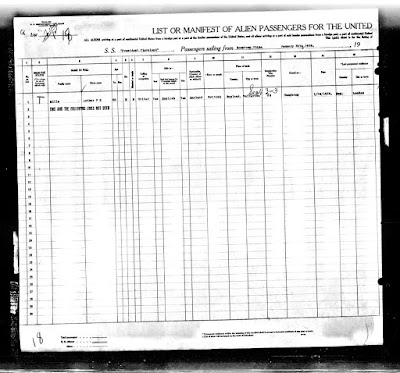


In addition, Mills is the only person on the manifest's page [above]. Apparently no one else was making the trip from China to L.A.

Having always wondered if Arthur had missed george's 1925 wedding because he was in China, the answer now comes back a resounding 'no'...

Uncle Dudley and Jamaica:


Although Arthur and George's uncle, Dudley Acland Mills (Lt.-Col., Royal Engineers), is commonly associated with his eccentric activities in China, we find him here, on page 2326 of the 3 April 1906 edition of the London Gazette, being named by the King to be a member of the Legislative Council of the Island of Jamaica [below].


The Rev. Barton R. V. and Rev. Henry Mills:

I did not record in which text I found the following thumbnail sketches [below] of the lives of Barton Mills, father of George Mills, and Barton's uncle, Henry Mills, also a cleric in the Church of England. (We met Henry once before.)


Gillmore Goodland, Revisited:


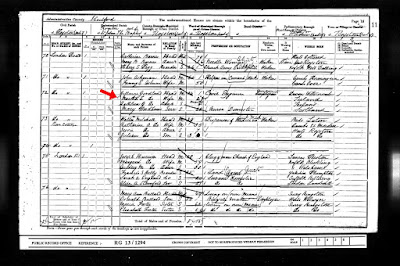
In our seemingly never ending study of Gillmore Goodland and family, there was an additional weirdness that has just come to light. The 1901 census lists Gillmore, a 34 year old "civil engineer," as living on London Road at Royston, Hertfordshire—a place we recently examined in relation to the maternal family of Egerton Clarke—with his daughter, Kathleen G. Goodland, aged 5 months, a 28 year old Scottish nurse/domestic named Mary Woodhams, and his 23 year old wife, "Martha L. Goodland."

Goodland's wife was also named "Kathleen." It’s odd that the census taker managed to get her middle initial—standing for "Lillis"—correct, but somehow managed to get "Martha" in as her first name. Peculiar.


In addition, when we looked at Gillmore Goodland's children, we found Kathleen and Joan Goodland, his daughters. What we did not find was much about his son, Desmond Gillmore Goodland, who must have been born around 1910.

There is a birth record for him now, seen below, having been born in Godstone, Surrey, in the summer of 1910. That's the location recorded for his older sisters on the 1911 census.

We had thought young Desmond (he would sign his name in 1941 as "Desmond Gillmore Goodland" below, right) was in Wales, during that census, possibly with his aunt, Grace Goodland.

We now know that's incorrect. The infant in Wales recorded as "Gilmore Goodland" actually had that first name spelled correctly: Gilmore, with one "L". This child was actually Frank Gilmore Goodland, son of Gillmore's brother Ernest Talbot Goodland, who was then living in Australia, and Ernest's wife, Winifred Margaret Goodland (née Owen), who was visiting "her sister Florence Owen together with my great grandmother Selina Owen in Cardiff."
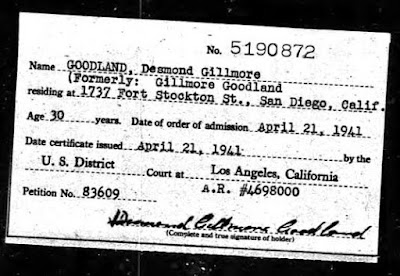
Many thanks to Winifred's descendant, John Owen, for providing the above information in his own words, as well as for helping me work out the lad's identity.

However, that begs the question: "Where was infant Desmond Gillmore Goodland—less than a year old, with his mother and father in North America for a year and his sisters in Godstone—during the taking of the 1911 census?"

It still seems odd that Gillmore and Kathleen would have sailed to America when he was a newborn—and they clearly did—presumably leaving him in England, but sequestered in a place where the infant would not make the census count.

Peculiar. But, then, there were many peculiarities in the story of Gillmore Goodland, Engineer.


Sir Leonard Daldry on Tape:


Daldry was a croquet player who competed at the time the Mills siblings were on the circuit along the south coast of England. Those with an interest (and the access, which I do not enjoy) may want to peruse a taped interview with Sir Leonard. It is entered in the text: A Guide to Manuscripts and Documents in the British Isles Related to Africa: British Isles (Excluding London) by James Douglas Pearson and Noel Matthews (London: Mansell, 1994).
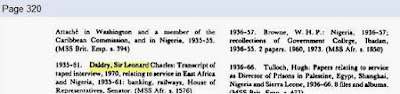


The entry, seen above, reads: "1935 – 1961. Daldry, Sir Leonard Charles: Transcript of taped interview, 1970, relating to service in east Africa and Nigeria, 1935 – 1961; banking, railways, House of Representatives, Senator. (MSS Afr. s. 1576)"

My hunch is that the interview would be fascinating.
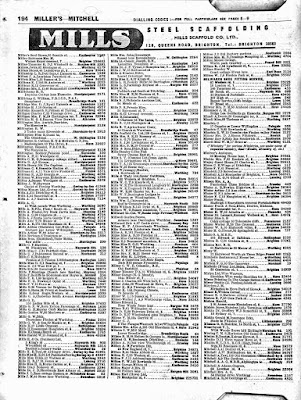

I Wish I Could Dial It and See Who Answers:

Lastly, there is something about a single, innocuous entry, tucked away in the 1951 Brighton telephone directory that holds my interest. There is no way of knowing if it is our George Mills, but it reads:

Mills G. 36 Vernon ter, Brighton 1 . . . . . . . . . Hove 36575

Is it the George Mills of our interest? For all we know, it could be a Gareth or a Guy Mills.

I'm not certain why entirely, but of all of the G. Millses I've come across in all of the telephone directories, on all of the World Wide Web, this one makes me think it could be George...


And, as always, if you have any information, speculation, or recollections of George Mills, his family, his friends, his life, or his times, please don't hesitate to contact me, and thank you very much in advance!


Tuesday, July 12, 2011

Louise and Dorothy Rachel Melissa Walpole; Part 2


In her autobiography, A Different Drummer: Chapters in Autobiography [Duckworth: 1930], Lady Dorothy Mills writes of her youthful years before her engagement to Arthur Mills, brother of George Mills:

Halfway through my teens, the inevitability of me had become apparent, life changed. "Tom-boyish-ness" was discouraged, and it was subtly instilled in me that I had a part to play in the world. Slowly the beauty of my heritage began to dawn on me, the pride of prospective possession, and with it grew also the realization that I was but a cog in a great machine, the juggernaut of Family Tradition. My looks and my accomplishments were dealt with, I was in general tidied up, and at eighteen I "came out." For awhile the world seemed to be mine to play with. I adored it all, the frocks, the parties, the dancing, the flirtations, the young men who sweated under the collar when they proposed and whom I had no intention of marrying, though I knew that some day I would have to make a 'good match, a prospect that I classed alongside a visit to the dentist.

She continues:

In 1916 I got married after a three years' family warfare; warfare that one might say ended in a draw, in that on the one hand I had done what I intended, on the other that I was cast into utter darkness, to become the Outlier I have ever since remained. I had no trousseau, we had no prospects and no money, scarcely enough even to pay for the wedding celebrations. For though everyone advised a registry office, I decided on a church wedding, and a fashionable one too, that should be, if needs must, my last defiance to a sceptical world. I was the first London bride to wear a gold wedding dress, and incidentally, that bit of gold brocade was to be the last evening frock, except of my own making, that I was to know for several years, until finally it was turned economically into a sofa cushion!


Lady Dorothy was disowned by her family, unwilling to play her expected familial (and financial) role by selecting a suitable bridegroom with the money necessary for admittance into the Earldom. It would be uncanny to me if part of her independent spirit was not, in fact, due to beliefs about family, love, and marriage passed along by Louise Corbin Walpole, directly or indirectly, from the time Dorothy had attended the rancorous Wiedemann trial within her mother's womb, through having been raised under the cloud of the scandal, the tragedy of the death of her brother (the family's much-needed heir), and a bevy of burdensome expectations.

Louise and Dorothy, even if it never had been uttered aloud, had to have known they were disappointments to her father, Robert Horace Walpole, 5th and Final Earl of Orford. Louise, saddled with ill-health and anguish stemming from the scandal and the death of a child, bore up well (as a Walpole should) and eventually became a noted 'globe trotter.' Dorothy, however, eventually chafed under her own set of external expectations and the need to keep up appearances, perhaps even in tribute to her late mother.

Was there a curse bestowed upon the family by the vindictive Fraulein Valerie Wiedemann? Walpole died alone in New Zealand nursing home, far from his family's estates, the Earldom having become extinct with his passing when he was unable to produce an heir. He never got any of wealth of afther-in-law D. C. Corbin: Lady Dorothy collected an inheritance from her distant grandfather only after the passing of her estranged father, the Earl.

Louise passed away at the age 42, the result of a seemingly inconsequential "indisposition" after years of unhappiness, which included with a phobia of having her picture appear in public.

Lady Dorothy slowly estranged herself from her husband, Arthur, and his family as well—neither Dorothy nor Arthur, for example, attended brother George's 1925 wedding although they lived only a few city blocks away—becoming a world traveller and explorer who fascinated society by doing it all without dragging husband Arthur along. She openly wrote of what little need she actually had for him, in addition to the amusing romantic entanglements that arose during her adventures, none of which, according to her, ever came to fruition.

At the height of her career, Dorothy was seriously injured in a car accident in 1929 and never fully recovered. She managed a subsequent trip along the Orinoco, about which she wrote a book that was published in 1931. She also was planning a trip to the Middle East when her father passed away in 1932, allowing her access to the trust fund that had been waiting for her since her grandfather Corbin's passing in 1918.

In that same year, 1932, she filed for divorce from Arthur on the grounds of his adultery. Arthur, like her own flirtatious father, would never see a penny of her American inhertitance.

Lady Dorothy never wrote another book, although she continued to publish the occasional sensational article about her adventures in newspapers in the United States and elsewhere througn the 1930s, just as she had always done. She was soon largely forgotten.

She retired to Brighton, where she lived in a seafront hotel until her passing in 1959. She never remarried and remained childless.

A curse, perhaps? It seems she got what she wanted, and always on her own terms.

Her life, as she packaged and sold it to readers, was both legend and myth [above, left, an illustration that accompanied a wire service story she wrote in 1922 about her real-life adventures]. One wonders, though, if it all made her content with her own life in reality.

The most telling photograph of her mother, Louise Corbin, throughout this entire tragic tale is one I recently found in, oddly, the Badminton Library's 1895 edition of Sea Fishing, a book of which it had been implied by the press that Lord and Lady Orford had been the authors.

Almost expectedly, as was the case virtually with all of the exaggerations that had been published as facts about the Orfords in 1905 (we read about them last time), Robert and Louise Walpole actually are not listed among the main writers of the text: The main author was John Bickerdyke, but the section entitled "Tarpon" is credited to Alfred C. Harmsworth.

That section begins on page 445 of the text, and is fully titled "Tarpon Fishing in the Gulf of Mexico."

On page 448, Harmsworth writes: "Among the most successful tarpon anglers are the Lord and Lady Orford. Lady Orford is probably the only woman in the world who has killed two in one day. Her best fish was 128 lbs. Lord Orford has killed one weighing 183 lbs., the fifth largest known tarpon at the time of the writing.

He has kindly furnished me with some notes of his experiences during his visit in 1894. He says, after remarking that few tarpon fishers agree as to the details of the sport, and that every man has his own theory on the subject:

Our first attempts at tarpon fishing were at Punta Gorda, but we had no luck, and I do not think well of the place from an angling point of view. About the middle of April we went to Fort Myers, and there my wife and I killed seventeen fish, my best 183 lbs, smallest 75 lbs. I have presented one weighing 150 lbs. to the Norwich Museum, and am keeping my 183-pounder and Lady Orford's 106-pounder. There can be no doubt in my opinion that the tarpon, as a fish, is quite as game as the salmon."

After several paragraphs of discussion of the actual catching, reeling in, and killing of the fish, Walpole adds: "One has many slips while tarpon fishing and it should never be forgotten that the slightest check can be fatal to one's chance of killing. One of my fish (it had only fouled the trace by getting it under its scissor jaw) took three hours to kill."

Harmsworth adds a few lines about the difference between tarpon and salmon fishing, but Walpole sums it up this way:
"Of course there is not the pretty scenery, the casting, and the same amount of knowledge of where fish are to be found that makes salmon angling so delightful. Nevertheless, tarpon fishing is a magnificent sport, and I wonder that more Englishmen do not take to it."

Right off the bat, I'll say that I love Punta Gorda, far more than Walpole ever could have—my parents lived there for some 25 years after my father retired!

Secondly, what's interesting is what's written about Lady Orford: "…probably the only woman in the world who has killed two in one day."

That brings us to the point here: The somber photograph seen adjacent to this text. It is taken from page 447 of the book, and depicts a woman standing between two tarpon, strung up after the catch.

Now, I've seen this sort of trophy photograph before, and the angler usually is smiling ear to ear, reflecting pride and determination, or both.

Here we see what is ostensibly an anonymous "angler and her catch," but it is clearly Louise Walpole posed between her 106- and 128-pounders. Don't forget, she very much preferred not to have her photograph displayed in public, hence the attempt at anonymity. And Lord Orford probably probably provided it as well as very correctly feeling that, despite the very open clue in the text, the vengeful Valerie Wiedemann, one-time stylish German governess and current debt-ridden madwoman, was unlikely to be reading deep into a tome about the fishing habits of rich Englishmen.

The utter neutrality of Louise's face is stunning. I can make out no pride in her catch, and certainly no joy. In fact, beyond the distinctly neutral expression seemingy encompassing her entire face, there seems to also have been a touch of sadness, or perhaps resignation, in her eyes.

We saw a hint of ominous melancholy in her LIFE magazine photograph above as well.

One occasionally sees a similar vacant expression in a criminal's mug shot, by a grave site after the funeral, or perhaps in a pensive moment, when a person is alone and and solemnly contemplative. One would not associate this woman's face with the exhilaration of this sport—described here as making the "kill"—as well as having earned the distinction of becoming the first woman to bring two of these magnificent creatures to their demise at one time.

One also must consider the idea that it was likely Lord Orford's description of his bride's enthusiasm for tarpon fishing that we've read about all along, not her own.

That notion is corroborated in the June 1905 issue of Ainslee's magazine (Vol. XV, No. 5), in whch the author, Lady Willshire, describes the renowned outdoorswoman, Louise Corbin Walpole (Lady Orford), who we know throws popular shooting parties in Norfolk: "Next after music, sport—fishing most especially—engages her particular interest. Though she rarely goes out with the guns, her husband declares she is a capital shot, and that she could and would ride to hounds with the most daring of our fox-hunting peeresses."

This is a woman who suffered a great deal during a life that ended all too soon. Making that publicly apparent, however, would have been out of the question, as we can can read above and observe in her seemingly noble bearing in an image she [or Lord Orford] did allow to be published. As Lady Dorothy wrote above, "[Walpoles] had a part to play in the world... [as] a cog in a great machine, the juggernaut of Family Tradition."

We see etched very clearly on the drawn face of Louise Corbin Walpole in 1894 the so-called joy she took in sharing the "globe trotting" hunting and fishing adventures of her hsuband.

The record shows that Lady Dorothy was along on many of those excursions. On page 138 of her autobiography, Dorothy writes her own recollection of that 1894 deep sea fishing trip to florida:

The Christmas of my fifth year brought me my first sight of an alligator. It was in southern Florida, where my parents were deep sea fishing, and the negligence of a nurse gave me opportunity to wander unattended by the river bank, where a party of negroes had just landed—to my childish eyes—the dragon of all my fairy tales. Round, blue eyes surveyed the Apochryphal beast with a faint fear that merged into fascination.

"When I am big I shall kill those," I announced grandiloquently. The darkies roared delightedly with a flash of white teeth.

"When li'l Missy big, she hunt 'em 'gaitor good," they assured me. I think on that Christmas Day came the first premonition that, many years hence, the prototypes of those good-natured darkies would be my hunting companions and brothers in the dark jungles of Africa, where so many strange beasts have their habitation.


Setting aside any criticism regarding colonialism and racism, this is—at least in hindsight, and in the mind of Lady Dorothy—a premonition that her own path would be markedly different than the one taken by her mother and father. And her choice in that regard could have been as much due to her mother's long term reaction to her father's illicit liaison as it was from the highly publicized affair itself.

One wonders, as well, what sort of speculative and gossipy discussions of the scandal young Dorothy was privy to while governesses, nurses, and parlour maids assumed she was playing, studying, or wrapped up in reading a book [as we see her in her youth, left]. One also wonders of the impact all of that had on her. The passage above is the only reference to Louise Corbin, directly or indirectly, in Lady Dorothy's memoirs.


In the end, Lady Dorothy married a man like her father: A soldier, a traveller, and a flirt. Unlike her mother, she was determined that she would not need a man—or even a family—and spent a lifetime proving just that.

Family time together could not have been so very important to the Walpoles clan in general. In her autobiography, she also relates, "My first actual memory of a foreign Christmas was as a very small and miserably seasick child crossing the Atlantic to North America, in the teeth of an icy northerly gale. Perhaps it was that initiatory experience that atrophied [my] Dickens' spirit." The chapter goes on to describe all of the Christmases in her life, 1888 – 1929, that she had spent away from friends, family, and especially England.

That would have included Christmases spent without husband Arthur, who doesn't seem to have figured much into her holiday agendas. One Christmas during the 1920s, while Arthur may have been enjoying festivities with his own family (or amusing himself in other pleasant ways with another pleasant person who happened to be located in England at the time), Lady Dorothy was in the Sahara where, on a certain Christmas Day, she and her guide, Ismael, had discovered a dying man and chose to pass him by. A half hour later, they watched from the saddles of their camels as the vultures finally swooped down for their own holiday meal. Ismail placidly told her, "To-morrow his bones will make a good landmark for the caravans. We needed one in those dunes."

Christmas is, after all, about giving—just as that poor wretch had.

It seems that Lady Dot's estrangement was not simply from her own family, but everyone's family, and England's fascination at the time with her daring exploits doesn't make those deeds seem any less empty when considered in the context of a more fully realized life spent at times with one's own, loving family. Still, she had a vision of herself that included other things, many real and some undoubtedly the product of her vivid imagination [at right, an illustration from a 1934 newspaper story sold into U.S. syndication by Lady Dorothy].

We see this no better than in the contrast between the first two illustrations of Lady Dorothy above—cool, stiff, and aloof—and the certainly more lurid, sensual, and vulnerable autobiographical newspaper imagery that percolated up from somewhere within her. She was clearly the antithesis of her mother when it came to having a desire for one's likeness to be published.

Thank goodness Louise had passed away before Robert Horace Walpole and his daughter, Dorothy Rachel Melissa, her loved ones, made the uncompromisingly mutual decision to divest themselves of each other—permanently.

In this tragic tale of family obligations and tradition without accompanying familial love, yes, Louise Melissa Corbin Walpole to me is the most tragic of all the characters life with which life seems to have dealt bitterly during my study of the life and times of George Mills.

I hope I'm wrong about her profound suffering. But I suspect I'm not.


Monday, July 11, 2011

A Final Look at Louise Melissa Corbin Walpole; Part 1


Last summer I made a decision that I almost came to regret. The end of the story seemed the most tragic of all I'd done here. And today finally seems the time to finish with it.

I had decided to tackle the courtroom drama between Robert Horace Walpole, 5th and Final Earl of Orford, and Miss Valerie Wiedemann (sometimes spelled "Weidemann") regarding his alleged rape of her in Istanbul, and his claim that she was merely an adventuress looking for blackmail money after satisfying his lust. In fact, at the outset, I had intended to transcribe it ain its entirety to make it all searchable here. I wearily soon gave up on that.

It was somewhat related to our study of George Mills because Walpole, a man of questionable character despite the courts predictably coming down along his side of the argument when all was said and done. Both sides admitted what amounted to sexual contact, but whether that was consensual (and whether Walpoole afterwards had given her a signet ring and a promise of marriage) was in question. The precipitating events occurred in September 1882. [The entire unwieldy thread can be accessed by clicking HERE.]

Walpole, then the bachelor heir to the Earldom of Orford, later married American heiress Louise Melissa Corbin on 17 May 1888 at the English Embassy Church in Paris, France. Miss Corbin, daughter of multi-millionaire capitalist and railroad magnate D. C. Corbin of the northwestern United States, was raised by her mother, Louisa Corbin, an eternally sickly (or perhaps hypochondriacal) 'hothouse orchid' of a woman who raised her children, including Louise, in and around the great spas of Europe. Young Louise, presumably in line for a large inheritance from her elderly father (a man she actually barely knew) and twelve years Walpole's junior, must have been quite a catch for Robert (whose landed family was in need of a great influx of cash), and the engagement was written up in a December 1887 supplement of LIFE magazine.

LIFE also published a picture of the young Louise [right; click to enlarge]—an action that would carry tragic consequences.

Wiedemann, then in England, serving as a governess and still trying unsuccessfully to contact Walpole about his alleged promise to her (and to his illegitimate child), saw the photograph of the heiress in the periodical and apparently snapped.

Walpole v. Wiedemann became a scandalous staple for readers in Great Britain and around the world during three sensational, lurid, and always surprising trials from 1888 through 1891. Of the sheltered Louise and that published image, I wrote last year: "[Louise had] gone from eligible society girl to the public target of her new husband's crazed ex-lover. She'd heard from the seemingly unstable German ex-governess, 'You know that I must curse you from the bottom of my heart, and that I do so, and shall do so in all eternity for the endless suffering you have brought over me, and also, you run away whenever I come. I shall meet you once, and you shall hear my curse.' That couldn't possibly have sat very well with young Louise, likely still dreaming of marital bliss at that point."


What couldn't have helped matters was the trial returned to popular discourse another Victorian sex scandal, one involving Walpole's uncle, Horatio Walpole, who had run off with a friend's mentally unstable wife and fathered an illegitimate child around 1850.

Three Walpole v. Wiedemann trials occurred, as well as numerous appeals. Weiedemann was left a beggar (who oddly appears of no UK census, during the 1891 trial or after), portrayed in the press as driven mad and still trying to raise money for a 4th day in court and justice.

Louise had not weathered the embarrassment of the scandals and the threats very well, to say the least.

During the sequence of trials, she gave birth to the couple's first child, a daughter, Dorothy Rachel Melissa Walpole (who would later become Lady Dorothy Mills) on 11 March 1889 in Kensington, London, England.

Soon after, the following item appeared in the The Pullman [Washington] Herald reported on 13 April, 1889, "From the time her child was born Mrs. Robert Horace Walpole, formerly Miss Louise Corbin of New York, has been very ill, and her friends fear that she can not recover. Since the scandal between her husband and Miss Wieldman [sic] was exposed in court a few months ago she has been very nervous and in depressed spirits. Mr. Walpole is heir to the Earldom of Oxford [sic]."

The frightening words there, in the hometown newspaper of D.C. Corbin, are: "...her friends fear she cannot recover."


During the course of the many trials, Louise—who had survived that scare back in 1889, after attending and hearing much of the distressing testimony while she was pregnant—once again became pregnant with a child who would hopefully become Walpole's own subsequent heir to the Earldom of Orford. Louise gave birth to a son, Horatio Corbin Walpole, on 9 January 1891. Little Horatio likely would have been conceived in May of 1890, between the appeal of the first Wiedemann v. Walpole trial in April and the onset of the second trial in June 1890…

There is no public record of the details of Horatio's birth or christening, and whether or not he was a healthy infant. However... young Horatio died on 20 May 1893, suddenly leaving Robert Horace Walpole without a male heir—something that would become a real problem for him in the future [The statue of Horatio at his tomb is seen, left; click to enlarge].

From the 8 December 1894 edition of the Toronto Daily Mail, hower, came better 'family' news for Robert Walpole: "London, Dec. 7.—The sudden death of the Earl of Orford is announced. He will be succeeded by his nephew, Robert Horace Walpole, who in 1888 married Miss Louise Melissa Corbin, of New York. The succession to the Earldom of Orford recalls the suit for breach of promise brought against the new Earl by a German governess of Constantinople prior to his marriage to Miss Corbin."


While the 4th Earl's passing (and the sale of his estate, especiually his collection of rare books) brought the new Lord Orford an immediate influx of cash, it still reminded everyone of the costly and scandalous trials—something that must have eaten at Louise, still mourning the passing of her son, Horatio.

We'll soon see that, in 1894, Lousie did not seem to have been in the best of spirits.

But, come 1905, we find an article entitled "Ladies' Gossip" from the Otago [N. Z.] Witness on 15 February 1905, which contains this description: "The present peer [Walpole] met his bride in Paris when she was Miss Louise Melissa Corbin, daughter of a well-known railway king of New York [sic], and after their marriage the couple lived very quietly in a little house at Waybourne [also Weybourne and Waborne], when Mr Walpole's duties as a sub-lieutenant in the Navy did not call him elsewhere. When he succeeded to the title, he went globe trotting with his wife and visited Japan, Ceylon, the West Indies, and America. In Florida they took to tarpon fishing with notable success, to which a 183-pounder, stuffed and varnished, which adorns the staircase at Mannington Hall, bears mute testimony. It was on the strength of this and other achievements that the Earl and Countess were asked to write on tarpon fishing for the Badminton Library."


Things seem to have settled down for Robert and Louise in the intervening decade. A time in the couple's life during which Walpole was embroiled in an embarrassing sexual scandal and the papers blared his family's name constantly was, by 1905, summed up entirely as having lived "very quietly in a little house," and his departures in association with those frequent court appearances he made became carrying out his "duties as a sub-lieutenant in the Navy"—which Walpole indeed was when he encountered Wiedemann during his time of indiscretion.

In fact, the June 1905 edition of Ainslee's (Vol. XV, No. 5), describes that "little house" in greater detail: "Lady Orford—who was Miss Corbin—lives at Waborne Hall, her husband’s magnificent Georgian place in Norfolk. There she gives shooting parties, from there she goes with her husband and pretty young daughter to fish in Scotland and Norway, and the chief interest that brings her up to London is her taste for music and the opera, which, she declares, is the only pleasure that one cannot gratify out of town."

A quiet life in a little house, indeed!


Two weeks later, The Bruce [N.Z.] Herald ran a story on 28 February [Huitanguru] 1905 on Robert Horace Walpole, Earl of Orford [spelled "Oxford" in the article, entitled "The Earl of Oxford"]: "The Earl of Oxford [sic], who has had his Georgian mansion, Wolterton Hall [right], built by Ripley for Sir Horace Walpole, thoroughly modernised from cellar to attic, is a peer who has had many stirring adventures in his half-century of life…

In 1888 he married Miss Louise Corbin, the daughter of the famous American railroad magnate, who, sharing to the full his adventurous spirit, has accompanied him on all his world-wide travels and helped him shoot big game in all parts of the earth."

Lady Dorothy Mills had accompanied her mother and father on these extensive, and likely expensive, trips.


1905 was a year in which the Countess, Louise, was for some reason in the public eye. It is unlikely, however, that she had wanted the attention. We can determine that from this item in the 15 December 1905 edition of the Otago [N. Z.] Witness: "The Countess of Orford, although her portrait is rarely seen in any illustrated paper, is one of the most interesting Anglo-American peeresses. Her sporting record is quite exceptional, and, together with her husband—now the head of the Walpole family—she has traveled in search of sport in many little-known countries, and she is one of the few women who have enjoyed the excitement of tarpon fishing, Lord Orford's favourite outdoor amusement."


While all seems quite rosy in this glamourous marriage of an American heiress to an adventurous peer, the phrase, "her portrait is rarely seen in any illustrated paper," jumps out as one that still is dripping with the pain of the trails, and Valerie Wiedemann's threats of a "curse" after Louise's portrait ran in LIFE magazine.

Despite Walpole's adventurous lifestyle, Corbin had not provided the influx of cash that the family felt it needed, except after the death of his uncle, the Earl, and that seems to have been quickly spent. In fact, Corbin seemed to distrust, or at least dislike, Walpole completely. From historylink.org we discover: "When D. C. Corbin died in 1918, he left to that branch of the family only a trust fund for his granddaughter [that would be Lady Dorothy] from which she could not draw income until the death of her father, the earl. In the meantime, Lord Orford’s diary makes it clear that, during his marriage, little money had been forthcoming from his rich American father-in-law."

The elder Corbin, in fact, would outlive his daughter, Louise, by nine years.


Louise Melissa Corbin Walpole passed away on 4 May 1909. From a special cable from London to the New York, the Times ran this headline: "COUNTESS OF ORFORD DROPS DEAD IN HOME; Niece of Austin Corbin Collapses While Preparing for a Motor Trip. WAS WELL KNOWN HERE Visited New York Nearly Every Year and Was Interested in Fishing, Shooting, and Other Sports."

Sickness, we see, still had been stalking Louise. The New York Times article goes on to state: "The Countess of Orford (nee Corbin) died to-day with tragic suddenness at her home in Wolterton Park, Norfolk. She had been ill for several days, but the indisposition was so slight that she had arranged to go motoring this afternoon."


The 5 May 1905 New York Sun reported [below, right]: "She had been indisposed for several days, but her condition did not seem in any way serious. She was dressing for an automobile ride when she collapsed. Her maid summoned her daughter Dorothy, who reached the room just before her mother died. The Earl of Orford, who was in London, hastened with all speed to Wolterton Park when he heard the sad news."

This is far more coverage than the scant 50 or so words run by the London Times for her obituary. The headline by itslef in the New York Times, by comparison, was 36 words long. It should be mentioned that the family was not from and did not live in New York City, although that was often written.


Louise Melissa Corbin Walpole seems to me to be an exceptionally tragic figure in our research regarding George Mills and his family. She never would have met George, having passed away in Norfolk while he was a child, likely at school in Parkfield at Haywards Heath. Her daughter, Dorothy, would become a popular and prolific author, but Dorothy's biography only mentions Louise once, in passing, unnamed. We have no idea what, if any, were Louise's last words.

Still, her impact on her daughter, Dorothy, who would be disowned by her father and family by choosing to marry George's brother, Arthur Frederick Hobart Mills, for love and not money, would carry over into her relations with the Mills family.

Louise clearly had known what it was like to have married without love having been the major factor—and she must have been disappointed almost immediately with the life she and Robert Walpole led, despite all of the "globe trotting" and estates. Walpole hungered not only for revenue streams, but also for an heir that Louise was unable to provide. This must have been a source of some friction, or at least resentment, in the marriage, and none of this would have been lost on a girl with so keen a mind as young Dorothy.


We'll end here, but next time we'll consider the impact that Louise had on her daughter, and how that legacy played out in her relations with the Mills family... and her own.


Wednesday, July 6, 2011

Discovering Warren Hill School in 1880


The indefatigable Barry McAleenan is at it once again! Just when we think we've culled all of the archival images of Warren Hill School possible, Barry has sent more—for our personal use in this research [click the images to enlarge]!

Here's a message I recently received from Barry:

The local library found a couple of photos of Warren Hill School taken in 1880. The second assistant was most insistent that copies should only be for personal use - not for books as they have the copyright... The first assistant was affable and helpful. So it goes.

The scanner was unavailable, so I resorted to using a camera and natural lighting from a small window as the flash was far too bright:

Both are stamped BUDGEN BEQUEST

[This image is located above, left]

Reference PG 01316
Builders at work. Note the extensive landscaping that must have occurred.

The back says
Warren Hill School Additional buildings
Genl [General] Buchanan 1880 [The 1875 map shows no buildings on the site]
Meads road etc


[This next image is seen, right]

Reference PG 01510
School and 2 people

The back says
Building the 3rd Addition to Warren Hill School [Phase 4 since the first sod was cut?]
Photo Genl Buchanan


Are they good enough?


Far more than good enough, Barry!

First, it's interesting to note the change from an 1875 Eastbourne map that shows no buildings at all on this site to what apparently is the "third addition" to the main building. There is much to be learned from these images since we know that Warren Hill didn't become a school until 1885!


Right off the bat, we can see that the building layout depicted on the 1930 map [see it by clicking HERE] grew from right to left (east to west), and appears to be growing quickly at the time of these images.

But for what reason? Warren Hill started as a school in 1885, some five years later. Was this the Victorian mansion of a homeowner? If so, why were three additions done in so swift a time—between 1875 and 1880?

The provenance indicates that these 1880 images were captured by a "General Buchanan."

This is likely Gen. James Buchanan, who appeared on the 1881 UK census living at No. 5, Grange Gardens, in Blackwater Road. He was 63 years old that year, and had been born in Bangalore in the East Indies. His occupation was listed in what appears to be this way: "General [illegible symbol—"H"?] Ind. Army Cavalry." He dwells there with his wife, 54, two adult daughters (one of whom was born in India), and a son-in-law, along with servants.

Incidentally, the General lives next door to a retired Colonel from the Bengal Staff Corps, James W. H. Johnstone, and the Colonel's family—a wife, three daughters, 13 through 21 years of age, and servants—who reside at No. 6.

Grange Gardens [Both No. 6 and No. 5 are pictured today, at left] at Blackwater Road appear to be about a half mile east-northeast of the site where these photographs of the additions to Warren Hill were taken. Just as an aside, but seeing these homes of retired British officers still makes me wonder why Lt. Arthur F. H. Mills, brother of George Mills, was unable to support an allegedly impoverished wife back in England during the First World War (and a promotion to Captain during the conflict did not seem to help). Did wages only become enough to support a wife and consider having a family when one became, say, a Major? And then was one able to afford a home like No. 6 after reaching Colonel?


Anyway, Barry adds:

The index for the files and labels gave the following details

Warren Hill

Alfred M Wilkinson 1885-1916/17

Preparing boys for public school or Royal Navy

M A North and F R Ebden 1916/17 -

War Memorial designed by Sir Robert Lorimer.


We can now corroborate that the complete roster of principals of Warren Hill were, in order: A. Max Wilkinson, M. A. North, F. R. Ebden, Joshua Goodland, and Bertram de Glanville.

It strikes me as odd, however, that someone might have invested in building this beautiful structure, and spent over five years slowly adding on to the empty structure, turning it into a school for boys headed into the military. It must have first been a home, or even a business, it seems, for however briefly. One wonders why it is identified here as "Warren Hill," and not "The home of Someone-or-Other," even if the annotations were written later.

And beautiful this edifice is! We now can easily see the finish of the walls, windows, gables, and chimneys, and what one supposes was the original landscaping to the right [east] in front of what must have been the first part of the structure built.

There's reason to believe that someone constructing an edifice of this size, even for use as a private residence, would have expected a great deal of company. Our assumption that the kitchen is likely located there, in the original structure to the east, remains plausible.

We can also see that the conservatory/greenhouse clearly visible in the sepia image [view it by clicking HERE] is part of that original structure.


Just past the conservatory, to the northeast, Barry writes: "The masters' house appears to be down Beachy Head road and the optimum reproduction scale probably shows it to be behind the man's left ear beyond the lean-to conservatory. It shows up conveniently alone in both the 1899 and 1930 maps. What do think? Number 161 in the parcel (on the 1930 map)."


I had to admit, I couldn't see anything in the image, beyond that left ear [seen, right]. Barry, however, has seen the original image.

Barry continues: "If I look carefully enough, I seem to be able to see a gable - in the mess of tree branches - of what could well be the Masters' house. But it is only discernable briefly if you do a slow zoom!"


Admittedly, I still can't make out a gable, no matter how, but I accede to Barry's careful perusal of the original photograph, and believe that the house across and down Beachy Head Road from the school may have been the mysterious and missing master's residence.

Now, I don't think that house was in the West Ward census from 1901 that I examined here a few weeks ago [see it by clicking HERE]. And my access to those census records from the United States is only searchable by people--I need surnames, at least. Once I "hit" someone in that locale, I can search it entirely, including all surrounding dwellings, but I can't enter it in any other way. Without the name of someone living in that home during the late 19th or early 20th century, I can't check census documents to see if it may, indeed, have been chock full of schoolmasters!

We can see further evidence of the house to which Barry refers by examining the vintage image of it from the post card photograph as it is inset against a screen shot of the road as it appears today [pictured, left], captured from Google Maps Street View. We can see that, while some modifications have been made, the real structure of the dwelling's chimnneys still are exactly the same!


Lastly, these old photographs indicate that I must flip-flop one again in my speculation regarding the age of the post card image (seen by clicking HERE) of Warren Hill School that we have previously discussed. I had originally thought that it must have been the oldest of the images, but changed my mind to it being the newest—perhaps more recent than 1930—and thinking it simply must have been "antiqued."

Still, that didn't explain the flatness of the front façade of the building, facing Beachy Head Road. These 1880 images depict the structure before the final westward additions have been built, and it seems likely to me that the front of the building would not yet have included the bulge in the front that is missing in the image on the post card.

Hence, I believe that the post card image is the oldest of Warren Hill [seen, right] out of the original three I received from the Eastbourne Local History Society, and nearly identical in overall structure to these latest 1880 images found in the library by Barry Mc!


Once again, I owe Barry a greater debt of gratitude than I could ever begin to express. His resolve and ingenuity have helped me grope my way along the way here at Who Is George Mills? and I am most grateful.

As always, thanks, Barry!


Tuesday, June 21, 2011

Fr. John Basil Lee Jellicoe, Part 2


When I was a boy, my parents used to drag my brother and me on family holidays to camp in a caravan at various scenic locales in the eastern portion of the United States. Almost invariably, my father would strike up a conversation with some fellow around a campfire and inform him we were from Pennsylvania.

That chap, no matter where he himself was from, would typically say something to my father along the lines of, "Oh! Pennsylvania! Do you know our friends, the Smiths?"

After politely assuring him that the Smiths (or whomever) that we knew were very unlikely the same Smiths that he knew, Dad would still grumble later about the fact that a couple of million people lived in The Keystone State, and about people's stupidity in general.


* * * * *


Sometimes I wonder if my father wouldn't have a good long rant about me and what I'm doing here, in essence asking the entire U.K., "Say, do you happen to know a bloke named Mills?"

I mean, sure, George Mills was an officer's reserve military paymaster (in WWII) and went to Oxford (Christ Church) and was concerned about the Anglican Church and Roman Catholicism. And Father J. B. L. Jelliocoe was an officer's reserve paymaster in the military (in WWI; perhaps this is where Mills got the "reserve officer" idea) and went to Oxford (Magdalen College) and was concerned about the church as well. And A. B. H. Bishop went to Oxford (Jesus College) at the same time as those two, and was Head of Magdalen College School at Brackley during the same period Jellicoe was head of the Magdalen College Mission in Camden. Oh, and Bishop was raised in Cornwall, where George Mills was born, but raised quite near George's Acland family ancestral home at Killerton in Devon.

And it likely is just a coincidence that Mills and Bishop left Oxford and each became involved in independent preparatory schools. And that Mills was writing books about those preparatory schools at the same time that Bishop was advancing his career in the schools. And it's likely just a coincidence that George's father was a social reformer in London, based in Kensington, during the 1920s and early 1930s, while Jellicoe was a London social reformer in nearby St Pancras during that same era.

Small world, isn't it?

So it's probably just a colossal coincidence that, when the young but worn-out Jellicoe passed away in 1935, his memorial service was attended by a gentleman named "Mr. H. E. Howell," a chap bearing the same moniker as a gentleman who, as an old friend of the author, had helped George Mills by reading the manuscript for his first novel, Meredith and Co.: The Story of a Modern Preparatory School, in 1933.

This Howell attended the service as the representative of All Saints Margaret Street, a Victorian Anglo-Catholic High Church that rests almost midway between the Kensington address of the Mills and the St. Pancras parish to the northeast, where Jellicoe had worked so diligently on behalf of the poor.


* * * * *


So much of what we've discussed above may all simply be coincidental. Let's look at some hard-copy evidence.

Here's is how the London Times documented Jellicoe's death on 26 August 1935:


THE REV. J. B. L. JELLICOE

SLUM CLEARANCE IN ST. PANCRAS


The Rev. John Basil Lee Jellicoe died on Saturday in a nursing home of pneumonia in his thirty-seventh year. He will be remembered for his remarkable work as the chairman and organizer of the St. Pancras House Improvement Society, Limited, which has demonstrated that the improvement of slum areas by private enterprise is a sound financial proposition. The elder son of the Rev. T. H. L. Jellicoe, of Sullington Warren, Pulborough, Jellicoe took his degree from Magdalen College, Oxford, and after preparation at St. Stephen's House was appointed in 1922 head of the Magdalen College Mission and curate of St. Mary's, Somers Town. He resolved that he would not rest till his people had homes fit to live in, and the rehousing schemes started by his society have already provided many excellent flats with gardens, trees, ponds, swings for the children, and other amenities. Although the rents charged are not more than what the tenants paid for the old slums, the loan stock receives 2 per cent. and the ordinary shares 3 per cent. In 1929 Messrs. Whitbread entrusted the control of the rebuilt public house in Stibbington Street to Father Jellicoe. It was licensed to sell beer but not spirits, and was provided with a roof garden, a restaurant, and various games. When it was proposed to form a college for publicans, to be conducted by Church of England clergymen, Father Jellicoe said it was hoped "to attract young men of the best type who would regard the office of publican as a great and honourable profession. They should regard it also as a magnificent opportunity of social service by providing decent and happy recreation for their fellow-men." The progress of the society was steady, with the support of the Prince of Wales, the Archbishop of Canterbury, the late Minister of Health (Sir Hilton Young, now Lord Kennet), and others, and more blocks of flats were opened. But, as a letter in The Times last June showed, the society still needs at least £150,000 in loan stock and Ordinary shares to rebuild three verminous and overcrowded sites in Somers Town already in its possession. Last year Father Jellicoe moved to St. Martin-in-the-Fields as curate.


In that obituary we find that by 1935 Jellicoe had moved his career locale even closer to Kensington (and George Mills, who was probably teaching at Eaton Gate in Belgravia), taking over as the incumbent at St. Martin-in-the-Fields at Trafalgar Square. By the way, 1922 was the year that Mills ended his pursuit of an Oxon degree.

Details of Jellicoe's funeral were published in the Times on 29th August 1935 [my emphases]:


THE REV. J. B. L. JELLICOE

The funeral of the Rev. Basil Jellicoe took place at Chailey Parish Church {right]yesterday. The service was conducted by the Bishop of Dover, assisted by the Rev. H. J. Boyd and the Rev. H. H. Matravers. The choir boys of St. Mary's of the Angels Song School, under the Rev. Desmond Morse-Boycott, took part in the service. The principal mourners included:–
Mrs. Jellicoe (mother), Lieutenant-Commander C. J. L. Jellicoe (brother), Mrs. I. L. Murray (aunt), the Rev. John and Mrs. Murray, Mr. Felix St. H. Jellicoe, Mr. St. Alban Jellicoe, Miss Jellicoe, Mrs. Jellicoe and the Rev. Arthur H. Boyd and the Rev. Halbert J. Boyd (uncles).

Among others present were:-
Mrs. Madge Waller (representing the Under 40 Club), Mr. Eric Beetham and Mr. R. D. Just (representing the Fellowship of St. Christopher). the Rev. N. Scott, Miss E. Terry, Mr. R. L. Atkinson, Mr. L. Day and Mr. Ian B. Hamilton (representing St. Pancras House Improvement Society), the Rev. J. C. Nankivell (representing the Isle of Dogs Housing Society), the Rev. N. G. Powell (representing Canon Carr, St. Michael's Housing Society, Penzance), Mr. Donald G. Pelly (Strichard Housing Society).

The Rev. C. P. Shaw (representing the Church Union Housing Association), the Rev. Percy Maryon-Wilson and the Rev. Lorimer Reece (representing the Magdalene College Mission), the Rev. H. W. Grepe, the Rev. W. T. Norburn, the Rev. Hampden Thompson, Canon H. L. Pass (representing the Dean and Chapter of Chichester Cathedral), the Rev. C. W. Handford, the Rev. A. R. H. Faithfull, the Rev. C. E. B. Neate, the Rev. F. G. Fincham, the Rev. Montague Cox, the Rev. Donald V. Beckingham, the Rev. W. A. C. Ullathorne, the Rev. B. Thackeray, the Rev. E. I. Frost, the Rev. C. P. Orr, the Rev. C. G. Earmaker, Mr. and Mrs. R. C. Blencowe, Mr. and Mrs. I. Blencowe, Miss Blencowe, Mrs. Morse-Boycott.

Mrs. Maryon-Wilson, Miss Bartlett Blake, Elsie Lady Shiffner, Mr. and Mrs. J. H. Boyd, Lieutenant-Commander and Mrs. E. B. Martino, Mr. Alan L. Todd, M.P., Miss Margerson, Mr. and the Hon. Mrs. Maryan-Wilson, Mrs. Hampden Thompson, Mr. and Mrs. Basil Henriques, Lady Kenderdine, and Mrs. Reginald M. Mason.

A memorial service was held at St. Mary the Virgin, Somers Town [left], yesterday for the Rev. John Basil Lee Jellicoe. The Rev. Percy Maryon-Wilson officiated, assisted by the Rev. H. L. O. Rees and the Rev. T. M. Parker.

Among those present were:-
Mrs. D. G. Morris, Mr. Halliday McCartney, Miss Critchley, Mr. S. Rundle, Mr. and Mrs. John Gillard, Mr. W. H. Sheppard, the Rev. Langtry Williams (New York). the Rev. Eric Bailey (All Saints', Margaret Street). The Rev. T. A. S. Marsden, Mr. P. Henniker Heaton, Mr. A. J. Stewart, Miss Hunt, Mrs. Kightley, Mrs. M. White, Mr. John F. Dell, Mr. L. Myers, Mr. and Mrs. Toop, Miss E. Miller, Miss S. G. Saunders, Mr. Charles Low, Miss E. M. Evans, Miss Oaker.

Miss F. A. Day, Mrs. M. P. Leonard, Mr. W. L. Cooke, Miss Packer, the Rev. L. Jones, the Rev. J. W. E. Hooton, Mrs. A. Clark (St. Mary's Schools). Mrs. Ayrton, Mrs. Davidge, the Rev. Adam Fox (representing Magdalen College).

Miss Collet, Sister E. Armstrong, Miss De Rougemont, the Rev. Nigel Scott (representing St. Pancras House Improvement Society), Councillor F. Howson (former Mayor of St. Pancras), Mr. E. Ormnan, Mrs. Hunt, Mr. W, Bell, Miss Crowe, Miss Gedge, Miss E. Ayr, Miss E. Perry, the Rev. Norman Haigh, Mrs Henley Chater.
The Rev. J. A. Gorton, Brother Kenneth (B.S.F.A.), Mr. H. E. Howell (All Saints', Margaret Street), Sister Gent, the Rev. M. Le Marrino, Father Biggart (representing the Community of the Resurrection), Mrs. W. Sharp, Father Ferguson, the Rev. C. D. Horsley, the Rev. A. Swift, Mrs. E. A. Taylor, Miss Horsley.

Miss Edith Neville (chairman of the St. Pancras House Improvement Society) was unable to be present owing to absence abroad, and Lady Warren was unable to be present owing to serious illness.


I did not transcribe the above myself (my thanks to Chailey 1914-1918), so I do not know how accurate any of it is. For example, there's a fair chance that "Miss Margerson" may be "Miss Margesson," daughter of Mr. M. and Lady Isabel Margesson, a couple that attended the wedding of George Mills and Vera Louise Beauclerk in 1925. In addition, not only did they attend the wedding of George's brother, Captain Arthur F. H. Mills, to Lady Dorothy Walpole, but Mr. Margerson gave the bride away (as she was not on speaking terms with her family because of the couple's union that day).

As a frequent transcriber of the predominant font of that era's London Times (and with the crow's-footed bifocal squint to prove it), an "ss" as in Margesson can appear to resemble a "rs" as you can see in the name "margesson" in the fine print of this item [right] from the Times regarding the Mills-Walpole nuptials.

Nonetheless, there's no reason to think that the Mr. H. E. Howell mentioned there is part of any transcription error.


* * * * *


Anyway, again dispensing with what may be simple coincidence and looking more at facts, the contemporary "Jellicoe Community" of today still allows students from Oxford to volunteer and work in the community to meet the needs of the local people, just as it did back in the days of Camden's Magdalen College Mission.

Even before the days of Jellicoe's stewardship, students volunteered. From the 1916 text In Slums and Society: Reminiscences of Old Friends by James Granville Adderley, we read an instructive description of the Magdalen College Mission: "I shall never forget my initiation to that 'open house,' where burglars and undergraduates fed and played and slept under one roof."

That was written during a time just before Jellicoe, Bishop, and Mills all attended various constituent colleges at the University of Oxford, from which the mission drew those compassionate undergraduates.

Moving forward in time, into the 1920s and 1930s when Fr. Jellicoe became established at the Mission, we read this from a website entitled The Jellicoe Blog describing the sometimes theatrical nature of the legendary reformer: "Jellicoe had been born into privilege and used his many connections to assemble a powerful alliance for change - enlisting the support of the Prince of Wales, the Archbishop of Canterbury and the Housing Minister in his St Pancras House Improvement Society. He understood the importance of dramatic flourish – erecting vast papier-mâché effigies of the rats and bugs that infested the slums, and ceremonially torching them as the first slums were demolished. And he used the ‘new media’ of his age: making an early film of the conditions in which his parishioners lived, and making a mobile cinema in a trailer, so that those who lived in prosperity up and down the land could see what life in the slums was really like. After each showing he told them: 'Now you know what life is like. You have no excuse for inaction.'"

Back to (almost) unbridled speculation…

We know George Mills attended Harrow School at The Grove, the school's house strong in drama and the arts, and that Mills worked in with children at Windlesham House School in Portslade in performances, dramatic productions, and even musicals. Again, would it be a stretch to consider that perhaps working with the ever-present and attention-starved (as well as quite often actually starved) children of the slums that followed Jellicoe around could have been what helped nudge Mills along towards becoming a schoolmaster after departing Oxford?

Still, London and its environs comprised populous and bustling metropolis that was the crossroads of England and the rest of the U.K., if not the entire Empire, upon which the sun never set.

What were the actual chances that all of these men knew each other well? What were the chances that all of these circumstantial occurrences were anything other than sheer coincidence?
We've no evidence these men ever met while attending Oxford, or that any save Jellicoe ever worked at the Mission. There's no evidence that the Howell at the 1935 funeral service is the Howell thanked in the 1933 preface of Meredith and Co. And, although their names rest alongside each other's for eternity in that preface, we have no proof that Howell and Bishop ever met, even though they both knew George Mills. And, finally, George's father, Revd Barton R. V. Mills was a much older man than Basil Jellicoe, and although they both crusaded for social reform, each man in his own way, they may have run in completely different circles and may never have so much as met.

There also is no solid reason to think that it's noteworthy that Jellicoe, born in 1899 and son of a cleric, was raised in Chailey, Sussex, just 15 miles or so north of—of course!—Seaford, East Sussex, a coastal town that simply won't stop cropping up coincidentally in the story of George Mills. But if you do think 15 miles is simply too far away from Seaford to connect it with Mills, let's discuss the fact that Chailey sits just four miles or so east of the location of Parkfield School in Haywards Heath, where George, born in 1896 and son of a cleric, attended classes.

What we do know is that, in some way—even loosely—these men somehow are linked to George Mills, circa 1933, perhaps if only in a way similar to the logic behind Six [or, depending on whether or not the teller understands the concept, Seven] Degrees to Kevin Bacon [right]. Exactly how they were linked is the mystery, one we may never solve.


* * * * *


It has been over a year since my first messages to All Saints Margaret Street, Magdalen College School, and the Old Brackleians were sent. No replies with research assistance have been forthcoming so far, and may not ever be.

We may never know more than we now do about these men who seem so tantalizingly close to each other—personally, historically, and even spiritually. Perhaps this is all a series of overblown coincidences, neatly if not randomly arranged on an undreamed-of internet some 80 to 90 years later, and even if it is true these men did know each other, that in itself doesn't make any one man's behavior at the time in any way causal in regard to any aspect of another's life.

But I find it hard to believe that such strong-willed, talented, and outgoing men wouldn't have influenced each other in many ways, directly and indirectly.

In a way, all of this seems suspiciously as if a nearby camper asked my father if he knew the "Smiths" from Pennsylvania, and the more the fellow described them, the more it became apparent that they—out of millions—actually had been our neighbours…


* * * * *


Fr. Jellicoe inspired a stage musical [left] that recently played at the Shaw Theatre on Euston Road in London, and his memory is held fast by the communities he helped, as well as a more figurative, charitable community that still works in his memory.

I'll close with these words from Fr. Rob Wickham, rector of Hackney:

Jellicoe was angry. He saw 5 children to a bed, he saw children with breathing difficulties, and he saw the effect that mass unemployment can have in a community. He saw loan sharks at work, and he saw people every night affected by fleas, bed bugs, rats and cockroaches. “How can I preach Jesus when people live in such filth? The devil is the Lord of Somers Town," came his cry.

This vision of a new Jerusalem led him to use a local workforce to charge the same rents after the rebuilding as before, and to keep a community strong through its nurseries, rent clubs, furniture clubs and even a pub – a place where clergy and churchwardens might go after evensong!

This vision holds dear today. It is a vision which undergirds the principles of the Jellicoe Communities and Community organizing. Local people doing something – galvanizing their efforts to make a difference in the communities in which they live and where they service.


* * * * *


For more information about the Jellicoe Community today, see http://www.theology-centre.org/jellicoe-community.