Showing posts with label brighton. Show all posts

Sunday, May 5, 2013

Eastern Terrace Today... and Yesterday


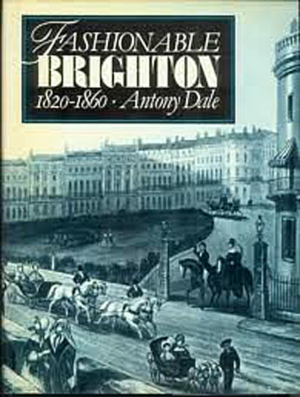
Fashionable Brighton 1820-1860 by Antony Dale


Here's an update on  information I had provided regarding Eastern Terrace, the last dwelling of Lady Dorothy Mills, once the globe-trotting sister-in-law of George Mills:


Vinylrichie has left a new comment on your post "Steyning Mansions Hotel, Eastern Terrace, Brighton...":

As a resident of Eastern Terrace for the past decade, I must correct your assertion that "Among other units on Eastern Terrace, numbers 4, 5, 7, 8, and 9 are now owned and maintained by Brighton Polytechnic as Halls of Residence".
The properties are now all in provate hands and have not been used as student accommodation for many years. Nos 8 and 9 are still individual, one-family houses worth in excess of £3m. All the others are sub-divided into flats.
Here is link to fascinating piece of history about Eastern Terrace...

 
http://books.google.co.uk/books?id=bKM9AAAAIAAJ&pg=PA167&lpg=PA167&dq=sassoon+eastern+terrace&source=bl&ots=DyhOmNb7xN&sig=RfAMx3cgo-XGzRZsw6DtHZHJrec&hl=en&sa=X&ei=HDb3UNGIJ6-W0QX2jIHoAg&ved=0CEEQ6AEwAw#v=onepage&q=sassoon%20eastern%20terrace&f=false


Posted by Vinylrichie to Who is George Mills? at January 16, 2013 at 6:28 PM 


Thank you, sir or madam!

Sunday, August 28, 2011

Lady Dorothy Mills Turns 50


This is just a relative quickie today, based on our previous entry (below). While searching for events occurring at the address of the family of George Mills in Kensington, I also stumbled upon this classified advertisement in the 3 November 1938 issue of The Times:


LADY DOROTHY MILLS wishes to DISPOSE of eight remaining years' lease of attractive, modern, convenient, non-basement ; CHELSEA COTTAGE ; parquet ; five good rooms, kitchen, bath ; Ideal boiler ; gas and electric fires ; good cupboards. Rent £165. Premium £50. Rates about £50. Semi-fitments, &c., available for cheap purchase. View between 11 and 6. — 17, Burnsall Street, S.W.3. Flaxman 2476.


Lady Dorothy, ever one to stretch a dollar after her estrangement from her family upon the occasion of her marriage to Captain Arthur F. H. Mills, D.C.L.I., in 1916, would have been turning 50 years of age on the 11th of March the following spring, and must have had an one eye looking toward retirement and the other on making a few extra quid by subletting her desirable Chelsea home [above, left; click to enlarge] for a premium while taking up less expensive residence elsewhere.

We already know that Lady D. spent the rest of her life living in Steyning Mansions Hotel at Eastern Terrace in Brighton. In 1958, the hotel was offering rooms with a private bath, telephone, and TV at the following rates: "Winter from 9 gns., Summer from 10½ gns."

Those rates presumably were far lower before the Second World War, at the tail end of the Great Depression, when she arrived. Eight years of rent from her Burnsall Street flat must have paid for a good many of her subsequent summers and winters in beautiful, seaside Brighton.


Tuesday, July 12, 2011

Louise and Dorothy Rachel Melissa Walpole; Part 2


In her autobiography, A Different Drummer: Chapters in Autobiography [Duckworth: 1930], Lady Dorothy Mills writes of her youthful years before her engagement to Arthur Mills, brother of George Mills:

Halfway through my teens, the inevitability of me had become apparent, life changed. "Tom-boyish-ness" was discouraged, and it was subtly instilled in me that I had a part to play in the world. Slowly the beauty of my heritage began to dawn on me, the pride of prospective possession, and with it grew also the realization that I was but a cog in a great machine, the juggernaut of Family Tradition. My looks and my accomplishments were dealt with, I was in general tidied up, and at eighteen I "came out." For awhile the world seemed to be mine to play with. I adored it all, the frocks, the parties, the dancing, the flirtations, the young men who sweated under the collar when they proposed and whom I had no intention of marrying, though I knew that some day I would have to make a 'good match, a prospect that I classed alongside a visit to the dentist.

She continues:

In 1916 I got married after a three years' family warfare; warfare that one might say ended in a draw, in that on the one hand I had done what I intended, on the other that I was cast into utter darkness, to become the Outlier I have ever since remained. I had no trousseau, we had no prospects and no money, scarcely enough even to pay for the wedding celebrations. For though everyone advised a registry office, I decided on a church wedding, and a fashionable one too, that should be, if needs must, my last defiance to a sceptical world. I was the first London bride to wear a gold wedding dress, and incidentally, that bit of gold brocade was to be the last evening frock, except of my own making, that I was to know for several years, until finally it was turned economically into a sofa cushion!


Lady Dorothy was disowned by her family, unwilling to play her expected familial (and financial) role by selecting a suitable bridegroom with the money necessary for admittance into the Earldom. It would be uncanny to me if part of her independent spirit was not, in fact, due to beliefs about family, love, and marriage passed along by Louise Corbin Walpole, directly or indirectly, from the time Dorothy had attended the rancorous Wiedemann trial within her mother's womb, through having been raised under the cloud of the scandal, the tragedy of the death of her brother (the family's much-needed heir), and a bevy of burdensome expectations.

Louise and Dorothy, even if it never had been uttered aloud, had to have known they were disappointments to her father, Robert Horace Walpole, 5th and Final Earl of Orford. Louise, saddled with ill-health and anguish stemming from the scandal and the death of a child, bore up well (as a Walpole should) and eventually became a noted 'globe trotter.' Dorothy, however, eventually chafed under her own set of external expectations and the need to keep up appearances, perhaps even in tribute to her late mother.

Was there a curse bestowed upon the family by the vindictive Fraulein Valerie Wiedemann? Walpole died alone in New Zealand nursing home, far from his family's estates, the Earldom having become extinct with his passing when he was unable to produce an heir. He never got any of wealth of afther-in-law D. C. Corbin: Lady Dorothy collected an inheritance from her distant grandfather only after the passing of her estranged father, the Earl.

Louise passed away at the age 42, the result of a seemingly inconsequential "indisposition" after years of unhappiness, which included with a phobia of having her picture appear in public.

Lady Dorothy slowly estranged herself from her husband, Arthur, and his family as well—neither Dorothy nor Arthur, for example, attended brother George's 1925 wedding although they lived only a few city blocks away—becoming a world traveller and explorer who fascinated society by doing it all without dragging husband Arthur along. She openly wrote of what little need she actually had for him, in addition to the amusing romantic entanglements that arose during her adventures, none of which, according to her, ever came to fruition.

At the height of her career, Dorothy was seriously injured in a car accident in 1929 and never fully recovered. She managed a subsequent trip along the Orinoco, about which she wrote a book that was published in 1931. She also was planning a trip to the Middle East when her father passed away in 1932, allowing her access to the trust fund that had been waiting for her since her grandfather Corbin's passing in 1918.

In that same year, 1932, she filed for divorce from Arthur on the grounds of his adultery. Arthur, like her own flirtatious father, would never see a penny of her American inhertitance.

Lady Dorothy never wrote another book, although she continued to publish the occasional sensational article about her adventures in newspapers in the United States and elsewhere througn the 1930s, just as she had always done. She was soon largely forgotten.

She retired to Brighton, where she lived in a seafront hotel until her passing in 1959. She never remarried and remained childless.

A curse, perhaps? It seems she got what she wanted, and always on her own terms.

Her life, as she packaged and sold it to readers, was both legend and myth [above, left, an illustration that accompanied a wire service story she wrote in 1922 about her real-life adventures]. One wonders, though, if it all made her content with her own life in reality.

The most telling photograph of her mother, Louise Corbin, throughout this entire tragic tale is one I recently found in, oddly, the Badminton Library's 1895 edition of Sea Fishing, a book of which it had been implied by the press that Lord and Lady Orford had been the authors.

Almost expectedly, as was the case virtually with all of the exaggerations that had been published as facts about the Orfords in 1905 (we read about them last time), Robert and Louise Walpole actually are not listed among the main writers of the text: The main author was John Bickerdyke, but the section entitled "Tarpon" is credited to Alfred C. Harmsworth.

That section begins on page 445 of the text, and is fully titled "Tarpon Fishing in the Gulf of Mexico."

On page 448, Harmsworth writes: "Among the most successful tarpon anglers are the Lord and Lady Orford. Lady Orford is probably the only woman in the world who has killed two in one day. Her best fish was 128 lbs. Lord Orford has killed one weighing 183 lbs., the fifth largest known tarpon at the time of the writing.

He has kindly furnished me with some notes of his experiences during his visit in 1894. He says, after remarking that few tarpon fishers agree as to the details of the sport, and that every man has his own theory on the subject:

Our first attempts at tarpon fishing were at Punta Gorda, but we had no luck, and I do not think well of the place from an angling point of view. About the middle of April we went to Fort Myers, and there my wife and I killed seventeen fish, my best 183 lbs, smallest 75 lbs. I have presented one weighing 150 lbs. to the Norwich Museum, and am keeping my 183-pounder and Lady Orford's 106-pounder. There can be no doubt in my opinion that the tarpon, as a fish, is quite as game as the salmon."

After several paragraphs of discussion of the actual catching, reeling in, and killing of the fish, Walpole adds: "One has many slips while tarpon fishing and it should never be forgotten that the slightest check can be fatal to one's chance of killing. One of my fish (it had only fouled the trace by getting it under its scissor jaw) took three hours to kill."

Harmsworth adds a few lines about the difference between tarpon and salmon fishing, but Walpole sums it up this way:
"Of course there is not the pretty scenery, the casting, and the same amount of knowledge of where fish are to be found that makes salmon angling so delightful. Nevertheless, tarpon fishing is a magnificent sport, and I wonder that more Englishmen do not take to it."

Right off the bat, I'll say that I love Punta Gorda, far more than Walpole ever could have—my parents lived there for some 25 years after my father retired!

Secondly, what's interesting is what's written about Lady Orford: "…probably the only woman in the world who has killed two in one day."

That brings us to the point here: The somber photograph seen adjacent to this text. It is taken from page 447 of the book, and depicts a woman standing between two tarpon, strung up after the catch.

Now, I've seen this sort of trophy photograph before, and the angler usually is smiling ear to ear, reflecting pride and determination, or both.

Here we see what is ostensibly an anonymous "angler and her catch," but it is clearly Louise Walpole posed between her 106- and 128-pounders. Don't forget, she very much preferred not to have her photograph displayed in public, hence the attempt at anonymity. And Lord Orford probably probably provided it as well as very correctly feeling that, despite the very open clue in the text, the vengeful Valerie Wiedemann, one-time stylish German governess and current debt-ridden madwoman, was unlikely to be reading deep into a tome about the fishing habits of rich Englishmen.

The utter neutrality of Louise's face is stunning. I can make out no pride in her catch, and certainly no joy. In fact, beyond the distinctly neutral expression seemingy encompassing her entire face, there seems to also have been a touch of sadness, or perhaps resignation, in her eyes.

We saw a hint of ominous melancholy in her LIFE magazine photograph above as well.

One occasionally sees a similar vacant expression in a criminal's mug shot, by a grave site after the funeral, or perhaps in a pensive moment, when a person is alone and and solemnly contemplative. One would not associate this woman's face with the exhilaration of this sport—described here as making the "kill"—as well as having earned the distinction of becoming the first woman to bring two of these magnificent creatures to their demise at one time.

One also must consider the idea that it was likely Lord Orford's description of his bride's enthusiasm for tarpon fishing that we've read about all along, not her own.

That notion is corroborated in the June 1905 issue of Ainslee's magazine (Vol. XV, No. 5), in whch the author, Lady Willshire, describes the renowned outdoorswoman, Louise Corbin Walpole (Lady Orford), who we know throws popular shooting parties in Norfolk: "Next after music, sport—fishing most especially—engages her particular interest. Though she rarely goes out with the guns, her husband declares she is a capital shot, and that she could and would ride to hounds with the most daring of our fox-hunting peeresses."

This is a woman who suffered a great deal during a life that ended all too soon. Making that publicly apparent, however, would have been out of the question, as we can can read above and observe in her seemingly noble bearing in an image she [or Lord Orford] did allow to be published. As Lady Dorothy wrote above, "[Walpoles] had a part to play in the world... [as] a cog in a great machine, the juggernaut of Family Tradition."

We see etched very clearly on the drawn face of Louise Corbin Walpole in 1894 the so-called joy she took in sharing the "globe trotting" hunting and fishing adventures of her hsuband.

The record shows that Lady Dorothy was along on many of those excursions. On page 138 of her autobiography, Dorothy writes her own recollection of that 1894 deep sea fishing trip to florida:

The Christmas of my fifth year brought me my first sight of an alligator. It was in southern Florida, where my parents were deep sea fishing, and the negligence of a nurse gave me opportunity to wander unattended by the river bank, where a party of negroes had just landed—to my childish eyes—the dragon of all my fairy tales. Round, blue eyes surveyed the Apochryphal beast with a faint fear that merged into fascination.

"When I am big I shall kill those," I announced grandiloquently. The darkies roared delightedly with a flash of white teeth.

"When li'l Missy big, she hunt 'em 'gaitor good," they assured me. I think on that Christmas Day came the first premonition that, many years hence, the prototypes of those good-natured darkies would be my hunting companions and brothers in the dark jungles of Africa, where so many strange beasts have their habitation.


Setting aside any criticism regarding colonialism and racism, this is—at least in hindsight, and in the mind of Lady Dorothy—a premonition that her own path would be markedly different than the one taken by her mother and father. And her choice in that regard could have been as much due to her mother's long term reaction to her father's illicit liaison as it was from the highly publicized affair itself.

One wonders, as well, what sort of speculative and gossipy discussions of the scandal young Dorothy was privy to while governesses, nurses, and parlour maids assumed she was playing, studying, or wrapped up in reading a book [as we see her in her youth, left]. One also wonders of the impact all of that had on her. The passage above is the only reference to Louise Corbin, directly or indirectly, in Lady Dorothy's memoirs.


In the end, Lady Dorothy married a man like her father: A soldier, a traveller, and a flirt. Unlike her mother, she was determined that she would not need a man—or even a family—and spent a lifetime proving just that.

Family time together could not have been so very important to the Walpoles clan in general. In her autobiography, she also relates, "My first actual memory of a foreign Christmas was as a very small and miserably seasick child crossing the Atlantic to North America, in the teeth of an icy northerly gale. Perhaps it was that initiatory experience that atrophied [my] Dickens' spirit." The chapter goes on to describe all of the Christmases in her life, 1888 – 1929, that she had spent away from friends, family, and especially England.

That would have included Christmases spent without husband Arthur, who doesn't seem to have figured much into her holiday agendas. One Christmas during the 1920s, while Arthur may have been enjoying festivities with his own family (or amusing himself in other pleasant ways with another pleasant person who happened to be located in England at the time), Lady Dorothy was in the Sahara where, on a certain Christmas Day, she and her guide, Ismael, had discovered a dying man and chose to pass him by. A half hour later, they watched from the saddles of their camels as the vultures finally swooped down for their own holiday meal. Ismail placidly told her, "To-morrow his bones will make a good landmark for the caravans. We needed one in those dunes."

Christmas is, after all, about giving—just as that poor wretch had.

It seems that Lady Dot's estrangement was not simply from her own family, but everyone's family, and England's fascination at the time with her daring exploits doesn't make those deeds seem any less empty when considered in the context of a more fully realized life spent at times with one's own, loving family. Still, she had a vision of herself that included other things, many real and some undoubtedly the product of her vivid imagination [at right, an illustration from a 1934 newspaper story sold into U.S. syndication by Lady Dorothy].

We see this no better than in the contrast between the first two illustrations of Lady Dorothy above—cool, stiff, and aloof—and the certainly more lurid, sensual, and vulnerable autobiographical newspaper imagery that percolated up from somewhere within her. She was clearly the antithesis of her mother when it came to having a desire for one's likeness to be published.

Thank goodness Louise had passed away before Robert Horace Walpole and his daughter, Dorothy Rachel Melissa, her loved ones, made the uncompromisingly mutual decision to divest themselves of each other—permanently.

In this tragic tale of family obligations and tradition without accompanying familial love, yes, Louise Melissa Corbin Walpole to me is the most tragic of all the characters life with which life seems to have dealt bitterly during my study of the life and times of George Mills.

I hope I'm wrong about her profound suffering. But I suspect I'm not.


Saturday, February 12, 2011

Lady Ursula Helen Abbey and Some Other Surprises


As promised, we'll now peek into the life of a member of the peerage...

Lady Ursula Abbey was born on 14 June 1899, the daughter of Wilfred Dallas Cairns, 4th Earl of Cairns, and Olive Cobbold of Greyfriars, Storrington. On 7 July 1921, she married John Roland "Jack" Abbey (He had dropped the 'w' from 'Rowland'), son of William Henry Abbey and Florence Belcher, who lived a Sedgwick Park, Horsham, Sussex. As well as being an entrepreneur—already a partner for decades, he took over Brighton's Kemp Town Brewery in 1933—W. H. Abbey was named High Sheriff of Sussex in 1935, and commissioned a portrait of himself [pictured, left] to be painted that year by Oswald Birley. Lady Ursula presented the image to the Brighton and Hove Museums in 1970.

"Jack" Abbey, born 23 November 1894, was educated by a private tutor instead of attending school after suffering a serious elbow injury as a boy.

He was commissioned into the Rifle Brigade, Prince Consort's Own, as a regimental lieutenant on 21 November 1914, serving two years on the Western Front in the 13th and 8th Battalions. He was the only surviving officer of his battalion after the Battle of Flers-Courcelette. By 17 January 1919, Abbey was the Deputy Assistant Provost Marshal attached to HQ, having been promoted to captain during WWI.

In November 1916, he was gassed, necessitating a five month period of hospitalization before being invalided out of combat in October 1917, a year before his younger brother, Noel Roland Abbey of the Grenadier Guards, was killed in action on the Western Front.

A member of the reserve class of officers at the onset of WWII, Jack Abbey returned to the military as an officer in the Army Catering Corps before reuniting with the Rifle Brigade on 17 November 1941. He served from 1941 to 1943 as a staff officer of the Admiral-Superintendent at Great Yarmouth, and was awarded the honorary rank of Major in 1946.

After the First World War, however, Jack became manager of his father's Kemp Town brewery. He then married Lady Ursula in 1921, shortly after a series of whole-plate glass negative images of her was taken by famed Regent Street portrait photographer, Alexander Bassano, on 4 June 1920. These images [one is seen at right] of the seemingly vulnerable, strikingly beautiful Lady Ursula are simply captivating, and can be found at the National Portrait Gallery.

The year 1925 saw the birth of a daughter, Juliet Hermione Abbey, who married the naval war hero, Lt. Commander John Somerville Kendall Oram of Wiltshire, in 1948.

In 1942, Lady Ursula served the war effort by managing a committee that worked six days a week assembling care parcels for the Rifle Brigade's prisoners-of-war.

By 1929, though, Jack had begun collecting books, at first from modern private presses. Eventually, however, he began collecting antiquarian volumes, and by 1946, he began buying medieval illuminated manuscripts. In 1943, he had become president of the brewery upon his father's death, allowing him to build a collection that at one time held of 1,300 volumes [Abbey's book plate is seen, left]. Like his father, Jack would soon be named High Sheriff of Sussex in 1945, a position he held for a year.

According to his biography at bookrags.com, "Maj. J. R. Abbey's book collection was the largest and one of the most remarkable of his generation. He is perhaps best known for his collection of color-plate books and fine bindings, but he also collected many illuminated manuscripts and at one time owned seven books from the library of the sixteenth-century French book collector Jean Grolier. Abbey was one of the first to collect neglected minor works and bought copies of them in their original wrappered parts. From the beginning it was the appearance of books that appealed to him, and two Arts Council exhibitions of bindings from his collection show that he was attracted by the strong geometric patterning and vibrant colors of contemporary English and French binders. Although he was not a scholar, he was an avid visitor of libraries and bookshops, making note of his own observations and also drawing on the advice of distinguished scholars such as A. N. L. Munby and G. D. Hobson when adding to his collection."

In the 1950s, Abbey sold much of his collection of illustrated books and illuminated manuscripts to Paul Mellon (K.B.E., 1974), an American collector, who later bequeathed it to Yale University.

Although he had donated or sold off books from his collection during his lifetime [a 1965 Sotheby's catalog is pictured, right], the bulk of Abbey's collection was sold at auction after had passed away on 24 December 1969. The auction sales spanned the years 1970 to 1975 and brought Lady Ursula the tidy sum of £993,509. She did maintain some of the collection after Jack's death, and that was auctioned by Sotheby's on 19 June 1989 for tens of thousands of pounds, just a year after her own passing in October of 1988.

During their lives together, Lady Ursula had been an avid dog breeder and her canines participated in dog shows at the Royal Agricultural Hall. In addition, she often presented an award to selected participants in the form of a go, cup.

In fact, her retriever, Chiltington Light, is still listed on-line for its pedigree. It's probably only a coincidence that the wife of a brewmaster had a dog called Chiltington Light, which would be a fine upscale name for a mass-produced American "Lite" beer!
Incidentally, one of that dog's categories according to the 1930 catalogue of the Cruft's Dog Show and Exhibition of Sporting Appliances at the Royal Agricultural Hall, Post Graduate Bitches [below, right], does rekindle memories of my first marriage...

Dogs weren't her only interest, however. The Guernsey Cattle Society's Hand Book, volume 63, records the transfer of stock from C. Micklem of Long Cross House, Chertsey, Surrey, to Lady Ursula Abbey of Storrington on 5 November 1947.

Although she is mentioned above as being of Storrington, her family's home, Lady Ursula has been associated with other locales as well.

Many sources provide the residence of the Abbeys as being Woldhurst Manor, Crawley, Sussex, as early as 1929's Armorial families: a directory of gentlemen of coat-armour by Arthur Charles Fox-Davies. Researching Woldhurst Manor, however, isn't as easy as it may seem: Google wants desperately to change any search for it to one for "Windhurst Manor." Finding a map of its location has been frustrating!

The Abbeys are also associated with the Wyvis Estate [pictured left, with boathouse and lodge visible] in Scotland.

In 1904, Lt. Colonel Rupert Wilkin, CMG, a nephew of deceased furniture magnate Walter Shoolbred, inherited the estate from his bachelor uncle. Shoolbred had acquired the lands of Wyvis and Kildermorie, and had even had a steamer ship reassembled in its entirety on Loch Glass to facilitate moving of building materials throughout his land.

Although the date of its acquisition is uncertain, Jack and Lady Ursula Abbey apparently purchased Wyvis from Wilkins, or perhaps his estate. The estate had been valued at £607,507 when Rupert had inherited it in 1904, and it would be of interest to know what the Abbeys paid for Wyvis and for how long it was theirs.

1992's continuing Evanton Oral History Project by Adrian Clark adds this about the Abbey's residence at Wyvis: "Rupert, a bachelor, was followed by Major and Lady Ursula Abbey, also from England. They are remembered as having been very friendly; she was reputedly keener on the shooting than he was."

That makes sense: A pair of the above-mentioned portraits of Lady Ursula from before her wedding show also show her in outdoor attire with hat and gloves [One is seen, right].

And Lady Ursula, fond of animals and competition, would seem tailor-made for the outdoors and shooting, while her husband, brewery owner and book collector Jack, seems to have been happier engaging in indoor pursuits. (Abbey owned Kemp Town Brewery in Brighton, East Sussex [below, left], until merging it with Charringtons & Co. Ltd., London, in 1954.) Imagine what a wonderfully serene and scenic place Wyvis Lodge must have been for Abbey to peruse manuscripts and texts from his collection, fireside, with a nice cup of tea!

Needless to say, the Abbeys were quite unlike Lady Dorothy and Captain Arthur Hobart Mills, brother of our George Mills. While Lady Dorothy, daughter of the 5th Earl of Orford, was a hunter, a fisherwoman, and came from a family that was a cash-starved and longed for her to marry into money—and disowned her when she did not—Lady Ursula seems to have made a match that surely would have pleased the Hon. Robert Horace Walpole, Lady Dorothy's father, to no end.

Eventually, Lady Ursula's name appeared less and less in The Times under the headings of "Court Circular" and "Kennel Club Show" and increasingly more often under "Sports in Brief" and "Croquet."

Her very first croquet tournament match, according to the lamentable search engine of The Times, was played on 25 September 1951 at the Roehampton Club's autumn tournament. She defeated Mrs. M. B. Reckitt [pictured below, right] (+10) in the second round of Handicap Singles, Class X. I can find no record of Agnes, Violet, or George Mills having played in that fall tournament.

The last match the nefarious search engine of The Times yields for Lady Ursula Abbey is a loss (-18) in the first round of Handicap Doubles at Parkstone at the East Dorset Tournament on 12 September 1973 to J. W. Haynes and R. H. C. Carder. Lady Abbey had been paired with Capt. M. F. Buller.

By that year, 1973, George Mills had been gone for a year and Agnes and Violet, while they still may have taken a turn around a lawn for sport, had ceased their tournament play. By the end of July 1975, the spinster sisters of George Mills would no longer be with us either. Lady Abbey would live until 1988.

The mercurial archive of The Times shows Lady Ursula having been in competition with the Mills siblings on 3 occasions, playing singles and winning against Agnes at Eastbourne on 27 September (+6) and 5 October 1965 (+18), after having lost (-19) in doubles to "Aggy" and her partner, Capt. W. A. T. Synge, on 7 July of that same year in tandem with her partner, Miss H. D. Parker, at Budleigh Salterton.

Lady Ursula's husband, Jack—listed in The Times croquet results as "Major J. R. Abbey"—played a Mills sibling once, beating Violet (+3) on 13 September 1960 at Parkstone.

Once again, it's likely that Lady Ursula's love of competition and the outdoors exceeded Major Abbey's—The Times engine provides 79 results after searching '"lady ursula abbey" croquet', from 1951 through 1973, while searching '"j r abbey" croquet' yields only 64 "hits," those ranging from 1913 (in which a "J. R. Abbey" won a doubles match at Brighton on 18 September in tandem with the Hon. Mrs. S. Coleridge) through 1967—a phenomenally long time to have played such a relatively few matches!

Examining Jack Abbey's final tournament match, at least according to the capricious search engine at The Times, is interesting. He lost (-20) to the legendary Mrs. Alex Fotiadi of the Bowdon Croquet Club [pictured, left] on 3 October 1967 at Eastbourne in the first round of Handicap Singles "X." Mrs. Fotiadi was a dominant figure in that era of tournament croquet.

However, what I find just as interesting are these additional results from the same day's matches: George Mills (scratched) lost in a walk-over to Lady G. Fitzgerald, and George's sister, Agnes, lost (-17) to Mrs. E. M. Temple, and Lady Ursula fell to Mrs. J. Povey (-14) in the very same round at Eastbourne.

Needless to say, the incredibly moody search engine of The Times had never produced that particular day's matches for me when I'd searched repeatedly for croquet results for either G. R. or Miss A. E. Mills!

One last item, perhaps of interest only to me, is that on that same October day in Eastbourne, M. B. (Maurice) Reckitt [right]—a 5-time opponent and one time partner of the Mills siblings—beat Mrs. D. M. C. Pritchard (+4) in a second round match. Reckitt had also played in a match back in that 1913 Brighton tournament on the very same day Jack Abbey teamed with the Hon. Mrs. Coleridge. And his wife, Amy Reckitt, you'll recall from above, had been Lady Ursula's first croquet tourney opponent!

Jack and Lady Ursula Abbey were certainly the type of people with whom the Mills sisters (and perhaps George) liked to socialize. I'd be stunned to find that the Abbeys—or at least Lady Ursula—hadn't spent an afternoon or evening with the Mills at Grey Friars. Lady Ursula's love of croquet, competition, and the outdoors would have rivaled that of the Misses Mills, whom, I'll remind you, had a love of the outdoors (They were "charming and keen on the Girl Guides") as well as both being athletic.

The accompanying image of Lady Ursula [pictured, left] has been identified as "probably" having been taken in 1957 at Devonshire Park in Eastbourne during what appears to have been the so-called "Southern Championships" which apparently were attended by a great many players of the era—some in number 66 in just that one group photograph. In fact, the above images of Mr. & Mrs. Reckitt are cropped from the same image. Who knows how many overall players may have participated, but missed that photo op?

Since first viewing that photograph, found on the Bowdon Croquet Club website, I've been prone to think that the "Southern Championships" were the South of England Croquet Championship at Eastbourne, played in early October.

There's just one thing, though: There are no records showing that Lady Ursula Abbey played at all in that tournament in Eastbourne in 1957.

Two others in that group photograph are also not listed among the competitors in the Devonshire Park Championships in October 1957, according to The Times. Those two are George Mills and his sister, Violet.

Even if incorrectly dated, that Devonshire Park group photograph does, however, add much to our knowledge of the Mills siblings: A second photographic image of a dapper George Mills, and, at long last, glimpses of both Agnes and Violet!

We'll look at those three visages (among others), learn more about the photgraph, and read some thoughts from a man who, as a boy, knew George Mills, all in our next post!


Monday, January 17, 2011

Steyning Mansions Hotel, Eastern Terrace, Brighton


We know a great deal about the life of Lady Dorothy Mills (née Walpole), and still more information is coming to light regarding her penchant for globetrotting.

Our last 'contact' with Lady Dorothy, however, came as a telephone listing in a 1939 London directory years after her ostensible retirement and divorce from author Arthur F. H. Mills, brother of George Mills: Mills Lady Dorothy, 17 Burnsall st S.W.3 FLAxman. 2476.

More than one source describes Lady D. as living in Brighton at the time of her death in 1959, including records at ancestry.com. Where in Brighton, though, I couldn't determine.

Yesterday, I found the manifest of the twin-screw ship Alcantara [right] of the Royal Mail Lines that arrived in Southampton on 21 January 1952, steaming in from "Brasil and the River Plate." Aboard was a "MILLS, Dorothy R. M."—our own Dorothy Rachel Melissa Mills—and English author, aged 62 years.

The typewritten address given is "Steyning Mansions Hotel, Eastern Terrace, Brighton." [Pictured in 1950, top left]

A quick internet search turns up only one mention of Steyning Mansions Hotel in the National Archives:

"BRIGHTON BOROUGH PETTY SESSIONAL DIVISION

LICENSING PLANS PTS/2/9 1909-54

Steyning Mansions, Kemp Town Client; Steyning Mansions Hotel Syndicate PTS/2/9/804 23.4.47, 3.3.48"


There's more, however, to be found in Google Books.

Here's an advertisement found in The New Statesman and Nation, Volume 8, issue 355, dated February 7, 1948:

STEYNING Mansions Hotel, Brighton. Kings Cliff. Sea front near bathing pool. Unique comfort and excellent cuisine. Every room has own private bathroom "en suite," G.P.O., phone, wireless and elec. fire. Lift. Garage. Fully licensed. Brochure... Tel. 2589.

And here's an almost identical entry from The Spectator, volume 80, 1948:

BRIGHTON. Kings Cliff. STEYNING MANSIONS. Unique comfort and excellent cuisine. Sea Front. Every room has own private bathroom "en suite," G.P.O. Telephone, wireless, and electric fire. Lift. Garage... Tel. 2589.

Nothing anywhere mentions Mills being a resident. However, we do know a smattering about a few of her neighbors, at least around the time Lady Dorothy likely moved to seaside Steyning Mansions [A view from a flat today is pictured, left] , circa 1939.

We know that in 1939, Steyning Mansions housed a "Miss Parry" of the British Orthoptic Society, according to Volume 1 of the British Orthoptoic Journal of that same year.

Another resident just before WWII was Georgette Heyer (16 August 1902 – 4 July 1974), an English Regency romance and detective fiction novelist, who'd moved "briefly to a flat in Steyning Mansions, Brighton, and then to a service flat at 25 Adelaide Crescent, Hove", with her unemployed husband (according to biographer Jane Aiken Hodge in The Private World of Georgette Heyer; Bodley Head, 1984). Heyer had recently lived in Macedonia, and one wonders if Lady Dorothy might have taken a fancy to the fellow traveller, author, and breadwinning woman.

Heyer was renowned during her career for rejecting her publishers' requests to do interviews to propote her books, saying, "My private life concerns no one but myself and my family," a sentiment that must have been echoed by Lady Dorothy, whose so-called autobiography contains precious little about her own private life.

Steyning Mansions is also advertised in the periodical The English-speaking World (vol. 40-42) in 1958:

BRIGHTON. Marine Parade, Steyning Mansions Hotel PRIVATE BATH and telephone to every bedroom. Licensed. TV. Winter from 9 gns., Summer from 10½ gns. Tel. 26461-2-3.

When did the Steyning Mansions Hotel Syndicate start operating the hotel? When did the hotel cease operation? We do know it was at least in business from 1939 through 1958.

It wasn't the only hotel on the block: Unit No.1 on Eastern Terrace became the Court Royal Hotel in 1914 and was converted into Court Royal Mansions around 1955 [The time is pictured in the photograph, circa 1955, right].

Among other units on Eastern Terrace, numbers 4, 5, 7, 8, and 9 are now owned and maintained by Brighton Polytechnic as Halls of Residence. Others contain flats that range from over a half million pounds down to a basement flat going for roughly £250,000—quite a change from back in 1958, when a winter in likely that same subterranean locale started at just 9 guineas a week!

Yes, Eastern Terrace has changed a bit since Lady Dorothy Mills called the area home in the mid-20th century.

If you have any information about Lady Dorothy, Steyning Mansions Hotel, or the Eastern Terrace, Brighton, of that era, please don't hesitate to contact me... and thank you!


Monday, March 15, 2010

Word from Windlesham School!


Yesterday, on a balmy and breezy Sunday afternoon here in central Florida, I tried to do a little internet sleuthing. In my newly-arrived copy of Meredith and Co., the dedication reads as follows [And, yes, I know you can see it, left]:

To MR. J. GOODLAND, sometime Head Master of Warren Hill, Eastbourne; to the STAFF AND BOYS OF THE SAME SCHOOL, and to those of WINDLESHAM HOUSE, BRIGHTON, THE CRAIG, WINDERMERE, and the ENGLISH PREPARATORY SCHOOL, GLION, among whom I spent many happy years, this book is affectionately dedicated.

In trying to track down information on George Mills, I contacted the prestigious and impressive Windlesham School, Washington, Pulborough, RH20 4AY, via an e-mail form at their website, http://www.windlesham.com/. This morning, stamped Monday, March 15, 2010 7:36 AM, I received the cordial and extremely engaging reply below:


Dear Mr Williams,

Thank you for your message which is a most intriguing one. This is so not least as I suspect that I may well have read one of George Mills books in my youth, my father and I both being passionate cricketers. I have subsequently gone onto your 'Who is George Mills?' website, which made for fascinating further reading.

You are correct, I'm sure, in ascribing the dedication as being to this Windlesham House. The school was until 1913 located in the heart of Brighton and then moved out to the suburbs until 1934. Since that time it has been at its present home a short distance away in the heart of the West Sussex part of the South Downs.

A satisfactory answer to your question as to why the dedication should be as you describe it is less easy to establish. There were certainly two brothers and a cousin with the surname Mills at Windlesham in the late 1890s, though none had George anywhere in their names. Equally the school history 1837-1937 makes no mention of a teacher by the name of Mills, but interestingly we are still in contact with a Patrick Mills who left here in 1942, possibly a son?

However, the resources at my disposal are far short of the total archival material that may provide an answer. My role is that of Secretary to the Windlesham House Association, the alumni body. What I will do is to copy into this correspondence Dr Tom Houston, the school historian, a very near contemporary of Patrick Mills. He is currently engaged on an update of the school history and may well have something that can shed further light on the connection.

I very much look forward to his response. I do hope that we can help you resolve a little more about George Mills.

Every good wish.
Richard Martin

An article on the school’s 2010 centenary from Attain, the official magazine of the Independent Association of Prep Schools [IAPS], also describes the school’s history from the its origins: “Windlesham House School originates from a school set up for a dozen or so pupils by Reverend Worsley at Newport on the Isle of Wight in 1826. It was bought by the Malden family in 1837, initially for the children of naval officers, and was moved to Brighton in 1837. In 1913, the School moved to Portslade and in 1934 went to its present site at Washington.”

Right now, we really have no way of knowing how old Mills was when he wrote his books, all published between 1933 and 1939, but is there a clue in Meredith and Co.’s dedication?

When Mills refers to the staff and boys of “WINDLESHAM HOUSE, BRIGHTON”, could he be dedicating his novel to the staff and boys of a school he’d been familiar with as a boy?

A previous posting suggests that Mills attended a school called Parkfield in Haywards Heath. Checking Google Maps, it appears that Haywards Heath may be just 15 or 20 km due north of Brighton, up A273 or B2112, depending which side of Burgess Hill one would be skirting.

If Mills attended Parkfield at a time when he might’ve been acquainted with staff and boys from Windlesham House while it was still in Brighton, the very youngest he could’ve been in 1913 would be about 13 years old. That would have made him around 33 years old when his first book, Meredith and Co., was published, and near 39 when both Minor and Major and St. Thomas of Canterbury went to press. However, he could also have been much older.

Of course, when Windlesham House moved to Portslade in 1934, the school might still have been commonly referred to as being located at Brighton, while meaning the city’s suburbs. That could make Mills at least somewhat younger than a man nearing middle age in 1939.

This would also make sense if Mills served in the military during World War II. Here’s some insight into the climate regarding war with Germany in the late 1930s from historyonthenet.com:
When war broke out in September 1939, some men volunteered to join the armed services, but Britain could still only raise 875,000 men. Other European countries had kept conscription between the wars and were able to raise much larger armies than Britain. In October 1939 the British government announced that all men aged between 18 and 41 who were not working in 'reserved occupations' could be called to join the armed services if required.

With a conscription possibly reaching to age 41, and with Nazi “hit and run” bombers working the southeastern coast of England from 1940 on, you don't have to be Hercule Poirot to know it seems likely that the war in some way might have uprooted Mills—or at the very least thrown him off of his usual writing/teaching routines—no matter what age he might have been at the time.

From 1942 to 1943, the heaviest bombing on the south coast was in Eastbourne, home of another locale in Mills’s dedication above. And that’s where we’ll go in our next post.

Meanwhile, as always, please let me know if you have any information about George Mills, his life, his career, or his relationship to 'WINDLESHAM HOUSE, BRIGHTON'!