Showing posts with label dogs. Show all posts

Sunday, July 24, 2011

Mr. Egerton Clarke, the Siege of the Alcázar, and the Second World War


The last time we met, we left Egerton Clarke in his home—probably at Egerton Gardens, S.W.3 [left]—with his purportedly Irish wife, Teresa, and his three children.

I could speculate on which of the babies with the last name of Clarke, and with a mother's maiden name of Kelly, born between 1926 and 1941 might have been the children of Egerton and Teresa, but there really is no way of knowing. There were a pair—a boy and a girl—born in the late 1920s in Winchester, where the Clarkes had been married in 1926, but I have no sure way to ascertain those were their children.


[Note: The names and even a photograph of the children with their parents can be found in this later entry: Rediscovering Egerton Clarke. It is also worth noting that, according to his graddaughter, Janine La Forestier, Teresa is spelled "Theresa." (08-17-11)]


We also left Egerton having enjoyed his thumbnail biographical sketch published in the Catholic Who's Who and Yearbook, 1941.

Today, let's take a look at how his poetry was received at the time of its publication during the early decades of the 20th century—and I feel so very old writing that last phrase!


In Blackfriars: Volume 13 in 1932, we find this critique of Clarke's new book, The Seven Niches: A Legend in Verse [London: C. Palmer, 1932], available for 2/6:

Mr. Egerton Clarke is a Catholic poet whose earlier volumes have won praise and popularity. In The Seven Niches he breaks new ground and offers a long poem in the form of a Catholic legend. The idea has the charm of originality and the flavour of experiment : both are justified.

He has succeeded in a difficult task. A long poem such as this will tax any poet's sincerity and prove whether he is capable of sustaining his inspiration to the end. Even the physical strain of producing a long poem defeats many a writer. It demands vision, uniformity of mood, consistent style, and balanced expression. A standard tone must be maintained, together with a definite level of inspiration. Atmosphere must be created and upheld. Facility of expression, obvious clichés, commonplace rhymes may creep into a purely narrative poem, where the story is the first thing that matters. Tennyson and Masefield [right] are examples of such almost inevitable lapses.

But The Seven Niches is more like a richly embroidered tapestry than an unadorned tale. Every detail is complete in colour and execution ; every tiny piece will bear close inspection. That is the author's triumph. He has weighed every word, re-cast every phrase. He has considered every image, every metaphor before giving his final sanction. Therefore the poem has emerged clear-cut, glistening, chaste as a masterpiece in stained glass. Because the poem was not easy to write it is not easy to read. It does not carry the reader along with easy rhyme and dancing rhythm. For its understanding there must be concentration — even a mood of spiritual sympathy, almost of devotion.


Amazing praise for a poet of any era, being compared quite favorably to the two Poet Laureates with the longest tenures in history. It is a shame that his mother, Emma Anna Clarke, did not live to hear her son compared to those greats: She had passed away in 1931 while residing in her birthplace, Bishops Stortford, Herts. A solicitor, not Egerton, was the executor of the £194 12s. she proved in probate after actually expiring in "Silverdale Sydenham," south of London.


Most of the critiques of his work that are available today focus on his last book of poems: Alacazar and Other Poems [London: Burns, Oates, & Washbourne, 1937]. Here are some samples from the critics:

From the St Gregory's Society's The Downside Review (Vol. 56) in 1938:

WITHIN the thirty pages of this booklet Mr Egerton Clarke has collected some nineteen poems, several of which have already appeared in various Catholic periodicals. Perhaps the first poem in the book — that concerned with the famous siege of the Alcazar in 1936 — is most representative of Mr Clarke's poetic insight and expression.

The subject itself affords a good touchstone of poetic talent : the the minor poet, elated by the theme, dilates on valour and seldom goes deeper than the barest surface of reality. Mr Clarke sees the event both in its contemporary setting and its ultimate causes. The result is a finely-wrought integration of an historical event and its supernatural ramifications.


Also from 1938, this from the Dublin Review:

In Alcazar Mr. Clarke has produced a volume of poems of value and interest and materially increased his reputation as a writer of poetry.

His interpretation of history in the title poem, in which the communist assault on Christendom is regarded as the final working out of the schism of Byzantium from Rome, is made convincing and the result is a piece of the school of [G. K. Chesterton's] "Lepanto". But there are finer and more individual poems. "Cistercians in the Mangold Field" has great power, and there is an apocalyptic beauty in "Munera Angelorum."


[Note: Egerton Clarke and G. K. Chesterton were, indeed, friends according to Clarke's family. (08-17-11)]


And, finally, this from the Ampleforth Abbey's The Ampleforth Journal: Volumes 43-44, in 1937:

ALCAZAR. By Egerton Clarke (Burns Oates & Washbourne) 1s.

Fr Martindale once said that man is the only creature whose natural posture is on his knees. Mr Clarke shows a realisation of this truth in this little book of poems — there are only nineteen of them — for each is an expression of love through prayer that we find only too seldom in poetry of to-day. But except for this sameness of purpose we should find it hard to believe that the author of the two Christmas poems, "Munera Angelorum " and " Presents from the North " was the same as the author of the loosely-constructed and still more loosely expressed "Solitary Eye."

In the one the poet shows a delicateness of technique which is completely lacking in the other. Similarly in "Black Coat—6 p.m." and "Edgware Road", he departs from direct expression and loses his reader in sentences of enormous length; piling image on image, metaphor on metaphor, until the sense is lost. It is worth while comparing from the point of view of technique (and incidentally of poetic value) these lines from the Solitary Eye:—


…Buses and men

In dark heraldic shapes, of unreal origin

To his one frightened eye, swerve to a vast triangle

filled with designing ladybirds, then scatter

in long expanding pentagons that soon

resolve their shivering blurs to one blue, steady

and returning star, the solitary eye


With these from "The Hand," a poem written on holding the reliquary containing the hand of Blessed Margaret Clitheroe: —

Within my hand thy hand that folded with its twin in prayer...


I only wish that Google Books would provide me with more than that single line of a poem written about the fascinating story of the martyred saint [right] whose hand is kept in the chapel of the Bar Convent in York.


Other poems and articles by Clarke appeared over time in journals like Blackfriars; although the following list is in no way meant to be comprehensive, here is a sample:


• Clarke, E. (1932), REGZNAE EQUESTRIUM (for D. B. Wyndham Lewis). New Blackfriars, 13: 428

• Clarke, E. (1931), THE INHERITANCE. New Blackfriars, 12: 577

• Clarke, Egerton. "William Butler Yeats." The Dublin Magazine, April/June 1939

• Clarke, Egerton. "William Butler Yeats," Dublin Review, 204:409 (Apr- May-June 1939), 305-21. [Includes an untitled poem written in memory of Yeats.]

• Clarke, Egerton. "Gérard Hopkins, Jesuit." Dublin Review, 198 (London 1936) 127-141.


It appears that Clarke's work was well-regarded by contemporary critics in the United Kingdom, and sought after by certain periodicals. However, what I am unable to determine is whether or not it was regarded as completely mainstream, or a highly regarded Catholic niche author.

The idea of the son of a clergyman in the Church of England, and sometimes even the clerics themselves, resolving to become Catholic permeates the story of George Mills. I have heard from British citizens of today that it doesn't matter very much if a vicar might be a Roman Catholic, but I've been unable to determine if that's generally true. Clerics contacted for insight regarding the subject have not replied to those requests.

Here's an interesting point of view from the knowledgeable Jennifer M., Poet Laureate of this website:

Everything I know about the Catholic and Anglican churches in England runs from Henry VIII to Elizabeth I, when converting from one to the other was a huge big deal, and you sure would hide it if you were around certain people. Maybe there was still a stigma attached to it in George’s time. Wikipedia tells me that as of 2001, only 8% of England and Wales was Catholic.

English Catholicism continued to grow throughout the first two thirds of the 20th century, when it was associated primarily with elements in the English intellectual class and the ethnic Irish population.

I wonder if it was easier to make a living as an Anglican cleric, and that’s why [George's father, the Revd Barton R. V. Mills, a Roman Catholic convert who then took several livings as a vicar, and ascended to chaplaincy at the Chapel Royal at the Savoy] did it. Or maybe it was more socially acceptable [by then]. I guess maybe a lot of people had to do things that were against their beliefs in order to survive, whether it was 1883 or 1583.


With that statistic—8% of the population—fixed in my mind, I wonder if Egerton Clarke was a renowned poet or a renowned Catholic poet. I also wonder if there was—or is—a difference.

If not as a Catholic author, but surely as an author whose religion was Roman Catholic, Clarke soon began to write children's books—another area in which he and George Mills shared something in common.

The Catholic publishing house of Burns, Oates, & Washbourne had printed Egerton's noteworthy Alcazar and Other Poems in 1937, his response to the symbolic and propaganda-oriented stand-off [below, right] between Republican and Nationalist forces at Toledo, Spain, during the Spanish Civil War.

In 1936 and in 1937, Egerton had also published children's books with that company: St Peter, the First Pope, and Our Lady of Flowers.

While Egerton did not publish in 1938 any text that I can find, he was still involved in the area of children's literature after 1937.

The evidence is found in the preface to the third children's book of George Mills, 1939's Minor and Major, which focused on boys' preparatory schools:

PREFACE


THIS book deals with life in a big preparatory school, and tells about the boys and masters, their goings-out and their comings-in. All the characters are imaginary, and no allusion is meant to any living person.

The boys, who first appeared in Meredith & Co. and King Willow, once again present themselves for a short time during a cricket match.

I wish to record my thanks to my old friend, Mr H. E. Howell, for so kindly reading the manuscript and proofs. I also recognize the kindly aid of a schoolboy, Terence Hadow, whose criticisms have been invaluable, as also has the encouragement given to me by my friend, Mr Egerton Clarke, who has read the book in manuscript form. My thanks are also due to Mr A. L. Mackie, who has kindly helped to read the proofs.

G.M.


Once again we find the mysterious Mr. H. E. Howell, and we've discussed the tragic circumstances under which Terence Hadow was lost during the Second World War.

Here, we consider the fact that Egerton Clarke—an old friend of Mills who had recently published children's books of his own—was offering encouragement as well as reading George's original manuscript before the book's 1939 press run.

The fact that Mills doesn't mention Clarke in either of his first two books suggests this was a reunion of sorts for the two old friends. Egerton ostensibly had been pursuing a career as a poet while becoming a father, while Mills had been striving to make teaching his vocation at a variety of public schools and having been trying to make a husband of himself, although he remained childless.

In 1939, Mills would complete the third book of his prep school 'trilogy,' but that would not be the only text he'd have published in that very year, before the looming World War: Mills also published a children's book, Saint Thomas of Canterbury, with—and you may have guessed this—Burns, Oates, & Washbourne. Saint Thomas, still found on the shelves of the British Library, remains the only text of George's that I have not seen or read.


If someone should mention to me it was simply coincidental that Egerton Clarke had helped Mills with the writing and editing of his manuscript for Minor and Major in the same year that Mills also had published St Thomas of Canterbury at the Egerton's Catholic publishing house, that it was all completely unrelated, I would have to disagree.

Perhaps the 1938 release of George's King Willow, the sequel to 1933's Meredith and Co., had come to the attention of Clarke, reuniting the two men after marriage and careers had separated the two old army and Oxford mates. Or perhaps they simply bumped into each other at the theatre or in a coffee shop that year. For whatever reason, they had reconnected.


The year 1938 followed Egerton's publication of his poem "Alcazar," a work that was clearly an intense experience for both the reader and the poet. The siege [left] involving the army of fascist Generalissimo Francisco Franco at Toledo, and the suffering of the innocents involved, foretold the painful story of the Second World War, a global conflict fueled, at least in its European Theatre of Operations, by the tenets of fascism during which the world's suffering was immense.

War was declared by Britain in 1939, the year George Mills published his last published writing, save for the odd letter to the editor of The Times thereafter.

Egerton Clarke, as far as one can tell, had already published his final literary works in 1937.

Neither man would write creatively again.

We know that on 11 October 1940, Mills re-entered the military as part of the Royal Army Pay Corps—where he had once been ceremoniously disposed of as a 'useless' fatigue man—and as a 2nd lieutenant at that.

What became of poet Egerton Clarke during the hostilities, though? Once again, we must look to the reference books. In the text Catholic Authors: Contemporary Biographical Sketches (1948) by Matthew Hoehn, we find this relatively complete entry:


Egerton Clarke 1899-1944.

From 1933 to 1939, Egerton Clarke was children's Librarian of Messrs. Burns Oates and Washbourne, the Catholic publishers. In 1939 he was art editor of the publishing firm of Hutchinson's.

Egerton Clarke was born in 1899, the son of the Reverend Percy Carmichael Clarke, an Anglican Chaplain living at Dinard, Brittany. He was educated at St. Edmund's School, Canterbury and at Keble College, Oxford. When 23 years of age (1922) he was received into the Church. During World War I he served with the 5th Devon Regiment from 1917 to 1918. In 1926 he married Teresa Kelly of Dublin. Two sons and one daughter were born from the marriage. The author of many books of poems, he was a vice-president of the Catholic Poetry Society. Up until his death in October, 1944 he was secretary of St. Hugh's Society for Catholic boys of the professional classes. He is the author of: The Death of Glass and Other Poems (1923); The Ear-ring (1923); The Popular Kerry Blue Terrier (1927); The Death of England and Other Poems (1930); The Seven Niches: a Legend in Verse (1932), and Alcazar (1937). He was also a contributor to periodicals.


Egerton Arthur Crossman Clarke passed away on 20 October 1944. We don't know the cause of Egerton's death, but it is interesting to note that there were Nazi rocket attacks on England during that time, specifically these dates:

Oct. 3, (20.00 hours) A4 rocket fired, impacted in Denton, the impact was about 10 minutes later (longer than normal) creating much damage.

Oct. 03, (23.00 hours) A4 rocket fired, impacted Wanstead (Leytonstone)

Oct. 09, (10.42 hours) A4 rocket fired, impacted at Brooke.


If he had been injured in the collateral damage of those explosions, he could have been in the hospital for a while before he succumbed to his wounds.

It also is entirely possible, however, that, given his lifelong weakness of heart, the organ simply failed Egerton at last, causing his death at the tender age of 45 years.


[Note: No! Clarke actually died of tuberculosis after an experimental procedure according to Janine. She adds: "When my grandfather was ill, they did an experimental treatment on him - deliberately collapsing his lung(s)? - the treatment failed. Clearly." (08-17-11)]


Perhaps Clarke would have published additional poetry and children's books after the war. We'll never know.

But we do know that George Mills never published another book.

The time frame form 1939 through 1945 was a period during which Mills—like many others in the UK and across the globe—lost a great many people who were dear to him, not the least of which would have been his wife, his mother, and Egerton Clarke.

You may recall the London Gazette, dated 2 November 1943, ran the following item:

Lt. and Paymr. G. R. A. Mills (150796) relinquishes his commn. on account of ill health, 3 Nov. 1943, and is granted the hon. rank of Lt.


This bout with "ill health" pre-dates the death of Egerton Clarke the following year, but it suggests that George already was struggling to survive the war, even though it seems improbable that Mills, then 47 years of age, was near any actual combat.

The condition of his health did not preclude George from engaging in a public tiff with a retired Major General in the letter column of The Times in April of 1944 while Mills was using the rocket-damaged Naval and Military Club [right], Piccadilly, as his mailing address.

After the death of Egerton Clarke in late 1944, and his mother in late 1945, Mills went quiet until he wrote a whimsical remembrance of his father's to The Times in April of 1959.

These letters to the editor—written almost exactly 15 years apart—are believed to be the last words that George would publish.


In 1944, George Mills lost a friend and contact in the publishing industry. Still, he had published works with the Oxford University Press and Geo. G. Harrap and Co. without any assistance from Egerton Clarke of which we're aware.

It seems as if the global conflict that changed the world so profoundly may have played a part in silencing George Mills, at least as author, even though he had other windmills at which he needed to tilt before his own passing in 1972.


That's a story for another day, though. Next time, we'll look at the poetry of Egerton Clarke—primarily his early work, circa 1920—from the vantage point of today.

Don't miss it!


Saturday, July 23, 2011

Mr. Egerton Clarke, Kezil, and the Popular Kerry Blue Terrier


By the end of September 1918 Egerton Arthur Crossman Clarke found himself demobilised from the military. The armistice would not be signed until 11 November of that year.

On 29 September 1918, the Kaiser had been advised that Germany's situation was hopeless. General Erich Ludendorff, according to Wikipedia, "could not guarantee that the front would hold for another 24 hours." Negotiations began in earnest in October.

To enlisted men around the camps in England, all of this must have been a secret, or just a part of an ever-grinding rumour mill at best.

Egerton Clarke, despite his weak heart and health issues, would have been anticipating staying in the service for a bit longer, and hitting the streets as a civilian during that month of October 1918 must have caught him a bit off guard, even if it was liberating. It's unlikely he had any knowledge that the hostile nations had entered into entente, and it's unlikely that he had been in the midst of preparing himself and planning for an armistice, and peace [above, left].

Egerton's 61 year old mother, Emma Anna Clarke, was ensconced at Thorley Wash, Hertfordshire, with her widowed and wealthy elder sister, Hannah Patten, so there was no immediate need to begin taking responsibility for her.

In fact, having been a scholar at St Edmund's School in Canterbury up until joining the ranks, Clarke probably knew little, if anything, about caring for himself in the world outside of academia. What would he do? Where would he go?

When one knows nothing but school, it's likely one would attempt a return to the safety, order, and stability of an educational institution. That was the case with young Egerton.

During our study of George Mills, Egerton's friend form the Army Pay Corps, we learned of an opportunity presented to veterans of the war to attend university. It was described here by Anabel Peacock, an archivist at Oxford:

[A veteran] was exempted from taking Responsions (preliminary examinations for entry) and the examinations of the First Public Examination, under a decree of 9 March 1920. This decree stipulated that until the end of Trinity Term 1923 any member of the University who had been engaged in military service for twelve months or more before his matriculation, was permitted to offer himself for examination in any Final Honours School, despite not having met the statutory conditions for admission to that School. This was on condition that he had obtained permission from the Vice Chancellor and the proctors; that he had entered upon the third term and had not exceeded the twelfth term following his matriculation; and that he had paid the fee for admission to the examinations the decree excused him from.


This was the situation of which Mills had taken advantage when he matriculated from Christ Church, Oxford, on 19 October 1919, following his service under the Colours. It was probably under the auspices of the same decree that Clarke entered.

From Nicola Hilton, Archives Assistant at Oxford, we learn this about Egerton:

Egerton Arthur Crossman Clarke was born on the 20 September 1899 in Canterbury, Kent. He was the second son of Percy Carmichael Clarke, Clerk in the Holy Orders, deceased. Before coming to Oxford, Egerton attended St Edmund's School, Canterbury, Kent. He matriculated (ie was admitted to the University) from Keble College on 14 October 1918. I cannot find any record of a degree being conferred (ie at a ceremony) on Mr Clarke.


[Note: Thanks to Janine La Forestier, Clarke's granddaughter, we can identify Egerton's brother: "In front of me now is a letter in which he is answering a question my mother must have asked concerning his brother. The letter dated December 1, 1942 refers to his brother as John (Jack) Percy Dalzell Clarke born in 1892 and died 21/02/1915." (08-17-11)]


Considering the above information, we once again find a connection between Egerton and George Mills. It may only be circumstantial, but with both gentlemen, formerly mates in the armed forces, matriculating during the same week—Egerton on Monday and George on Saturday—it seems strange to think that they had not been in contact and that they had not been sharing, at the very least, loose plans to further their educations at Oxford.

And it may not be far-fetched to believe that Oxford may have been George's idea—and if not his idea, then a very practical decision. His father, the Revd Barton R. V. Mills, was a graduate, as had been his grandfather, Arthur Mills, M.P., and Barton still was alive—he was serving as a "Chaplain to the Forces"—and able to take the boys, advise them, and show them around a bit. Egerton's father, the Revd Percy Carmichael Clarke, had attended Cambridge, but unfortunately had passed away on 1902. There could have been no similar connection there.

It would have been comforting, one imagines, for both boys to know that they were heading off to university assured there would be at least one familiar and friendly face among the Oxon crowd.


By 1919, Egerton had become editor of Clock Tower at Keble, presumably a literary magazine of some sort, and his name appears in the 1919 calendar. He, however, actually was busily working on another literary project—and a somewhat surprising one.

In 1920, Clarke would publish his first book, with this lengthy title: The Popular Kerry Blue Terrier: Its History, Strains, Standard, Points, Breeding, Rearing, Management, Preparation for Show, and Sporting Attributes.

A new edition of this seemingly immortal book is still in print today. The original 1920 first edition is described thusly:

By Egerton Clarke. With a foreword by The Rt. Hon. The Earl of Kenmare. Line drawings by Hay Hutchison. Illustrated. London: Popular Dogs Publishing Co. [1920]. 12mo., 78p., blue cloth with gilt lettering, and endpapers, illustrated with photographs and drawings.


This project may only be a surprise to those who aren't aware of George Mills and his family's great affinity for dogs. From his father's early church-going days in Cornwall to reminiscences from his last years in Budleigh Salterton, an overall fondness for dogs pervades his story. One could even make the argument that a dog was the most popular character of a pair of his children's books.


Contrasting with the publication of The Popular Kerry Blue Terrier, Clarke also published a book of poems entitled Kezil and Other Poems [London : A.H. Stockwell, 1920]. Kezil is available today as a scanned reproduction of the original text, as well as on-line.

Clarke's dedication is quite interesting:


Dear ———

To whom one should dedicate a first book is often, I am told, a difficult question to decide.

For my part I can but feel that to offer this, my first to any one particular person would be both ungenerous and unfair, and it is for this reason I am persuaded to offer it, small though its value may be, to all those who have been good to me through-out my life.

So my offering is to you, friends, and among you :

Firstly, my Mother because you are also the mother of these poems ;

Nan, because without you these poems would not have been written by my hand, and because of your care for a stranger-child :

Madeleine, for the sake of your gentleness ;

Dorothy Sayers, in recognition of your kindness, and in appreciation of "Op" ;

Ernest Duggan, because of the door you opened for me ;

Gerald Crow, because you opened my eyes once and for all ; and last but not least

" Kezil," mysterious inspirer of so much.


EGERTON A. C. CLARKE.


THE GRANGE,

FOLKESTONE, June, 1920.


First of all, we find Egerton residing in Folkestone, near Dover, on the southeast coast, while writing at least this dedication.

We can determine some of his influences: Poet and biographer Gerald Henry Crow (we hopefully will hear more about him soon) and Oxford's own Dorothy L. Sayers, novelist, playwright, essayist, translator and poet. Here he specifically mentions the latter's interesting 1915 collection of poetry, Op. I.

Ernest Duggan and Madeleine are two unknown characters in the life of Egerton Clarke, circa 1920. Duggan did not attend Oxford, and Egerton has left us no clues with which to determine his identity—there are more than a few Ernest Duggans in the Empire, circa 1920. And Madeleine will remain a mystery, at least until she gains a surname.

Nan, however, is essentially nameless, but quite interesting nonetheless. She is appreciated in this dedication "because without you these poems would not have been written by my hand, and because of your care for a stranger-child."

These touching words imply not just the binding and careful treatment of a youth's injured hand, but that Egerton was treated with an overall care and tenderness that would not necessarily have been expected from a stranger. Heart-wrenching tales of orphans such as Oliver Twist and Jane Eyre were well-known, and while they had been around for many decades by the passing of Clarke's father in 1902, the more modern world at the turn of the 20th century still would not have been an orphan's proverbial oyster.

The presence of Nan caring for a "stranger-child" also gives us insight into the lack of mothering suffered by Egerton during his youth. Where he experienced the tenderness of Nan's care is unknown at this point. Perhaps early in France she had been his nurse. Perhaps she was a matron at St Edmund's School in Canterbury who took a liking to the boy—or he to her. Perhaps she was simply someone who watched after him when school was out, someone who allowed him to leave St Edmunds occasionally.

Apparently, at whatever time Nan bestowed her kindness, Clarke had had no mother to provide it for him. Knowing that our best guess right now is that his mother was in the workhouse at Watford in 1911, that would go a long way toward explaining why Egerton so very much needed a "Nan."

By contrast, Egerton's mother essentially is thanked for having given birth, and so, indirectly, having enabled him eventually to write the poems found within the text. There are certainly no immediate thanks for her, just an overall fondness, and a gratitude born of a worrisome life that finally seemed to have turned out well.

Missing from the dedication would be George Mills: A friend but not a powerful influence on Clarke's words and imagery.


"Kezil: A Fantasy" is a languidly alluring, Eastern erubescence of a poem, and well worth reading. Within the brief text, Clarke explains: "'KEZIL' a Persian word meaning 'red,' or sometimes, I believe 'the red one.' — E.C."

But for our purposes here, I've selected a different poem from this volume to share:


IN HOSPITAL.

SEMI-CONSCIOUS.


PALE shadows round my head.
In whispering conference,
Nurses moved, and one said,
"B. one-seven-five ref'rence,
A. F. discharge," like ghosts,
They swayed unreal about
The room, The Red Cross hosts.
I wished someone would shout —
I wanted so to sleep.
A cruel "Hush !" "Be quiet."
Was all I heard and "creep
Like mice ;" and " Special diet."
Now and then a single word,
A phrase, against my brain,
Insistent beat and stirred
The quietude to pain,
Then somewhere slammed a door.
One moment echoed deep
Along the empty corridor,
Outside, I turned and heard no more,
And turned again and fell asleep.


Winchester,
1918.


When last time we read of Egerton's hospital stays in Winchester, it appeared to have been so easy for him: Resting in bed, recuperating, enjoying some time away from duty. In the poem above, written in that bed, we can see that clearly was not the case as Clarke, reconstructing his lack of lucidity, expresses the semi-consciousness of his condition and does his best to capture fleeting and fragmented scraps of his environment.

His volume ends tenderly with this poem:


FINIS.

To M. C.


NOT so much pity, what better an end
Than a night of shadow and quiet sleep,
When there's nothing of love that's left to spend,
Why should we linger to fidget and weep ?

O little's the pity of such a kind,
Let us light our candle and go upstairs
As children do, and dropping down the blind
A comfort make wherein to say our prayers ;

Not so tenderly now, no endless kiss,
Nor hold my hand so long, now love is pain,
But say "sleep well, sweet dreams," and things like this—
"Good-night," laugh too, lest Love find fault again,

Pity can go the way of love, and now,
As though we had nothing of that to mend,
Politely unkissed let us nod and bow,
With a "God bless you, dear," and "Good-night, friend."


Quite a contrast, I think, to The Popular Kerry Blue Terrier ("Teeth set right ensure a strong grip on the terrier's natural foe—vermin"). Perhaps these final verses are dedicated to Madeleine—M. C.—who was probably not his lover, ascending the figurative stairs with him 'as children do.'

Egerton Clarke would go on to write texts, poems, and a play. Here is as complete a bibliography as I can manage for his works after 1920:


• The Ear-ring: A comedy in one-act. [London: Egerton, 1922]

• The Death of Glass and Other Poems. [London: Egerton, 1923]

• Nature Poems. [Amersharm: Morland, 1923]

• The Death of England. [London: C. Palmer, 1930]

• The Seven Niches: A Legend in Verse. [London: C. Palmer, 1931]

• St Peter, the First Pope. [London: Burns, Oates, & Washbourne, 1936]

• Our Lady of Flowers. [London: Burns, Oates, & Washbourne, 1937]

• Alcazar and Other Poems. [London: Burns, Oates, & Washbourne,1937]


Editions of Who's Who in Literature in 1928 described Clarke in this way:

CLARKE, Egerton A. C. b. 1899. Ed. Clock Tower (KebleColl.,Oxford), 1919. Au. Of Kezil and Other Poems (Stockwell), 1920; The Earring (one-act comedy); (Hugh Egerton), 1922. Sub.-Ed. National Opinion, 1922. C. Morn. Post, West. Gaz., Colour, Even. News, Dy. Mirror, Poetry Rev., Oxford Poetry, Oxford Fort. Rev., Nat. Opinion. 73, EGERTON GARDENS. S.W.3.


So, by 1928 Clarke, who had published with a publisher called Egerton, was living in London, interestingly in Egerton Gardens, situated just across Brompton Road and less than 1,000 feet from the Holy Trinity Church in which George Mills wed Vera Louise Beauclerk in 1925.

Egerton did not attend.

Clarke did follow George into the world of wedded bliss when he returned to Winchester and married Teresa Kelly in the spring of 1926.


[Note: Janine also reports that "Therese received her nurses training from Guys Hopital in 1922." Note the spelling of Mrs. Clarke's name. A photograph depicting her nurse's uniform can be found at Rediscovering Egerton Clarke. (08-17-11)]


We can see from the bibliography and the brief biography above that 1926 was in the middle of a 6 year period during which Clarke did not publish a book, although another edition of The Popular Kerry Blue Terrier would be published in 1927 or 1928.

An on-line reference to this new edition describes it thusly:

Clarke, Egerton.
The Popular Kerry Blue Terrier
Popular Dogs Publishing Company, Ltd, c1928
65b, Long Achre, London, W.C.2.

Egerton Clarke of Narcunda Kennels wrote the “Popular Kerry Blue Terrier”, with a forward by the Rt. Hon. The Earl of Kenmare. Illustrations by Hay Hutchison. Published by Popular Dogs Publishing Company Ltd. in England in the 1920's. There is no publishing date in the book, but advertising for The Bog Kennels on page 71 makes reference to the dates 1925 and 1926. This is the first book published on Kerry Blue Terriers. Addresses breed history, Standard, Points, Breeding, Rearing, Management, Preparation for show, and Sporting attributes. A very scarce book. Hardcover, 78 pages.


All we really know of Egerton at this time is that, after his marriage, he is associated with a place called "Narcunda Kennels," presumably in England. By 1930, however, his wife crops up in the Cruft's Dog Show Catalogue in the category [below, left]: "Class 806—FOX TERRIERS—MINOR LIMIT BITCHES." It reads: "2071 Mrs. England. Colonnade Credit. b. Born 24 Oct. 27. Breeder, Mrs. Egerton Clarke. By Earlington Goldfinder—Selecta Merit."

[Just an aside: In this 1930 catalogue, the first person listed in the "Index to Exhibitors" is "Abbey, Lady Ursula, Woldhurst manor, Crawley, Sussex. 770." Lady Ursula Abbey, a well-known breeder of show dogs, played croquet with and against George Mills and his sisters during the 1950s and 1960s.]

Clarke, if nothing else, obviously shared a love of dogs, and of breeding dogs, with his bride. It's an odd interest for a child, Egerton, ostensibly raised in an orphan school, to have picked up. One wonders what sort of life that "Nan" was able to share with him before he went off to war, or if the school itself had a Kerry Blue Terrier that became a love of Egerton's life.

In fact, could some of Egerton's dog tales (no pun intended) have made their way into the stories of George Mills?


Let's look at an excerpt from an even more informative biography of Egerton Clarke, this time from The Catholic Who's Who & Yearbook: Volume 34, edited by Sir Francis Cowley Burnand in 1941:

Clarke, Egerton — b. 1899, s. of Rev. Percy Carmichael Clarke, some time Anglican Chaplain of Dinard, Brittany; educ. St Edmund's Schl Canterbury and Keble Coll. Oxford; received into the Church 1922; served 5 Devon Regt 1917-8; a Vice-Presdt of the Catholic Poetry Soc.; Sec. St Hugh's Soc. for Cath. Boys of the Professional classes; m. (1926) Teresa, dau. of Joseph Wm Kelly and Clara Kelly (nee Sheil), of Dublin (2 sons, 1 dau.). Publications: The Death of Glass and Other Poems (1923) — The Ear-ring (1923) — The Popular Kerry Blue Terrier '(1927)— The Death of England and Other Poems (1930) — The Seven Niches: a Legend in Verse (1932)— Alcazar (1937).


By 1941 Egerton and Teresa Clarke had two sons and a daughter. But what's really interesting here, along with the title of the text [right], is that he was "received into the Church 1922." During the mid- to late-1920s, Egerton had become involved in a new religion: Roman Catholicism.

Dogs. The Army Pay Corps. Oxford. Writing. Neither staying at Oxford to earn a degree. Fathers who were Anglican clergymen. And their own conversions to Catholicism.

Yes, there was a great deal that George Mills had in common with his friend, Egerton Clarke.


Next time we'll look at the children's books of Clarke and the final published text of George Mills, as well as reviewing Egerton's contributions to George's own literary work.

See you then…


Sunday, June 5, 2011

Of Memories, Healing, and Lost Relatives


Several weeks ago, about a week apart (likely after the release of the April/May issue of Croquet Gazette, No. 331), I received two delightful messages from the enchanting locale to which we'll return today: Budleigh Salterton.

The first message I received was this one, entitled George, Aggy and Vi Mills, from Joanna Healing, who is well known at the Budleigh Salterton Croquet Club:


I met George Mills a few times, but do not remember him apart from his name.

I, as a child, did know Aggy and Vi Mills, and do have 2 specific personal memories about them.

If you want to know more, I would be happy for you to contact me.

Best wishes
Joanna


Imagine my excitement! Before this, I could count on the fingers of one hand the number of people who have actually met George Mills with whom I've been in contact. And I could count on the fingers of… well, two fingers... the number of those people who actually have any specific memory of him at all.

It was with great excitement that I wrote back to Joanna, a lovely person and a keen player who is in the midst of writing a history of sorts about the croquet club at Budleigh.

When she replied, I was delighted. This is also from Joanna:


I remember that Aggy and Vi Mills were very fond of children, and they used to ask my sister and myself to tea every now and then, and play card games with us in Budleigh Salterton. I don’t remember which games. I have always remembered this because on one occasion I peed on my chair and sat there the rest of the afternoon on a wet chair, far too embarrassed to say anything. Of course this was discovered when my mother came to collect us. Everyone was very nice to me, but I was so utterly mortified I refused to ever go again.

The other memory I have is when Aggy and Vi (and I think George but am not sure) came to our house in Otterton [the village is pictured, left]. My sister and I came back from walking Tarka our Labrador, and found them with a few other friends around the piano singing (probably Gilbert and Sullivan). Tarka rushed in and jumped up against Aggy.

You mention Lt. Col. Gerald E Cage in the Croquet Gazette – I knew a Lt. Col. Gerald Cave in Budleigh Salterton.

I also remember Guy and Joan Warwick – Guy better because Joan died earlier.

Sir Leonard Daldry used to be our neighbour.

A bridge partner of mine has been compiling a history of the Croquet club at Budleigh Salterton and I attach the history that I have contributed, but it does not mention the Mills, but it might be of some interest. I have added a few bits just for your interest.


Thank you very much, Joanna!
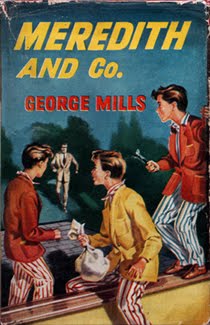
While, historically speaking, the events regarding the Mills described above are not earth-shaking (unless you were the one who had been mortified), they do help us make the Mills siblings far more human. Sometimes the three of them often seem to boil down into bland history: dates and places, births, deaths, marriages, finishes in croquet tournaments, and phone records in agate print. But human beings are so much more.

We knew the Misses Mills were "charming" and "very keen" on the Girl Guides and involved in sport of one kind or another for their entire lives. Neither sister, Agnes or Violet, ever married.

Joanna's two anecdotes make them more real, especially envisioning them sipping tea with a neighbourhood youngster at Grey Friars and kindly dismissing the unfortunate accident that had occurred and politely never mentioning it again.

And we already know that the Mills family was disposed to love dogs, although we're uncertain if the Mills owned one while residing in Budleigh. Their travel to croquet tournaments for uncertain lengths of time (one can't always count on making it to the final) could have made it an imposition for them to seek help in caring for a dog.

An insight we once gained via George in a letter to The Times in 1959 demonstrated a longstanding familial love of dogs, and it's no accident that one of the most endearing and popular characters in his books was a mischievous bulldog named Uggles.

And mixing an appearance by an excited Labrador, along with the Mills siblings crooning Gilbert & Sullivan tunes while gathered around a friend's piano, says much about how affable and social the Mills were! My hunch is that, even if her feathers had been ruffled a bit by the excited Tarka, Agnes dismissed it all with a smile and many laughs were enjoyed by all.

Most people are concerned about privacy in this internet age, and rightfully so. Still, Joanna has an interesting reason for allowing me to use her identity publicly:


I ordinarily would say I want absolutely no reference to my name, but for the last about 25 years I have been trying to find my half-sister without success. So I suppose getting my name published would be a good thing. You never know, she might be living within a mile of you. I don’t know if she is alive or dead, what country she lives in or whether or not she ever married. I haven’t seen her for over 50 years.


In addition to Joanna Healing's chilhood memories of the Mills, she also shared some charming recollections of the croquet club at that time. Here are excerpts from her text 1960s – JOANNA HEALING REMEMBERS:


MAIN CLUB HOUSE

My sister remembers going to a gambling evening where everyone was in evening dress and dripping diamonds and playing bingo amongst other things.

I remember going to a Bring and Buy sale for charity there which had some rather generously donated valuable bits of jewelry and ornaments.

My father was Chairman for one year, but hated the endless waffling at committee meetings. However he did take on the position of Treasurer and did that for over 30 years.

At one end of the bridge room, there are 2 paintings by Dorothy Bradshaw. She was a well renowned artist, and had had paintings accepted by the Royal Academy. She donated the paintings to the club. She was a member, but I don’t think she played bridge.


BRIDGE (and Chess)

Occasionally, the bridge rooms were referred to as the snake pit. This club used to be known as The House of Lords and the club across the road was known as The House of Commons.

At one time, it was decided to have a 3d and a 6d room. This was in the days of rubber bridge when the reward I think was 3d or 6d per 100 points gained by the winning players. I think the better players tended to play in the 6d room. The 6d room was where the main bridge room is now, and the 3d room was the smaller room beyond that at the end of the club house.

Bridge was very popular – at one time the only days the club was officially closed for bridge was Christmas day and Good Friday.

The standard of bridge was extremely high, and the cigarette smoke overwhelming.

In 1964 my mother read a letter printed in The Daily Telegraph and written by a Major Ponder which was rather chauvinistic about women, their brains and chess. My mother wrote back via The Daily Telegraph, saying (amongst other remarks) “Is not one of the world’s greatest players a woman” also “Women think and act quickly, and our days are too busy to waste hours dithering over the next move” also “As an average female I now publicly challenge Major Ponder to a game, or the best of three if he can get through so many in one afternoon”. The Daily Telegraph loved it. They organised a chess match of the best of 3 games to be played at The Palace Hotel, Torquay.

My mother panicked – she hadn’t played chess for 18 months – and she immediately got us her two daughters practising with her, and I seem to remember that she got Brigadier Peters (also a club member) to help her practice also.

At The Palace Hotel, in front reporters and live BBC, she beat Major Ponder by 3 games to 0.


TENNIS

[The croquet] club used to be called the Lawn Tennis and Croquet Club, even though Bridge was the overwhelming part of the club.

The top players loved coming to Budleigh Salterton and considered our tournament as their pre Wimbledon tournament.


CROQUET

Major Freddy Stone was a strong croquet player. I remember my sister and I stealthily took a couple of clips off the hoops and sneaked up behind him and clipped them to the back of his jacket. We did not realise what chaos we had caused or how upset he was going to be. But he was a lovely man, and forgave us quickly.

My father learned to play Croquet in his senior years, and very quickly he did very well. But it perhaps it would have been impossible for him to tell the difference between the red and the green ball as he was extremely colour blind. I suspect he simply remembered which ball was which, and if that memory went awry, he would have asked another player to point out which was which.


I do remember when road workmen used to wave red or green flags to motorists when they need to control traffic around their work on the road. My father was driving us to Exmouth when a road man waved a red flag for him to stop. Daddy being colour blind drove on and received somewhat bad language from all around as the waved flag had been red to stop. On the return journey Daddy saw a flag being waved and stopped. Again trouble. The angry workman had been waving the green flag for him to drive on!


Finally, Joanna added these thoughts regarding Budleigh Salterton:


Budleigh Salterton is mentioned in one of the Gilbert and Sullivan operettas – it is a lovely small seaside town – old fashioned. It used to be said that there was more money hidden under the mattresses of Budleigh Salterton than in all the banks in Birmingham. I have also heard that the Major speaks to the Colonel, the Colonel speaks to the General, and the General only speaks to God in Budleigh Salterton. The history of the town has produced a town that has a lot of very pleasant people in it, mostly retired and where manners are still very important.

I used to think my parents had a good life, and thought that that was what I wanted to do when I was grown up. I am now here again and wouldn’t live anywhere else in the world.


If you can help in Joanna's quest for information about her sister, please let me know and I'll see that she gets the information immediately. Thank you again, Joanna, and accept my wishes for the very best of luck in locating your sister!


Saturday, February 12, 2011

Lady Ursula Helen Abbey and Some Other Surprises


As promised, we'll now peek into the life of a member of the peerage...

Lady Ursula Abbey was born on 14 June 1899, the daughter of Wilfred Dallas Cairns, 4th Earl of Cairns, and Olive Cobbold of Greyfriars, Storrington. On 7 July 1921, she married John Roland "Jack" Abbey (He had dropped the 'w' from 'Rowland'), son of William Henry Abbey and Florence Belcher, who lived a Sedgwick Park, Horsham, Sussex. As well as being an entrepreneur—already a partner for decades, he took over Brighton's Kemp Town Brewery in 1933—W. H. Abbey was named High Sheriff of Sussex in 1935, and commissioned a portrait of himself [pictured, left] to be painted that year by Oswald Birley. Lady Ursula presented the image to the Brighton and Hove Museums in 1970.

"Jack" Abbey, born 23 November 1894, was educated by a private tutor instead of attending school after suffering a serious elbow injury as a boy.

He was commissioned into the Rifle Brigade, Prince Consort's Own, as a regimental lieutenant on 21 November 1914, serving two years on the Western Front in the 13th and 8th Battalions. He was the only surviving officer of his battalion after the Battle of Flers-Courcelette. By 17 January 1919, Abbey was the Deputy Assistant Provost Marshal attached to HQ, having been promoted to captain during WWI.

In November 1916, he was gassed, necessitating a five month period of hospitalization before being invalided out of combat in October 1917, a year before his younger brother, Noel Roland Abbey of the Grenadier Guards, was killed in action on the Western Front.

A member of the reserve class of officers at the onset of WWII, Jack Abbey returned to the military as an officer in the Army Catering Corps before reuniting with the Rifle Brigade on 17 November 1941. He served from 1941 to 1943 as a staff officer of the Admiral-Superintendent at Great Yarmouth, and was awarded the honorary rank of Major in 1946.

After the First World War, however, Jack became manager of his father's Kemp Town brewery. He then married Lady Ursula in 1921, shortly after a series of whole-plate glass negative images of her was taken by famed Regent Street portrait photographer, Alexander Bassano, on 4 June 1920. These images [one is seen at right] of the seemingly vulnerable, strikingly beautiful Lady Ursula are simply captivating, and can be found at the National Portrait Gallery.

The year 1925 saw the birth of a daughter, Juliet Hermione Abbey, who married the naval war hero, Lt. Commander John Somerville Kendall Oram of Wiltshire, in 1948.

In 1942, Lady Ursula served the war effort by managing a committee that worked six days a week assembling care parcels for the Rifle Brigade's prisoners-of-war.

By 1929, though, Jack had begun collecting books, at first from modern private presses. Eventually, however, he began collecting antiquarian volumes, and by 1946, he began buying medieval illuminated manuscripts. In 1943, he had become president of the brewery upon his father's death, allowing him to build a collection that at one time held of 1,300 volumes [Abbey's book plate is seen, left]. Like his father, Jack would soon be named High Sheriff of Sussex in 1945, a position he held for a year.

According to his biography at bookrags.com, "Maj. J. R. Abbey's book collection was the largest and one of the most remarkable of his generation. He is perhaps best known for his collection of color-plate books and fine bindings, but he also collected many illuminated manuscripts and at one time owned seven books from the library of the sixteenth-century French book collector Jean Grolier. Abbey was one of the first to collect neglected minor works and bought copies of them in their original wrappered parts. From the beginning it was the appearance of books that appealed to him, and two Arts Council exhibitions of bindings from his collection show that he was attracted by the strong geometric patterning and vibrant colors of contemporary English and French binders. Although he was not a scholar, he was an avid visitor of libraries and bookshops, making note of his own observations and also drawing on the advice of distinguished scholars such as A. N. L. Munby and G. D. Hobson when adding to his collection."

In the 1950s, Abbey sold much of his collection of illustrated books and illuminated manuscripts to Paul Mellon (K.B.E., 1974), an American collector, who later bequeathed it to Yale University.

Although he had donated or sold off books from his collection during his lifetime [a 1965 Sotheby's catalog is pictured, right], the bulk of Abbey's collection was sold at auction after had passed away on 24 December 1969. The auction sales spanned the years 1970 to 1975 and brought Lady Ursula the tidy sum of £993,509. She did maintain some of the collection after Jack's death, and that was auctioned by Sotheby's on 19 June 1989 for tens of thousands of pounds, just a year after her own passing in October of 1988.

During their lives together, Lady Ursula had been an avid dog breeder and her canines participated in dog shows at the Royal Agricultural Hall. In addition, she often presented an award to selected participants in the form of a go, cup.

In fact, her retriever, Chiltington Light, is still listed on-line for its pedigree. It's probably only a coincidence that the wife of a brewmaster had a dog called Chiltington Light, which would be a fine upscale name for a mass-produced American "Lite" beer!
Incidentally, one of that dog's categories according to the 1930 catalogue of the Cruft's Dog Show and Exhibition of Sporting Appliances at the Royal Agricultural Hall, Post Graduate Bitches [below, right], does rekindle memories of my first marriage...

Dogs weren't her only interest, however. The Guernsey Cattle Society's Hand Book, volume 63, records the transfer of stock from C. Micklem of Long Cross House, Chertsey, Surrey, to Lady Ursula Abbey of Storrington on 5 November 1947.

Although she is mentioned above as being of Storrington, her family's home, Lady Ursula has been associated with other locales as well.

Many sources provide the residence of the Abbeys as being Woldhurst Manor, Crawley, Sussex, as early as 1929's Armorial families: a directory of gentlemen of coat-armour by Arthur Charles Fox-Davies. Researching Woldhurst Manor, however, isn't as easy as it may seem: Google wants desperately to change any search for it to one for "Windhurst Manor." Finding a map of its location has been frustrating!

The Abbeys are also associated with the Wyvis Estate [pictured left, with boathouse and lodge visible] in Scotland.

In 1904, Lt. Colonel Rupert Wilkin, CMG, a nephew of deceased furniture magnate Walter Shoolbred, inherited the estate from his bachelor uncle. Shoolbred had acquired the lands of Wyvis and Kildermorie, and had even had a steamer ship reassembled in its entirety on Loch Glass to facilitate moving of building materials throughout his land.

Although the date of its acquisition is uncertain, Jack and Lady Ursula Abbey apparently purchased Wyvis from Wilkins, or perhaps his estate. The estate had been valued at £607,507 when Rupert had inherited it in 1904, and it would be of interest to know what the Abbeys paid for Wyvis and for how long it was theirs.

1992's continuing Evanton Oral History Project by Adrian Clark adds this about the Abbey's residence at Wyvis: "Rupert, a bachelor, was followed by Major and Lady Ursula Abbey, also from England. They are remembered as having been very friendly; she was reputedly keener on the shooting than he was."

That makes sense: A pair of the above-mentioned portraits of Lady Ursula from before her wedding show also show her in outdoor attire with hat and gloves [One is seen, right].

And Lady Ursula, fond of animals and competition, would seem tailor-made for the outdoors and shooting, while her husband, brewery owner and book collector Jack, seems to have been happier engaging in indoor pursuits. (Abbey owned Kemp Town Brewery in Brighton, East Sussex [below, left], until merging it with Charringtons & Co. Ltd., London, in 1954.) Imagine what a wonderfully serene and scenic place Wyvis Lodge must have been for Abbey to peruse manuscripts and texts from his collection, fireside, with a nice cup of tea!

Needless to say, the Abbeys were quite unlike Lady Dorothy and Captain Arthur Hobart Mills, brother of our George Mills. While Lady Dorothy, daughter of the 5th Earl of Orford, was a hunter, a fisherwoman, and came from a family that was a cash-starved and longed for her to marry into money—and disowned her when she did not—Lady Ursula seems to have made a match that surely would have pleased the Hon. Robert Horace Walpole, Lady Dorothy's father, to no end.

Eventually, Lady Ursula's name appeared less and less in The Times under the headings of "Court Circular" and "Kennel Club Show" and increasingly more often under "Sports in Brief" and "Croquet."

Her very first croquet tournament match, according to the lamentable search engine of The Times, was played on 25 September 1951 at the Roehampton Club's autumn tournament. She defeated Mrs. M. B. Reckitt [pictured below, right] (+10) in the second round of Handicap Singles, Class X. I can find no record of Agnes, Violet, or George Mills having played in that fall tournament.

The last match the nefarious search engine of The Times yields for Lady Ursula Abbey is a loss (-18) in the first round of Handicap Doubles at Parkstone at the East Dorset Tournament on 12 September 1973 to J. W. Haynes and R. H. C. Carder. Lady Abbey had been paired with Capt. M. F. Buller.

By that year, 1973, George Mills had been gone for a year and Agnes and Violet, while they still may have taken a turn around a lawn for sport, had ceased their tournament play. By the end of July 1975, the spinster sisters of George Mills would no longer be with us either. Lady Abbey would live until 1988.

The mercurial archive of The Times shows Lady Ursula having been in competition with the Mills siblings on 3 occasions, playing singles and winning against Agnes at Eastbourne on 27 September (+6) and 5 October 1965 (+18), after having lost (-19) in doubles to "Aggy" and her partner, Capt. W. A. T. Synge, on 7 July of that same year in tandem with her partner, Miss H. D. Parker, at Budleigh Salterton.

Lady Ursula's husband, Jack—listed in The Times croquet results as "Major J. R. Abbey"—played a Mills sibling once, beating Violet (+3) on 13 September 1960 at Parkstone.

Once again, it's likely that Lady Ursula's love of competition and the outdoors exceeded Major Abbey's—The Times engine provides 79 results after searching '"lady ursula abbey" croquet', from 1951 through 1973, while searching '"j r abbey" croquet' yields only 64 "hits," those ranging from 1913 (in which a "J. R. Abbey" won a doubles match at Brighton on 18 September in tandem with the Hon. Mrs. S. Coleridge) through 1967—a phenomenally long time to have played such a relatively few matches!

Examining Jack Abbey's final tournament match, at least according to the capricious search engine at The Times, is interesting. He lost (-20) to the legendary Mrs. Alex Fotiadi of the Bowdon Croquet Club [pictured, left] on 3 October 1967 at Eastbourne in the first round of Handicap Singles "X." Mrs. Fotiadi was a dominant figure in that era of tournament croquet.

However, what I find just as interesting are these additional results from the same day's matches: George Mills (scratched) lost in a walk-over to Lady G. Fitzgerald, and George's sister, Agnes, lost (-17) to Mrs. E. M. Temple, and Lady Ursula fell to Mrs. J. Povey (-14) in the very same round at Eastbourne.

Needless to say, the incredibly moody search engine of The Times had never produced that particular day's matches for me when I'd searched repeatedly for croquet results for either G. R. or Miss A. E. Mills!

One last item, perhaps of interest only to me, is that on that same October day in Eastbourne, M. B. (Maurice) Reckitt [right]—a 5-time opponent and one time partner of the Mills siblings—beat Mrs. D. M. C. Pritchard (+4) in a second round match. Reckitt had also played in a match back in that 1913 Brighton tournament on the very same day Jack Abbey teamed with the Hon. Mrs. Coleridge. And his wife, Amy Reckitt, you'll recall from above, had been Lady Ursula's first croquet tourney opponent!

Jack and Lady Ursula Abbey were certainly the type of people with whom the Mills sisters (and perhaps George) liked to socialize. I'd be stunned to find that the Abbeys—or at least Lady Ursula—hadn't spent an afternoon or evening with the Mills at Grey Friars. Lady Ursula's love of croquet, competition, and the outdoors would have rivaled that of the Misses Mills, whom, I'll remind you, had a love of the outdoors (They were "charming and keen on the Girl Guides") as well as both being athletic.

The accompanying image of Lady Ursula [pictured, left] has been identified as "probably" having been taken in 1957 at Devonshire Park in Eastbourne during what appears to have been the so-called "Southern Championships" which apparently were attended by a great many players of the era—some in number 66 in just that one group photograph. In fact, the above images of Mr. & Mrs. Reckitt are cropped from the same image. Who knows how many overall players may have participated, but missed that photo op?

Since first viewing that photograph, found on the Bowdon Croquet Club website, I've been prone to think that the "Southern Championships" were the South of England Croquet Championship at Eastbourne, played in early October.

There's just one thing, though: There are no records showing that Lady Ursula Abbey played at all in that tournament in Eastbourne in 1957.

Two others in that group photograph are also not listed among the competitors in the Devonshire Park Championships in October 1957, according to The Times. Those two are George Mills and his sister, Violet.

Even if incorrectly dated, that Devonshire Park group photograph does, however, add much to our knowledge of the Mills siblings: A second photographic image of a dapper George Mills, and, at long last, glimpses of both Agnes and Violet!

We'll look at those three visages (among others), learn more about the photgraph, and read some thoughts from a man who, as a boy, knew George Mills, all in our next post!