Monday, July 11, 2011

More for the "Scrapbook"...


This just in from thoughtful Joanna Healing of Budleigh Salterton, a bit to late to make Saturday's first "scrapbook" (of sorts) of memorabilia:

You may already have this information, but I thought I had better send it to you in case.

First up is the impressive photograph at the left, taken at Budleigh in 1974. We've seen this MacRobertson Shield image before, but only a smaller, black-and-white, low-resolution version that appears on the website of the World Croquet Federation. (Click this wonderful, colour photograph to enlarge it in a new window.)

One player above is unidentified—the gentleman in the back row to the fr left—but it is clearly Sir Leonard Daldry. The WCF site records him as having been a referee in 1974. J. G. "Guy" Warwick was also a refree that year, and is pictured opposite Daldry in the back row, far right.

Complete details of that year's competition can also be found at the Croquet Records Site.


In addition, Joanna enclosed this croquet résumé of Guy's sister, the great Joan Warwick, including a scan of her 1973 obituary from the Croquet Gazette. Many thanks to Joanna for her generosity and kindness to an ignorant stranger with a growing love of the sport!

Sunday, July 10, 2011

Focusing on Warren Hill's Master's Residence, 1901


As regular readers know, some time ago, Michael Ockenden of the Eastbourne Local History Society sent this message: "Another Michael of Eastbourne Local History has turned up these two photographs of Warren Hill School. The first is probably from a postcard and shows the view looking up what is now Beachy Head Road with the school on the left. It's hard to date precisely but one can suppose that it is pre 1900. The masters' residence must be the house on the right. The girls walking down the hill are almost level with a group of flint cottages which still stand."

It's that post card image that interests us today, especially regarding that master's residence.

The last time we looked at Warren Hill School, we determined that the configuration of the structure in those 1880 photographs discovered by Barry McAleenan was essentially the same as the image of the school from the post card mentioned above. Mr. Ockenden's assessment of the image as dating from before the turn of the century was spot on!

The house in the image is now 10, Beachy Head Road, and we've wondered for a while here about the possibility of it being the hard-to-find master's residence. I had searched the "West Ward" census for 1901 and found nothing that could be called a Master's residence, although I did find many homes and flats containing a schoolmaster or two!


It turns out that the "West Ward" document I could access using the name of Head Master A. Max Wilkinson (giving me access to the census at Warren Hill School that day) did not contain the houses across the street down near what is now the junction with Colistocks Road [pictured above, today]. And the only way of "getting in" was by knowing the name of a resident—shutting me out of those nearby houses completely.

The problem has been solved by the intrepid Jennifer M., a dear friend and a wizard with these census documents.

Here's what she had to say:


Looking at the 1899 map [which you can see by clicking HERE], I’m fairly sure the building on lot 161[which is on the 1930 map, which you can see by clicking HERE] (#10) is what the 1901 census taker called “Warren Hill cottage.”

The inhabitants are:
     1. Charles E King, 38, schoolmaster
     2. Francis H. Brodrick, 33, schoolmaster
     3. George Anderson, 24, schoolmaster
     4. Eliza Shepherd, 46, housekeeper - domestic
     5. Isabella Morrison, 25, parlourmaid


I think #6 BHR is “Fairfield Cottage.” It has a family living in it by the name of Broson. I think. The handwriting is old-fashioned and curly. The family members names are Arthur, Orpha, Katie and Edith.

I’m not sure which are the Beachy Head Villas #1 and #2 (maybe on the 1899 map in section 115 2-790?), but I think “new cottages 1-6” are the ones next to #6. If you want those names, too, let me know.

And when I searched, yes, the school itself was in a different district from all the cottages on the other side of BHR.


So, we find that the cottage of schoolmasters was appropriately named "Warren Hill Cottage." You can see the entire page of the census document by clicking HERE.


Along the road today, traveling west toward the site of Warren Hill School [as seen, above], we can start at the intersection of Beachy Head and Meads Street. On the right hand side, now recessed off the road and behind a thick hedgerow, would seem to be the "new cottages." We clearly can see cottages number 5 and 6, however, listed on this excerpt from the full census page.

Then the census taker came to Nos. 1 & 2 Beachy Head Villas. They would seem to be the L-shaped buildings across the road, to the south.


Then the taker went to both Warren Hill Cottage and Fairfield Cottages [seen, above, as they appear today, No. 10 (left) and No. 6]. One of the two buildings would be the master's residence of Warren Hill School, although I might have guessed it would have been what is now No. 6, Holly Cottage. We'll never know, however, the exact path walked by the census taker on 31 March 1901.

What is particularly interesting would be to know if the cottage was owned by Warren Hill School. We know the school's grounds encompassed land along Carlisle Road up to Boston House, which is now a girls' school. Could that tract of land have extended east to include the cottages mentioned above? Or did the school simply rent a house for the use of the schoolmasters. It would seem to have been a fairly posh set-up: In no other residence of an ordinary schoolmaster did we find domestic servants—at least not in the West Ward!

Nonetheless, it would seem the entrepreneurial enterprise known as Warren Hill School would have been flush with assets that went beyond the mere operation of the school early in the 20th century. It is staggering to consider what all of that land would be worth today!


When Joshua Goodland bought and then sold the institution [above], around and during the onset of the Great Depression, it was probably a substantial transaction. It also allowed Goodland to hire a young schoolmaster named George Mills, who is the focus of our research here.

George in all likelihood lived in that master's residence while his wife, Vera, stayed in Knightsbridge with her mother and sister, and described it in his novels. It may not be exciting for everyone, but I'm delighted to have a location for Mills during his time in Meads!

Many thanks to the relentless Jennifer, the Sultana of the Census, for her persistence in locating first, the census document, and then the residence itself. And many thanks for her kindness and friendship as well.


Saturday, July 9, 2011

A Scrapbook of Croquet Memories


Today, we'll take a look at a scrapbook full of photographs and writing that have been shared with me. They match faces with many of the names we've mentioned here at Who Is George Mills? and should be of interest, particularly to croquet enthusiasts or denizens of Budleigh Salterton—or both! (You can click any image to enlarge it in a new window.)

Our first one, seen above, is scan I received from Michael Downes of Budleigh, and he provides the source volume below, as well as a list of local players at the Budleigh Salterton Croquet Club in 1958, along with a visiting team from London. Michael wrote:

Details are:

Back row (l-r); C.V. West (Groundsman), J.W. Solomon (London), Major G.F. Stone (Budleigh Salterton), R.F. Rothwell (L), A.J. Cooper (BS), J.G. Warwick (BS), W.P. Omerod [misspelt: should be Ormerod] (BS).

Middle row: J.A. Holliweg (L), Ian Baillieu (L), Miss E.J. Warwick (BS), Lt-Col G.E. Cave (BS), M.B. Reckitt (L).

Front row: Mrs W. Longman (L), W. Longman (L), Mrs E. Rotherham, capt. (BS), E.P.C. Cotter, capt. (L), Col D.W. Beamish (BS)

Source: Les Berry & Gerald Gosling, Budleigh Salterton and Raleigh Country, 1998. p.78


Next up is a scanned newspaper article along with a photograph sent by the omnipresent Barry McAleenan. It describes a tournament at the Saffrons in which Barry's grandfather, Dr. H. R. McAleenan, competed as an octogenarian and won the X Handicap. Pictured is Mrs. Barbara Chittenden, then captain of the Compton Club.


Taking a look at the article, it mentions some familiar names: Mrs. E. (Hope) Rotherham and Mr. E. A. (Tony) Roper, Dr. McAleenan's victim in the X Handicap finals.

Barry adds: "Dr HR 'Herbie' McAleenan was my grandfather. In 1957 he would have been 76 years old, but played on for another decade. Eventually, he gave up on the grounds that the youngsters 'ought to be allowed to win more often.' I attach a cutting from the local paper for 1964. He was born in 1881 and married in 1914. I presume he was a member of the Compton Club."


Next up, we'll see a series of images sent by the extremely generous Judy Perry, daughter of Bill Perry of the Budleigh Salterton Croquet Club.

In the first, below, we see what Judy describes as "Geraldine Cave (2nd left) and Bill Perry(Best Man) (right) at Gerald Cave's wedding to Marjorie in London."


Judy: "Sorry I can't remember date, nor do I know who the other two people are." If you happen to recognize either, please let me know!


Judy continues: "The 2nd photo is a line-up for, I think, the President's Cup, not sure which year (if you can't work it out I probably will be able to). Location looks to me to be the Hurlingham Club, London. They are Back row. Bill Perry, Douglas Strachan, Gerald Cave, Nigel Aspinall, and Roger Bray. Front Row is Bernard Neal, John Solomon, William Ormerod and John Simon"


Anyone having an idea about the year, again, please let me know! [Update: From Chris Williams of the Croquet Association: "The President's Cup photo would be 1968 at Hurlingham."]


As well as the above photographs, Judy shared something very special:

I have discovered a poem by Gerald Cave as follows:-


THE BIG FOUR – AN AFTERTHOUGHT
By G.E.Cave.

Nigel & Keith, Roger and John –
Their names are fresh to ponder upon.

Champion of Champions: the title is new;
John keeps his grip on it, what can we do?
Nigel, the toast of Australia, snoops
Round the court, leaving balls tucked in hoops.
Keith is the artist, displaying his zeal
With quadruple, Quintuple, Sextuple peel.
While Roger strides smilingly round on his way,
With a Triple – taken – ‘Three times a Day’.

Solomon, Aspinall, Wylie & Bray:
Which is the one for your money today?

While you’re deciding, remember the skill
Of William & Patrick & Bernard & Bill:
Also David O’Connor, John Simon and Strachan
Who well may come back in unbeatable form.
The future is bright with a host of young stars,
But we do need a Venus to stand up to Mars.

So again I’ll endeavour to sum the thing up –
WHO will part John from his Championship Cup?"


I think it is dated 1970.


Many of these are the players Judy identified in the image above. The great John Solomon owned the CA Championship from 1963 to 1968, and won it a total of 10 times between 1953 and 1968.


In addition, Judy sent the following colour images. I've included her descriptions with each.


Bill Perry + Guy and Joan (Warwick)


This is a photo taken on the bottom lawn at Budleigh Salterton Croquet Club. Date unknown, (late 60s early 70s?) but several people who weren't locals are in it so it must have been a tournament of some sort.


Line up is:

Front Row: Unknown could be Robin Godby who lived in London, Joan Warwick, John Solomon (who was the subject of the poem I sent you by Gerald Cave), Bill Perry + Sally his dog, unknown, Sir Leonard Daldry.

Back Row: John Cooper (I think), unknown, unknown, unknown, Guy Warwick, unknown, Gerald Cave.


What wonderful image of several of the characters we've been following here. Should you be able to identify any of the "unknowns," please let me know and I'll update this at once!


In closing, Judy also included this:

There is another croquet poem which you may have come across already, written in much the same era by Giles Borrett who you may have come across in your research.


A CROQUET PLAYER'S PRAYER

I thank thee Lord that in my life
Croquet has played a lovely part;
Has found me friends and kept me fit
And warmed the cockles of my heart.

So when I play my final match
May I not have the smallest doubt
That when I've run the Rover hoop
Thou wilt be there to peg me out.

Giles Borrett


I know that all the croquet players of that generation loved it.


What a wonderful way to close things here this afternoon.

It is difficult for me to express adequately my gratitude for the generosity and kindness of Michael, Barry, and Judy. In fact, my thanks go out to everyone who has helped me along the way!

Next time, we'll return to Warren Hill in Meads and get help from a different source in finding something that's been elusive. Stay tuned…


Wednesday, July 6, 2011

Discovering Warren Hill School in 1880


The indefatigable Barry McAleenan is at it once again! Just when we think we've culled all of the archival images of Warren Hill School possible, Barry has sent more—for our personal use in this research [click the images to enlarge]!

Here's a message I recently received from Barry:

The local library found a couple of photos of Warren Hill School taken in 1880. The second assistant was most insistent that copies should only be for personal use - not for books as they have the copyright... The first assistant was affable and helpful. So it goes.

The scanner was unavailable, so I resorted to using a camera and natural lighting from a small window as the flash was far too bright:

Both are stamped BUDGEN BEQUEST

[This image is located above, left]

Reference PG 01316
Builders at work. Note the extensive landscaping that must have occurred.

The back says
Warren Hill School Additional buildings
Genl [General] Buchanan 1880 [The 1875 map shows no buildings on the site]
Meads road etc


[This next image is seen, right]

Reference PG 01510
School and 2 people

The back says
Building the 3rd Addition to Warren Hill School [Phase 4 since the first sod was cut?]
Photo Genl Buchanan


Are they good enough?


Far more than good enough, Barry!

First, it's interesting to note the change from an 1875 Eastbourne map that shows no buildings at all on this site to what apparently is the "third addition" to the main building. There is much to be learned from these images since we know that Warren Hill didn't become a school until 1885!


Right off the bat, we can see that the building layout depicted on the 1930 map [see it by clicking HERE] grew from right to left (east to west), and appears to be growing quickly at the time of these images.

But for what reason? Warren Hill started as a school in 1885, some five years later. Was this the Victorian mansion of a homeowner? If so, why were three additions done in so swift a time—between 1875 and 1880?

The provenance indicates that these 1880 images were captured by a "General Buchanan."

This is likely Gen. James Buchanan, who appeared on the 1881 UK census living at No. 5, Grange Gardens, in Blackwater Road. He was 63 years old that year, and had been born in Bangalore in the East Indies. His occupation was listed in what appears to be this way: "General [illegible symbol—"H"?] Ind. Army Cavalry." He dwells there with his wife, 54, two adult daughters (one of whom was born in India), and a son-in-law, along with servants.

Incidentally, the General lives next door to a retired Colonel from the Bengal Staff Corps, James W. H. Johnstone, and the Colonel's family—a wife, three daughters, 13 through 21 years of age, and servants—who reside at No. 6.

Grange Gardens [Both No. 6 and No. 5 are pictured today, at left] at Blackwater Road appear to be about a half mile east-northeast of the site where these photographs of the additions to Warren Hill were taken. Just as an aside, but seeing these homes of retired British officers still makes me wonder why Lt. Arthur F. H. Mills, brother of George Mills, was unable to support an allegedly impoverished wife back in England during the First World War (and a promotion to Captain during the conflict did not seem to help). Did wages only become enough to support a wife and consider having a family when one became, say, a Major? And then was one able to afford a home like No. 6 after reaching Colonel?


Anyway, Barry adds:

The index for the files and labels gave the following details

Warren Hill

Alfred M Wilkinson 1885-1916/17

Preparing boys for public school or Royal Navy

M A North and F R Ebden 1916/17 -

War Memorial designed by Sir Robert Lorimer.


We can now corroborate that the complete roster of principals of Warren Hill were, in order: A. Max Wilkinson, M. A. North, F. R. Ebden, Joshua Goodland, and Bertram de Glanville.

It strikes me as odd, however, that someone might have invested in building this beautiful structure, and spent over five years slowly adding on to the empty structure, turning it into a school for boys headed into the military. It must have first been a home, or even a business, it seems, for however briefly. One wonders why it is identified here as "Warren Hill," and not "The home of Someone-or-Other," even if the annotations were written later.

And beautiful this edifice is! We now can easily see the finish of the walls, windows, gables, and chimneys, and what one supposes was the original landscaping to the right [east] in front of what must have been the first part of the structure built.

There's reason to believe that someone constructing an edifice of this size, even for use as a private residence, would have expected a great deal of company. Our assumption that the kitchen is likely located there, in the original structure to the east, remains plausible.

We can also see that the conservatory/greenhouse clearly visible in the sepia image [view it by clicking HERE] is part of that original structure.


Just past the conservatory, to the northeast, Barry writes: "The masters' house appears to be down Beachy Head road and the optimum reproduction scale probably shows it to be behind the man's left ear beyond the lean-to conservatory. It shows up conveniently alone in both the 1899 and 1930 maps. What do think? Number 161 in the parcel (on the 1930 map)."


I had to admit, I couldn't see anything in the image, beyond that left ear [seen, right]. Barry, however, has seen the original image.

Barry continues: "If I look carefully enough, I seem to be able to see a gable - in the mess of tree branches - of what could well be the Masters' house. But it is only discernable briefly if you do a slow zoom!"


Admittedly, I still can't make out a gable, no matter how, but I accede to Barry's careful perusal of the original photograph, and believe that the house across and down Beachy Head Road from the school may have been the mysterious and missing master's residence.

Now, I don't think that house was in the West Ward census from 1901 that I examined here a few weeks ago [see it by clicking HERE]. And my access to those census records from the United States is only searchable by people--I need surnames, at least. Once I "hit" someone in that locale, I can search it entirely, including all surrounding dwellings, but I can't enter it in any other way. Without the name of someone living in that home during the late 19th or early 20th century, I can't check census documents to see if it may, indeed, have been chock full of schoolmasters!

We can see further evidence of the house to which Barry refers by examining the vintage image of it from the post card photograph as it is inset against a screen shot of the road as it appears today [pictured, left], captured from Google Maps Street View. We can see that, while some modifications have been made, the real structure of the dwelling's chimnneys still are exactly the same!


Lastly, these old photographs indicate that I must flip-flop one again in my speculation regarding the age of the post card image (seen by clicking HERE) of Warren Hill School that we have previously discussed. I had originally thought that it must have been the oldest of the images, but changed my mind to it being the newest—perhaps more recent than 1930—and thinking it simply must have been "antiqued."

Still, that didn't explain the flatness of the front façade of the building, facing Beachy Head Road. These 1880 images depict the structure before the final westward additions have been built, and it seems likely to me that the front of the building would not yet have included the bulge in the front that is missing in the image on the post card.

Hence, I believe that the post card image is the oldest of Warren Hill [seen, right] out of the original three I received from the Eastbourne Local History Society, and nearly identical in overall structure to these latest 1880 images found in the library by Barry Mc!


Once again, I owe Barry a greater debt of gratitude than I could ever begin to express. His resolve and ingenuity have helped me grope my way along the way here at Who Is George Mills? and I am most grateful.

As always, thanks, Barry!


Tuesday, July 5, 2011

Dr. Harold J. Penny of Adelaide and Stoke-on-Trent


Today we'll meet a person who numbered among the most common opponents of the Mills family: Dr. H. J. Penny. Penny presents a figure with an interesting history, especially when one includes him among the diverse mix of post-WWII croquet characters and personalities with which we've become acquainted here at Who Is George Mills?

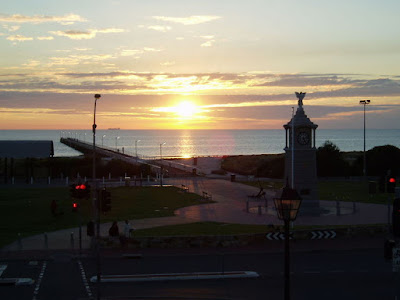
Harold John Penny was born on 24 June 1888 to Charles James Penny and Emma Stephens Penny in Semaphore, Adelaide, South Australia [upper left]. Of his family or youth we know little to nothing, but in the Adelaide Advertiser of Tuesday, 22 December 1903, we find that Penny (out of St. Peter's Collegiate School) —then 15 years of age—had passed Junior Examinations at "The University." Penny had passed exams in English Literature, Greek, Latin, French, geometry, and chemistry, earning him a place on the "List of students who have passed five or more subjects, and who therefore, receive the junior certificate."

In the same newspaper two years later, on Monday, 18 December 1905, Penny passed three Senior Examinations at the University of Adelaide: Greek, Latin, and geometry. Five passed examinations were required for earning a senior certificate, so Penny's name appeared on a list below that one: "List of candidates who have passed in less than five subjects."
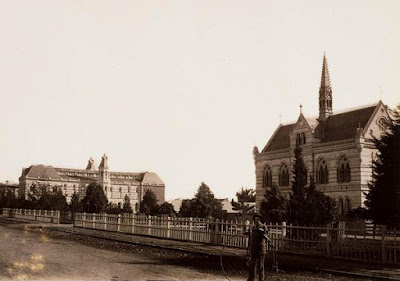

In 1906, Penny also passed five examinations, according to the Tuesday, 25 December, edition of The Advertiser: Greek, Latin, French, arithmetic and algebra, and geometry. He received a 1906 senior certificate.

In the same chronicle, on Thursday, 19 December 1907, Penny appears on a "Pass List" of the University of Adelaide, once more having passed examinations in Greek, Latin, and French.

At this point, Penny, who apparently has enjoyed years of schooling in languages and maths, seems to have left it all for a spell.


He crops up again in 1911. According to data recorded at http://www.rowinghistory-aus.info/, Penny rowed in the Adelaide University Men's Eight, which competed at the 1911 Australian University Championships in Port River, Adelaide. His team finished 3rd behind Melbourne and Sydney Universities.

According to that site: "This was the first of four straight wins pre WWI for Melbourne but the margin was small - 1 1/2 lengths from Sydney. The race was conducted over a 3 mile course on 10th June 1911."

Penny rowed for Adelaide again in the 1912 Championship held in the Parramatta River, Sydney, and once again his team finished 3rd behind Melbourne and Sydney. The site this time adds: "The race was conducted on 1st June 1912."
Penny was clearly back at Adelaide, but studying what subject in earnest?

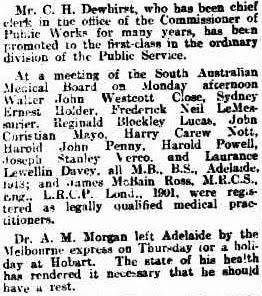
The Advertiser dated Thursday, 18 December 1913, carried this information about the 25-year-old Australian: "The Dean of the Faculty of Medicine presented for the degrees of Bachelor of Medicine and Bachelor of Surgery:-Walter John Westcott Close, Laurance Llewellin Davey, Sydney Ernest Holder, Frederick Neill Le Messurier, Reginald Blockley Lucas, John Christian Mayo, Harry Carew Nott, Harold John Penny, Harold Powell, and Joseph Stanley Verco (Everard Scholar)."


The next day, Friday, 19 December 1913, the same newspaper ran this item [seen, left]: "At a meeting of the South Australian Medical Board on Monday , afternoon Walter John Westcott Close, Sydncy Ernest Holder, Frederick Neil LeMessurier, Reginald Blockley Lucas, John Christian Mayo, Harry Carew Nott, Harold John Penny, Harold Powell, .Joseph Stanley Verco, and Laurance Lewellin Davey, all M.B., B.S., Adelaide, 1913; and James McBain Ross, M.R.C.S., Eng., L.R.C.P. Lond., 1901, were registered as legally qualified medical practitioners."


By 10 January 1914, we find this note in a column entitled "Personal" within the Adelaide Advertiser: "Dr. Harold John Penny, M.B., B.S., (Adel. 1913), was appointed by the Executive Council to be a resident medical officer of the Adelaide Hospital for the ensuing 12 months."
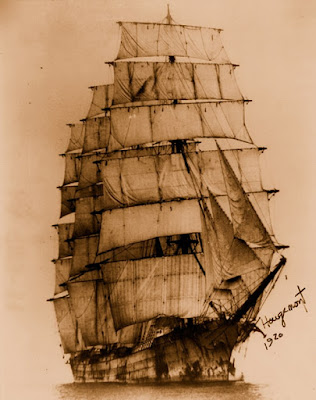

By 12 March 1914, Penny made the papers in a case in which the master of a four-masted barque, Hougemont, John McDonald, was accused of "having on 18 February unlawfully and maliciously shot at [inebriated able seaman] John Murray with a revolver, with intent to do grievous bodily harm."

The article continued: "Harold John Penny, resident medical officer at the Adelaide Hospital, said he treated Murray in the institution on February 19."

The case was held over for trial, while Penny must have had some interesting dinner table conversation that day.


According to The Advertiser, dated Tuesday, 21 April 1914, Penny took part in an inquest into the death of a 38-year-old laborer, Joseph Eade, who had died at the hospital on 16 April: "Dr. Harold John Penny, of the Adelaide Hospital attributed the cause of death to shock and hemorrhage, consequent upon bullet wounds. These were just below the ribs on the left side of the body. The internal organs in this vicinity were injured. The deceased had told the witness that he used a firearm with his right hand… The Coroner's verdict was that deceased died from bullet wounds self-inflicted whilst of unsound mind."


Yet another case, this one described in the same paper on Saturday 27 February 1915, actually involving the will, estate, and beneficiarfies of Catherine Ratliffe of Australia Plain, cited: "Harold John Penny, medical practitioner at the Children's Hospital, said that on January 21 he was a resident medical officer at the Adelaide Hospital. He recollected the informant being brought in. She was suffering from shock and hemorrhage, caused by three recent bullet wounds in the right shoulder, two cuts on the lip, and a bruise near the collarbone. He attended to the patient for 10 days until she left the hospital. The wounds could be caused by bullets from a revolver of the kind produced."


Perhaps it was the violence of such cases that caused Penny to look into a shift to the local Children's Hospital [picturd, left].

And treating those victims of gunshot wounds would foreshadow the next phase of Penny's medical career.

We now fast-forward to the London Gazette of 1 June 1915 for the item regarding Penny. In a section entitled "ARMY MEDICAL SERVICE. Royal Army Medical Corps." it says: "The undermentioned to be temporary Lieutenants:— Dated 26th March 1915. Harold John Penny, M.B."


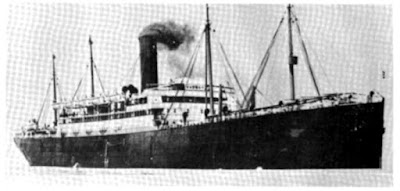
That notice confirmed what had appeared in the Adelaide Advertiser on Saturday 20 March 1915, several months after Great Britain had entered hostilities in the First World War: "Dr. Harold J. Penny, late of the Adelaide and Children's Hospitals, and youngest son of Mr. C. J. Penny, Hackney, has been notified of his appointment to the staff of the R.A.M.C., and leaves by the R.M.S. Mongolia [seen below, right] on Thursday next for London."


The Gazette followed with this in their 10 April 1916 edition, in a similar section: "ARMY MEDICAL SERVICE. Royal Army Medical Corps." It reads: "The undermentioned temporary Lieutenents to be temporary Captains:— Dated 26th March 1916. Harold J. Perry, M.B."

In exactly one year, Penny had entered the service and been promoted to Captain. Under unprecedented and nightmarish conditions, Penny was obviously excelling.


Following the war, the Medical Directory of 1919 listed Penny's practice as having been in his hometown at "23, Osborne Street, Hackney, Adelaide, S.A." Penny have returned to Australia and hung out a shingle after witnessing the carnage of the war. Considering the chemical warfare, as well as the technological advances made in the efficient mechanized destruction of soldiers, during the worldwide conflict, one shudders to think of some of the horrors he witnessed—ones that would have made those gunshot simple gunshot wounds treated in Adelaide seem extremely mild by comparison.

But records at Britain's National Archives at Kew contain the following record: "Divorce Court File: 8145. Appellant: Harold John Penny. Respondent: Winifred Annie Penny. Co-respondent: Frederick Haddon Rowat. Type: Husband's petition for divorce. Covering dates: 1925."


This would indicate that, at some point between 1919 and 1925, Penny relocated once again, this time to back to England.

F. H. Rowat was a dentist. His description in the 1960 edition of The Author's & Writer's Who's Who reads: "ROWAT, Frederick Haddon, FDS, HDD, LDS b: India 1894. e: Merchant Venturers Sch. Bristol, m: Munro-Chick. d: 2. Dentist, publ.: This Won't Hurt a Bit (J. Wright); The Palmy Days of British Oratory (Ceylon Times), a: Braeside, North Petherton, Somerset."


Penny's wife was probably born in Australia in the late 19th century, but there is no dearth of "Winifred Annies" having been born in South Australia during that period. Her maiden name is unknown. Neither records from the UK nor Australia record their marriage. In fact, ancestry.com has no record of the Penny union in any of its collections.
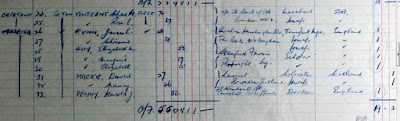
In 1938, at the age of 50, Dr. Penny sailed into Southampton aboard the steam ship Balmoral Castle of the Union-Castle Line on 19 September from Madeira. His address is handwritten as "28 Windmill St., Tunstall, Stoke/Trent."


This address is corroborated by a 1950 Stoke-on-Trent telephone directory, which lists his practice—clearly a partnership—in this way:

Penny, H. J, & Fee, S. R, Physns, Srgns,
      28 Windmill St, Tunstall . . . . . . Stoke-on-Trent 87642

His residence is listed as:

Penny, Dr. H. J,
      Claremont Porthill . . . . . . . . . . . Stoke-on-Trent 88180


The Medical Directory of 1961, however, lists the practice as being called "Penny, Fee, Wojtulewski, & Neill."


Notable on the manifest of Dr. Penny's return trip from Madeira is the lack of a wife, or even of a travelling companion. He was the only unaccompanied male from Britain or its colonies on the voyage. This trip alone may say a great deal about the pain from which Penny still must have suffered due to the betrayal committed by his wife and their divorce proceedings some 13 years earlier.

In the Medical Directory for 1959, Commonwealth List, Penny is listed as practicing at "28, Holland Street, Tunstall, Staffs," and it indicates his "Date of Registration" as having been 3 May 1915—coincidental with his arrival for service in the Royal Army Medical Corps.


Penny began playing tournament croquet, just before his trip to Spain, having competed in the North of England from 27 June to 2 July 1938. He also played that tournament in 1939, as well as in the Derbyshire Championship and for Hurlingham's Younger Cup, in which he beat Aimee Reckitt.

After the war, Penny—58 years of age in the summer of 1946—returned to the lawns. His career post-war record can be found in the database of the Croquet Association by clicking HERE.

Although the CA records Penny as an opponent of the Mills siblings—George, Agnes, and Violet—just 3 times (1-2 versus Agnes Mills), results from the London Times provide some evidence that—aside from doubles games which included George Mills—Penny played Violet Mills at least 3 times. He lost to her in 1960 (Parkstone) and twice (Budleigh Salterton). In fact, there is no evidence Penny ever beat Vi Mills.
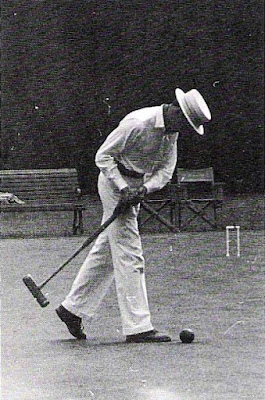
Six career games against the Mills siblings may not seem like a great deal, but it does make him one of their arch enemies here—especially figuring in his appearances as a doubles partner and opponent of one or the other of the sibs.

The Times also records the Mills siblings as having encountered a C. H. R. Penny during their time playing croquet, although I also cannot locate him in the database. The Pennys played doubles together at least once, on 15 September 1960 at Parkstone, where they lost to the tandem of George Mills and Bryan Lloyd-Pratt [pictured, left], (-13).

A 1960 telephone directory for Southampton lists a C. H. R. Penny as residing at Chaffyn Grove Cottage, 75 Bourne Avenue, with telephone number "Salisbury 2905."


[Update: This was received today, 6 July 2011, from Mr. Williams of the CA:

CHR (Christopher) Penny is in the 1946-1984 database. Search for Christopher Penny. I have 14 games for him between 1957 and 1963.

Chris

For career information on Christopher H. R. Penny, click HERE, and thank you, Chris!

The database records no games against them, but C. H. R. Penny played singlely against the Mills at least once: He defeated Violet Mills in the Level Singles Final at Parkstone in 1960, according to The Times.]


Were the two Pennys related, they would have played even more matches as a family against the Mills family—hence, their inclusion here.

A member of what we recently saw referred to as "Croquet's Old Brigade," Dr. H. J. Penny died in Bournemouth, Dorset, England in March 1968. As far as we know, he never remarried. Penny played croquet from 1938 through 1967, winning 232 of 513 post-war games.


Monday, July 4, 2011

Remembering Guy Warwick


Greetings, everyone, on Independence Day here in the States. With Canada Day and our 4th of July holiday falling so closely together—and with my beloved Philadelphia Phillies having just wrapped up a series against the Toronto Blue Jays, I guess the patriotic fervor in North America this weekend can be summarized in these lines, written by David Murphy of the Philadelphia Daily News, regarding what both nations do celebrate: "[O]ur love for country, alcohol, and B-List celebrities… and, perhaps, our love for baseball." And that doesn't even mention our cultural love of fireworks here in the U.S.!

In contrast to that, however, today's entry takes on a more sombre tone.

In addition to the Croquet Gazette obituary of Joan Warwick, Chris Williams of the Croquet Association sends along this:


Guy Warwick's obituary was in the December 1981 Gazette as was that of Mrs E (Hope) Rotherham. Unfortunately there is little of his non croquet life.


J.G. Warwick

One of Croquet's Old Brigade, Guy, aged 87, died peacefully at St. Cecilia's Nursing Home, Budleigh Salterton on November the 3rd. He had been in poor health for some years, but only recently realised he could no longer manage a full game, nevertheless he seldom failed to be a spectator and critic at the Budleigh tournament.

He will be remembered as having represented Devon many times in the Inter-Counties and also being chosen to play in the President's Cup in 1963 (when he finished seventh with 4 wins). He used to be a regular entrant at the Hunstanton Tournament, lying in a part of England where he spent much of his early life and once had the distinction of beating the great John Solomon on level terms! He was runner-up in the Surrey Cup in 1957, runner-up in the first Chairman's Salver in 1966 jointly with Edgar Jackson, won his C.A Silver Medal in 1960, won the Du Pre Cup in 1963, won the South Of England Championship in 1962, the South of England Doubles Championship in 1968 and 1969 with Lt. Col. D.M.C. Prichard & E.C. Tyrwhitt-Drake respectively.

He will be sadly missed.

AJC


Just after receiving the above, friend Judy Perry of Budleigh Salterton sent the scan of a Kodachrome slide that you see at right. In the striking, vividly-coloured image, we can see Guy Warwick, Joan Warwick, and Judy's father, Bill Perry.

Judy also sent along a couple of other images that I'll upload soon, but I wanted to post these while we were still on the thread of the Warwicks! Many thanks to Judy, Chris, and everyone at the CA for their thoughtfulness!


Friday, July 1, 2011

"There's rosemary, that's for remembrance; pray, love, remember..." -- Shakespeare


If you've been following our thread regarding Joan Warwick, we've looked briefly at her childhood and more deeply into her career as a hockey player and manager. In fact, we vicariously went along via press reports as she toured New Zealand and Australia in 1938. Sailing back to England aboard the RMS Strathmore, she returned to her home in Peterborough to write a still noteworthy book on women's hockey umpiring.

Still, our interest in her began as a croquet player, particularly while living with her brother, Guy Warwick, at Sherwood on Westfield Road in Budleigh Salterton. The unfailing Chris Williams of the Croquet Association has some knowledge of the area and weighed in on Wednesday 29 June with this:

With regards to their house Sherwood, I think it was 3 Westfield Road and looks as if it had been turned into flats. Two houses in Westfield Road (3 and 5) (on the left as you go up the hill) have been knocked down and a small estate is being built on them. The view on Google Street View was taken early in the building process. When I was last there about a month ago the houses were nearly finished.

Blue Cedar Homes are the developers.


http://www.bluecedarhomes.co.uk/budleigh-salterton.html

Regards,
Chris


By clicking on the link above, one can get a better look at changing Westfield Road than available through Google Maps. From this, we can surmise that Guy and Joan lived at the far end of Westfield from their neighbours and croquet comrades, George, Agnes, and Violet Mills.

However, that's not all Chris sent. From the archives of the CA, he also provided us with this, Joan Warwick's obituary from the September 1973 issue of Croquet Gazette:


CA Gazette September 1973

Miss EJ Warwick

Not a few croquet players have become attached to Budleigh Salterton, because of Joan Warwick. She always had a welcome for everyone, and especially for new visitors, so it seemed natural to see her - albeit in a wheelchair - at the club on the Monday of their big July tournament. What courage this must have taken was only realised when on Wednesday morning, July 4th, she died.
Joan had learnt her croquet from her brother Guy and after playing in a tournament at Budleigh Salterton they decided to move there together in 1957, a happy and successful venture for them both. That year Joan was selected for the Ladies' Field Cup and for the next twelve years she and Mrs Rotherham dominated Women's Croquet. Joan won the Ladies' Eight and the Women's Championship five times each. She appeared four times in the President's Cup and was a much sought after Doubles partner, winning the Mixed Doubles Championship with three different partners. But the peak of her croquet career came when she was the only woman included in the 1963 Triangular Test Tour of New Zealand, which she also toured in 1927 as a Hockey International.

Joan excelled in other spheres besides sport. She was commissioned in the A.T.S. at its inception and helped to form it; she ended the War as a Senior Commander. She then trained as a Housing Manager and did invaluable work in Paddington until she had to return home to look after her mother, herself a well known croquet player. After serving as a County Councillor for the Soke of Peterborough, Joan originated and organised the Home Help service there. After retiring she became a regular driver for the hospital service and only gave up reluctantly when she became ill a year ago.

It is hard to believe we will not see Joan again; standing solidly with her left foot forward, swinging her mallet determinedly on its straight low course and keeping her head severely down while we watch the ball speeding to its target. She was a staunch friend, unselfishly sharing her knowledge and generous with her advice and praise. Joan's personality and style has left its imprint on croquet.

EAMP

(Betty Prichard)


What a remarkable woman, and what a pleasure it is for me to help ensure that her complex and generous life and legacy are not forgotten. And all that from someone who, as we know, simply listed her occupation as "home duties."

And for readers in America (and anywhere else), who make up a large portion of those dropping by this website, the "A.T.S." mentioned above was the Auxiliary Territorial Service, and much more can be learned about it at http://www.atsremembered.org.uk/, where Mr. Williams was kind enough to direct me. An interesting note is that then future Queen of England, Elizabeth II, joined the A.T.S. and rose quickly from Subaltern (equivalent to a Lieutenant) to Junior Commander (Captain) by the end of the Second World War. She "completed the course at No. 1 Mechanical Training Centre of the ATS and passed out as a fully qualified driver."

It certainly is a very limited list of characters we've studied here who outranked the Queen at any time, as Joan would have done as a Senior Commander (Major)! Warwick was decommissioned in 1945 upon "attaining the age limit," according to the London Gazette, 10 August 1945, page 4073, but found other ways to continue to serve the people of her country.


Joan is also remembered on-line by the Wrest Park Croquet Club [below, right] in a 2010 newsletter that can be found at http://angliacroquet.co.uk/2010/Wrest_Park_newsletter_2010_12.pdf.

It reads:


The Steel Cup

This cup has a history. It is inscribed Bedford Croquet Club, Steel Challenge Cup, Class C, and the first winner was Muriel Hume in 1929. The cup was presumably donated by or associated with Dorothy Dyne Steel. Today Class C means players of handicap 6-11 (A being 2 or less and B 2-5), but this may not have been the case 80 years ago. We also don’t know if the competition was for handicap or advanced play. Of the 22 winners between 1929 and 1956 sixteen were women, and women won on the last 11 occasions. I leave it to others to describe how and when we acquired the cup, but it reappeared as a club trophy in 1985 when the winner was John Wheeler.


The winner in 1955 was Miss E.J. Warwick. Joan Warwick was a first-class hockey player before taking up croquet. Described in Prichard’s History
of Croquet as “a dogged player of the orthodox 4-back and peg type, cautious and careful,” she won the Women’s Championship on five occasions between 1960 and 1968, the Ladies Field Cup five times, and the Mixed Doubles three times. She played in the President’s Cup on four occasions and was also in the victorious MacRobertson Shield team which travelled to New Zealand in 1963.


Some 25 years after her glittering farewell dinner in Australia, following a playing tour of New Zealand with the All-England women's hockey team during which she served as manager, Joan returned to play yet another sport—and win.

One last note regarding Joan Warwick can be found in 1973's The Bedside 'Guardian': A Selection from 'The Guardian': Volume 22 by William Leslie Webb, as we can see in this excerpt:

"And some of the people to beat are Hope Rotherham [pictured in 1957, left] - with a mysterious swing from somewhere behind her which nevertheless operates brilliantly - and Kitty Sessions, and Joan Warwick. They follow a trail blazed by Mrs Joad, first women's champion in 1869. How far have they come in a century of decorous aggression? Are women likely to be found in the England line-up for the MacRobertson Shield in the Tests against Australia next year? Not very likely… though male pre-eminence seems to lie not so much in their strong wrists as in their friendships with computers."


Exactly how much computers have allowed male players to dominate since 1973 would be for others to determine, but at that time—near the end of her life, in flagging health, and aged 75 years—Joan Warwick was still considered one of the "people to beat" in what appears to have been the increasingly male-dominated sport of croquet.

Records and statistics pertaining to her career—spanning 1954 –1972, and throughout which she won a stunning 60% of her games—are available by clicking HERE.

We already know she went 18-15 against her brother Guy, who ironically taught her to play. Regarding other players we know, she went 45-40 against the above-mentioned Hope Rotherham [by far her most frequent opponent], an amazing 21-1 versus Barbara Chittenden, 21-4 facing Nora Elvey, a devastating 15-1 against Agnes Mills, 9-3 against both Isobel Roe and Betty Prichard (author of the obituary above), 6-4 versus Maurice Reckitt, 5-0 facing Lady Ursula Abbey, 5-2 against Ralph Creed Meredith, 2-2 vs. Dacre Stoker, only 2-7 playing Bill Perry, and 1-1 when pitted against Violet Mills. She suffered her greatest number of defeats at the hands of croquet legend Pat Cotter, against whom she was 3-19.

I think it is also remarkable that Warwick—a woman, and almost 65 years of age as well—made the roster of the 1963 MacRobertson Shield team. With there being some some debate, as seen above, about the ability of women to play at this level and on the world stage, let's take a look at her performances during that significant January 1963 event, her return trip to New Zealand after 25 years:

Miss EJ Warwick beat Mrs WL Martin +2, +9

Warwick/Curtis lost to Middlemiss/Middlemiss -13, +2, -1

Warwick/Curtis beat Saalfeld/Lewis +6, -3, +16

Miss EJ Warwick beat HC Ford +4, +24

Curtis/Warwick beat Saalfeld/Lewis +16, +12

Miss EJ Warwick beat HC Ford -9, +4, +2

Miss EJ Warwick beat AE Saalfeld +3, +7


Put simply: An amazing achievement.


That 1963 MacRob team from Great Britain is depicted, right:

Back row, Humphrey Hicks, William Ormerod, Bryan Lloyd-Pratt, David Curtis,

Front, Joan Warwick, John Solomon, Patrick Cotter (Cpt), Bobby Wiggins


As noted above, Joan passed away on 4 July 1973. She truly exemplifies the qualities of what has become known as the "Greatest Generation."

In thanking Chris Williams for generously providing Miss Warwick's CA obituary, I added that sometimes I am floored by what I learn by doing all of this. I pry in a tiny way into the life of a person, but what I often find is merely data--birth, death, marriage, divorce, date of arrival, date of departure, etc. [as exampled in the composite image below; click to enlarge] from the London Gazette, 1973 and 1981].


Learning so much additional information about her as a person, beyond simply mere scores and cold, impersonal data, is what makes what I do here so very rewarding. After following Joan via newspaper reports through Australia in 1938, I will then run this obituary separately. I am very happy that it will then be accessible to a wider audience, especially including Americans who never would have had much of a chance to know of her. And I thank Mr. Williams and everyone else who has assisted me along the way in doing my small part in remembering her. She was a remarkable croquet player, but that seems to pale in comparison to how much more remarkable and inspirational she was as a person.


My hat's off to Miss E. J. Warwick as an athlete, a working woman, a volunteer, and as a person. She's without a doubt one of the favourite characters I've met via my research into the life and times of her neighbour, George Mills.

If you have any additional information about or memories of Joan Warwick that you would be willing to share, please let me know!

Oh--and happy Canada Day to our readers from the north!