Monday, January 17, 2011

Steyning Mansions Hotel, Eastern Terrace, Brighton


We know a great deal about the life of Lady Dorothy Mills (née Walpole), and still more information is coming to light regarding her penchant for globetrotting.

Our last 'contact' with Lady Dorothy, however, came as a telephone listing in a 1939 London directory years after her ostensible retirement and divorce from author Arthur F. H. Mills, brother of George Mills: Mills Lady Dorothy, 17 Burnsall st S.W.3 FLAxman. 2476.

More than one source describes Lady D. as living in Brighton at the time of her death in 1959, including records at ancestry.com. Where in Brighton, though, I couldn't determine.
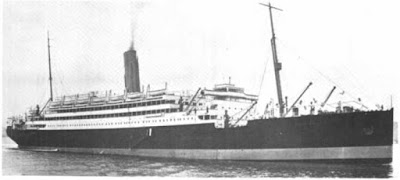
Yesterday, I found the manifest of the twin-screw ship Alcantara [right] of the Royal Mail Lines that arrived in Southampton on 21 January 1952, steaming in from "Brasil and the River Plate." Aboard was a "MILLS, Dorothy R. M."—our own Dorothy Rachel Melissa Mills—and English author, aged 62 years.

The typewritten address given is "Steyning Mansions Hotel, Eastern Terrace, Brighton." [Pictured in 1950, top left]

A quick internet search turns up only one mention of Steyning Mansions Hotel in the National Archives:

"BRIGHTON BOROUGH PETTY SESSIONAL DIVISION

LICENSING PLANS PTS/2/9 1909-54

Steyning Mansions, Kemp Town Client; Steyning Mansions Hotel Syndicate PTS/2/9/804 23.4.47, 3.3.48"


There's more, however, to be found in Google Books.

Here's an advertisement found in The New Statesman and Nation, Volume 8, issue 355, dated February 7, 1948:

STEYNING Mansions Hotel, Brighton. Kings Cliff. Sea front near bathing pool. Unique comfort and excellent cuisine. Every room has own private bathroom "en suite," G.P.O., phone, wireless and elec. fire. Lift. Garage. Fully licensed. Brochure... Tel. 2589.

And here's an almost identical entry from The Spectator, volume 80, 1948:

BRIGHTON. Kings Cliff. STEYNING MANSIONS. Unique comfort and excellent cuisine. Sea Front. Every room has own private bathroom "en suite," G.P.O. Telephone, wireless, and electric fire. Lift. Garage... Tel. 2589.
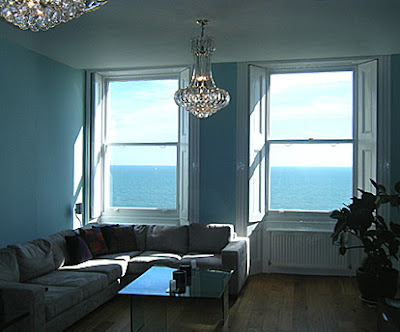
Nothing anywhere mentions Mills being a resident. However, we do know a smattering about a few of her neighbors, at least around the time Lady Dorothy likely moved to seaside Steyning Mansions [A view from a flat today is pictured, left] , circa 1939.

We know that in 1939, Steyning Mansions housed a "Miss Parry" of the British Orthoptic Society, according to Volume 1 of the British Orthoptoic Journal of that same year.

Another resident just before WWII was Georgette Heyer (16 August 1902 – 4 July 1974), an English Regency romance and detective fiction novelist, who'd moved "briefly to a flat in Steyning Mansions, Brighton, and then to a service flat at 25 Adelaide Crescent, Hove", with her unemployed husband (according to biographer Jane Aiken Hodge in The Private World of Georgette Heyer; Bodley Head, 1984). Heyer had recently lived in Macedonia, and one wonders if Lady Dorothy might have taken a fancy to the fellow traveller, author, and breadwinning woman.

Heyer was renowned during her career for rejecting her publishers' requests to do interviews to propote her books, saying, "My private life concerns no one but myself and my family," a sentiment that must have been echoed by Lady Dorothy, whose so-called autobiography contains precious little about her own private life.

Steyning Mansions is also advertised in the periodical The English-speaking World (vol. 40-42) in 1958:

BRIGHTON. Marine Parade, Steyning Mansions Hotel PRIVATE BATH and telephone to every bedroom. Licensed. TV. Winter from 9 gns., Summer from 10½ gns. Tel. 26461-2-3.

When did the Steyning Mansions Hotel Syndicate start operating the hotel? When did the hotel cease operation? We do know it was at least in business from 1939 through 1958.
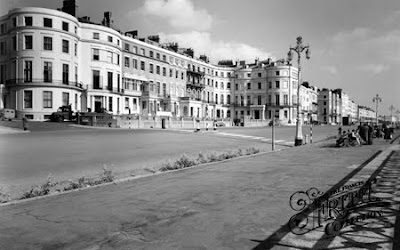
It wasn't the only hotel on the block: Unit No.1 on Eastern Terrace became the Court Royal Hotel in 1914 and was converted into Court Royal Mansions around 1955 [The time is pictured in the photograph, circa 1955, right].

Among other units on Eastern Terrace, numbers 4, 5, 7, 8, and 9 are now owned and maintained by Brighton Polytechnic as Halls of Residence. Others contain flats that range from over a half million pounds down to a basement flat going for roughly £250,000—quite a change from back in 1958, when a winter in likely that same subterranean locale started at just 9 guineas a week!

Yes, Eastern Terrace has changed a bit since Lady Dorothy Mills called the area home in the mid-20th century.

If you have any information about Lady Dorothy, Steyning Mansions Hotel, or the Eastern Terrace, Brighton, of that era, please don't hesitate to contact me... and thank you!


Saturday, January 15, 2011

MWM Seeking Beryl & Ian


Everything new that I learn about George Mills or his family necessarily informs everything else I've learned. A professor once explained some rudimentary system theory to me, and if I understood it correctly, the gist is this: Change one part of a system and you've made changes in the entire system.

My collection of information about Mills easily fits the American Heritage Dictionary's definition of a "system": A group of interacting, interrelated, or interdependent elements forming a complex whole.

So, the corollary here, I suppose, would be: Learn something new about one aspect of George Mills and you've made changes in what you know about the entire body of information.

Case in point: Here's something I've wondered about for some time now. There are so many aspects to the life of George Mills that as I ruminate over what you've shared with me, that new information informs other bits and pieces I know--or about which I've wondered.

The edition of King Willow whose image [right] was recently posted on the Budleigh & Brewster United website by friend Michael Downes is apparently from the late 1950's of early 1960's. There's no copyright info in that edition of the text, the publisher no longer exists, and dates of publication I've seen on-line (1955 through 1963) have all turned out to have been guesses made by antique booksellers. Given the style of art and haircuts on the characters, that 'era' seems about right.

Those years put the book's new publication squarely in George's time living in Budleigh Salterton. The updated dedication to that edition of King Willow is to a young newlywed couple "Beryl and Ian." This sounds strange, but I've contacted a variety of "Beryls and Ians" around the internet who were born in the late 1930s and none of the couples knew of a George Mills, nor had any books dedicated to them, and it seemed they could've been from anywhere Mills had ever lived or taught.

I'd long speculated that Mills must've lived for years with his spinster sisters at Grey Friars. It is clearly documented that he'd died there, but I knew he might've only been staying with them as an invalid in the last year or so of his life, and had lived elsewhere. We now know that George Mills was a vibrant, long-time resident of the Budleigh community. It's been confirmed, and that now informs what we know about the dedication of the later edition of King Willow!

Is it possible Beryl & Ian are still in Budleigh and their names simply don't appear on-line for me to find? Mills's dedication uses "long voyage" and "good ship" to describe their matrimonial bliss--a perfect metaphor from a man and for a young couple who all live by the sea!

Does anyone now living (or who has lived) in Budleigh know any couples (or ex-couples) named Beryl & Ian who might've known George? My hunch is that they were very likely the children of George's friends at the croquet club and would now be 70-ish years of age. I could be wrong, but the clues point in that direction!

Please let me know if any of this rings a bell, and as always, I very much appreciate your help!

Thursday, January 13, 2011

Ain't It Funny How Time Slips Away...


I've been thinking about Dr. David Evans and his recent description of George Mills [right].

"...a very sociable welcoming person."

"...devoted to his sisters Aggie and Vi."

"...but in no way was he dependent on them."

That's good news. As I mentioned in my last entry, I feared that Mills may have become 'damaged' (for lack of a better term) by a string of personal tragedies and illness he'd suffered during the 1940s.

It's good to know that to a physician (and one from a time during which I suppose healers grew to know their patients far more personally), George seemed hale and happy.

Still, the question nags me now just as it did almost a year ago: Why does a fellow write and publish three well-received books during the years 1938 and 1939, and then never publish more than a letter to The Times for the rest of his life—some 32 years?

Backpedaling to the very beginnings of my search for the identity of George Mills, I'll remind you that Heather Lawrence of Peakirk Books in Norfolk opines, "It is possible he just got fed up with writing!"

"Fed up" is a term that I would typically associate with a writer of far less successful tales and far fewer published works. Still, who can say she's wrong?

Another set of words crossed my mind as well. I received a thoughtful and well-considered message from my dear friend, Jennifer, in Philadelphia. Although on a somewhat different topic, it offers a similar line of thinking:

"Maybe [one's] creative life has just run its course. Margaret Mitchell only wrote the one novel... Not every creative person keeps creating until they die. Maybe some people can't sustain that kind of emotional energy. Maybe they don't want to."

That notion of 'not wanting to,' possibly due to being 'fed up,' returns to my mind again and again.

Perhaps while not completely shattering his life, Mills couldn't 'sustain the emotional energy' necessary to write something book length after those tragic events—the death of his wife, a dear friend, his mother, all during a war that left London bleeding and his own health a shambles.

In the words of that noted philosopher, Willie Nelson (seen left, a man who never seems to have lost his muse), "Ain't it funny how time slips away?" Did Mills always mean to write another book? Was his summer term at Ladycross Boys' Catholic Preparatory School in Seaford, Sussex, in 1956 seen as a chance to collect new characters, develop a new setting, and create new stories about prep school boys—a subject he'd once lovingly depicted in such amazingly precise detail? Dr. Tom Houston of the Windlesham House Association describes George thusly: "Mills evidently had a gift for befriending boys and learning their secrets; Meredith & Co. captures the idiom of pupils during the interwar period more accurately than any other novel."

Peakirk's Heather adds: "Meredith & co was 1 of the first prep school stories of its kind, lighthearted & whimsical, a forerunner to the Jennings books of Anthony Buckeridge, in so far as it emphasizes the comical side of school life. However the importance of games & work are not forgotten."

1933's publication of Meredith & Co. by Oxford University Press—a sumptuous, Depression-era book illustrated by the fabled C. C. Brock—speaks volumes about the high regard that was shown by the industry for his manuscript.

Following that with three more books in 1938-1939, had Mills managed so quickly use up all of his stories, his patience, and his passion for writing? And did he ever try to rekindle it all later in life?

Or, despite a nice, little side income from the re-issuing of his schoolboy titles in the 1950s, did the fact that he was an author become something that Mills simply stopped thinking about and ceased discussing with anyone? Were his conversations eventually filled with the weather, bridge strategies, croquet tournaments, and the results of cricket matches at Lord's? Residents of Budleigh's Westfield Road, which ended at the Mills domicile, Grey Friars, today know that another children's author, Charles Warrell, the aged creator of the famed I-Spy books, lived on that very same lane. Why did no one ever seem to realize neighbor George Mills was a children's book author as well?

Michael Downes recently reported: "Budleigh Salterton has a literary festival, and one of the documents produced by our local museum for that event was a list of authors formerly living in the town. George Mills (along with many others) was not on the list, and I have added to it over the years with other names. So George Mills is quite a find for us."

So it seems Mills probably wasn't always 'meaning to get around to it,' as far as writing another book was concerned. Perhaps he was just waiting for inspiration to strike. Still, he certainly didn't let his neighbors and the community at large know of his past, or of any hope he might've had that his literary muse might someday return. Or is it possible he actually had... and no one very much cared?

Jennifer certainly agrees Mills may have been awaiting inspiration and adds: "[But] you can spend the rest of your life sitting around waiting. Tearing things out of one's psyche is an arduous and not always pleasant process. It's easier to say, well, those days are gone. I don't have the energy for that anymore. It's frightening how easy it is to just let your mind sink into its own puddle of lethargy."

Perhaps George Mills was, indeed, 'fed up.' Perhaps he just 'didn't want to' write. Perhaps he faced his own 'puddle of lethargy' and simply never did meet his muse again—even among the prep boys at Seaford in 1956.

For whatever reason, Mills apparently must have spoken so little of his literary career that Budleigh residents never knew they had a popular author in their midst in the person of the very sociable and welcoming George Mills.

Still, I'd love to know: Why?

And I wonder: Is this really all about George Mills?

Or is this really far more about me?


Some "Well-known Budleigh Characters"


More news from Budleigh Salterton and friend Michael Downes!

Here's some of what Michael had to say in his latest message: "Here's a photo [left] of Dr Evans, (George's) GP, and some memories of the family which I've put on my blog… I contacted the funeral directors in Budleigh Salterton in the hope of finding out whether George was buried or cremated, but unfortunately they throw out any records over ten years old."

It's a pity about those records. It may seem a bit morbid, but it would be interesting to know how the story of George Mills ended. A family plot including many of the cast of characters we've learned about here would actually give the story some finality and provide my "relationship" with the Mills family—I do feel a great deal of warmth for them—some closure.

You can read Michael's blog entry "Searching for George Mills in a Parallel Universe" at: http://budleighbrewsterunited.blogspot.com/2011/01/searching-for-george-mills-in-parallel.html

Here is an excerpt from that blog entry:

'"[George Mills] was a very sociable welcoming person," recalls Dr David Evans of his former patient, "as indeed were his sisters. They used to have quite big parties, and were well-known Budleigh characters. He was devoted to his sisters Aggie and Vi. They got on well as a nice little family, but in no way was he dependent on them."

Dr Evans remembers that George Mills and his sisters were croquet fanatics, and were also keen on bridge. "They would go to Budleigh Salterton Croquet Club under all circumstances."

He remembered that Violet was a good golfer. "Just after World War Two she was on a ship to South Africa and was invited to represent the national England golf team."

Again, I delighted to be able to publish such little details like this which at the speed of light will reach my literary detective friend in Florida. Details which, like tiny brush strokes, will help him complete his portrait of the mysterious George Mills.'

Michael also weighs in on the possibility of Budleigh existing in a "parallel universe," a strange notion I recommend that you explore more deeply by clicking on the link above—it's well worth reading!

I know that, to many, these few sentences from Dr. Evans won't seem like much, but to me they're absolute treasures.

After so many months—now going on a year—of investigating the nearly forgotten lives of George Mills and his family, I've become familiar with them all in so many ways. Mostly, though, I know a myriad of recorded details, events, and dates. One of the ways in which I'm least familiar with them all, however, is in any sort of personal way.

We know George Mills to be a very likeable, social fellow. Dr. Tom Houston of the Windlesham House Association wrote of George's time at Windlesham: "In the Michaelmas term 1925 he wrote pieces (a prologue and songs) for a staff concert, and wrote that up in the magazine. He made people laugh, a lot." Houston also believed Mills had been involved in theatre productions as part of the school's Amateur Acting Association.

I worried aloud for some time now that the talented and affable Mills, who never published another book after 1939, may have become a sort of "broken" man after suffering a series of tragedies during and just after World War II. Had Mills become a fellow who tragically had to forfeit a career as an author, and spent his final years needing the care of his spinster sisters?

Not to worry, apparently! Dr. Evans describes Mills as "a very sociable welcoming person," and I must admit, little in his life story could have made me happier.

Hearing of the entertainments of George, Aggie, and Vi—his sisters Agnes and Violet Mills—warmed my heart. I look at the photograph of Grey Friars posted last time and think of it glowing with light in the evening, the end of Westfield Road lined with gas guzzling cars of the post-war era, party-goers hurrying to the house, and the sound of laughter drifting occasionally through the summer air.

Like George, his sisters apparently enjoyed sports and games, and even excelled at them. It also seems the Mills siblings were all healthy and physically, mentally, and socially active well into their seventies.

Some questions remain: As they passed away during the decade of the 1970s, who were the executors of their wills? Who now holds the copyrights to Mills's novels? And what became of their collected family photographs, documents, and memorabilia? One fears that what didn't sell in an estate sale after the deaths of the three childless housemates may have ended up in the dustbin. However, the answer to that last question would likely stem from an answer to either of the first two.

Hopefully others will recall knowing or hearing about these three "well-known Budleigh characters" and their exploits. There's still much to be known about George's life between his enlistment in the armed forces in 1940 and his passing in 1972.

Who knows from where the next bit of information will come? I feel confident that thanks to kind, curious, and generous people like Michael Downes, Dr. David Evans, Barry McAleenan, David Wingate, and others like them, we will, indeed, learn much more!


Sunday, January 9, 2011

Grey Friars, a Burial Ground, Croquet, and a Floridian Literary Detective


It's a hazy, winter Sunday morning here in the horse country of Florida. It can't decide if it wants to be cloudy or sunny, chilly or warm. I have a strong cup of coffee and a fine pair of slippers, and I'm savoring this exciting latest entry...

Here's something that doesn't happen every day: George Mills appearing in someone else's blog!

Michael Downes, an author, press officer for Budleigh Salterton's Fairlynch Museum, longtime educator, and friend of Who Is George Mills? posted an entry about this website on his own blog, Budleigh & Brewster United, a site celebrates among other things the connection between his corner of East Devon, birthplace of both Sir Walter Raleigh and Salem, Massachusetts, founder Roger Conant, and the United States of America.

You can read the entry at: http://budleighbrewsterunited.blogspot.com/2011/01/who-was-george-mills.html

The first really exciting aspect of his post is the wonderful photograph that Michael has taken of Grey Friars [above, left]. It has been quite awhile since the name Grey Friars appeared as a passing note in the autobiography of Sir Robert Hart, and it certainly proved elusive—until now! I appreciate the effort Michael put into securing, not only the image, but also the permission of the house's owner for its use.

He also posted this intriguing paragraph:

And yesterday afternoon Annie and I spent time at St Peter's Burial Ground searching for the Mills family grave. Maybe the sea mist had something to do with it, but our search was in vain. However I did have the pleasure of meeting a charming and informative 80-year-old local man who was visiting the many graves of his own family members, and who remembered that George Mills and his sisters were croquet-players. It may be that the Croquet Club as well as the Literary Festival organisers will be pleased to learn about the Mills family.


I wish I'd been there to talk with that local gentleman cloaked in the sea mist covering the burial ground as he shared memories of individuals its possible no one has really thought much about for almost 35 years. George, Agnes, and Violet Mills, as far as I know, all died childless, and its quite likely that a fairly distant relative in the 'Glyn Mills Bank' branch of the family came to Budleigh as executor of Violet's will in 1975, disposed of Grey Friars and the siblings' estate, and left.

It certainly would be interesting to read the probate documents of the wills of George, Agnes, and Violet. It would even allow us to discover who owns the copyright of George's novels, and who we might contact to find out what happened to the family's ephemera—photographs, awards, paperwork, ticket stubs, passports, etc.—all of which would be treasures to me!

The fact that the Budleigh Salterton Croquet Club sat just 100 feet or so from Grey Friars [pictured, right] is important to the story of Mills and his sisters as well. Right now I'm in the midst of sifting through literally decades of croquet tournament results in The Times listing a trio initialed "Miss A. E. Mills," "Miss V. E. Mills," and occasionally a "G. R. Mills," all of whom played in tournaments as singles and sometimes in various combinations as doubles.

We know from his books that George Mills was a man who was fond of sports, and his step-brother, Arthur, loved golf, so much so that for the rest of his life he seemingly never lived more than the proverbial stone's throw from a golf course after leaving London in the wake of his divorce from Lady Dorothy Mills.

It seems, however, George's spinster sisters enjoyed sporting activities as well, given their lengthy record as croquet players. I find it hard to believe that a different "Miss A. E. Mills" and "Miss V. E. Mills" paired up so often in tournaments in London and along the southern coast of England.

There are even tennis results in editions of The Times from 1930s in which a "Miss V. E. Mills" played in tennis tournaments.

Apparently Violet, at the age of 33 on 6 September 1936, was finally defeated in the second round of Ladies' Singles at the Sidmouth Lawn Tennis Tournament by a Mrs. G. Lucas, 6-1, 6-0.

Two years earlier, on 2 August 1934, Miss V. Mills was beaten 6-1, 6-1, by Miss MacTier in the third round of the Bedford Tournament.

[The search engine at The Times website is notoriously finicky, so although these are the only two results I can find in this era of London tennis, I by no means can claim its the exhaustive list and invite anyone who can concoct a better strategy for searching those archives to help me!]

Anyway, what we know is that the family enjoyed sports and remained quite active, even into their "Golden Years."

On 26 June 1970, "Miss V. E. and G. R. Mills," +20, defeated "Mrs. N. A. C. McMillan and Mrs. D. Wayman" in the handicap doubles at Parkstone. Violet would have been almost 68 years old, with George approaching 74.

Later that year at Parkstone, L. S. Butler, +10, beat Miss A. E. Mills on 17 September in level singles. Agnes had just turned 75 years of age on June 11.

Michael Downes has mentioned having a friend who is membership secretary of the Budleigh Salterton Croquet Club [pictured, above left]. As I research Agnes, Violet, and George via The Times, I hope they will be able to come up with some additional documentation on a local and more personal level.

Thank you, Michael (and Annie!), most of all for the line in your blog entry which describes me as a "Floridian literary detective." After months of procrastinating about mowing the lawn and painting the house to fool around with my research on George Mills, my wife must surely believe I'm the biggest slacker around.

Now, it appears that I'm a "literary detective," and I feel much better about everything I've been doing here!


Saturday, January 8, 2011

Found: George Mills at Grey Friars!


What was my most exciting Christmas present? Well, I got lots of great stuff—books, CDs, shirts, wine—but I think the one thing that had me most excited was simply delivered to me near Christmas. It actually wasn't a Christmas present at all!

I had left upon my holiday travels and, while checking my work e-mail from a hotel in western Kentucky, I stumbled upon this very Spartan message, copied here in its entirety: "I have info about George Mills."

After replying, I received the following, wonderful e-mail from Michael Downes, author of the book Oundle's War and master of the blog Budleigh & Brewster United - celebrating sisterhood!

Hi Sam

I contacted a lawyer friend of mine who lives in Budleigh Salterton, in the road where George Mills used to live. He tells me that when he moved to Budleigh Salterton in 1972, George Mills had just died, leaving two sisters living in the house, Grey Friars. The good news is that the house is still there, and has not been demolished to make way for a condo. My lawyer friend tells me that the three Mills were all related to the Mills of Glyn Mills Bank. He will speak to the present owner of Grey Friars to see if he knows anything about George Mills.

I have attached a document which I found on the internet about a Mills of the Glyn Mills Bank; lots of names for you to follow up there.

We have a lot of snow here at present. When it clears I will take a photo of Grey Friars and will also visit the town cemetery to see if I can spot George Mills' grave.

Budleigh Salterton has a literary festival, and one of the documents produced by our local museum for that event was a list of authors formerly living in the town. George Mills (along with many others) was not on the list, and I have added to it over the years with other names. So George Mills is quite a find for us.

If you click on the BudleighBrewster link... you will see that I have an interest in life across the pond.

Best wishes

Michael

And this, also in the text, must be an excerpt of an e-mail from Michael's friend:

When we moved to Pagets in 1972 George Mills had just died leaving two sisters living at Grey Friars, which is... directly at the (dead!) end of Westfield Road [pictured, right]. The three Mills were all related to the Mills of Glyn Mills Bank. But what became of that I am not sure. I did not know that George Mills was a children’s author but it is entirely possible. Interestingly there was another children’s author who lived in Westfield Road – he was the author of a series of the “I Spy” books, but at present the name escapes me! I cannot remember whether the Taylors bought Greyfriars from the Mills Family Executor or whether there was another owner(s) in between.


It's odd that messages that so frequently refer to someone's passing would have me so excited, but they do!

I knew George Mills and his sisters, Agnes and Violet, lived in Grey Friars (then apparently written as two words) from several sources, one of which was the Kelly's Directory of Budleigh Salterton for 1939, which contained the interesting residence address: "Spence, Miss, Grey Friars, Westfield Rd ." After finding that, I'd searched on Google Maps and virtually drove the length of Westfield Road, but couldn't determine which house was Grey Friars. The Royal Mail didn't respond to requests for help, and the only additional proof I had that Miss Spence's 1939 home [circled below, left] had also been the residence of George Mills was a letter written to The London Times by Mills, published on Wednesday, 8 April 1959, signed:

Yours faithfully,
GEORGE MILLS.
Grey Friars, Budleigh Salterton, Devonshire.

We know that Mills spent the summer of 1956 teaching at the Ladycross Catholic Boys' Preparatory School in Seaford, which doesn't seem a place to which he'd have been able to commute daily from Budleigh Salterton. He must have been boarded there, possibly at the school itself.

It's also possible, I suppose, that he stayed with his brother, Arthur, for the summer, but George's commute from Downton would've been roughly 160 miles a day, round trip. That seems extremely unlikely, even in those days of cheaper gasoline. You can see the distances on the map, below right, with Budleigh sporting a purple pin, Seaford gold, and Arthur's home in Downton the red letter "A."

Did Mills teach anywhere else after moving to Budleigh Salterton? It's possible. Had he not written books in the 1930s, we wouldn't know where he'd worked during that era—and even knowing, finding out information about Warren Hill School in Eastbourne, The Craig School in Windermere, and the English Preparatory School in Glion, Switzerland has been difficult. And, as we know, it's been extremely difficult to be completely definitive about the school he referred to in his original dedication to King Willow (1939) as the Eaton Gate Preparatory School in London.

Even with the above schools named, we've only been able to surmise what subjects he might have taught or the lengths of time during which he was employed. Even more mysterious is why he moved so often from school to school between 1925 and 1940.

In 1940, Mills's career took a different path for a few years. He became a 2nd lieutenant paymaster in the Royal Pay Corps during WW II, but resigned his commission due to ill health during 1943, and amost disappeared from the public record.

The Pay Corps was something he'd thought about a great deal, and he must have considered himself quite knowledgeable about its operations as we also have a letter to The Times written by him in April 1944 [below, left] in which he critiques the way soldiers are paid. It's signed:

I am Sir, your obedient servant,
GEORGE MILLS, late paymaster, Royal Army Pay Corps,
Naval and Military Club, 94, Piccadilly, W.1.

Despite his ill health, George was apparently able to drag himself down to the club and use it as his mailing address—unless he was residing there. Either way, his mind was sharp enough to have read a letter about military pay in a previous edition of The Times and very pointedly take issue with it.

Mills discusses the streamlining of office procedures and the difficulty of ascertaining exact pay grades for various members of the military.

Perhaps we should be wondering if thinking that Mills found work in Budleigh Salterton as a schoolmaster is errant, and if we should consider the possibility that he found work in an office doing bookkeeping or accounting, based on his experience in the service.

Except for the summer of 1956 that Mills spent in Seaford with the classmates of young Barry McAleenan, we don't have a shred of proof that Mills taught a single day after, say, 1939-1940. In 1956, Mills would have been 59 years old, just about to turn 60.

His books were coming back into print in new editions [below, right] for a new generation of readers. He must have been called upon to discuss his experiences as a teacher in the late 1920s and early 1930s, and the children and places that'd been the inspirations for his novels.

Even if Mills had worked as, say, a bookkeeper in Budleigh Salterton, he may have retired by age 59 and perhaps sought one more taste of those earlier days, before the Second World War, when he was a bright, funny, popular schoolmaster with a young wife and a bright future as an author of noteworthy children's books that were unique in their ability to capture the quirky and amusing parlance of the prep school boys of that time.

Perhaps Mills even considered writing more books as he saw his stories begin to populate the shelves of booksellers once more—something he hadn't seen since before the war.

He never did write professionally again—as a far as we know. Did he ever author another story or text under a pen name? There's no reason to think so, but no proof that he didn't.

I believe that someone out there must know all of this: The Story of George Mills. And that's why it's so exciting to have been contacted by Michael Downes!

There'll be more here from Michael very soon, but let me close by saying, once again, that if you know anything about the life, career, or family of George Mills, please let me know. And thank you very much in advance!

Saturday, January 1, 2011

Edward Ernest Bowen, George Mills, and "Willow the King"


A recent contact has brought to mind something I'd researched, but had never written. I'll expand more on that contact at a later date, but today—with the new year arriving here in Florida this morning with mild breezes tickling the desiccated grasses—I thought I'd re-examine his questions: "Why George Mills? How did your interest in him originate?"

I'd been watching an episode of Ever Decreasing Circles on evening when a character made a statement regarding "King Willow." Being an ignorant American, I was interested in finding out about this King Willow, so I did an internet search.

It soon became apparent that "King Willow" was a reference to Edward Ernest Bowen's poem [and song] "Willow the King." And that character seemed to have been personified in a book that I found at amazon.com: King Willow, by an author I knew nothing about, George Mills.

Out of curiosity, I ordered the book, and quickly found out that no one knew very much about George Mills, and that finding information on someone of that name was like seeking the proverbial needle in the haystack.

I'd written about that bland story before, and have blathered on endlessly about how difficult it's been to squeeze information about George out of the worldwide web, but have neglected to follow up on the "link" between Mills and Bowen.

According to wikipedia.com, Bowen was born 30 March 1836 in Glenmore, County Wicklow, Ireland. He received his education at King's College in London and Trinity College, Cambridge, before being named a an assistant master at Marlborough School in 1858. He moved to Harrow School in 1859, the year that controversial headmaster Charles John Vaughan—a close friend of Arthur Mills, M.P., grandfather of George Mills—left Harrow amid rumors of an alleged homosexual affair.

George's father, Revd. Barton Reginald Vaughan Mills—who'd been named in honor of Harrow headmaster Vaughan—attended Harrow in 1870 and 1871 while Bowen taught there.

When it came time to find a school for George Mills, Barton sent his son to Harrow, where young George spent 1910 through 1912.

House Master Bowen had passed away on 8 April 1901 at Moux, Côte-d'Or, France, but his legacy at the school must have made the presence of his spirit palpable for George. Not only had George likely heard stories of Bowen from his father, but Bowen's effect on the campus was undeniable.

Wikipedia continues: "As a schoolmaster, Bowen believed that boys must be interested in his lessons and at ease with the teacher — in contrast to the grave formality typical of the Victorian era schoolmaster. He was the founder of the 'modern side' at Harrow, which gave prominence to subjects other than Latin and Greek.

Bowen was also an enthusiastic sportsman and pedestrian... At Harrow, he was the first master to identify himself thoroughly with sports and games."


A cursory reading of Mills's three books about prep school boys—Meredith and Co.: The Story of a Modern Preparatory School (1933), King Willow (1938), and Minor and Major (1939)—makes it obvious that Mills fancied himself as a teacher molded in the image of Bowen.

Mills was apparently a teacher of "English or English subjects," and the character patterned after himself in each of his novels teaches French, as opposed to Latin or Greek. Those characters also assist with the cricket and football [soccer] teams, and King Willow [pictured, left, circa 1960] is largely about the boys on the cricket team at fictional Leadham House School.

Mills was also involved in theatrical and musical productions, at least a Windlesham House School, then in Portsmouth. His belief in a "modern" education for boys clearly contrasts with the Victorian paradigm mentioned above, one that, in the middle of the 19th century at Harrow, was referred to by Jonathan Gathorne-Hardy as "an adolescent boy's jungle; a jungle where lust and brute strength raged completely unrestrained."

Barton Mills and his son, George, were products of the more sensitive approach brought to Harrow at least in part by Bowen. It's no wonder Mills found the man to be a fine model, presumably for both himself as a schoolmaster, and for the best headmasters and instructors in his novels.

I'll end this post with words from Bowen himself. Below, find the text of "Willow the King," along with an excerpt regarding the poem from the book Harrow School, edited by Edmund Whytehead Howson and George Townsend Warner, and his biography from the book A Timeline History of Harrow School, offered by the Harrow Association [click to enlarge].:


Wednesday, December 29, 2010

Of Walpoles, Beauclerks, Ramsays, Aclands, and Mills


Let's take a holiday break from the sordid tale of Robert "Robin" Horace Walpole—whose fate was lamented in our last post by an unnamed "London correspondent"—and recall why his proceedings against German governess and alleged 'adventuress' Valerie Wiedemann are anything more than an interesting sidebar to our research on George Mills.

Remember that Mills's grandfather had been Arthur Mills, a moderately powerful Member of Parliament, friend of Gladstone, world traveler, expert on colonization, and son-in-law of Thomas Dyke Acland, 11th Baronet, M.P. for Devon North and Somerset West, and Privy Counsellor.

George's father had been the Reverend Barton Reginald Vaughan Mills, an Anglican cleric (who was a practicing Catholic) with a checkered career who became a foremost scholar researching, interpreting, translating, and publishing the writings of St. Bernard of Clairvaux.

Barton had two sons and two daughters, the first son having been born of his first wife, Lady Catherine Mary Valentia Hobart-Hampden, who was granted the rank of Earl's daughter at their wedding.

Barton's elder son, Arthur Frederick Hobart Mills [pictured, right, circa 1925], was born on 12 July 1887 after his mother had returned from Italy after surviving the February earthquake in San Remo, where Barton was apparently working as a chaplain. Lady Catherine would die two years later, an event that must have rocked the worlds of both Barton and young Arthur.

Barton eventually remarried, taking Elizabeth Edith Ramsay, daughter of Sir George Dalhousie Ramsay, C.B., as his second wife. "Edie" would give birth to Agnes Edith (1895), our George Ramsay Acland (1896), and Violet Eleanor Mills (1901).

Barton himself had married well, and his two boys would eventually do the same.

George, who became a schoolmaster masquerading as a graduate of Oxford, took the hand of Vera Louise Beauclerk, a society girl listed among the peerage in The Plantagenet Roll of Royal Blood, in 1925.

His half-brother, Arthur, had also married well, taking Lady Dorothy Rachel Melissa Walpole, elder daughter of our own Robert Horace Walople, 5th Earl of Orford, as his wife in 1916. Marrying Arthur, then an apparently impoverished commissioned officer and war hero in the Duke of Cornwall's Light Infantry, caused Lady Dorothy to become estranged from her father who insisted on a marriage to a more suitable [read: rich] match.

Lady Dorothy Mills [pictured, left, in 1924], of course, had been born and bred amid the turmoil and seemingly endless repercussions of the scandalous Wiedemann v. Walpole trials, and all of that could not have had any small impact on the entire family, including impressionable Lady Dorothy.

Nevertheless, the boys had done well for themselves in regard to matrimony, which is likely why we know so much about the family today. Even with such influential wives, the literary works of George and Arthur Hobart Mills have been largely forgotten. Having married into the peerage, however, assured that they had been recorded in the public record for posterity—at least the portions of their lives led within the duration of each man's childless marriage.

George's wife, Vera, died in 1942, after which George, in seriously ill health a year later, faded into almost impenetrable obscurity. He surfaced only as editions of his books from the 1930s were revived in the 1950s, as a summer instructor at the Ladycross School in Seaford, East Sussex, in 1956, and as an on-again, off-again croquet player in amateur tournaments around southern England while residing with his spinster sisters in Budleigh Salterton, Devon, where he passed away in 1972.

His brother, Arthur, was divorced by Lady Dorothy in 1933 after having been discovered engaging in an adulterous affair the previous year.

Arthur Mills did remarry later in 1933, but, like his brother, George, almost completely dropped off the proverbial map except to publish 14 lightly-regarded crime/spy novels. Apparently, Arthur primarily gardened, golfed, and spent time with his new wife, Monica, 17 years his junior, until his death at Winds Cottage, Downton, near Lymington, Hampshire, in 1955. George Mills appears to have never remarried.

The fact that we know so much about the Mills brothers, George and Arthur, is largely attributable to their "high profile" first wives.

There's still much to be known about Arthur's relationship with his entire family, and especially with his brother George [pictured, right, in 1956], whose 1925 wedding Arthur failed to attend.

We can glimpse some of what must have been Arthur's life through the eyes of Lady Dorothy, a prolific and extremely private travel writer, who left clues to her relationship with Arthur—a relationship that was certainly coloured by her own relationship with her father, the estranged Earl of Orford—bread-crumbed through her writings.

And so we have been exploring the relatively sordid roots of Lady Dorothy's family history for clues to both her relationship with her husband, Arthur Mills, and his brother, George.

There are still a few more twists and turns in the story of Robert Horace Walpole, the last Earl of Orford and father of our Lady D., and we'll examine them in upcoming posts, as well as linking interestingly ambiguous aspects of her autobiography to her father's life story.

And before I forget, many thanks to everyone who has helped me research the life and career of George Mills, and have a safe, healthy, and happy new year!


Tuesday, December 28, 2010

"One of the most melancholy figures to be seen in all London..."


This article, dated 2 October, appeared on 12 Whiringa-ā-rangi [November] 1891 on page 3 of New Zealand's Star newspaper. It is the last news story [although its journalistic integrity is clearly open to question] regarding the four years of courtroom wrangling between German governess Valerie Wiedemann and the heir to the Earl of Orford, Robert Horace Walpole, father of Lady Dorothy Mills.

Despite the icily acidic quality of the text, it's very much a heart-wrenching description the lengthy and scandalous proceedings had on Wiedemann in particular. One wonders what became of her. The immigration and travel records of ancestry.com describe none of her movements, nor any record of her birth, death, or marriages.
She seems to have disappeared from public records and memory—at least records and memories to which I have access. The same wire service report also appeared untitled on page 2 of the Bush Advocate on 3 Hakihea [December] 1891.

With that, here is the text from an unknown "London correspondent," professing to describe the last known condition of Miss Valerie Wiedemann...


TOPICS OF THE DAY.

[FROM OUR LONDON CORRESPONDENT.]

London, Oct. 2.

VALERIE WIEDEMANN AGAIN.

One of the most melancholy figures to be seen in all London just now is a faded, rather bilious-looking young woman, with watery eyes and a monomaniacal expression, who haunts popular public resorts trying to sell tickets for some "French and German Readings," to be given next week at the Piccadilly Hall. This is none other than Valerie Wiedemann, the heroine of the notorious Walpole case. A sane person would have been content with the £300 which the last Jury who tried the breach of promise issue so very unjustly gave the plaintiff. But Miss Wiedemann is mad, a raving lunatic on this one subject, and she is trying to raise money for more litigation. I saw her outside the Stock Exchange in Throgmorton Street on Monday. She waylaid all the men she could and persuaded them to buy tickets. A few, a very few did so out of curiosity or pity or both, but the majority fled like frightened rabbits at her approach. The whole affair is frightfully hard on Mr Walpole, who, by this never-ending scandal, has literally been driven out of England, as well as made bankrupt. Hot blooded youths, tempted to youthful indiscretions, should bear in mind his story. One evening's folly has cost him a lifetime of misery. What the end will be who can say, for Miss Wiedemann is mad, and lives only for revenge.


The World in 1891


Here's some perspective on the world at the time of Robert Horace Walpole's 1891 appeal of a ruling in favor of Valerie Wiedemann, a decision that was overturned in the Court of Appeal. I'd meantl to post this before leaving town for Christmas and simply forgot. Here it is…

Deaths in 1891 included author Herman Melville, painter Georges Seurat, U.S. General William Tecumseh Sherman, poet Arthur Rimbaud, and Circus magnate P.T. Barnum.

Notable 1891 births included author Zora Neale Thurston, U.S. Chief Justice Earl Warren, painter Max Ernst, composer Sergei Prokofiev, songwriter Cole Porter, wrestler Man Mountain Dean, Field Marshall Erwin Rommel, author Henry Miller, and the last verified living person born in 1891,
Emiliano Mercado del Toro.

Events that occurred in 1891 included New Scotland Yard being named HQ of the London Metropolitan Police, James Naismith inventing basketball, the founding of Philadelphia's Drexel University and California's Stanford University, Maria Skłodowska [later Curie] entering the Sorbonne, Eugène Dubois discovering Java Man, John Heath scoring the first penalty kick awarded in a football [soccer] match, Liliuokalani being proclaimed queen of Hawaii, Thomas Edison displaying his prototype kinetoscope, Carnegie Hall opening in New York City with a concert conducted by maestro Peter Ilyich Tchaikovsky [pictured, above left, in 1891], Nikola Tesla inventing the Tesla coil, and a New Orleans mob storming the Old Parish Prison and lynching 11 Italians arrested but found innocent of the murder of Police Chief David Hennessy.

In the world of art, Henri Matisse began his studies at Académie Julian, Claude Monet completed his Poplar Series [pictured, right] and began his Haystack Series, Paul Gauguin painted Femmes de Tahiti, ou Sur la plage [below, left], and the work of the Pre-Raphaelites was in bloom.

In music, Brahms debuted Clarinet Quintet in B Minor, Opus 115, a fourteen-year-old Pablo Casals performed a solo cello recital in Barcelona, the Chicago Symhony Orchestra first performed, and Henry J. Sayers wrote the words and music of "
Ta-ra-ra-boom-de-ay".

The U.K.'s Strand Magazine debuted a new character, Sherlock Holmes, by Arthur Conan Doyle.

Also published during 1891 were Ambrose Bierce's An Occurrence at Owl Creek Bridge, Oscar Wilde's The Picture of Dorian Grey, and Thomas Hardy's Tess of the d'Urbervilles, and a single performance of the controversial play Ghosts by Henrik Ibsen was performed at the Royalty Theatre in London to avoid censorship.

In the U.S., the Wrigley Company was founded in Chicago. Abroad, the Paris-London telephone system was opened, fees for primary schooling in the U.K. were abolished, and the Great Blizzard of 1891 sunk 14 ships and killed 220 in South and West England.

Sunday, December 12, 2010

Capt. Walpole's Pyrrhic Victory


There isn't much immediate reaction available on the internet regarding the success of Robert Horace Walpole's 1891 appeal, a victory which left Valerie Wiedemann in far more debt than she had ever been, having now been burdened with the court costs of that final appeal as well as legal fees for all of her proceedings dating back to 1888.

This excerpt appeared the same day as the judgment, 29 July 1891, in the New York Evening World, on page 3. Most of the world incorrectly assumed Walpole's wife, Louise Corbin, was a native of New York, although she had never been a resident there. Hence, some immediate interest interest in the proceedings was shown in the Big Apple.

Walpole, it seems, scored only a Pyrrhic victory. While he ended up owing Wiedemann nothing, the toll the scandal took on his marriage must have been terrible, as we shall soon see. And there is every reason to believe that it had a long term effect on the life of his daughter, Lady Dorothy Rachel Melissa Walpole, who would eventually become the sister-in-law of George Mills.


The Wiedemann v. Walpole Appeal: 30 July 1891, Part 3


Welcome to the third and last installment of what I believe are images of the final courtroom clash between Valerie Wiedemann and the Hon. Robert Horace Walpole, this an appeal of the ruling of the third trial.
Click to enlarge each image in a new window.


The Wiedemann v. Walpole Appeal: 30 July 1891, Part 2


Welcome to the second installment of what I believe are images of the final courtroom clash between Valerie Wiedemann and the Hon. Robert Horace Walpole, this an appeal of the ruling of the third trial.
Click to enlarge each image in a new window.


The Wiedemann v. Walpole Appeal: 30 July 1891, Part 1


This is the first part of what I believe are images of the final courtroom clash between Valerie Wiedemann and the Hon. Robert Horace Walpole from the London Times, this an appeal of the ruling of the third trial.
Click to enlarge each image in a new window.