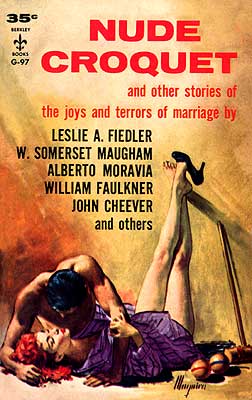
It seems a natural segue to point out here that, at the bottom of The Jellicoe Blog, there is the following statement and link: "We are grateful for financial support for our work from MB Reckitt Trust."
Imagine my surprise when I spotted the name of one of the croquet cronies of George, Agnes, and Violet Mills at the bottom of a blog about the work of Fr. Basil Jellicoe, the subject of our last two entries!
Do coincidences ever cease around here?
Maurice Benington Reckitt (19 May 1888 – 11 January 1980) is described in Wikipedia as "a leading British Anglo-Catholic and Christian Socialist writer. He edited Christendom, A Journal of Christian Sociology from 1931 to 1950. Earlier he was a supporter of guild socialism and a founder of the National Guilds League."
In addition, it includes this information: "Reckitt was a leading player and croquet administrator winning the Men's Championship twice (1935 and 1946). Reckitt was President of the Croquet Association between 1967 and 1975."
 We know that Reckitt [pictured, right, by artist John Prince, versus Charles Colman, whose mustard company had merged with Reckitt's family firm] took to the lawns with the Mills siblings on several occasions, and in tournament play, the database of the Croquet Association shows that Agnes went 0-3 against Reckitt, although she went 2-1 against Maurice's wife, Aimee. Violet Mills was 0-1 against Maurice.
The database shows no records for George Mills, but the erratic London Times search engine does give the results of a single match, played on 10 July 1965 in the second round of Handicap Doubles at Budleigh Salterton, in which George paired with Maurice in a loss to Mrs. R. B. N. Smartt and Miss J. Cooper, (-4). Mills and Reckitt presumably had played together and won in the first round.
I admit to being clueless as to how doubles partners were arranged in croquet at that level, and so have no idea if this indicates if the men were close, or if chance happened to make them partners.
Reckitt was born into the fortune of the family business, Reckitt & Sons, now Reckitt Benckiser. It only took a few moments for me to locate several of their products beneath our kitchen sink, in the laundry, or within the refrigerator here in Ocala: Brasso, Cling Free, Frank's Red Hot, Resolve, Old English, Lime-A-Way, Spray 'n Wash, Easy Off, and French's Mustard.
Maurice was not really involved much in the family business, however.
 It is not my purpose to write a biography of Reckitt—that's been done. In 1941, at the age of approximately 53 Reckitt wrote an autobiography entitled As It Happened: An Autobiography. He was also the subject of the 1988 biography Maurice B. Reckitt by John S. Peart-Binns.
Ample material regarding his life and the founding of "The MB Reckitt Trust" (originally "The Christendom Trust" before 2005) can also be found at http://www.mbreckitttrust.org/history.html.
Nor is it merely my purpose to point out the next (now almost expected) coincidence regarding the fact that George Mills seems to have been a bystander (and perhaps and acquaintance, or even friend) while two British men of great social and spiritual import—Reckitt and Jellicoe—fought on behalf of Christian social causes. Long after the death of both men, their names are linked by the association of Reckitt's trust with the Jellicoe Community.
The following is an excerpt from information on the history of the trust at the website mentioned above:
Reckitt was brought up as an Anglo-Catholic, and as a young man became involved with guild socialism and various Christian social movements. During the First World War, he joined the Labour Research Department, and in 1923 became Chairman of the League of the Kingdom of God. His most enduring achievement was Christendom, a quarterly journal of ‘Christian sociology’ which he edited (and largely subsidized) from 1931 to 1950. His vocation, in the words of his biographer, John Peart-Binns, ‘was to be available’. He spent most of his life ‘co-ordinating and leavening the thinking of small groups together with such people as T. S. Eliot, Dorothy L. Sayers, T. M. Heron, Philip Mairet and many priests’. He authored and edited numerous books on Christian social issues, of which the most readable and best-known is his account of the social movement in the Church of England, From Maurice to Temple (1947).
Author Martin Jarrett-Kerr continues elsewhere in that website:
 Maurice Reckitt [right] was a comparatively wealthy layman, married but with no children. The Reckitt family derived its wealth from ‘Reckitt’s Blue’ in North East Yorkshire. Maurice was educated privately until university, when he went to St John’s College, Oxford, where he got a good degree in history.
He was brought up as a traditional ‘Anglo-Catholic’, but as a youth he soon became worried by the gap, even contradiction, between his faith and the human and social life around him. As a schoolboy he came under the influence of the fine historian Fr John Neville Figgis, C.R., who was not a typical ‘Christian socialist’ so much as a scholar who saw, and taught others to see, the significance of ordinary ‘worldly’ life in the light of the Christian gospel. After university Reckitt became involved in lively and intelligent groups concerned with social ordering…
When Reckitt went up to Oxford ‘I became’, he said, ‘a Socialist in 1908, and I shall always think that, for my generation, a Socialist was a very good thing to have been.’ But he was disillusioned with the ‘Fabian atmosphere’ of Oxford socialism, and found the Church Socialist League more congenial. His practical work in 1916 was as an assistant in London of the ‘Labour Research Department’: his task was to read, mark and index the trade union press. (This is interesting, as disproving the picture of Reckitt as a rich dilettante talking about egalitarianism in comfortable surroundings.)
Later, in 1923, the Church Socialist League ‘was reborn, not without travail, as the League of the Kingdom of God’. One of its members, Sir Henry Slessor, explained that ‘we came to see that our objective was not the promotion of Socialism, but the advent of the Will of God as expressed in His Kingdom on Earth. A society pledged to forward this purpose, sacramental in doctrine, composed solely of communicants, seemed far nearer to our desires than one pledged to Socialism, in part supported by modernists and persons only sub-Christian in belief.’
Interestingly, the change from "Christendom" to "MB Reckitt" in the actual name of the trust in 2005 was based strictly on practical matters, according to the fund's website: "The change of name was decided upon because the Trustees considered that the term ‘Christendom’ nowadays carries connotations that have nothing to do with either the origins or the focus of the Trust, and which could mislead the public. By using the name of the benefactor who endowed the Trust, continuity with the honourable past of the Trust is maintained."
 How the term Christendom (which was also the name of a quarterly journal subsidized and published by Reckitt from 1931 to 1950) came to be used for the trust is exemplified here in this passage written by theologian Duncan B. Forrester:
It has become conventional to assert that we now live in a post-Christendom situation, and to look back patronizingly to the attempts to revive a rather romanticized version of medieval society on the part of Maurice Reckitt, V. A. Demant and the Christendom Group, or even T. S. Eliot in his The Idea of a Christian Society, with its ringing pronouncement that ‘The Christian can be satisfied with nothing less than a Christian organization of society – which is not the same thing as a society consisting exclusively of devout Christians. It would be a society in which the natural end of man – virtue and well-being in community – is acknowledged for all, and the supernatural – beatitude – for those who have the eyes to see it . . .’ But if that kind of political theology has had its day with the recognition that Christendom has passed away beyond recall, there remains an urgent need for a post-Christendom beyond theology.
Reckitt's vision, however, probaby is summed up better in what is essentially a mission statement for The MB Reckitt Trust: "Being and building communities that are diverse and cohesive, in order to bring about a stronger society."
The Mills family, notably George's father, the Revd Barton R. V. Mills, struggled with at least some aspects of religion. The elder Mills converted to Roman Catholicism during his time at Christ Church, Oxford, but spent virtually the rest of his life as an Anglican vicar, chaplain, and cleric, even having been an assistant chaplain at the Chapel Royal of the Savoy, in which one of his first services was during the funeral of Queen Victoria.
Barton Mills was an erudite man, a lover of history, chess, and debate, and a scholar whose translations and interpretations of the work of Bernard of Clairvaux are still cited today. He also gave of himself, serving as an Acting Chaplain to the Forces during the First World War, in which sons Arthur and George served, and as an officer of the Associated Societies for the Protection of Women and Children, and as founder of the Association for Improving the Status of the Unbeneficed Clergy.
 Mills seemed to share the belief of Fr. Jellicoe, as explained by the current Archbishop of Canterbury, that: "[H]e had no problem at all in coming to preach in a church part of which was reserved for the service of Christ in the form of his poor."
For the Reverend Mills, this was all about career choices, subjugating personal belief and allowing himself opportunities to do the work to which he felt called, while also being able to support his wife and children. Roman Catholicism was a matter of personal devotion; the Anglican Church provided his public pulpit, as well as his bread and butter.
It would be stunning to me to find out that these theological and deeply personal matters of faith had not been discussed with George, especially just before Barton's death in 1932. This is corroborated by the fact that George's funeral service was held in the Catholic Church of St Peter, Prince of the Apostles [left], at Budleigh Salterton in 1972.
No, the Catholicism of Barton Mills was not a secret taken to his grave.
Reckitt had an Anglo-Catholic upbringing, but his lifetime of work as a Christian socialist seems to have transcended denominational barriers as well.
 A 1958 manifest from a ship called the Rangtiki documents it sailing into England from New Zealand with Maurice and his wife, Evelyn Aimee, aboard. Their address is given as "157 St. James Court, Buckingham Gate, London SW1."
While this address is a bit closer to The Guards Museum than the London stomping grounds of the Mills family just to the west of Buckingham Palace Gardens, it would have been within extremely familiar territory to George Mills.
The men also shared a common Oxford background (although Mills did not earn his degree) and likely many similar lifelong beliefs on social and religious subjects. One does not doubt they had their differences regarding how exactly those beliefs should be acted upon, perhaps even assertively expressed over cocktails at the bar in the clubhouse at Budleigh, but their similar backgrounds of privilege, with some devotion to helping those in need, no doubt gave them a wide berth of common ground upon which to stand.
Reckitt's wife, Aimee, was as we know a competitive tennis player in the second decade of the 20th century [Wimbledon 1923, 1925, 1927; pictured, above, in 1927 with Lili Alvarez, Aimee at left], but was apparently not a particularly healthy woman overall. She passed away in 1968.
We also know this from the trust's website:
Miss [Dorothy] Howell-Thomas compiled a ‘Bibliography of Maurice B. Reckitt’s published work, for his ninetieth birthday’ (1978); and this was revised and enlarged in 1980. She also helped the archivist of the University of Sussex to sort out the Reckitt archives deposited there, along with other related material, especially that associated with Reckitt’s friend and colleague, Philip Mairet, sometime editor of The New English Weekly to which Reckitt frequently contributed.
Reckitt lived to the age of 91, and was still active in matters regarding his trust until his death in 1980. His bibliography is vast, and the amount of archival material related to Reckitt's life and work held at the University of Sussex is, to me, astonishing.
 In addition to his work on Guilds and Christian social issues and philosophies, Reckitt also penned the text Croquet Today, and as we know, was an avid player of championship caliber, as well as a successful administrator for the Croquet Association, giving him yet another interest in common with George and the spinster Mills sisters.
But Reckitt's legacy is his trust, and its requirement that the projects which it endows should not simply be charities, but institutions and organizations that… well, let Mr. Jarrett-Kerr explain:
From time to time, before his death in 1980, Reckitt protested that the Trust was still behaving in too theoretical a manner. He submitted a ‘Statement’ to be read and discussed at the Trust meeting of 6 May 1973, which emphasized the clauses in the Trust Deed that the Trust is ‘charged with promotion of research into the application of Christian social Thinking’ and with obtaining expert advice ‘upon the form and feasability [sic] of research projects and the areas where they could best be affected’. He feared that the Trust had neglected its duty in this respect – the duty ‘to initiate, seek out and further enquiry into what we may judge to be the vital aspects of modern economic and industrial disorder’. Instead it was ‘tending to confine itself to doing exactly what it began by repudiating – distributing its resources (on) purely charitable gifts.’
Reckitt's trust apparently has stayed true to his vision of not simply bandaging the ills of society, but endowing those who would work to prevent society's wounds from manifesting themselves at all.



![Meredith and Co. [1933] by George Mills](https://blogger.googleusercontent.com/img/b/R29vZ2xl/AVvXsEjlUeRNPnH8Xd8JT59QdtabQHRI6DI6Hqew57i6qixjOL3LjgUD9g22o3-wNlmBya36D5-6KZXX-sxLnktAfEqjlvTmdwyiIL2K6VHOGW2Wq9Pe8_oFGknENfVE1Xrkdj0b8FYXTz_6SMg/s1600-r/sm_meredith_1933.JPG)
![King Willow [1938] by George Mills](https://blogger.googleusercontent.com/img/b/R29vZ2xl/AVvXsEgiz_iaQjinIbVw6yQ-W4hwx6wGJwMQH9azCs3Qacp9eX627B7Eq9hMn1wlHLzlkbcflHRWM8VcPX-1uteKbs4LA5q5Oq69WhrnhzBQLjpseK_M34PSoOOhTZ96EfVAGFehG53gZ0M4EvU/s1600-r/sm_1938.JPG)
![Minor and Major [1939] by George Mills](https://blogger.googleusercontent.com/img/b/R29vZ2xl/AVvXsEgH5nj4Q6BNpzVEb1vyJeGV6ikuN4SFAyDa-jypIgbvdrxqcjHkNxqjrXH7ptZmge7oTTpn5QjAI0yCJPdI-fIzooCDD1TAA3RDxO9jzLcU3QOIhBWKiKNz6CPjCSTZgIPd9_4zM7LLpAw/s1600-r/sm_1939.JPG)
![Meredith and Co. [1950] by George Mills](https://blogger.googleusercontent.com/img/b/R29vZ2xl/AVvXsEgm_JPAXPpX0wb8bDkjYG67Sg1HePiPhRP6b9oUMWvkJhiW6XJzmxTQ7TBepfxpPgRrFNCRuumYRj-SAfU9Kw-uDsbO5HBtyxfQfClHVMJxJUkDpbkrCPhzpC4H_g_ctlirgnSla4vX1EQ/s1600-r/sm_1950.JPG)
![Meredith and Co. [1957?] by George Mills](https://blogger.googleusercontent.com/img/b/R29vZ2xl/AVvXsEg0zRm3-CCmA8r2RrBmrACDvmxJjoBjfxUoPI9yc6NWu1BZ3dd89ZvCixmmKZe1ma0QiDIrsDZNqf-8h1egh0JLiRYHagXAqQ1UknWPy6SksK76psYPcEMLGa_Aj7wo2vMFPo0aMdcx_pg/s1600-r/sm_meredith.JPG)