Showing posts with label glyn mills bank. Show all posts

Thursday, January 13, 2011

Some "Well-known Budleigh Characters"


More news from Budleigh Salterton and friend Michael Downes!

Here's some of what Michael had to say in his latest message: "Here's a photo [left] of Dr Evans, (George's) GP, and some memories of the family which I've put on my blog… I contacted the funeral directors in Budleigh Salterton in the hope of finding out whether George was buried or cremated, but unfortunately they throw out any records over ten years old."

It's a pity about those records. It may seem a bit morbid, but it would be interesting to know how the story of George Mills ended. A family plot including many of the cast of characters we've learned about here would actually give the story some finality and provide my "relationship" with the Mills family—I do feel a great deal of warmth for them—some closure.

You can read Michael's blog entry "Searching for George Mills in a Parallel Universe" at: http://budleighbrewsterunited.blogspot.com/2011/01/searching-for-george-mills-in-parallel.html

Here is an excerpt from that blog entry:

'"[George Mills] was a very sociable welcoming person," recalls Dr David Evans of his former patient, "as indeed were his sisters. They used to have quite big parties, and were well-known Budleigh characters. He was devoted to his sisters Aggie and Vi. They got on well as a nice little family, but in no way was he dependent on them."

Dr Evans remembers that George Mills and his sisters were croquet fanatics, and were also keen on bridge. "They would go to Budleigh Salterton Croquet Club under all circumstances."

He remembered that Violet was a good golfer. "Just after World War Two she was on a ship to South Africa and was invited to represent the national England golf team."

Again, I delighted to be able to publish such little details like this which at the speed of light will reach my literary detective friend in Florida. Details which, like tiny brush strokes, will help him complete his portrait of the mysterious George Mills.'

Michael also weighs in on the possibility of Budleigh existing in a "parallel universe," a strange notion I recommend that you explore more deeply by clicking on the link above—it's well worth reading!

I know that, to many, these few sentences from Dr. Evans won't seem like much, but to me they're absolute treasures.

After so many months—now going on a year—of investigating the nearly forgotten lives of George Mills and his family, I've become familiar with them all in so many ways. Mostly, though, I know a myriad of recorded details, events, and dates. One of the ways in which I'm least familiar with them all, however, is in any sort of personal way.

We know George Mills to be a very likeable, social fellow. Dr. Tom Houston of the Windlesham House Association wrote of George's time at Windlesham: "In the Michaelmas term 1925 he wrote pieces (a prologue and songs) for a staff concert, and wrote that up in the magazine. He made people laugh, a lot." Houston also believed Mills had been involved in theatre productions as part of the school's Amateur Acting Association.

I worried aloud for some time now that the talented and affable Mills, who never published another book after 1939, may have become a sort of "broken" man after suffering a series of tragedies during and just after World War II. Had Mills become a fellow who tragically had to forfeit a career as an author, and spent his final years needing the care of his spinster sisters?

Not to worry, apparently! Dr. Evans describes Mills as "a very sociable welcoming person," and I must admit, little in his life story could have made me happier.

Hearing of the entertainments of George, Aggie, and Vi—his sisters Agnes and Violet Mills—warmed my heart. I look at the photograph of Grey Friars posted last time and think of it glowing with light in the evening, the end of Westfield Road lined with gas guzzling cars of the post-war era, party-goers hurrying to the house, and the sound of laughter drifting occasionally through the summer air.

Like George, his sisters apparently enjoyed sports and games, and even excelled at them. It also seems the Mills siblings were all healthy and physically, mentally, and socially active well into their seventies.

Some questions remain: As they passed away during the decade of the 1970s, who were the executors of their wills? Who now holds the copyrights to Mills's novels? And what became of their collected family photographs, documents, and memorabilia? One fears that what didn't sell in an estate sale after the deaths of the three childless housemates may have ended up in the dustbin. However, the answer to that last question would likely stem from an answer to either of the first two.

Hopefully others will recall knowing or hearing about these three "well-known Budleigh characters" and their exploits. There's still much to be known about George's life between his enlistment in the armed forces in 1940 and his passing in 1972.

Who knows from where the next bit of information will come? I feel confident that thanks to kind, curious, and generous people like Michael Downes, Dr. David Evans, Barry McAleenan, David Wingate, and others like them, we will, indeed, learn much more!


Sunday, January 9, 2011

Grey Friars, a Burial Ground, Croquet, and a Floridian Literary Detective


It's a hazy, winter Sunday morning here in the horse country of Florida. It can't decide if it wants to be cloudy or sunny, chilly or warm. I have a strong cup of coffee and a fine pair of slippers, and I'm savoring this exciting latest entry...

Here's something that doesn't happen every day: George Mills appearing in someone else's blog!

Michael Downes, an author, press officer for Budleigh Salterton's Fairlynch Museum, longtime educator, and friend of Who Is George Mills? posted an entry about this website on his own blog, Budleigh & Brewster United, a site celebrates among other things the connection between his corner of East Devon, birthplace of both Sir Walter Raleigh and Salem, Massachusetts, founder Roger Conant, and the United States of America.

You can read the entry at: http://budleighbrewsterunited.blogspot.com/2011/01/who-was-george-mills.html

The first really exciting aspect of his post is the wonderful photograph that Michael has taken of Grey Friars [above, left]. It has been quite awhile since the name Grey Friars appeared as a passing note in the autobiography of Sir Robert Hart, and it certainly proved elusive—until now! I appreciate the effort Michael put into securing, not only the image, but also the permission of the house's owner for its use.

He also posted this intriguing paragraph:

And yesterday afternoon Annie and I spent time at St Peter's Burial Ground searching for the Mills family grave. Maybe the sea mist had something to do with it, but our search was in vain. However I did have the pleasure of meeting a charming and informative 80-year-old local man who was visiting the many graves of his own family members, and who remembered that George Mills and his sisters were croquet-players. It may be that the Croquet Club as well as the Literary Festival organisers will be pleased to learn about the Mills family.


I wish I'd been there to talk with that local gentleman cloaked in the sea mist covering the burial ground as he shared memories of individuals its possible no one has really thought much about for almost 35 years. George, Agnes, and Violet Mills, as far as I know, all died childless, and its quite likely that a fairly distant relative in the 'Glyn Mills Bank' branch of the family came to Budleigh as executor of Violet's will in 1975, disposed of Grey Friars and the siblings' estate, and left.

It certainly would be interesting to read the probate documents of the wills of George, Agnes, and Violet. It would even allow us to discover who owns the copyright of George's novels, and who we might contact to find out what happened to the family's ephemera—photographs, awards, paperwork, ticket stubs, passports, etc.—all of which would be treasures to me!

The fact that the Budleigh Salterton Croquet Club sat just 100 feet or so from Grey Friars [pictured, right] is important to the story of Mills and his sisters as well. Right now I'm in the midst of sifting through literally decades of croquet tournament results in The Times listing a trio initialed "Miss A. E. Mills," "Miss V. E. Mills," and occasionally a "G. R. Mills," all of whom played in tournaments as singles and sometimes in various combinations as doubles.

We know from his books that George Mills was a man who was fond of sports, and his step-brother, Arthur, loved golf, so much so that for the rest of his life he seemingly never lived more than the proverbial stone's throw from a golf course after leaving London in the wake of his divorce from Lady Dorothy Mills.

It seems, however, George's spinster sisters enjoyed sporting activities as well, given their lengthy record as croquet players. I find it hard to believe that a different "Miss A. E. Mills" and "Miss V. E. Mills" paired up so often in tournaments in London and along the southern coast of England.

There are even tennis results in editions of The Times from 1930s in which a "Miss V. E. Mills" played in tennis tournaments.

Apparently Violet, at the age of 33 on 6 September 1936, was finally defeated in the second round of Ladies' Singles at the Sidmouth Lawn Tennis Tournament by a Mrs. G. Lucas, 6-1, 6-0.

Two years earlier, on 2 August 1934, Miss V. Mills was beaten 6-1, 6-1, by Miss MacTier in the third round of the Bedford Tournament.

[The search engine at The Times website is notoriously finicky, so although these are the only two results I can find in this era of London tennis, I by no means can claim its the exhaustive list and invite anyone who can concoct a better strategy for searching those archives to help me!]

Anyway, what we know is that the family enjoyed sports and remained quite active, even into their "Golden Years."

On 26 June 1970, "Miss V. E. and G. R. Mills," +20, defeated "Mrs. N. A. C. McMillan and Mrs. D. Wayman" in the handicap doubles at Parkstone. Violet would have been almost 68 years old, with George approaching 74.

Later that year at Parkstone, L. S. Butler, +10, beat Miss A. E. Mills on 17 September in level singles. Agnes had just turned 75 years of age on June 11.

Michael Downes has mentioned having a friend who is membership secretary of the Budleigh Salterton Croquet Club [pictured, above left]. As I research Agnes, Violet, and George via The Times, I hope they will be able to come up with some additional documentation on a local and more personal level.

Thank you, Michael (and Annie!), most of all for the line in your blog entry which describes me as a "Floridian literary detective." After months of procrastinating about mowing the lawn and painting the house to fool around with my research on George Mills, my wife must surely believe I'm the biggest slacker around.

Now, it appears that I'm a "literary detective," and I feel much better about everything I've been doing here!


Saturday, January 8, 2011

Found: George Mills at Grey Friars!


What was my most exciting Christmas present? Well, I got lots of great stuff—books, CDs, shirts, wine—but I think the one thing that had me most excited was simply delivered to me near Christmas. It actually wasn't a Christmas present at all!

I had left upon my holiday travels and, while checking my work e-mail from a hotel in western Kentucky, I stumbled upon this very Spartan message, copied here in its entirety: "I have info about George Mills."

After replying, I received the following, wonderful e-mail from Michael Downes, author of the book Oundle's War and master of the blog Budleigh & Brewster United - celebrating sisterhood!

Hi Sam

I contacted a lawyer friend of mine who lives in Budleigh Salterton, in the road where George Mills used to live. He tells me that when he moved to Budleigh Salterton in 1972, George Mills had just died, leaving two sisters living in the house, Grey Friars. The good news is that the house is still there, and has not been demolished to make way for a condo. My lawyer friend tells me that the three Mills were all related to the Mills of Glyn Mills Bank. He will speak to the present owner of Grey Friars to see if he knows anything about George Mills.

I have attached a document which I found on the internet about a Mills of the Glyn Mills Bank; lots of names for you to follow up there.

We have a lot of snow here at present. When it clears I will take a photo of Grey Friars and will also visit the town cemetery to see if I can spot George Mills' grave.

Budleigh Salterton has a literary festival, and one of the documents produced by our local museum for that event was a list of authors formerly living in the town. George Mills (along with many others) was not on the list, and I have added to it over the years with other names. So George Mills is quite a find for us.

If you click on the BudleighBrewster link... you will see that I have an interest in life across the pond.

Best wishes

Michael

And this, also in the text, must be an excerpt of an e-mail from Michael's friend:

When we moved to Pagets in 1972 George Mills had just died leaving two sisters living at Grey Friars, which is... directly at the (dead!) end of Westfield Road [pictured, right]. The three Mills were all related to the Mills of Glyn Mills Bank. But what became of that I am not sure. I did not know that George Mills was a children’s author but it is entirely possible. Interestingly there was another children’s author who lived in Westfield Road – he was the author of a series of the “I Spy” books, but at present the name escapes me! I cannot remember whether the Taylors bought Greyfriars from the Mills Family Executor or whether there was another owner(s) in between.


It's odd that messages that so frequently refer to someone's passing would have me so excited, but they do!

I knew George Mills and his sisters, Agnes and Violet, lived in Grey Friars (then apparently written as two words) from several sources, one of which was the Kelly's Directory of Budleigh Salterton for 1939, which contained the interesting residence address: "Spence, Miss, Grey Friars, Westfield Rd ." After finding that, I'd searched on Google Maps and virtually drove the length of Westfield Road, but couldn't determine which house was Grey Friars. The Royal Mail didn't respond to requests for help, and the only additional proof I had that Miss Spence's 1939 home [circled below, left] had also been the residence of George Mills was a letter written to The London Times by Mills, published on Wednesday, 8 April 1959, signed:

Yours faithfully,
GEORGE MILLS.
Grey Friars, Budleigh Salterton, Devonshire.

We know that Mills spent the summer of 1956 teaching at the Ladycross Catholic Boys' Preparatory School in Seaford, which doesn't seem a place to which he'd have been able to commute daily from Budleigh Salterton. He must have been boarded there, possibly at the school itself.

It's also possible, I suppose, that he stayed with his brother, Arthur, for the summer, but George's commute from Downton would've been roughly 160 miles a day, round trip. That seems extremely unlikely, even in those days of cheaper gasoline. You can see the distances on the map, below right, with Budleigh sporting a purple pin, Seaford gold, and Arthur's home in Downton the red letter "A."

Did Mills teach anywhere else after moving to Budleigh Salterton? It's possible. Had he not written books in the 1930s, we wouldn't know where he'd worked during that era—and even knowing, finding out information about Warren Hill School in Eastbourne, The Craig School in Windermere, and the English Preparatory School in Glion, Switzerland has been difficult. And, as we know, it's been extremely difficult to be completely definitive about the school he referred to in his original dedication to King Willow (1939) as the Eaton Gate Preparatory School in London.

Even with the above schools named, we've only been able to surmise what subjects he might have taught or the lengths of time during which he was employed. Even more mysterious is why he moved so often from school to school between 1925 and 1940.

In 1940, Mills's career took a different path for a few years. He became a 2nd lieutenant paymaster in the Royal Pay Corps during WW II, but resigned his commission due to ill health during 1943, and amost disappeared from the public record.

The Pay Corps was something he'd thought about a great deal, and he must have considered himself quite knowledgeable about its operations as we also have a letter to The Times written by him in April 1944 [below, left] in which he critiques the way soldiers are paid. It's signed:

I am Sir, your obedient servant,
GEORGE MILLS, late paymaster, Royal Army Pay Corps,
Naval and Military Club, 94, Piccadilly, W.1.

Despite his ill health, George was apparently able to drag himself down to the club and use it as his mailing address—unless he was residing there. Either way, his mind was sharp enough to have read a letter about military pay in a previous edition of The Times and very pointedly take issue with it.

Mills discusses the streamlining of office procedures and the difficulty of ascertaining exact pay grades for various members of the military.

Perhaps we should be wondering if thinking that Mills found work in Budleigh Salterton as a schoolmaster is errant, and if we should consider the possibility that he found work in an office doing bookkeeping or accounting, based on his experience in the service.

Except for the summer of 1956 that Mills spent in Seaford with the classmates of young Barry McAleenan, we don't have a shred of proof that Mills taught a single day after, say, 1939-1940. In 1956, Mills would have been 59 years old, just about to turn 60.

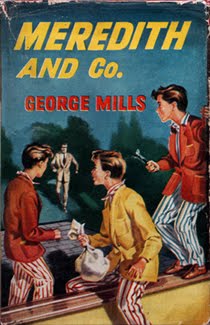
His books were coming back into print in new editions [below, right] for a new generation of readers. He must have been called upon to discuss his experiences as a teacher in the late 1920s and early 1930s, and the children and places that'd been the inspirations for his novels.

Even if Mills had worked as, say, a bookkeeper in Budleigh Salterton, he may have retired by age 59 and perhaps sought one more taste of those earlier days, before the Second World War, when he was a bright, funny, popular schoolmaster with a young wife and a bright future as an author of noteworthy children's books that were unique in their ability to capture the quirky and amusing parlance of the prep school boys of that time.

Perhaps Mills even considered writing more books as he saw his stories begin to populate the shelves of booksellers once more—something he hadn't seen since before the war.

He never did write professionally again—as a far as we know. Did he ever author another story or text under a pen name? There's no reason to think so, but no proof that he didn't.

I believe that someone out there must know all of this: The Story of George Mills. And that's why it's so exciting to have been contacted by Michael Downes!

There'll be more here from Michael very soon, but let me close by saying, once again, that if you know anything about the life, career, or family of George Mills, please let me know. And thank you very much in advance!