Showing posts with label tom h.. Show all posts

Wednesday, August 10, 2011

Eight Years Later: The Final Chapter of King Willow


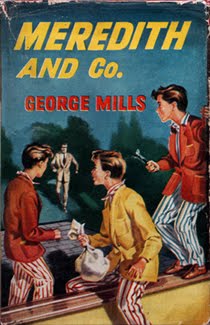
The final chapter of King Willow by George Mills is entitled "Eight Years Later," and it puts the finishing touches on the first two novels of Mills, including his very first, Meredith and Co.

The chapter begins: "It was late on a Wednesday afternoon, and the last day of the Oxford and Cambridge match at Lord's. The ground looked beautiful, the blue sky and green grass combining with the gay colours of the dresses in the crowded stands to make a wonderful splash of colour."

Oxford and Cambridge became the universities where the main schoolboy characters of Mills ended up.

After the match, the three main characters of King Willow—Pongo, Finch, and Falconer, better known as Hawk—end up in the car of Pongo, whom you may recall started as a timid and tearful young boy with a speech impediment at the beginning of Meredith and Co. They begin to discuss their former headmaster, "Peter" Stone, at fictional Leadham House School.

It is here we'll pick up Mill's narrative.


Shortly after the match, the three friends entered a large car that was waiting outside the pavilion. Pongo jumped into the driver's seat, while Finch and Hawk made themselves comfortable at the back. Pongo was on his way down to Sussex, to a small village where he now lived during vacation. He was going to drop the Hawk and Finch at their London hotels before going home…

There was a long traffic hold-up, and Pongo turned around.

'What about coming down and seeing Peter on Saturday? You know he's retired, and living quite near us, in the same village. You'd better come down to lunch, and we'll drop in to tea with Peter. By the way, Hawk, you've got to come see Uggles.'

'Uggles!' cried Finch. 'Is he still alive?'

'Yes,' answered Pongo, 'but he's very shaky on his pins, poor old chap! He'll go nearly mad when he sees the Hawk! There's quite a good train at 10.45 from Victoria. I'll meet you at the other end.'

As Pongo drove off from the traffic block, his mind went back some ten years, and he saw himself once again as a trembling new boy on his mother's arm, as he had waited for the train on the platform of Victoria Station. He addressed his two friends once more.

'I've not seen much of Peter yet, but I'll tell him we're coming. He'll probably give us tea in the garden. He's got a nice little place, and the last time I saw him he was very well.'

By this time the Hawk and Finch had reached their destinations, and Pongo dropped them off with a wave of his hand and a cheery 'Well, don't forget. The 10.45 from Victoria. I'll meet you.'


Longtime readers of this site will recall a message once received from Dr. Tom Houston of Windlesham House School, where George Mills had his first teaching job in 1925-1926. Let's review some of what Dr. Houston revealed about George.


G.R.A. Mills, BA Oxon, taught 4 terms at Windlesham House School [left] from Lent 1925 until Easter 1926, and maybe part or all of the summer, but his name was taken off the staff list by end of summer term 1926…

In 1925 Windlesham was at “Southern Cross”, Portslade, near Brighton; principal Mr Charles Scott Malden; headmaster Mr H D L Paterson; and the dog, Tubby.

In April George Mills married Miss Vera Beauclerc [sic]; they bought a house on Benfield Way, Portslade…

We have no record relating to his sudden (?) departure. He could, like a handful of other prep school masters, have been excited by the General Strike (that term)…

During summer 1935 he visited Mrs Charles [Malden], then in Springwells, Steyning, W. Sussex, and told her he had written a book “largely about Windlesham”, published by O.U.P. “He had been at 2 or 3 schools since, but is very faithful to Windlesham”, she said…

Uggles may have been related to Tubby, the Malden’s popular and heroic dog. The portrait of the headmaster Peter Stone has something of Christopher Malden, who had been in effect joint head for some years; he became principal in 1927. Mills evidently had a gift for befriending boys and learning their secrets; Meredith & Co. captures the idiom of pupils during the interwar period more accurately than any other novel.


There is certainly a wealth of information in those few paragraphs.

The excerpt from King Willow above notes that Pongo had a vacation home in a small village in Sussex. Mills, during the late 1920s and early 1930s was a rather itinerant teacher who had taught not only in Sussex, but in Windermere, London, and Glion, Switzerland, during the time. This home of Pongo's, used during vacations from school, could clearly have been based on Mills's own home in Portslade.

Despite Mills having left Sussex to continue to teach, he seems always to have kept ties there, which explains the repetitive nature of locations in Sussex continually cropping up in the later life of George Mills.

1935, incidentally, was the year during which Windlesham "moved to 60 acres in the Sussex downs north of Worthing," according to a more recent correspondence from Dr. Houston. That event may have occasioned some nostalgia on the part of Mills.

By the way, Charles Scott Malden, mentioned above, had died in 1896, the year of Mills's birth, and could not have been at Windlesham during George's tenure there, although the elder Malden still may have been a legend around campus.


However, it is the actual visit to Springwells, Steyning [right], that is of greater interest here. While what follows is not in any way a non-fiction account of that visit, the occasion must have meant a great deal to George Mills.


It was Saturday afternoon at about four o'clock, and three young men might have been seen walking slowly through the street of a beautiful little village in Sussex. They were arm-in-arm and talking excitedly.

'You know,' one of them was saying, 'Peter doesn't look much older. A bit grayer, that's all.'

The three young men went on talking until they reached a short drive entered by a wide gate that had been fixed against a post. They turned in through the gate and walked up the drive. Sitting outside the house, on a balcony, was Peter, with Mrs Stone. The tea things were laid, and Peter was on the look-out. When he saw his visitors he rose and hastened down the drive to meet them. He shook each hand cordially, his eyes sparkling with joy.

'Well, Falconer and Finch, this is a pleasure. Ogilvie [Pongo] told me you were coming down, and we were expecting you.'

The Hawk kept on looking at Peter. The grand old man had changed but slightly. He was as erect as ever, but perhaps somewhat more portly. He led the way up to the house, where Mrs Stone gave them all a very warm welcome.

Peter certainly had found a beautiful home. The house, an old farmstead, stood in a small but perfect garden. A little lawn stretched away from it, and a kitchen garden was at the back. Rose trees dotted about and well-kept flower-beds made the scene from the little balcony one of great beauty. Peter indicated some comfortable wicker chairs and Mrs Stone began to pour out the tea.

When the young men had settled themselves down, Peter talked about the match.

'I wish I had been there. That must have been a hot catch of yours, Falconer. The papers were full of it.'

'Oh, yes, sir,' laughed the Hawk. 'I told Finch that it was a bit of a fluke. He hit it straight at me, sir.'

During the serious business of tea there was little conversation. Peter kept glancing at the three boys, now grown to men, and he was very proud of them. Soon after tea Mrs Stone excused herself and left the men together. They produced their pipes and settled down to talking. They had eight years to bridge—eight years of ups and downs, of successes and failures at their public schools. Peter listened intently, allowing them to talk on.

After a while the conversation turned to the future and the careers they intended to adopt. The boys asked Peter's advice on all manner of subjects, and he did his best to answer them. Gradually, however, the as was only natural, the talk reverted to Leadham House, but this time Peter did not listen. As he sat back in his chair, blowing clouds of tobacco from his pipe, he was gazing into the future. He saw the three boys, now on the threshold of manhood, all making names for themselves and doing credit to their professions.

He knew their characters and feared nothing. He saw Finch destined for the Bar, a just and fearless judge, honoured by all men. Ogilvie, who was going into the army after his university career, Peter saw as a great soldier and administrator. But when he thought of Hawk, Peter smiled to himself. Falconer had been his favorite pupil, but Peter would not have admitted it to anybody. He knew that the hawk was to reach great heights, and he saw him as a priest in one of the poorest London parishes, cheerful and smiling, with a horde of ragged children clinging joyfully to the skirts of his cassock. He saw him in the midst of squalor and poverty going on his splendid way of radiating love and happiness. As he sat on the balcony that afternoon, entirely unconscious of the conversation going on around him, Peter's mind sped back through the years, and saw the Hawk, once more the grubby, laughing schoolboy devoted to sport and animals…


In this paragraph, filled with Peter's fictional reveries, we find some hidden real-life tributes.

First, Finch had earlier in the chapter been the batsman for Cambridge referred to by Falconer.

Finch is destined for the Bar out of Cambridge—much like the well-rounded mentor of George Mills at Warren Hill School in Eastbourne, Joshua Goodland [left]. While Goodland would never become a judge—Joshua would, in fact, pass away the next year while serving as vicar of the parish of Compton Dundon—it's probable that Goodland had shared with George the thought that if he'd stayed in his law career he might have at some point. After all, becoming a judge would have been the next logical step in his legal career. That step, however, was never taken: Goodland instead bought into Warren Hill School and eventually became owner and Headmaster. Perhaps it had been with regret that Goodland spoke of it with George.


And if this fictional visit to a village in Sussex reflects Mills's own visit there in 1935, it's interesting to note that 1935 was also the year in which Fr Basil Jellicoe, the noteworthy and charismatic reformer from the parish of St Pancras, had passed way from pneumonia at just 37 years of age—but most attributed his death to overwork on behalf of the London's poor children.

We've surmised there must have been a relationship between Jellicoe and Mills before, one that would have stemmed from George attending Oxford, where Jellicoe had run the Magdalen College Mission, which was manned by volunteer students from the university.

Once again, this indicates at the very least some admiration for Jellicoe [right] on the part of Mills, and even suggests that—given the intimacy that fictional Peter Stone exhibits in his knowledge Falconer above, as the latter graduates from Oxford—that the Mills and Jellicoe had been close friends.


Lastly, Peter envisions Pongo as an army officer who would make a "great soldier and administrator." Pongo as a timid young boy with a speech impediment (a lisp), as we know, was based on Mills himself.

So here we have a great clue: Pongo's character soon would be off to the army as an officer after of Oxford.
Mills, along with most others, must have seen war brewing in Europe. Soon after the publication of King Willow in 1938, George would be named an officer in the Royal Army Pay Corps out of the officer's reserve in 1940—interestingly, something Jellicoe had done following university, when he entered the navy as an officer during the First World War.


Spending WWII as a war substitute officer [left] certainly must have appealed to Mills. With the advent of hostilities in China and Europe signaling renewed global violence, a return to the military, this time as a officer, must have been on his mind.

So, here we have some evidence that Mills was already beginning to think that he might not spend the rest of his life writing books, especially as we can see that he was sending his most popular literary characters out into the world as adults.

George had been a failure in the Army Pay Corps during WWI, and in choosing Pongo for duty as an administrator in the army, he was—perhaps unknowingly—charting the same course for himself.


As we close things out at Who Is George Mills?, it seems natural that the examination of this chapter would fall close to the end of our work here. With that in mind, I'd like to finish it out to its end, as Peter sits among his billowing smoke, contemplating the future of the boys:


Then for no apparent reason he raised his eyes, and looked down the drive. What he saw made him sit up and smile.

'Ogilvie,' he asked suddenly, 'why didn't you bring Uggles to-day? I have not seen him for some time, and I was expecting him.'

Pongo laughed.

'Well, sir, he's rather weak on his legs these days, and he was so pleased at seeing the Hawk again that I thought it might be too much for him.'

Peter smiled expansively.

'He seems to have settled that point for himself. Here he comes!'

The three young men looked down the drive and rose to their feet. Uggles was labouriously coming towards them, puffing with his exertions, and Ogilvie laughingly called over to him.

'Come along, old chap, stir those stumps of yours!'

But the old bulldog found the pace altogether too hot for him. He was in extreme old age, but radiantly happy. Every few yards he lifted his head and looked up at his lord and master with devotion streaming from his eyes now growing dimmer. He ambled along slowly towards the spot where his friends were awaiting him, and snuffled as he went.


With that ending, King Willow closes with a paean both to the past and George's love of dogs, but with eyes focused clearly on the future.

George Mills was 42 years old when the book was published and surrounded by notes for his next two texts (which would both be published in 1939), but he was, himself, looking forward as well. Mills, who had known many more failures in his life than successes to that point, would begin to turn things around and make right many of the perceived wrongs he'd endured in his past.

This last scene, with a contemplative Peter wreathed in smoke and the worthy and loyal Uggles snuffling back to his friends, is the sort of sentimental tableau that Mills must have envisioned for himself at the end of his own life.

But before that could be, Mills had some unfinished business. First, his failed relationship with the military would need to be mended, leaving him with a point of pride there instead of a closeted shame.

We'll take a look at the ways in which Mills began to work steadily to vindicate what he perceived to be his failures next time.


Friday, June 17, 2011

Discovering Arthur Henry Burdick Bishop at Warwick School


The other day we took a look at one of the first pages of writing that author George Mills published: The preface to his first novel, Meredith and Co., in 1933. There we examined just who "Mr. H. E. Howell" might have been.

Today, we'll take a look at the other name in that preface, "Mr. A. Bishop."

First of all, I don't even want to discuss how many times the characters "a bishop" or "bishop a" appear on the internet. Google will provide "about 126,000,000 results" in about "0.21 seconds." Can you say, "Needle in a haystack?"

I immediately wrote to Magdalen College School, Brackley, and the Old Brackleians for help, but never received replies. Those institutions being my best, and possibly only, resources, the lack of response was truly a sticky wicket.

I trolled telephone directories, sought alumni lists, and grazed travel manifests, birth notices, marriages, and deaths for a year, all to relatively no avail. True, I had some names that seemed more likely than others, but nothing solid.

So, why on Sunday afternoon between mowing our front and back lawns, did I hit upon it? I can't say. It seemed I'd used the same search terms over and over and over (and over, for that matter), but this time received a slightly different result.

I found not an "A. Bishop" who'd been Headmaster at Magdalen College School, but an "A. H. B. Bishop." That was breakthrough, but I also was immediately inundated with "hits" from what appeared to be another A. H. B. Bishop, co-author (with a G. H. Locket) of a pair of science text books.

It didn't take long to unearth a link that referred to Bishop as "former" headmaster at Magdalen School, then currently (in that text) headmaster at Warwick School [right]! It also didn't take me very long to leap to the conclusion that we may have found a school where George Mills might have taught during the post-War years (1945 – 1956), during which we know so little about him!

You can't imagine how swiftly and excitedly I fired off an e-mail to G. N. Frykman, Warwick School Archivist. Then…

Well, let me let Mr. Frykman pick it up from there:

Dear Sam – I have searched the staff registers of Warwick School, and I cannot find the name of G. R. A. Mills, so he didn’t work here. It is strange, therefore, that you claim that A. H. B. Bishop (headmaster 1936 – 62) encouraged him in his publications. I wonder where you heard that? Bishop was himself, of course, a very successful published writer of chemistry text books. I enclose some paragraphs from Warwick School: A History by G. N. Frykman and E. J. Hadley (2004).


I will admit to some disappointment in failing to find a long-term post-War employer for George Mills, but I feel excited that we can learn about Mr. Bishop. It is both fascinating and instructive for our purposes here: He must have had not only an influence on George as an author, having proofed his manuscripts for Meredith, but had an impact on him as a teacher as well.

Here are some of the "paragraphs" mentioned above by Mr. Frykman:

Arthur Henry Burdick Bishop grew up in Cornwall and attended Callington Grammar School. He then served in the army in France, Egypt and Palestine from 1917 to 1920, before going up to Jesus College, Oxford, where he took First Class Honours in Natural Science in 1924. He was a very able chemist, and his two published text-
books (Introduction to Chemistry and An Elementary Chemistry, both written with GH Locket) were widely used throughout the country. His teaching career started at Westminster College, Oxford, but he was soon appointed to the post of Senior Chemistry Master at Radley, and thence to the headmastership of Magdalen College School, Brackley [Bishop's 1933 phone listing there is seen, left].


In 2003, Bill Grimes (Warwick School 1930 to 1938) remembered Bishop’s first assembly in Big School in 1936, when he said: “All my life I’ve wanted to be Headmaster of Warwick School, and now I’ve got here, I’m going to stay here!” This remark made more sense when it was discovered that Bishop had applied for the headmastership when it fell vacant in 1933, but had lost out when Percival Smith was appointed. He was certainly not expecting the chance of applying again quite so soon. Like his two predecessors, Riding and Percival Smith, AHB Bishop was offered a salary of £800 (a sum worth about £41,000 in 2003), together with whatever profits he could make from the boarding house. Almost his first action was to use the Junior House, which had been closed in 1935, as additional classrooms and cloak-rooms. Also in his first term, he gathered the whole school together to listen to the funeral of George V on the wireless in Big School. Within two years, he had arranged for the front of the school to be flood-lit – a short-lived improvement in view of the proximity of the Second World War.


Two things immediately strike me regarding Bishop. First, Mills and Bishop had spent time in Cornwall as youths. Mills was born there in 1896, although his family moved to London in 1901. Bishop had been born in 1898 around Woolwich/Plumstead in London, and taken as a boy to Cornwall.

However, Bishop's address in Callington, Cornwall, was actually closer to Devon, where George's kin owned a great deal of land and George had spent much time as a lad, as well.

With an affinity for Cornwall and Devon, and perhaps some common acquaintances, Mills—at Christ Church, Oxford, from 1919 to about 1922—was thinking about a future as a schoolmaster and probably met Bishop [right] while the latter was attending Jesus College at Oxford.

A second thing that jumps out at me is that, around 1933, Bishop was not appointed to the vacant headmaster position at Warwick School. This is the same time that Mills was set to publish his first book, which, according to advertising in the London Times, was in the stores for Christmas.

Unless things have changed a great deal in education, Bishop would have been considering at length and in depth his philosophies of education, of discipline, of teaching, of management, of selecting personnel, and of business in preparation for his 1933 interviews at Warwick. Helping Mills with his manuscript—especially as the book's fist edition from Oxford University Press was subtitled "The Story of a Modern Preparatory School"—probably helped structure the thinking of both men!

Mr. Frykman continues:

In the 1942 Prospectus, the tuition fees for Warwick boys are given as £5 per term (a 2003 equivalent of £145), and the separate boarding fee as £23 5s per term (£675). Boys from Leamington and beyond had to pay £6 per term. By 1950, as will be discussed shortly, the basic day-boy tuition fee had risen to £18 and the boarding fee to £30 per term, which, with post-war inflation taken into account, were equivalent to £350 and £600 per term in 2003. The tuition fee in 1950 was, in real terms, less than 20% of its value 50 years later. The most likely explanation for this lies in the low salaries paid to teachers at the time and in the fact that the boarders were still subsidising the day-boys.


Although during the Second World War, and beyond the scope of Bishop's editorial relationship with Mr. Mills, the paragraph above about Warwick School [pictured below, left, with Bishop addressing the boys] does much to give us insight regarding our investigations and awareness of preparatory schools such as Warren Hill School, Windlesham House, and elsewhere.

In addition, we have a better idea of the post-War situation for men like Mills, fellows who had been pre-War schoolmasters:

The school that greeted the end of hostilities retained only nine of its 1939 staff, though a further six eventually returned from the Forces. Inevitably, the staff body had been drastically affected by the war, and stability was desperately needed. In fact, for many, especially the younger men, the post-war period offered great opportunities, and it became increasingly the case that teachers did not stay a long time in their posts before moving on, either to promotions elsewhere or to other professions. There were, in short, to be fewer Mr Chips.


Now, we know from Dr. Tom Houston at Windlesham House School, that instability in the teaching ranks was characteristic of the 1920s as well. It would be interesting to know if the situation stabilized in the 1930s, but my hunch would be that it did not much: Schools in England failed during the Great Depression, and masters would have been scurrying for new positions as the rumour mill turned. In fact, of the schools at which George Mills taught, only Windlesham would survive until today.

George Mills, we know, had had a short "career" as an officer and paymaster in the Royal Army Pay Corps during WWII, and had had at least a modicum of training as an office clerk in the First World War. Couple all of that with the fact that it was difficult for schools to retain staff members after the war, and that they apparently often lost them to "other professions," and we… are still left with little direction as to what Mills did after the war. Did he teach? Work in an office? All of these options seemto have been very open to him.


In October 1959, twenty-three years after his appointment as Headmaster, Arthur Bishop was able to report to the governors:

The school is in good heart. For the first time there are well over 700 on the roll. The Junior School and Lower School are overflowing, and the Sixth Form is larger than ever. Both boarding houses are more than full.

At Advanced Level we gained 87.5% passes. At Ordinary Level subject passes improved from 54% in 1957 and 60% in 1958 to 69%. Mr Beeching deserves special mention for the outstanding science results.

The music of the school – orchestral and choral – is improving rapidly. The CCF maintains its high standards. Discipline is good, and the reputation of the school is good. The experiment of admitting boys on Common Entrance from preparatory schools at 13 is going well; the list is already full for next year and a reserve list is being built up.

Much of the credit for this flourishing state of affairs must go to the Second Master, Mr Dugdale and the staff who are most loyal and co-operative. Theirs is a 6 day week as against a 5 day week in the state schools and they willingly give up time to other activities in the dinner hour and after school. I trust the governors will continue their wise policy of recognising this extra work by the staff in their salary allowances.

When the school became independent it had to improve or fall back on state aid. Our scholarship must, at least, compare favourably with neighbouring state schools and in games, society and tone we must excel. That is why we must have a good staff and pay them well to expect so much of them.


George Mills was probably very much retired at the age 63 when this report was presented in 1959. Again, though, it provides substantial insight into the workings of British schools in the mid-20th century. The staff seems to have stabilized, and teachers were at least beginning to be paid commensurate with their worth.

Here's one last paragraph from Mr. Frykman:

It is fair to say that, of AHB Bishop’s 26 years as Headmaster, the early ones were supremely demanding, given wartime conditions. Contemporaries recall that, though not a logical and consistent thinker, Bishop usually got the right answer, and he certainly saw the school through to calmer waters whilst presiding over a huge increase in pupil and staff numbers, numerous building crises and educational changes. It is, indeed, probably fair to say that he saved the school in 1946… After a brief second marriage to Irene Titcomb in 1965, he died in 1969, at Bladon in Oxfordshire, after a short illness.


When I first read of Bishop's scientific background, and the chemistry texts he first published in 1936 (An Elementary Chemistry by O.U.P., like Mills) and 1939 (Introduction to Chemistry by Clarendon Press), I wondered how he got on with George Mills, an artsy fellow, far more in tune with literature, the stage, music, and the Times Crossword than valences, elements, compounds, and the Periodic Table.

Seeing the description above that Bishop was, quite unscientifically, not always "a logical and consistent thinker" certainly caused a friendship with Mills make far more sense.

[By the way, a coincidence: The books Bishop authored in the 1930s were reprinted in 1956 and 1960, just as the books of George Mills also were reissued during the very same time.]


Former Warwick student R. F. Wilmut has a website called Warwick School in 1961 [click here to visit], and he provides some insight into Bishop [seen, right, during the Queen Mother's visit in 1958] as both a headmaster and as an instructor:

A.H.B. Bishop, Headmaster... was born in 1898, and certainly exemplified the old-fashioned approach to being a Head - not necessarily a bad thing: though formal and perhaps a bit rigid in his attitudes he was approachable and certainly very fair-minded. I did once see him go into a near fury over a slightly persistent question (in one of his regular Q & A sessions at the end of his Religious Knowledge classes) over being allowed to wear duffel-coats instead of the regulation navy raincoats: he actually referred to schools who allowed this as 'going to rack and ruin'.

Many of the things I disliked about Warwick - the emphasis on games, a certain academic rigidity, and an inflexibility in dealing with boys (not only me) who didn't quite fit the expected mould - must I suppose be laid at his door, as he did exert a close control over the running of the school: to balance this he was always respected for his fairness and his manners, and indeed for firm leadership even if one did not always agree with him.


It must be remembered here that George Mills came from a different generation of schoolboys: A "modern" schoolmaster must have been a rare breed, indeed, in George's experience at the dawning of the 20th century. A man who, instead, stood for children, who was "approachable" and "fair-minded" while being an educational "leader" was something Mills emphasized in his own stories of prep schools. Unfortunately, what he had viewed as "modern" and much improved in 1933, children in 1961 saw as "old fashioned." Time marches on, eh?

For one thing, "games" were clearly a huge focus of the schools written about by Mills. In addition, formality and some degree of rigidity are apparent in most of George's schoolmasters at fictional Leadham House School, and his headmaster in Meredith and Co., Howell "Peter" Stone, likely was a fusion of the attributes of three leaders, Charles Scott Malden at Windlesham, Joshua Goodland at Warren Hill, and Arthur Henry Burdick Bishop, all of whom Mills found most admirable.

More on Bishop and Mr. H. E. Howell soon, but here in the States this is Father's Day weekend, and I've a daughter coming in!


Saturday, March 19, 2011

Visiting Warren Hill School, Eastbourne, circa 1928 – 1931


While plumbing the depths of the military file of George Mills during the Great War, another message from an old friend was put on the proverbial back burner. A couple of weeks ago, Michael Ockenden of the Eastbourne Local History Society e-mailed with some news and some images. These images recalled our indistincy knowledge of the whereabouts of Mills during the period from 1922 when he ostensibly departed Oxford University without a degree, on through to Oxford University Press's publication of his first children's novel in 1933, which was presumably done while George and his wife, Vera, were living in London.

Let's take a look at Michael's message:

"Hello Sam:

Eastbourne Local History Society has been given some photographs of Warren Hill School. They were taken between 1928 and 1931. Alas no shots of George Mills but we've found one of the headmaster, Mr J Goodland, to whom Meredith and Co was dedicated. There is another of a previous headmaster, Mr F R Ebden. A local street directory gives Ebden as joint principal with Mr J Goodland in 1929.

According to street directories, the principals in 1925 were M A North and F R Ebden; in 1929 they were F R Ebden and J Goodland; in 1932 Joshua Goodland is the sole principal; in 1933 the sole principal is H E Glanville. (I have not seen a directory for 1930 or 1931.)

By the way, an undated leaflet (not part of the album of photos) published by the school shows the sole principal as Joshua Goodland MA (Trinity Hall, Cambridge). This leaflet must have been published after the departure of Ebden in 1931, so probably in 1931 or 1932. There is a list of teaching staff and Mills is not mentioned.

Another photograph shows a woman and is captioned, "Jim" Goodland. She seems quite a bit younger but could have been the headmaster's wife, sister or perhaps a daughter. She is not mentioned in the leaflet and so was not a member of the teaching staff.

Is there a school dog in Meredith and Co? There are several photographs in the batch showing a dog called "Tiny".

With best regards

Michael Ockenden
Eastbourne Local History Society"


We've had a chance to look at the history of Warren Hill School in the past. To review, George Mills wrote in the dedication to his 1933 book, Meredith and Co., "To MR. J. GOODLAND, sometime Head Master of Warren Hill, Eastbourne; to the STAFF AND BOYS OF THE SAME SCHOOL, and to those of WINDLESHAM HOUSE, BRIGHTON, THE CRAIG, WINDERMERE, and the ENGLISH PREPARATORY SCHOOL, GLION, among whom I spent many happy years, this book is affectionately dedicated."

Now, we've read that dedication several times before. My assumption—and it may be incorrect—is that Mills listed Warren Hill School first because it was most proximate in time to the publication of the book. I know if I wrote a text and thanked my employers, I would thank my current employer first, and by name. I would probably do the same if I was currently unemployed and was planning on using that most recent employer as a primary reference.

However, Mills simply may have listed the schools in chronological order, Warren Hill (whose headmaster possibly gave him his first job as a schoolmaster) and the English Preparatory School at Glion last. Or, just the reverse: His most recent experience at Warren Hill, dating back to getting his feet wet, so to spoeak, as a novice in the snows of Glion.

We do know the opinion of respected Windlesham House Association historian, Dr. Tom Houston, who wrote: "[Mills] taught at three other schools probably after Windlesham; viz; at Warren Hall, Eastbourne (a 19th century school closed in 1930s or 1940s); at The Craig, Windermere (founded 1899); and at the English Preparatory, GLION."

His speculation is likely based, at least in part on this bit of information from the school's archives: "During summer 1935 he visited Mrs Charles, then in Springwells, Steyning, W. Sussex, and told her he had written a book 'largely about Windlesham', published by O.U.P. 'He had been at 2 or 3 schools since, but is very faithful to Windlesham', she said."

He concludes: "My guess is that Mills came to the school soon after leaving university to teach English or 'English subjects'; that was a junior appointment, seldom held for long."

Assuming that Mrs. Charles was reasonably correct in her guess of "2 or 3 schools" after Windlesham, that very probably kicks Windermere and Glion into the post-1926 period of George's career. Warren Hill, however, still may have come before Windlesham in the chronology. If so, though, why would Windlesham have had a record of George's alleged degree (BA Oxon), but not of his prior teaching experience in nearby Eastbourne.

While it is possible that Mills worked at Warren Hill before Windlesham, one has to defer to Dr. Houston's opinion based on his assessment of the primary sources. Mills must have joined the staff at Warren Hill after departing Portslade.

Laboring now under the opinion that one works close to home, and in failing at that, then has to travel farther and farther afield, I estimate that Mills taught at Windlesham, Warren Hill in Eastbourne, The Craig at Windermere, and the English Preparatory School in Switzerland, in that order.

Even allowing for just one year in Cumbria and one year at Glion, and those being 1931 and 1932 respectively, that puts Mills at Warren Hill in the neighborhood of 1927 – 1930.—and this meshes perfectly with the date of the "list of teaching staff" that Michael mentions above.

By 1933, according the information above, Joshua "Jim" Goodland is no longer listed as a principal of the school, perhaps explaining George's description of him as being "sometime Head Master."

You can see the photographs Michael sent throughout this post. Perhaps I am being overly nostalgic about the past (indeed, a depicted past from before my birth), but it is easy for me to see (and the feeling is almost palpable when one reads his books) why relatively idyllic images such as these, etched in his memory, must have seemed to Mills to have been his halcyon days.

Oh--and Uggles, a bulldog, was an extremely important and lovable character in Meredith and Co. and its sequel, King Willow. Even though there had been a gog, Tubby, at Windlesham, I actually would be surprised if I was told that Tiny [pictured, right], Warren Hill's dog, had done nothing to inspire some of Uggles's shenanigans.

Once again, I am indebted to Mr. Ockenden and the entire Eastbourne Local History Society for their thoughtfulness, generosity, and kindness.


Thursday, January 13, 2011

Ain't It Funny How Time Slips Away...


I've been thinking about Dr. David Evans and his recent description of George Mills [right].

"...a very sociable welcoming person."

"...devoted to his sisters Aggie and Vi."

"...but in no way was he dependent on them."

That's good news. As I mentioned in my last entry, I feared that Mills may have become 'damaged' (for lack of a better term) by a string of personal tragedies and illness he'd suffered during the 1940s.

It's good to know that to a physician (and one from a time during which I suppose healers grew to know their patients far more personally), George seemed hale and happy.

Still, the question nags me now just as it did almost a year ago: Why does a fellow write and publish three well-received books during the years 1938 and 1939, and then never publish more than a letter to The Times for the rest of his life—some 32 years?

Backpedaling to the very beginnings of my search for the identity of George Mills, I'll remind you that Heather Lawrence of Peakirk Books in Norfolk opines, "It is possible he just got fed up with writing!"

"Fed up" is a term that I would typically associate with a writer of far less successful tales and far fewer published works. Still, who can say she's wrong?

Another set of words crossed my mind as well. I received a thoughtful and well-considered message from my dear friend, Jennifer, in Philadelphia. Although on a somewhat different topic, it offers a similar line of thinking:

"Maybe [one's] creative life has just run its course. Margaret Mitchell only wrote the one novel... Not every creative person keeps creating until they die. Maybe some people can't sustain that kind of emotional energy. Maybe they don't want to."

That notion of 'not wanting to,' possibly due to being 'fed up,' returns to my mind again and again.

Perhaps while not completely shattering his life, Mills couldn't 'sustain the emotional energy' necessary to write something book length after those tragic events—the death of his wife, a dear friend, his mother, all during a war that left London bleeding and his own health a shambles.

In the words of that noted philosopher, Willie Nelson (seen left, a man who never seems to have lost his muse), "Ain't it funny how time slips away?" Did Mills always mean to write another book? Was his summer term at Ladycross Boys' Catholic Preparatory School in Seaford, Sussex, in 1956 seen as a chance to collect new characters, develop a new setting, and create new stories about prep school boys—a subject he'd once lovingly depicted in such amazingly precise detail? Dr. Tom Houston of the Windlesham House Association describes George thusly: "Mills evidently had a gift for befriending boys and learning their secrets; Meredith & Co. captures the idiom of pupils during the interwar period more accurately than any other novel."

Peakirk's Heather adds: "Meredith & co was 1 of the first prep school stories of its kind, lighthearted & whimsical, a forerunner to the Jennings books of Anthony Buckeridge, in so far as it emphasizes the comical side of school life. However the importance of games & work are not forgotten."

1933's publication of Meredith & Co. by Oxford University Press—a sumptuous, Depression-era book illustrated by the fabled C. C. Brock—speaks volumes about the high regard that was shown by the industry for his manuscript.

Following that with three more books in 1938-1939, had Mills managed so quickly use up all of his stories, his patience, and his passion for writing? And did he ever try to rekindle it all later in life?

Or, despite a nice, little side income from the re-issuing of his schoolboy titles in the 1950s, did the fact that he was an author become something that Mills simply stopped thinking about and ceased discussing with anyone? Were his conversations eventually filled with the weather, bridge strategies, croquet tournaments, and the results of cricket matches at Lord's? Residents of Budleigh's Westfield Road, which ended at the Mills domicile, Grey Friars, today know that another children's author, Charles Warrell, the aged creator of the famed I-Spy books, lived on that very same lane. Why did no one ever seem to realize neighbor George Mills was a children's book author as well?

Michael Downes recently reported: "Budleigh Salterton has a literary festival, and one of the documents produced by our local museum for that event was a list of authors formerly living in the town. George Mills (along with many others) was not on the list, and I have added to it over the years with other names. So George Mills is quite a find for us."

So it seems Mills probably wasn't always 'meaning to get around to it,' as far as writing another book was concerned. Perhaps he was just waiting for inspiration to strike. Still, he certainly didn't let his neighbors and the community at large know of his past, or of any hope he might've had that his literary muse might someday return. Or is it possible he actually had... and no one very much cared?

Jennifer certainly agrees Mills may have been awaiting inspiration and adds: "[But] you can spend the rest of your life sitting around waiting. Tearing things out of one's psyche is an arduous and not always pleasant process. It's easier to say, well, those days are gone. I don't have the energy for that anymore. It's frightening how easy it is to just let your mind sink into its own puddle of lethargy."

Perhaps George Mills was, indeed, 'fed up.' Perhaps he just 'didn't want to' write. Perhaps he faced his own 'puddle of lethargy' and simply never did meet his muse again—even among the prep boys at Seaford in 1956.

For whatever reason, Mills apparently must have spoken so little of his literary career that Budleigh residents never knew they had a popular author in their midst in the person of the very sociable and welcoming George Mills.

Still, I'd love to know: Why?

And I wonder: Is this really all about George Mills?

Or is this really far more about me?


Some "Well-known Budleigh Characters"


More news from Budleigh Salterton and friend Michael Downes!

Here's some of what Michael had to say in his latest message: "Here's a photo [left] of Dr Evans, (George's) GP, and some memories of the family which I've put on my blog… I contacted the funeral directors in Budleigh Salterton in the hope of finding out whether George was buried or cremated, but unfortunately they throw out any records over ten years old."

It's a pity about those records. It may seem a bit morbid, but it would be interesting to know how the story of George Mills ended. A family plot including many of the cast of characters we've learned about here would actually give the story some finality and provide my "relationship" with the Mills family—I do feel a great deal of warmth for them—some closure.

You can read Michael's blog entry "Searching for George Mills in a Parallel Universe" at: http://budleighbrewsterunited.blogspot.com/2011/01/searching-for-george-mills-in-parallel.html

Here is an excerpt from that blog entry:

'"[George Mills] was a very sociable welcoming person," recalls Dr David Evans of his former patient, "as indeed were his sisters. They used to have quite big parties, and were well-known Budleigh characters. He was devoted to his sisters Aggie and Vi. They got on well as a nice little family, but in no way was he dependent on them."

Dr Evans remembers that George Mills and his sisters were croquet fanatics, and were also keen on bridge. "They would go to Budleigh Salterton Croquet Club under all circumstances."

He remembered that Violet was a good golfer. "Just after World War Two she was on a ship to South Africa and was invited to represent the national England golf team."

Again, I delighted to be able to publish such little details like this which at the speed of light will reach my literary detective friend in Florida. Details which, like tiny brush strokes, will help him complete his portrait of the mysterious George Mills.'

Michael also weighs in on the possibility of Budleigh existing in a "parallel universe," a strange notion I recommend that you explore more deeply by clicking on the link above—it's well worth reading!

I know that, to many, these few sentences from Dr. Evans won't seem like much, but to me they're absolute treasures.

After so many months—now going on a year—of investigating the nearly forgotten lives of George Mills and his family, I've become familiar with them all in so many ways. Mostly, though, I know a myriad of recorded details, events, and dates. One of the ways in which I'm least familiar with them all, however, is in any sort of personal way.

We know George Mills to be a very likeable, social fellow. Dr. Tom Houston of the Windlesham House Association wrote of George's time at Windlesham: "In the Michaelmas term 1925 he wrote pieces (a prologue and songs) for a staff concert, and wrote that up in the magazine. He made people laugh, a lot." Houston also believed Mills had been involved in theatre productions as part of the school's Amateur Acting Association.

I worried aloud for some time now that the talented and affable Mills, who never published another book after 1939, may have become a sort of "broken" man after suffering a series of tragedies during and just after World War II. Had Mills become a fellow who tragically had to forfeit a career as an author, and spent his final years needing the care of his spinster sisters?

Not to worry, apparently! Dr. Evans describes Mills as "a very sociable welcoming person," and I must admit, little in his life story could have made me happier.

Hearing of the entertainments of George, Aggie, and Vi—his sisters Agnes and Violet Mills—warmed my heart. I look at the photograph of Grey Friars posted last time and think of it glowing with light in the evening, the end of Westfield Road lined with gas guzzling cars of the post-war era, party-goers hurrying to the house, and the sound of laughter drifting occasionally through the summer air.

Like George, his sisters apparently enjoyed sports and games, and even excelled at them. It also seems the Mills siblings were all healthy and physically, mentally, and socially active well into their seventies.

Some questions remain: As they passed away during the decade of the 1970s, who were the executors of their wills? Who now holds the copyrights to Mills's novels? And what became of their collected family photographs, documents, and memorabilia? One fears that what didn't sell in an estate sale after the deaths of the three childless housemates may have ended up in the dustbin. However, the answer to that last question would likely stem from an answer to either of the first two.

Hopefully others will recall knowing or hearing about these three "well-known Budleigh characters" and their exploits. There's still much to be known about George's life between his enlistment in the armed forces in 1940 and his passing in 1972.

Who knows from where the next bit of information will come? I feel confident that thanks to kind, curious, and generous people like Michael Downes, Dr. David Evans, Barry McAleenan, David Wingate, and others like them, we will, indeed, learn much more!


Friday, May 21, 2010

Mr. Mead's First Evening at School


I get the feeling that we're nearing the end of this quest for George Mills & Co. Those who've been willing to help have really helped quite a bit. Those who weren't so keen were sometimes prodded into helping. And some couldn't be bothered replying to requests for help even with a simple "no."

Oh—and there have been those whose replies have focused on me paying them for research and information. One of the funniest phrases I've bumped into: 'Our volunteers charge ₤10 per hour.'

So, feeling as if I've run out of other options, let's see what George Mills had to say about himself—or at least his first days teaching at Windlesham House, and subsequently at Warren Hill School in Meads, Eastbourne.

From Meredith and Co. (1933):

Mr. Mead enjoyed his first dinner at the school. Peter kept an excellent table, and was splendid company. Mead was given the post of honour near his hostess. He had met his future colleagues before dinner and had approved of them. After dinner there was a conference in the study.

'Make yourselves comfortable,' Peter said. 'Coffee over there; cigarettes and tobacco, too.'

When the men had settled down, Peter spoke again…

'Now you have met Mead. He is going to take French throughout the school, and help you, Marshall, with cricket. You can do with some help, I expect.'

'Yes, indeed, I can.'

Peter gave them a hint.

'Well then, we shall meet again in the morning. Good-night. Mead, if you have done all your unpacking, perhaps you will stay behind and finish your pipe.'

Remember, according to Dr. Tom Houston of Windlesham, "Peter," or Dr. Howell Stone, corresponds to Mr. Charles Scott Malden of Windlesham House, circa 1925. Malden and Mills would have worked under headmaster Mr. H. D. L. Patterson, with Malden becoming principal in 1927, after Mills had gone. Malden, however, apparently already had been considered a joint headmaster before that, however.

Mills had been a junior appointment at the time, a position Dr. Houston states was "seldom held for long," although Mills immediately married and purchased a home in Portslade near Windlesham, which was at the time at "Southern Cross" in Portslade, not in Brighton. Mills had come to the school to teach English or "English subjects."

Let's continue with Meredith and Co. [frontispiece, 1950 edition, right]:

When the rest of the staff had left the study, Peter turned to Mead.

'Now then,' he said, 'sit down, and make yourself at home.'

Mr. Mead sat down and waited.

'You said,' Peter started, puffing at his pipe, 'that this will be your first experience of teaching. Do you mind if I tell you a few stories of my first attempts?'

This was a delightful way of putting it, and Mr. Mead appreciated it.

'No, sir, I shall be most grateful.'

'Well,' said Peter, 'everything depends on your first hour in school. You stand or fall by that hour. I am starting you off tomorrow in the Sixth-form. It will help you to start with the bigger boys. You will be out of school the first hour. Books are given out then, and serious work starts next hour. But I want you to make those bigger boys work. Three of them, Meredith, Potter I, and Dimmer I are in for their Common Entrances this term, and will have to get down to it. You will not find that they will try to rag you; they know me too well for that; but they will see how far they can go in the way of taking things easy. Boys always do; I did so myself, and came a cropper! Let nothing pass in the way of inattention and fidgeting about. If you do, you will be at their mercy. When I first started teaching we had a young man on the staff who went into his class-room to take his first lesson, and stood in the doorway and said, "Good morning!" A chorus in the ascending scale greeted him; then he went to his desk and sat down, uncertain what to do next. The boys started playing about, and the young man never kept order at that school! I won't dictate to you how you should teach, but keep the class busy every moment of the time. If you have any trouble, send the boy to me. I shall think all the better of you if you do so, and will support your authority. If you start off by standing no nonsense the boys will respect you all the more for it."

This was very sound advice, to which Mr. Mead listened intently; and the more he saw of the head master, the more he liked him. Peter regaled him with a few funny stories about his early attempts at teaching. He then looked at his watch.

'Dear me, it is half-past eleven! Well, we shall meet again in the morning. By the way, any small thing you want to know ask Marshall, and if you are in difficulties don't hesitate to come see me. Good-night!'

It's difficult to imagine those words aren't to a great degree autobiographical. At the time, Mills was 29 years old, likely fresh from university, and engaged to be married.

Prior to that, Mills had served from 1916 through 1919 in the Great War, rising from a Private in the Rifle Brigade to a Lance Corporal in the Royal Army Service Corps. He began attending Christ Church in 1919 and Oxford in 1921. Dr. Houston speculates that Mills arrived at Windlesham shortly after departing Oxford where he did not take examinations or earn a degree—something Windlesham House believed he had done.

Mills [left] obviously respected Malden greatly, modeling the character of "Peter" on him. Seven years after leaving Windlesham, Mills wrote this book, describing Peter/Malden as "a splendid man with whom to work… as straight as a gun barrel."

It seems that George Mills loved working with Malden. Mills was engaged, just about to be married, and just about to purchase a home on Benfield Way in Portslade at the time. After just four terms, however, Mills no longer appeared on the Windlesham staff list by the end of the summer of 1926.

Houston speculates that Mills "could, like a handful of other prep school masters, have been excited by the General Strike (that term)."

The long-term ends of that work stoppage wouldn't seem to have dove-tailed very nicely with the more immediate needs of Mills's own situation in 1926, being a new husband, home-owner, and provider.

Still, it's still just the evening before the first class Mr. Mead—and I suspect Mills—would ever teach. There'[s so much more yet to happen.

Next time, let's follow Mr. Mead to his debut breakfast with the boys of fictional Leadham House School in Merdedith and Co. I have a hunch we'll find the 29-year-old George Mills sitting at that table as well…


Sunday, March 28, 2010

MR. G. R. A. MILLS and MISS V. L. BEAUCLERK


A wedding announcement from the London Times, Friday, 24 April, 1925 reads [with key attendees and locales bearing my own emphasis]:


MR. G. R. A. MILLS AND MISS V. L. BEAUCLERK

The marriage took place yesterday at Holy Trinity Church, Brompton, of Mr. George Acland Ramsay Mills, son of Rev. Barton and Mrs. Mills, 38, Onslow-gardens, S.W., and Miss Vera Louise Beauclerk, daughter of the late Mr. William Nelthorpe Beauclerk, of Little Grimsby Hall, Louth, Lincolnshire, and Mrs. Nelthorpe Beauclerk, 4, Hans-mansion, S.W. The officiating clergy were the Rev. Barton Mills (father of the bridegroom), the Rev. Walter Farnsworth, vicar of Little Grimsby, the Reverend Watkin Williams, and Rev. H. S. Sard.

The bride wore a cream gown embroidered in gold, and a gold and cream brocade train. She carried a bouquet of cream roses. the train was borne by Master Rafael Beauclerk and Master Robert Hart (cousins of the bride), who were dressed in black velvet suits with yellow shirts, and the bride was also attended by three child-bridesmaids, the Misses Diana and Hermione de Vere Beauclerk (nieces) and Miss Isyllt Llewellyn, and two grown-up bridesmaids, Miss Violet Mills (sister of the bridegroom) and Suzanne Flemming, whose frocks were of yellow georgette.

A reception was afterwards held at the Hans-crescent Hotel, and the bride and bridegroom later left for the honeymoon, which will be spent in Devonshire. Mrs. Mills wore a nigger-brown crêpe de Chine frock, embroidered in gold, with a hat to match.

Among those present were :—

Mrs. Barton Mills, Miss Othlie Mills, Miss Verity Mills, Colonel and Mrs. Dudley Mills, Mrs. Nelthorpe Beauclerk and Miss Beauclerk, Hester Lady Hart, Lady Hart, Mrs. Topham Beauclerk, and the Masters Beauclerk, Miss Agnes Mills, the Japanese Ambassador and Mme. Okamato, Don Carlos Dominguez and Mdlle. Dominguez, M. and Mme. de Lembeke, Mrs. R. de Lembeke, Mr. and Lady Isabel Margesson, the Hon. Mrs. Walter Paton, the Hon. Sophia Trollope, Mr. and the Hon. Mrs. Llewellyn, the Hon. Montagu and Mrs. Forbes, Theodosia Lady Hughes and Miss Winifred Hughes, Sir Claude and Lady Mallet, Lady Arnold, Sir William and Lady Adair, Lady Thompson, Sir John and Lady Jordan, Lady Atterbury, Sir Henry and Lady Burke and Master Burke, Lady Pontifex, Lady Addis and Miss Addis, Lady O'Conor, Lady Trollope, Mr. Benson Kennedy, Mr., Mrs., and Miss Wardrop, Colonel F. Gore, Mrs. Daniell, Mrs. Rolls, Mr. William Stone, Mr. Richard Pryce, the Misses Bryant, Ms. Sinclair, Mrs. Lacy Rogers, Miss Ethel Rogers, Mr. and Mrs. Erskine Barrett, Mrs. Alfred Porter, Mr. Gerald E. Maude, Mrs. Hayes Dashwood, Mrs. Eden, Mrs. Rochford, Miss Hughes, Mrs. Lane, Miss Jane Lane, Mrs. Fleming, Mr. and Mrs. Cory, Mrs. Baxter, Mr. and Mrs. Blois, Mr. Jenning, Captain Russell, Mrs. Dudley Morrison, Miss Henrietta Gladwell, Mr and Mrs. Seddon, Mrs. Philip Du Cros, Mrs. Arnold Ellert, Miss Irene Hart, Mr. and Mrs. Arthur Legge, Mrs. Cecil Fleurscheim, Captain and Mrs. Stanley Musgrave, Miss McConnell, Mrs. Leigh Taylor, Mrs. Douglas Ramsay and Master Ramsay, Mrs. Lugard, Mrs. de Vere Evans, Mrs. Ash, Mrs. Duncan Payne, Mrs. Wingate, Mrs. Ronald Wingate, Miss Plowse, Mr. Hamilton and Mr. Norman Lamplugh, the Misses Sanders, the Misses Chance, Major and Mrs. Brodie and Master Michael and Master Alexander Brodie, Mrs. Fardell, Mrs. and Miss Lindsay Watson, Miss Garford, Miss Wyndham Murray, Miss Ricardo, Mr. Derrick Clayton, Mr. Clive Bayley, Mr. and Mrs. Hubert Ansell, Miss Bower, Mr. Watkin Williams, Mrs. Watkin Williams, Mrs. Greenfield, Miss Acland, Miss Griffith, Mrs. Montague(?) Napier, Mrs. Bowra, Mr. and Mrs. A. Hughes, Mrs. Wintringham, Captain and Mrs. Gerald Greig, Miss Sparks, Mr. M. Acheson, Mrs. Leigh-Pemberton, Mme. Challe, Major R. B. Denny, Mr. R. W. S. Seton, Mr. and Mrs. Boyd Bredon, Mr. Eric Sachs, Mrs. Spencer Beaumont, Mrs. and Miss Farnsworth, Miss Standen, Mrs. Cavendish, Mr. and Mrs. Stirling, Mrs. Arthur Mcdonald, Miss Jean Anderson, Mrs. and Miss Vandeleur, Colonel and Mrs. Mortimer, Mr., Mrs., and Miss Seton, Mr. and Mrs. Flannery, Mrs. Griffith, Mrs. C. F. Hughes, Mrs. George Cooper, Miss McEwan, Mrs. Hazlett, Mrs. Darrioch, Mrs. George Lyster, Mr. and Mrs. Godfrey Pharazyn, Miss Ruth Pharazyn, Mrs. Peet, Mr. Mackellar, Colonel Jocelyn, Mrs. Heaton Armstrong, and Mrs. Langley.


It seems quite an international affair, although I'm unfamiliar with most of the names on the guest list. If any of them ring a bell with any readers, I do hope you'll let me know. Notably absent is the older step-brother of George, author Arthur Frederick Hobart Mills of London, born 12 July, 1887 and then 37 years of age. That same year, writing under the name Arthur Hobart Mills [He also wrote for American magazines as Arthur Mills], he published his book The Gold Cat [Hutchinson & Co., London; 1925]. By 1926, it was in its third edition. He was the author of dozens of books found in the British Library, mostly adventure fiction, as well as some memoirs of the First World War that he'd written under the pseudonym "Platoon Cammander" [right]. (The website Great War Dust Jackets charcaterizes the writings of the elder Mills brother as "now long forgotten", much like the published work of George Mills.) A. F. H. Mills is described as "a handsome and well connected man but with little money [in 1916]". One wonders exactly how as yet unpublished—and seemingly by comparison quite unaccomplished— younger step-brother George would have been described at the time of his own wedding in 1925, and if the half brothers got along.

Arthur F. H. Mills was the son of Revd Barton R. V. Mills and the late Lady Catherine Valentia Mary Hobart-Hampden, who took the rank of Earl's daughter at the wedding. Lady Catherine passed away in 1889, and Revd Mills remarried, taking Elizabeth Edith Ramsay, daughter of military man Sir George Dalhousie Ramsay, C.B., as his wife on 10 January, 1894. [George Ramsay Acland Mills was born to them on 1 October, 1896.]

The eccentric Lady Dorothy Rachel Melissa Walpole Mills, a cousin as well as then-wife of Arthur Hobart Mills, was also not in attendance. Lady Dorothy was a half-American who was also a journalist, writer, and well-known world traveler/explorer. In 1925, she had only just returned from becoming the first white woman to reach Timbuktu and had recently published The Arms of the Sun and The Dark Gods [Duckworth & Co., London, 1924 and 1925, respectively]. She likely did not attend the Mills/Beauclerk nuptials as she was undoubtedly traveling [as seen, left], at least some of 1925 in Palestine, and readying herself to publish four books in the next two years: A science-fiction novel, Phœnix, [Hutchinson & Co.: London], and travel books Beyond the Bosphorous and Through Liberia [Duckworth & Co., London] in 1926 and Episodes from the Road to Timbuktu [G. G. Harrap and Co., London] in 1927. She's the author of twenty-some books in the British Library, scattered here, here, and here.

It's conceivable Lady Dorothy was a bit busy in 1925! Incidentally, she is also the subject of a search for information similar to my own being conducted by American James Wallace Harris, who describes Lady Dorothy as "a forgotten writer whose books are about to disappear."

Anyway, it appears that George Mills and Vera Beauclerk boarded their own ship called Matrimony with much ado made of it, even without the reigning heavyweight authors of the family in attendance.

Easter that year was on 12 April, 1925. According to Windlesham, Mills "taught 4 terms at Windlesham House School from Lent 1925 until Easter 1926".

So Mills almost certainly would have been teaching at Windlesham at the time of wedding. As noted previously: "In April George Mills married Miss Vera Beauclerc; they bought a house on Benfield Way, Portslade. [below, right]"

The word "they" would imply that the purchase was made after the wedding, the then-28-year-old Mills opting to settle down near the school in Portslade with his 31-year-old bride.

The association of Mills and Vera lasted until her passing on 5 January, 1942, just months short of what would have been their 17th wedding anniversary.

The association of Mills and Windlesham was far shorter in duration. The list of wedding guests above simply does not appear to be any sort of compendium of British citizens likely to have been wildly sympathetic with the General Strike of 1926. That doesn't mean, however, Mills didn't walk with the million or so labourers who supported the coal miners during the strike's dates of 3 May, 1926, and 13 May, 1926.

According to wikipedia.org and its reference, the 1988 book Two Georges: The Making of the Modern Monarchy by David Sinclair, the Trade Union Congress "feared that an all-out general strike would bring revolutionary elements to the fore. They decided to bring out workers only in the key industries, such as railwaymen, transport workers, printers, dockers and ironworkers and steelworkers."

Mills just seems a terribly unlikely candidate to have been swept up in any fervency [left] on behalf of the coal miners, despite having possibly fought alongside some youngsters whose destiny would soon be found within those mines after the armistice. I find it incredibly difficult to believe, at least from my desk here in 2010, that a "junior appointment" and freshly minted bridegroom and homeowner would've risked his new found position at Windlesham, a situation he apparently loved dearly.

Still, a truly trusted authority on Windlesham, Dr. Houston, has speculated, "[Mills] could, like a handful of other prep school masters, have been excited by the General Strike (that term)."

Stranger things have happened, and "wildcat" involvement in a strike—even though Mills was no longer very much a youngster, being almost 30 years of age by May, 1926—would, indeed, go a long way in explaining his then bouncing from Eastbourne to Windermere, on to Glion, and back to Eaton Gate in London as a preparatory school master over the next decade, instead of having stayed settled at Windlesham.

Was Mills so active politically that it may have had a negative impact on his career at the time? As always, any thoughts, ideas, or information on the subject would be greatly appreciated!