Showing posts with label oxford u.p.. Show all posts

Thursday, July 28, 2011

Gallery 4: The Artwork of P. White


Similar to the first edition of Meredith and Co.—and unlike Mills sequels, King Willow and Minor and Major—Oxford University Press issued Meredith in 1950 without many interior illustrations. In fact, save the frontispiece, all of the remaining illustrations are found on the dust cover. [Click on any image to enlarge it.]

The jacket and frontispiece are not full colour: It uses a two colour separation (blue and yellow) with black line. The artist isn't renowned. In fact, he is a mid-20th century illustrator in search of a Christian name: P. White.


His wiry and energetic inks, when used to limn people, are somewhat reminiscent of George Cruikshank, making the frontispiece a little gem of a drawing. Unfortunately, it is muddled by the blue and yellow inks of the separation process, which did little for any of the illustrations, interior of exterior.


It is debatable as to whether or not the quality of the illustrator has fallen off from 1939 to 1950, mostly because the work of White here is not shown off in the best light. Certainly, though, we can see that the quality of the overall artistic book and jacket design has fallen off dramatically. Visually, this edition is miles below the level of artwork OUP set when the noted publisher commissioned C. E. Brock to illustrate the first edition of Meredtith.


Tuesday, July 26, 2011

Gallery 1: The Work of Charles Edmund Brock


As we continue to try to tie up loose ends here at Who Is George Mills?, it seems a good idea to open an art gallery of sorts related to the writing of George Mills. Over the next few days, we'll be uploading all of art found in Mills's boys' preparatory stories and making it searchable on-line.

Today we're starting with his classic: The first edition of Meredith and Co.: The Story of a Modern Preparatory School, published in 1933 by Oxford University Press, and illustrated by the legendary Charles Edmund Brock.

C. E. Brock, born in 1870, was 63 years of age and at the height of his fame when he was commissioned to do the watercolours for George's first book. That would provide one a great indication of the esteem in which Mills's manuscript was held at OUP at the time.

Besides the cover above [click any image to enlarge it], Brock also did a vertical watercolour of the the boys creeping out of the school at night, as well as a gorgeous frontispiece. You can see these two artworks to the right and below.


Next time, we'll advance to the 1950 edition of Meredith and Co. We'll see you then…


Friday, June 17, 2011

Discovering Arthur Henry Burdick Bishop at Warwick School


The other day we took a look at one of the first pages of writing that author George Mills published: The preface to his first novel, Meredith and Co., in 1933. There we examined just who "Mr. H. E. Howell" might have been.

Today, we'll take a look at the other name in that preface, "Mr. A. Bishop."

First of all, I don't even want to discuss how many times the characters "a bishop" or "bishop a" appear on the internet. Google will provide "about 126,000,000 results" in about "0.21 seconds." Can you say, "Needle in a haystack?"

I immediately wrote to Magdalen College School, Brackley, and the Old Brackleians for help, but never received replies. Those institutions being my best, and possibly only, resources, the lack of response was truly a sticky wicket.

I trolled telephone directories, sought alumni lists, and grazed travel manifests, birth notices, marriages, and deaths for a year, all to relatively no avail. True, I had some names that seemed more likely than others, but nothing solid.

So, why on Sunday afternoon between mowing our front and back lawns, did I hit upon it? I can't say. It seemed I'd used the same search terms over and over and over (and over, for that matter), but this time received a slightly different result.

I found not an "A. Bishop" who'd been Headmaster at Magdalen College School, but an "A. H. B. Bishop." That was breakthrough, but I also was immediately inundated with "hits" from what appeared to be another A. H. B. Bishop, co-author (with a G. H. Locket) of a pair of science text books.
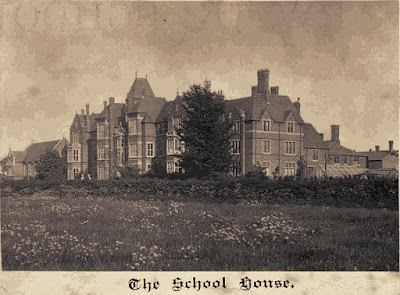
It didn't take long to unearth a link that referred to Bishop as "former" headmaster at Magdalen School, then currently (in that text) headmaster at Warwick School [right]! It also didn't take me very long to leap to the conclusion that we may have found a school where George Mills might have taught during the post-War years (1945 – 1956), during which we know so little about him!

You can't imagine how swiftly and excitedly I fired off an e-mail to G. N. Frykman, Warwick School Archivist. Then…

Well, let me let Mr. Frykman pick it up from there:

Dear Sam – I have searched the staff registers of Warwick School, and I cannot find the name of G. R. A. Mills, so he didn’t work here. It is strange, therefore, that you claim that A. H. B. Bishop (headmaster 1936 – 62) encouraged him in his publications. I wonder where you heard that? Bishop was himself, of course, a very successful published writer of chemistry text books. I enclose some paragraphs from Warwick School: A History by G. N. Frykman and E. J. Hadley (2004).


I will admit to some disappointment in failing to find a long-term post-War employer for George Mills, but I feel excited that we can learn about Mr. Bishop. It is both fascinating and instructive for our purposes here: He must have had not only an influence on George as an author, having proofed his manuscripts for Meredith, but had an impact on him as a teacher as well.

Here are some of the "paragraphs" mentioned above by Mr. Frykman:

Arthur Henry Burdick Bishop grew up in Cornwall and attended Callington Grammar School. He then served in the army in France, Egypt and Palestine from 1917 to 1920, before going up to Jesus College, Oxford, where he took First Class Honours in Natural Science in 1924. He was a very able chemist, and his two published text-
books (Introduction to Chemistry and An Elementary Chemistry, both written with GH Locket) were widely used throughout the country. His teaching career started at Westminster College, Oxford, but he was soon appointed to the post of Senior Chemistry Master at Radley, and thence to the headmastership of Magdalen College School, Brackley [Bishop's 1933 phone listing there is seen, left].


In 2003, Bill Grimes (Warwick School 1930 to 1938) remembered Bishop’s first assembly in Big School in 1936, when he said: “All my life I’ve wanted to be Headmaster of Warwick School, and now I’ve got here, I’m going to stay here!” This remark made more sense when it was discovered that Bishop had applied for the headmastership when it fell vacant in 1933, but had lost out when Percival Smith was appointed. He was certainly not expecting the chance of applying again quite so soon. Like his two predecessors, Riding and Percival Smith, AHB Bishop was offered a salary of £800 (a sum worth about £41,000 in 2003), together with whatever profits he could make from the boarding house. Almost his first action was to use the Junior House, which had been closed in 1935, as additional classrooms and cloak-rooms. Also in his first term, he gathered the whole school together to listen to the funeral of George V on the wireless in Big School. Within two years, he had arranged for the front of the school to be flood-lit – a short-lived improvement in view of the proximity of the Second World War.


Two things immediately strike me regarding Bishop. First, Mills and Bishop had spent time in Cornwall as youths. Mills was born there in 1896, although his family moved to London in 1901. Bishop had been born in 1898 around Woolwich/Plumstead in London, and taken as a boy to Cornwall.

However, Bishop's address in Callington, Cornwall, was actually closer to Devon, where George's kin owned a great deal of land and George had spent much time as a lad, as well.

With an affinity for Cornwall and Devon, and perhaps some common acquaintances, Mills—at Christ Church, Oxford, from 1919 to about 1922—was thinking about a future as a schoolmaster and probably met Bishop [right] while the latter was attending Jesus College at Oxford.

A second thing that jumps out at me is that, around 1933, Bishop was not appointed to the vacant headmaster position at Warwick School. This is the same time that Mills was set to publish his first book, which, according to advertising in the London Times, was in the stores for Christmas.

Unless things have changed a great deal in education, Bishop would have been considering at length and in depth his philosophies of education, of discipline, of teaching, of management, of selecting personnel, and of business in preparation for his 1933 interviews at Warwick. Helping Mills with his manuscript—especially as the book's fist edition from Oxford University Press was subtitled "The Story of a Modern Preparatory School"—probably helped structure the thinking of both men!

Mr. Frykman continues:

In the 1942 Prospectus, the tuition fees for Warwick boys are given as £5 per term (a 2003 equivalent of £145), and the separate boarding fee as £23 5s per term (£675). Boys from Leamington and beyond had to pay £6 per term. By 1950, as will be discussed shortly, the basic day-boy tuition fee had risen to £18 and the boarding fee to £30 per term, which, with post-war inflation taken into account, were equivalent to £350 and £600 per term in 2003. The tuition fee in 1950 was, in real terms, less than 20% of its value 50 years later. The most likely explanation for this lies in the low salaries paid to teachers at the time and in the fact that the boarders were still subsidising the day-boys.


Although during the Second World War, and beyond the scope of Bishop's editorial relationship with Mr. Mills, the paragraph above about Warwick School [pictured below, left, with Bishop addressing the boys] does much to give us insight regarding our investigations and awareness of preparatory schools such as Warren Hill School, Windlesham House, and elsewhere.
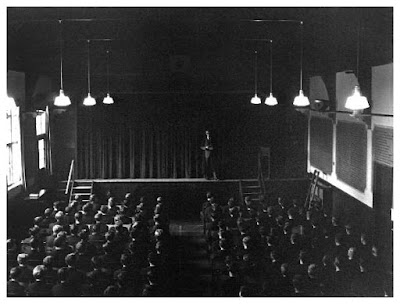
In addition, we have a better idea of the post-War situation for men like Mills, fellows who had been pre-War schoolmasters:

The school that greeted the end of hostilities retained only nine of its 1939 staff, though a further six eventually returned from the Forces. Inevitably, the staff body had been drastically affected by the war, and stability was desperately needed. In fact, for many, especially the younger men, the post-war period offered great opportunities, and it became increasingly the case that teachers did not stay a long time in their posts before moving on, either to promotions elsewhere or to other professions. There were, in short, to be fewer Mr Chips.


Now, we know from Dr. Tom Houston at Windlesham House School, that instability in the teaching ranks was characteristic of the 1920s as well. It would be interesting to know if the situation stabilized in the 1930s, but my hunch would be that it did not much: Schools in England failed during the Great Depression, and masters would have been scurrying for new positions as the rumour mill turned. In fact, of the schools at which George Mills taught, only Windlesham would survive until today.

George Mills, we know, had had a short "career" as an officer and paymaster in the Royal Army Pay Corps during WWII, and had had at least a modicum of training as an office clerk in the First World War. Couple all of that with the fact that it was difficult for schools to retain staff members after the war, and that they apparently often lost them to "other professions," and we… are still left with little direction as to what Mills did after the war. Did he teach? Work in an office? All of these options seemto have been very open to him.


In October 1959, twenty-three years after his appointment as Headmaster, Arthur Bishop was able to report to the governors:

The school is in good heart. For the first time there are well over 700 on the roll. The Junior School and Lower School are overflowing, and the Sixth Form is larger than ever. Both boarding houses are more than full.

At Advanced Level we gained 87.5% passes. At Ordinary Level subject passes improved from 54% in 1957 and 60% in 1958 to 69%. Mr Beeching deserves special mention for the outstanding science results.

The music of the school – orchestral and choral – is improving rapidly. The CCF maintains its high standards. Discipline is good, and the reputation of the school is good. The experiment of admitting boys on Common Entrance from preparatory schools at 13 is going well; the list is already full for next year and a reserve list is being built up.

Much of the credit for this flourishing state of affairs must go to the Second Master, Mr Dugdale and the staff who are most loyal and co-operative. Theirs is a 6 day week as against a 5 day week in the state schools and they willingly give up time to other activities in the dinner hour and after school. I trust the governors will continue their wise policy of recognising this extra work by the staff in their salary allowances.

When the school became independent it had to improve or fall back on state aid. Our scholarship must, at least, compare favourably with neighbouring state schools and in games, society and tone we must excel. That is why we must have a good staff and pay them well to expect so much of them.


George Mills was probably very much retired at the age 63 when this report was presented in 1959. Again, though, it provides substantial insight into the workings of British schools in the mid-20th century. The staff seems to have stabilized, and teachers were at least beginning to be paid commensurate with their worth.

Here's one last paragraph from Mr. Frykman:

It is fair to say that, of AHB Bishop’s 26 years as Headmaster, the early ones were supremely demanding, given wartime conditions. Contemporaries recall that, though not a logical and consistent thinker, Bishop usually got the right answer, and he certainly saw the school through to calmer waters whilst presiding over a huge increase in pupil and staff numbers, numerous building crises and educational changes. It is, indeed, probably fair to say that he saved the school in 1946… After a brief second marriage to Irene Titcomb in 1965, he died in 1969, at Bladon in Oxfordshire, after a short illness.


When I first read of Bishop's scientific background, and the chemistry texts he first published in 1936 (An Elementary Chemistry by O.U.P., like Mills) and 1939 (Introduction to Chemistry by Clarendon Press), I wondered how he got on with George Mills, an artsy fellow, far more in tune with literature, the stage, music, and the Times Crossword than valences, elements, compounds, and the Periodic Table.

Seeing the description above that Bishop was, quite unscientifically, not always "a logical and consistent thinker" certainly caused a friendship with Mills make far more sense.

[By the way, a coincidence: The books Bishop authored in the 1930s were reprinted in 1956 and 1960, just as the books of George Mills also were reissued during the very same time.]


Former Warwick student R. F. Wilmut has a website called Warwick School in 1961 [click here to visit], and he provides some insight into Bishop [seen, right, during the Queen Mother's visit in 1958] as both a headmaster and as an instructor:

A.H.B. Bishop, Headmaster... was born in 1898, and certainly exemplified the old-fashioned approach to being a Head - not necessarily a bad thing: though formal and perhaps a bit rigid in his attitudes he was approachable and certainly very fair-minded. I did once see him go into a near fury over a slightly persistent question (in one of his regular Q & A sessions at the end of his Religious Knowledge classes) over being allowed to wear duffel-coats instead of the regulation navy raincoats: he actually referred to schools who allowed this as 'going to rack and ruin'.

Many of the things I disliked about Warwick - the emphasis on games, a certain academic rigidity, and an inflexibility in dealing with boys (not only me) who didn't quite fit the expected mould - must I suppose be laid at his door, as he did exert a close control over the running of the school: to balance this he was always respected for his fairness and his manners, and indeed for firm leadership even if one did not always agree with him.


It must be remembered here that George Mills came from a different generation of schoolboys: A "modern" schoolmaster must have been a rare breed, indeed, in George's experience at the dawning of the 20th century. A man who, instead, stood for children, who was "approachable" and "fair-minded" while being an educational "leader" was something Mills emphasized in his own stories of prep schools. Unfortunately, what he had viewed as "modern" and much improved in 1933, children in 1961 saw as "old fashioned." Time marches on, eh?

For one thing, "games" were clearly a huge focus of the schools written about by Mills. In addition, formality and some degree of rigidity are apparent in most of George's schoolmasters at fictional Leadham House School, and his headmaster in Meredith and Co., Howell "Peter" Stone, likely was a fusion of the attributes of three leaders, Charles Scott Malden at Windlesham, Joshua Goodland at Warren Hill, and Arthur Henry Burdick Bishop, all of whom Mills found most admirable.

More on Bishop and Mr. H. E. Howell soon, but here in the States this is Father's Day weekend, and I've a daughter coming in!


Monday, May 30, 2011

Searching for the Residence of the Masters


Today's "quick hit" on Warren Hill School (1885-1936) focuses on the words "just below," and is not so "quick."

How much land did the school actually possess? We know from Joshua Goodland's freehold listing in a 1931 London Gazette, he held "Warren Hill, Beachy Head Road, and land in Carlisle Road, Eastbourne."

So how do references to a "master's residence" or "house for masters" figure into all of this? Is it possible that, despite owning the land mentioned above, the school rented a home in which the masters could live during the terms?

Let's take a look at some references to the house that we've had already.

From the Eastbourne Local History Society came this description of the post card image we see above, left: "[This image] is probably from a postcard and shows the view looking up what is now Beachy Head Road with the school on the left. It's hard to date precisely but one can suppose that it is pre 1900. The masters' residence must be the house on the right. The girls walking down the hill are almost level with a group of flint cottages which still stand. One of these was rented during various summers by Arthur Conan Doyle."


Here's a close-up of that house, across from Warren Hill [above]. We've seen it today in a street view from the front, its southern side [click HERE to view the image]. Let's see if we can espy that same side as above by 'driving' down the side street, Denton Road, via Google Street View and peering behind the foliage to get a peek at the eastern wall.

Take a look:


It appears that the same structure is still standing today, with some modifications having been made. If this was, indeed, the master's residence, and the small homes behind it are the "flint cottages" to which the ELHS refers, then it's very possible that the school (and Goodland in 1931) had possession of all of the land across from the school to the north, possibly all the way through to Upper Carlisle Road—some fine acreage!

On the 1930 map we have of the area, there are no structures on either of the two tracts of land below, or east of, the structure discussed above. Arthur Conan Doyle passed away in Sussex in 1930, and if cottages on those parcels are standing today, they must have been standing then. One wonders where the cottages mentioned actually might be.

One other bit of evidence for that large edifice having been the residence of the schoolmasters comes from the writing of George Mills.

In Chapter 6 of Meredith and Co. (1933; the dust jacket of the 1950 Oxford University Press edition is depicted below, right), several of the boys sneak out during the wee hours of the night to retrieve a troublesome lost envelope from the desk in the common-room of the master's residence. Here's the text: "Three perfectly noiseless figures crept down the corridor, a big door at the end was slightly unbarred, and the figures walked across the playground towards the master's cottage."

It appears from photographs and the map that the 'playground' at Warren Hill would have been on the west side of the building [far below], in an area between two outlying buildings. If Mills is referring to the landscape of Warren Hill, and not Windlesham House School which was in Portslade at the time, it seems likely the boys left the building from a corridor leading to the playground in the west and probably would have stolen across the quiet street.

The boys then slip into the cottage through a window with a broken latch, as depicted on the cover shown here. After almost being caught by the obnoxious Mr. Lloyd, we find out the master's cottage in Mills's book has two floors. When Lloyd finally shouts for Mr. Gold, another master, we find: "After a few minutes interval Gold appeared at the top of the stairs. He was in a dressing gown and a bad temper."

While we can't necessarily assume Mills wasn't taking artistic license with this schoolboy yarn and conjuring up everything, we find that, after making the boys had made their way into the larder: "Luck was with them. The window yielded to a little persuasion, and two minutes later they were cautiously entering the school building."


While I'm certain nothing was clocked by a stop-watch, two minutes would seem about right for three frightened boys to scurry from the house across the street, back to Warren Hill, jump the low wall [beside the doorway, above], dart through the foliage, cross the playground, and enter the school.

Of course, we don't know the layout of Windlesham while in Portslade, but the escapade in Mills's book does fit neatly with the geography of Warren Hill.

Except for one thing.


In the page we've examined from an ELHS newsletter (No. 104), we find the troubling, yet very confident sentence [above]: "A house for masters was situated on the other side [of Beachy Hill Road] just below the Denton Road junction."

If I am interpreting "just below" correctly, it would mean across the street and down the hill from the school. The 1930 map shows us only two buildings "just below," or downhill, from the junction, across the street near Coltstocks Road, and they're indicated on the map below.


If one of these houses had been, indeed, the house in which the schoolmasters lived, then it may not have been purchased in the same transaction in which the school was, and Goodland's freehold registration may not have encompassed the residence of the masters. It's even possible Goodland owned it as his own home, with master's rooming there while in Meads. Its status as a rental is also a possibility.


In addition, if either of these two lower houses [seen above and below] was in fact the home of the masters, Mills was clearly envisioning the layout of a different school—perhaps Windlesham—in his 1933 text.


Wednesday, May 18, 2011

Closing the Book on Joshua Goodland


On more occasions than I care to recall, I've absolutely wasted a dollar. But sometimes $1.00 is brilliantly spent, as in the case of my on-line purchase (+ $3.99 shipping!) of the useful book we'll examine today.

Vyvyan Holland's 1954 autobiography, Son of Oscar Wilde, begins: "I was born in my parents' house in Tite Street in November 1886… My arrival was somewhat of a disappointment to my father, who wanted a daughter to remind him of his sister, Isola…

In my birth certificate, my father's profession is given as 'author'. The declaration was made by my mother; my birth was not registered for some weeks after I was born, as my father and mother each thought the other had seen to the matter. When the time came, no one could remember the exact date on which I had been born… though everyone was sure it was during the first five days of November."

These paragraphs reside on the first page of Chapter One, ironically entitled "The Happy Years." Holland's life among guardians who sought to keep his identity a secret, and in a world that misunderstood or even reviled his father, seems to have been anything but idyllic.

His birth in 1886 made Holland ten years older than George Mills, and, although ten years is no blink of the proverbial eye, some of his life is instructive in understanding the world in which Mills was raised, especially regarding higher education in England.

What's most useful to us here, however, is that Holland records some details of his friendship with Joshua Goodland, a man who was also a major influence on the life of George.

We first meet Goodland in this text as Holland arrives at Trinity Hall [right], sent by his guardian family (which loves him none too well) to study Law after he is told matriculation to Oxford (his father's alma mater) is out of the question: "Before starting serious reading at either University one had to pass one's Preliminary Examination at Cambridge (or Responsions at Oxford), or be excused from it. If my Higher Certificate had included Greek, I would have been excused from this Preliminary Examination (known as the Little-Go). As it was, I had to take the whole examination and learn Greek in the bargain."

Just an aside: We know, for example, that when George Mills returned from the First World War, he was excused from taking Responsions at Oxford. We don't know for sure, but I would guess skipping Responsions was a boon to Mills because my hunch is that he, too, had neglected to study Greek in depth.

Holland continues: "Luckily the summer term at Cambridge had not yet begun, and, as I would naturally not be going up until after Long Vacation, this gave me the whole summer in which to prepare for my Little-Go in June. So I was sent up to Cambridge to prepare for the examination in charge of Joshua Goodland, with whom I lived in rooms at Trinity Street. I resented this very much, as I considered I was once more being thrown to the lions."

The year was 1904, and Holland is being raised by guardians who, frankly, don't seem to care very much for him personally, or for the memory of his father, Oscar Wilde.

"Goodland was about twelve years older than myself. He was a very sympathetic man, who afterwards became one of my greatest friends, but at the time I resisted all his attempts at friendship. I was not yet a member of the university and knew no one there, whereas he had taken his degree in Law the previous year and knew a great number of people. I felt that I was in the way in his sitting-room and tried to keep out of it as much as possible. I worked hard and neither drank nor smoked. Neither did I talk much. I spent most of my time, when not attending lectures or being coached in Greek and Paley's Evidences of Christianity, reading in my bedroom."

According to Holland, we know Goodland had earned his undergraduate degree in Law by the spring of 1904, and in 1903 if Holland is being literal. We can also begin to see Goodland as the kind of sympathetic man who could nurture a bright but wounded adolescent like Vyvyan Holland, as well as a bright young man in pain like George Mills.

"One day, when this had been going on a fortnight, Goodland tackled me on the subject after dinner. And I told him frankly that I knew I was redundant in his scheme of things and I thought it was more tactful to efface myself as much as possible. He then said: 'Look here, there must be some mistake somewhere. When I first saw your guardian, he told me you were a most difficult case, that you were idle, drank to excess, and frequented bad company. Yet you work very hard, refuse to drink even a glass of beer, and so far from frequenting bad company, never seem to speak to anyone at all.' That was typical of the 'family,' who delighted in being able to find fault with me and to prove to themselves that I was thoroughly bad."

Holland continues: "When Long vacation came, the problem with my disposal once more became acute. Goodland was going to Scandinavia with his good friend Peter Wallace, who had been at Trinity Hall with him. He offered to take me with them and my guardian accepted the proposition and obtained permission of the Chancery Court for me to leave England and go to Norway, Sweden, and Denmark.

In point of fact, we altered our minds at the last minute and went to Riga instead, by a Russian freighter through the Kiel Canal. From Riga we went back to St Petersburg, Moscow, and Nijni-Novgorod and back to St Petersburg, where we took a coasting steamer to Stockholm. We eventually ended up in a little village called Bydalen, about three hundred miles northwest of Stockholm, where we remained about a month before returning to England. I had to keep very quiet about having been to Russia, as the country was in a very unsettled state after massacres in front of the Winter Palace in St Petersburg [Bloody Sunday, depicted at right], and the Chancery Court would never have given me permission to go there."

Holland then writes a paragraph much of which can be found on-line: "Having been duly entered as an undergraduate at Trinity hall, I spent the remainder of the Long Vacation at Seaford, with Goodland and another Law coach. And there I had the misfortune to learn to play golf, an affliction from which I have never wholly recovered."

By 1907, however, Holland began to realize that studying Law was not for him. He relates: "So after another May Week I said goodbye to Trinity Hall and my friends there. It seems strange to me now that all the time I was at Stonyhurst and Cambridge my most intimate friends, such as Joshua Goodland, Gerald Seligman and Ronald Firbank, were quite unaware of my identity [as the son of Oscar Wilde]. But before I went down I told one or two of them. When I told my great friend Joshua Goodland, he said: 'I always thought there was something mysterious about you. And now I know why. But what does it really matter? Your father was a great writer.' And that cheered me as nothing else could have done."

Once again, we see that Goodland has the ability to assuage someone's pain with acceptance and reassurance—things for which George Mills must have hungered as well.

The final selection regarding Goodland proceeds some months after Holland has departed Cambridge: "Then one day Joshua Goodland came to see me and told me that he and Peter Wallace, with whom I had travelled to Russia and Sweden, were going to Canada on a shooting expedition in the north of Quebec, and I asked whether I could come too. As they were off in a week, this did not give me much time for preparation. But the world was free then. No passports were required for the American continent; there were no currency restrictions and passages were easy to obtain."

Later, he describes the trip itself: "And on 22 November 1907, I sailed from Liverpool on the R.M.S. Victorian, of the Allan Line, bound for Halifax, Nova Scotia.

This American trip lasted altogether five months, during which I spent a great deal of money I could ill afford. Goodland and Wallace were growing restless and decided to move on to Japan. But I began to take stock and had a feeling of lusisti satis and decided to return to England alone. So I left them at Monterey and took the train from San Francisco to New York. I began to have a guilty feeling of 'Life is real, life is earnest' and that I must buckle on my armour."

Now, Holland was under the guardianship of a family named Scoonce, and one must assume that they were responsible for him. He needed their permission to make this trip, so one might assume that they were making sure he had an allowance that provided a roof over his head and food on his table, even when he was attending Cambridge.

And am I correct in assuming that one must have paid some sort of tuition to an institution like Cambridge at the time, and that the Crown did not cover all costs for scholars who could pass the Little-Go?

Goodland was a Law coach while at Cambridge, and may have even done some work as an architect, but if the latter were true, Holland doesn't seem to have been aware of it. Joshua also took a great deal of time off from both his studies and his coaching, and when he travelled, the record shows it was first class, and the stays away from home were lengthy (as we can see from the fact that they stayed in America for five months before Goodland departed San Francisco for Japan).

Could Goodland have supported himself, gone to school, and supported a relatively expensive and time-consuming travel habit without some outside aid as well? No, and that's why we suspect that his brother, Gillmore Goodland, must have been the financier behind Joshua's education in the discipline of Law at Cambridge.

Just what were the travel costs then, even for a student who had a benefactor like Holland? After riding the train through Chicago (and visiting a doctor there for a case of bronchitis), he relates: "I was now getting near the end of my funds, and when I had booked a second-class passage to England on an American Line boat for £15, I had to watch every cent. So, on this my only visit to New York, I spent time walking about the streets, admiring the sky-scrapers and going to museums and art galleries during the three days I had to wait before my boat sailed. I dare say that I saw more of the surface of New York in those three days than most visitors see in a month.

The voyage on the ship was uneventful. I played bridge most of the time at ten cents a hundred and made about twenty dollars, which enabled me to remunerate the stewards adequately; when I arrived in London I had about thirty-three shillings left, which was cutting it a little fine in a journey all the way from San Francisco."

Imagine what gratuities must have been expected from first-class passengers in 1907! Travel, although the merest fraction of what the same trip would cost today, seems to have been relatively expensive. Twenty five years later, my own father would work summer vacations from high school cutting granite for street curbing in the hot sun in Philadelphia for $10 a week. One wonders exactly what $20 was worth in 1908!

Anyway, the fact that Goodland moved on to Japan [below, right, in 1908] and points in the Far East and South Seas, continuing to sail first-class and presumably providing appropriate remuneration for his stewards, indicates he had far more disposable income than a student typically might have, unless coaching Law was a veritable "cash cow" at the time.

Holland eventually returned to Cambridge to finish his degree and take examinations after a period of relative freedom, living in Kensington. He remarks: "It was strange to be back under the comparatively strict college discipline."

George Mills would have been 13 years old at the time, living in Kensington with his parents and younger sisters—at least when he wasn't in school at Parkfield in Haywards Heath. It's even possible the paths of the two crossed. Relative freedom would have been what George enjoyed as a young man, living at home in that part of London, and it seems certain that when George arrived at Christ Church at Oxford in October 1919, adjusting to that "comparatively strict college discipline" may have presented a problem similar to his handling of the discipline under which he'd wilted while in the military during the preceding three years.

In addition, Holland describes some of what University life would have been like in England during the early 20th century: "Not only had I to start an entirely new train of thought in studying Law, but I also took up rowing. Trinity Hall was a famous rowing college, and the sport was almost compulsory if you were there as an undergraduate. It almost amounted to treason to prefer another form of athletics, and although we had cricket and football blues in the college, they were looked upon with disfavor and even grave suspicion."

Interestingly, Oxford's own website reminds us today: "The University’s top athletes gain the status of ‘Blue’ – an accolade that stems from the first boat race in 1829, when Cambridge tied light blue ribbons to their boat and Oxford adopted Christ Church’s dark blue."

Christ Church was the college George Mills attended at Oxford, and likely a hotbed of rowing as well. One wonders if the long, lean, but very slightly built Mills, sporting a below average chest and girth and some nasty varicose veins, had much success.

Holland continues, writing of a student 'going down,' or entering the working world after graduation: "It is the same with his games. He plays cricket and football or rows [a Cambridge team is seen, left, in 1907] at his schools, and does the same thing when he reaches university. His great shock comes when he goes down."

Mills, like Goodland and Holland, was a lover of sport and games. It's easy to understand why teaching school might have appealed to George, resigning himself to that off-to-work-every-day, no-fun-and-games life after Oxford. The option being able to assist in the coaching of sports at a preop school would have had great appeal.

This final insight from Holland [below, right] regards University life of the era in general: "We all had an exaggerated idea of our own importance. We interpreted the word 'university' as being the center of the universe, round which everything else revolved. The prominence given in the press to events like the Oxford and Cambridge Boat race fostered this illusion… We sincerely thought that for all practical purposes a man's life was over when he went down and started a weary round of grinding work to keep body and soul together. And we thought that at the age of forty a man might as well be dead…

It was, I suppose, part of the general intolerance of youth and a sign of healthy enthusiasm. Sometimes we wondered how on earth people amused themselves in the outside world while we, the real lords of creation, were up at universities during term time."

There must have been aspects of university life that George Mills loved—or at least loved vicariously. At 25, upon leaving Oxon, Mills was ill-prepared, and still certainly not of a mind to grow up.

Though an intelligent fellow, George clearly seems to have chafed under the burden of academia. A lover of sport, fate failed to provide him a body that would have been hearty enough to compete, allowing him no respite while at Oxford in sculling or other physical recreations (his father, while there, had played competitive Chess). And being a child in a well-to-do family of many accomplishments, he seems to have been bereft of much self-discipline or ambition.

Still, I imagine Mills, upon his departure from Oxford, very much feared the lifelong death sentence that Holland describes above: Going down without any visible means of support, without a degree, and without a father who was likely to sympathize much with his son's shortcomings.

One thing that his attendance at Christ Church would have provided Mills was a sense of somewhat equal footing when he became acquainted with the robust Joshua Goodland. Although Goodland was sensitive and empathetic toward others who were struggling, be it academically or socially, it is unlikely much could have come of their meeting if Mills hadn't attained a level of confidence—perhaps even a level of comfort—with himself, making him receptive to Goodland's friendship and advice.

Something changed in George Mills between leaving the army with what must have been a certain sense of failure and his brief career as a schoolmaster that almost immediately led to him becoming a published author of multiple texts.

Oxford and the people he met there, to some degree, played an important role.

So did Joshua Goodland.


Thursday, January 13, 2011

Ain't It Funny How Time Slips Away...


I've been thinking about Dr. David Evans and his recent description of George Mills [right].

"...a very sociable welcoming person."

"...devoted to his sisters Aggie and Vi."

"...but in no way was he dependent on them."

That's good news. As I mentioned in my last entry, I feared that Mills may have become 'damaged' (for lack of a better term) by a string of personal tragedies and illness he'd suffered during the 1940s.

It's good to know that to a physician (and one from a time during which I suppose healers grew to know their patients far more personally), George seemed hale and happy.

Still, the question nags me now just as it did almost a year ago: Why does a fellow write and publish three well-received books during the years 1938 and 1939, and then never publish more than a letter to The Times for the rest of his life—some 32 years?

Backpedaling to the very beginnings of my search for the identity of George Mills, I'll remind you that Heather Lawrence of Peakirk Books in Norfolk opines, "It is possible he just got fed up with writing!"

"Fed up" is a term that I would typically associate with a writer of far less successful tales and far fewer published works. Still, who can say she's wrong?

Another set of words crossed my mind as well. I received a thoughtful and well-considered message from my dear friend, Jennifer, in Philadelphia. Although on a somewhat different topic, it offers a similar line of thinking:

"Maybe [one's] creative life has just run its course. Margaret Mitchell only wrote the one novel... Not every creative person keeps creating until they die. Maybe some people can't sustain that kind of emotional energy. Maybe they don't want to."

That notion of 'not wanting to,' possibly due to being 'fed up,' returns to my mind again and again.

Perhaps while not completely shattering his life, Mills couldn't 'sustain the emotional energy' necessary to write something book length after those tragic events—the death of his wife, a dear friend, his mother, all during a war that left London bleeding and his own health a shambles.

In the words of that noted philosopher, Willie Nelson (seen left, a man who never seems to have lost his muse), "Ain't it funny how time slips away?" Did Mills always mean to write another book? Was his summer term at Ladycross Boys' Catholic Preparatory School in Seaford, Sussex, in 1956 seen as a chance to collect new characters, develop a new setting, and create new stories about prep school boys—a subject he'd once lovingly depicted in such amazingly precise detail? Dr. Tom Houston of the Windlesham House Association describes George thusly: "Mills evidently had a gift for befriending boys and learning their secrets; Meredith & Co. captures the idiom of pupils during the interwar period more accurately than any other novel."

Peakirk's Heather adds: "Meredith & co was 1 of the first prep school stories of its kind, lighthearted & whimsical, a forerunner to the Jennings books of Anthony Buckeridge, in so far as it emphasizes the comical side of school life. However the importance of games & work are not forgotten."

1933's publication of Meredith & Co. by Oxford University Press—a sumptuous, Depression-era book illustrated by the fabled C. C. Brock—speaks volumes about the high regard that was shown by the industry for his manuscript.

Following that with three more books in 1938-1939, had Mills managed so quickly use up all of his stories, his patience, and his passion for writing? And did he ever try to rekindle it all later in life?

Or, despite a nice, little side income from the re-issuing of his schoolboy titles in the 1950s, did the fact that he was an author become something that Mills simply stopped thinking about and ceased discussing with anyone? Were his conversations eventually filled with the weather, bridge strategies, croquet tournaments, and the results of cricket matches at Lord's? Residents of Budleigh's Westfield Road, which ended at the Mills domicile, Grey Friars, today know that another children's author, Charles Warrell, the aged creator of the famed I-Spy books, lived on that very same lane. Why did no one ever seem to realize neighbor George Mills was a children's book author as well?

Michael Downes recently reported: "Budleigh Salterton has a literary festival, and one of the documents produced by our local museum for that event was a list of authors formerly living in the town. George Mills (along with many others) was not on the list, and I have added to it over the years with other names. So George Mills is quite a find for us."

So it seems Mills probably wasn't always 'meaning to get around to it,' as far as writing another book was concerned. Perhaps he was just waiting for inspiration to strike. Still, he certainly didn't let his neighbors and the community at large know of his past, or of any hope he might've had that his literary muse might someday return. Or is it possible he actually had... and no one very much cared?

Jennifer certainly agrees Mills may have been awaiting inspiration and adds: "[But] you can spend the rest of your life sitting around waiting. Tearing things out of one's psyche is an arduous and not always pleasant process. It's easier to say, well, those days are gone. I don't have the energy for that anymore. It's frightening how easy it is to just let your mind sink into its own puddle of lethargy."

Perhaps George Mills was, indeed, 'fed up.' Perhaps he just 'didn't want to' write. Perhaps he faced his own 'puddle of lethargy' and simply never did meet his muse again—even among the prep boys at Seaford in 1956.

For whatever reason, Mills apparently must have spoken so little of his literary career that Budleigh residents never knew they had a popular author in their midst in the person of the very sociable and welcoming George Mills.

Still, I'd love to know: Why?

And I wonder: Is this really all about George Mills?

Or is this really far more about me?


Sunday, June 6, 2010

The Road and the End, not by Carl Sandburg


It's a rather gloomy Sunday morning here in the otherwise Sunshine State, and I'm also in a rather gloomy mood. The school year is wrapping up and soon I'll have plenty of time to work on researching George Mills and family, but the trail is growing cold.

* This arrived yesterday from the Oxford University Press, publishers of several editions of Mills's books:

Elkins, Charlotte [charlotte.elkins [at] oup.com]
Sent: Thursday, June 03, 2010 3:41 AM

Dear Sam Williams

Thank you for your email.

I'm sorry to say that we don't have files going back that far, and have no information at all about this author or his books.

I found this entry on Wikipedia -
http://en.wikipedia.org/wiki/George_Mills_(writer) -but there is nothing more I can tell you, I'm afraid.

Sorry we can't be more help.

With best wishes

Charlotte Elkins Administrator
Children's Books
Oxford University Press


I appreciate Charlotte taking the time to research Mills. I had to chuckle, though, that I'd actually written that page she found on-line!


* This arrived last week from the Poughill Parish Church, seeking records about former vicar, Rev. Barton R. V. Mills:

Poughill Parish Church [poughillparishchurch [at] live.co.uk]
Sent: Saturday, May 29, 2010 6:55 AM

I'm afraid the church would not have any records that would be of help to you, but you may like to try the Truro records office. The Telephone number in UK is 01872 323127.

Regards

Paul Whybrow (Vicar)


I've already tried the archdiocese, and they did a marvelous job of coming up with information regarding the stained glass window dedicated to Barton Mills in Bude.


* This is in from the Fairlynch Museum in Devon:

From: M Brett [mbrett [at] aultbe.co.uk]

Sent: Thursday, May 13, 2010 3:42 AM

Hi Sam,

Thank you for your email requesting information on George Mills which has been passed to our Local History section.
As a small volunteer run Museum we make a charge of £10. to cover our researchers initial time. Upon receipt of payment we will be pleased to start investigations. Should, however, we find that this research involves a great deal of time we would contact you again before proceeding further.

Look forward to hearing from you.

Margaret (Brett)

Fairlynch Museum

My request had been for local information about George Mills in Budleigh Salterton, particularly "Greyfriars," and anything that might have been known about Agnes and/or Violet Mills through their collective time in Devon.

My problem here is that I really don't want to spend £10 to possibly have someone send me back a link to my own Wikipedia page!

* Another dead end has been Switzerland, where I tried the local Anglican Church in Glion, which might have had some ties to the boys who attended the English Preparatory School there, at which George Mills taught:


Geoffrey Jones [gj [at] vpfch.com]
Sent: Tuesday, May 11, 2010 4:35 AM

No one in the church can recall anything about the school in Glion. However we did forward your request to the Hill House school which does use Glion for some of its activities in Switzerland.
I do hope you are able to trace the history of the preparatory school.
Kind regards,
Geoffrey Jones

Unfortunately, here's been no word from Hill House School. From my location, far distanced from the Alps, it seems that the English Prep School—except for having hosted Wells, the son of American author Sinclair Lewis, beginning in November, 1924. Lewis mentions the school in his collected letters.

* Another mysterious school has been Eaton Gate Preparatory School in London where Mills likely worked in the mid- to late-1930s. There is a school there now, and I had written wondering if the present "pre prep" institution had any connection with Eaton Gate Prep:

admin [at] eatonhouseschools.com
Sent: Tuesday, May 11, 2010 4:47 AM

Dear Mr Williams
Thank you for your email and enquiry into Eaton Gate Prep as you call it.
The school is actually called Eaton House Belgravia now and is a independent boys pre prep school for boys aged 4 - 8 years old.
Sadly we have few records going back to the period you are interested in but we have forwarded your request to our Headteacher at Eaton House Belgravia, Miss Lucy Watts, to see whether she has come across anything of relevance to you.
We wish you the best with your project.
Kind regards

Eaton House Group of Schools

Who knows what might become of this? I'd love confirmation that the school did, indeed, actually exist. That's something I haven't been able to find anywhere else!

* There has been some movement in another area, but I don't know what will come of it. Here's word from the Middlesborough Diocese about Barton Mills's conversion to Catholicism:

archives [at] dioceseofmiddlesbrough.co.uk
Sent: Wednesday, May 12, 2010 7:53 AM

Dear Mr Williams,
Caroline has passed on to me your enquiry about Barton Mills.
If you know where he was living at the time of his possible conversion, then the RC baptismal register from that place can be checked to see if there is an entry there in his name for a “conditional baptism”. Of course, even if there is no such entry it will not prove he was not baptised into the Catholic church somewhere else - it is always very difficult to prove a negative.
Yours sincerely,
David Smallwood (Middlesbrough Diocesan Archivist)

I've replied with the requested location, and all I can do now is wait.

I do appreciate the kindness of all who have taken the time to help me in my research. I fear, though, I am beginning to see the end of the road in this venture, and that I may be nearing the end of either the end of the information available about George Mills, et al, and/or the end of information that its caretakers are willing or able to share.

Still, I'll be poking around for at least a while longer!


Tuesday, March 9, 2010

King Willow Arrives!


Besides finding information about this mysterious George Mills, I want to read all of his books. For a start, I've already received:

King Willow; Spring Books, London; printed in Czechoslovakia, Undated. [Illustrated by Tom Thursby]

I ordered it from Paperbackbookshop.co.uk Ltd., in Gloucestershire on 6 February, 2010, but it was shipped a prior from a P.O. box at the Brussels Airport in Belgium/Belgique/Belgie. My wife, Janet, ordered it for me, so I don’t actually know what it cost. It arrived on 25 February. The dust jacket lists it as a title in Spring Books' "Fanfare Series" for youths. It’s 256 pages and contains no copyright date.

This doesn’t appear to be a copy of either of the two editions of King Willow available on the shelves of the British Library. Those editions are:

King Willow, etc.; G. G. Harrap & Co.: London, 1938.

King Willow (New edition); Oxford University Press: London, 1951.

If anyone out there has any idea of the publication date of my undated 'Spring Books' edition, about the seemingly-defunct publisher [Spring Books], about Mills himself, or about the illustrator [Thursby], I certainly would appreciate the information!