Showing posts with label buckeridge. Show all posts

Thursday, July 28, 2011

George Mills: An Annotated Bibliography


Before we close things out here at Who Is George Mills?, it just wouldn't seem right not to have a bibliography of writing about Mills and his work from outside sources.

That said, it will have to be a slim one. If a great deal was ever written about Mills outside of brief advertisements for his books, not much of it is on-line today. I've presented everything here that I could find, no matter how spare.

And although this bibliography leads off with the text with the most disturbing title by far, it is in alphabetical order by author. Following each citation is either the entry in its entirety or an excerpt from the text. I have also taken the liberty of annotating each entry.


Adley, Derek John, and William Oliver Lofts Gullemont. The Men Behind Boys' Fiction. (London: Howard Baker, 1970)


Mills, George (r n) A schoolmaster in a Sussex preparatory school who has also written three highly enjoyable prep- school stories — 'Meredith & Co.', 'King Willow' and 'Minor and Major'.


[An incredibly skimpy but well-meaning autobiography and bibliography of the works of George Mills; one wonders about the meaning of "r n"; Mills was undoubtedly never a registered nurse!]


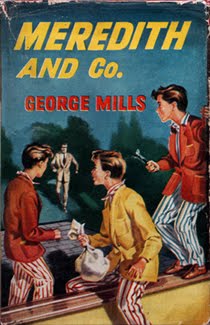
Auchmuty, Rosemary, Robert J. Kirkpatrick and Joy Wotton. The Encyclopaedia of Boy's School Stories: Volume 2. (Surrey: Ashgate, 2000; originally published in 1973) [above, right]


George Mills taught for many years in a preparatory school (after having been a pupil in one—Parkfield, in Haywards Heath), so it is not surprising that his three school stories should have a similar setting.

Meredith and Co. was one of the first prep school stories of its kind — lighthearted and whimsical, a forerunner to the Jennings books of Anthony Buckeridge in so far as it emphasises the comical side of school life, based on the misunderstandings that arise when the juvenile view of things meets the adult view. But it is also a more rounded picture of school life, in which the importance of games and work (the Common Entrance Exam) are not forgotten. The real hero, though, for many readers, was Uggles, a bulldog owned by one of the boys whose unexpected appearances caused havoc.

King Willow was a sequel to Meredith and Co., equally as high-spirited. Minor and Major was similarly set in a prep school, although a different one this time. If anything, it is even more whimsical, with its heroes nicknamed 'Puddleduck major and minor', and a series of pranks and bizarre happenings which disrupt the routine running of the school.


[What a well-considered summary and relatively complete summary of the prep school stories of George Mills. I would have to agree with the assessment that Uggles, the bulldog, was assumed to be a popular character, if by no one else but the publishing houses themselves—at least during the 1930s, when Uggles [far above, left] graced the gorgeous cover of the first edition of Meredith and Co., and was prominently displayed on the spine and in interior plates within 1938's King Willow.]


Kirkpatrick, Robert. "Prep Schools in Books: Celebrating 60 years of Jennings." 8PS Now Online. (www.ps-magazine.co.uk: 28/4/10, 08:13:54 GMT)


Excerpt: Prep schools, with their enclosed environments, rituals, rules and traditions, are ideal settings for fiction. Indeed, prep schools have featured in fiction since the late 19th century, although it wasn't until Anthony Buckeridge began portraying the adventures of J.C.T. Jennings on the BBC's Children's Hour in October 1948 that prep school stories began reaching a wide audience. To begin with, prep school fiction was aimed, not surprisingly perhaps, at young children. An early example was George Mills' Meredith and Co., first published in 1933 and reprinted in 1950 and 1957. These reprints were presumably cashing in on the popularity of Jennings, whose first appearance in book form (Jennings Goes to School) was 60 years ago this year.


[It takes no more difficulty than to look at the entry above to see that what Kirkpatrick has written here is exactly backwards: George Mills breathed life into the boys' preparatory school genre and his titles were popular until the onset of WWII, when, my hunch is, other matters began to take precedence. Following the war, in 1950, Anthony Buckeridge took advantage of a void by cashing in on the popularity of books like Mills's. It would have been tit-for-tat for Mills and his publishers subsequently to cash in on the success of Jennings with George's late 1950s/early 1960s reprints.]


Lucas, John. "Public school fiction faces test of time." Guardian Books Blog. (guardian.co.uk: 4 January 2011, 14.53 GMT)

Excerpt: The tradition of the school story began in earnest with the publication of Thomas Hughes's Tom Brown's Schooldays in 1857, which opened the floodgate for a stream of books, comics and tales flowing well into the 1970s. While the focus of these works varied, from the somewhat earnest moralising of George Mills's 1938 novel King Willow to the slapstick of Charles Hamilton's Billy Bunter and the anarchic hilarity of Geoffrey Willans's Molesworth series, they were nevertheless subject to a series of shared conventions, the recognition of which made them a familiar, nostalgic experience, even to those readers who didn't attend boarding school.


[It is interesting to note that within my lifetime—from 1973 to 2011 here—that there has been a shift in point of view regarding the work of George Mills. In the second entry above, George's books are seen as a "rounded picture of school life", while here in 2001, the Guardian sees the prose as merely "somewhat earnest moralizing". One then wonders how the point of view had changed between, say, 1933 and 1970.]


And that, as they say, is that.

We don't learn a great deal here. The lovers offering paeans to the Jennings books appear to have not read the many, if any, of the titles by Mills, while the most cogent and informed of these assessments cite the Mills books as the "forerunners" of those by Buckeridge.

What can get a feel for, however, is that the books of George Mills are part of a long tradition of boys' school stories still in existence today. Mills was a key—if not well remembered—figure in the transition between school stories that still held Victorian sensibilities and more modern prose, especially in his interpretation and use of jargon, and in the broader capacity of exemplifying that the whole child needed to be addressed by his education through games, sport, and, yes, hard work.

Mills was not prolific. He didn't write stories about Uggles, et al, for years. In fact, rather than starring a single boy, the fiction of Mills shifts the focus from lad to lad as time passes—as happens in real life—and pays homage to the passing of time, another tip of the cap to reality. Boys grow and change. They pass from form to form. They sit the Common Examination, and they leave, existing after that primarily in each other's memories.

It's a unique point of view: Establishing a "brand," as it would be marketed today, and then not milking it for every dollar or pound it could be worth. No Mills was not prolific. But he was, indeed, significant.

Chances are, if you have read any other scholarship or informational, about George Mills, his life, and his books, I wrote it. I do not mean to my chest in saying so: There simply was almost nothing on the internet when I began my research. George Mills on Wikipedia? Shelfari? The addled Library Thing? Yeah, I wrote those.

So if you have or are aware of any other direct references to George Mills or his work, please let me know and I will include it on this site as quickly as possible—and thank you!


Thursday, January 13, 2011

Ain't It Funny How Time Slips Away...


I've been thinking about Dr. David Evans and his recent description of George Mills [right].

"...a very sociable welcoming person."

"...devoted to his sisters Aggie and Vi."

"...but in no way was he dependent on them."

That's good news. As I mentioned in my last entry, I feared that Mills may have become 'damaged' (for lack of a better term) by a string of personal tragedies and illness he'd suffered during the 1940s.

It's good to know that to a physician (and one from a time during which I suppose healers grew to know their patients far more personally), George seemed hale and happy.

Still, the question nags me now just as it did almost a year ago: Why does a fellow write and publish three well-received books during the years 1938 and 1939, and then never publish more than a letter to The Times for the rest of his life—some 32 years?

Backpedaling to the very beginnings of my search for the identity of George Mills, I'll remind you that Heather Lawrence of Peakirk Books in Norfolk opines, "It is possible he just got fed up with writing!"

"Fed up" is a term that I would typically associate with a writer of far less successful tales and far fewer published works. Still, who can say she's wrong?

Another set of words crossed my mind as well. I received a thoughtful and well-considered message from my dear friend, Jennifer, in Philadelphia. Although on a somewhat different topic, it offers a similar line of thinking:

"Maybe [one's] creative life has just run its course. Margaret Mitchell only wrote the one novel... Not every creative person keeps creating until they die. Maybe some people can't sustain that kind of emotional energy. Maybe they don't want to."

That notion of 'not wanting to,' possibly due to being 'fed up,' returns to my mind again and again.

Perhaps while not completely shattering his life, Mills couldn't 'sustain the emotional energy' necessary to write something book length after those tragic events—the death of his wife, a dear friend, his mother, all during a war that left London bleeding and his own health a shambles.

In the words of that noted philosopher, Willie Nelson (seen left, a man who never seems to have lost his muse), "Ain't it funny how time slips away?" Did Mills always mean to write another book? Was his summer term at Ladycross Boys' Catholic Preparatory School in Seaford, Sussex, in 1956 seen as a chance to collect new characters, develop a new setting, and create new stories about prep school boys—a subject he'd once lovingly depicted in such amazingly precise detail? Dr. Tom Houston of the Windlesham House Association describes George thusly: "Mills evidently had a gift for befriending boys and learning their secrets; Meredith & Co. captures the idiom of pupils during the interwar period more accurately than any other novel."

Peakirk's Heather adds: "Meredith & co was 1 of the first prep school stories of its kind, lighthearted & whimsical, a forerunner to the Jennings books of Anthony Buckeridge, in so far as it emphasizes the comical side of school life. However the importance of games & work are not forgotten."

1933's publication of Meredith & Co. by Oxford University Press—a sumptuous, Depression-era book illustrated by the fabled C. C. Brock—speaks volumes about the high regard that was shown by the industry for his manuscript.

Following that with three more books in 1938-1939, had Mills managed so quickly use up all of his stories, his patience, and his passion for writing? And did he ever try to rekindle it all later in life?

Or, despite a nice, little side income from the re-issuing of his schoolboy titles in the 1950s, did the fact that he was an author become something that Mills simply stopped thinking about and ceased discussing with anyone? Were his conversations eventually filled with the weather, bridge strategies, croquet tournaments, and the results of cricket matches at Lord's? Residents of Budleigh's Westfield Road, which ended at the Mills domicile, Grey Friars, today know that another children's author, Charles Warrell, the aged creator of the famed I-Spy books, lived on that very same lane. Why did no one ever seem to realize neighbor George Mills was a children's book author as well?

Michael Downes recently reported: "Budleigh Salterton has a literary festival, and one of the documents produced by our local museum for that event was a list of authors formerly living in the town. George Mills (along with many others) was not on the list, and I have added to it over the years with other names. So George Mills is quite a find for us."

So it seems Mills probably wasn't always 'meaning to get around to it,' as far as writing another book was concerned. Perhaps he was just waiting for inspiration to strike. Still, he certainly didn't let his neighbors and the community at large know of his past, or of any hope he might've had that his literary muse might someday return. Or is it possible he actually had... and no one very much cared?

Jennifer certainly agrees Mills may have been awaiting inspiration and adds: "[But] you can spend the rest of your life sitting around waiting. Tearing things out of one's psyche is an arduous and not always pleasant process. It's easier to say, well, those days are gone. I don't have the energy for that anymore. It's frightening how easy it is to just let your mind sink into its own puddle of lethargy."

Perhaps George Mills was, indeed, 'fed up.' Perhaps he just 'didn't want to' write. Perhaps he faced his own 'puddle of lethargy' and simply never did meet his muse again—even among the prep boys at Seaford in 1956.

For whatever reason, Mills apparently must have spoken so little of his literary career that Budleigh residents never knew they had a popular author in their midst in the person of the very sociable and welcoming George Mills.

Still, I'd love to know: Why?

And I wonder: Is this really all about George Mills?

Or is this really far more about me?


Wednesday, March 10, 2010

Word from Heather at Peakirk Books, Norfolk


I’ve ordered Minor and Major from Peakirk Books in Norfolk, U.K., and have been getting great customer service from Heather Lawrence. Here’s my order info:

ITEMS ORDERED-------------

Item.........MILLS, George:, Minor and Major
Item Number..14155
Quantity.....1

Email: info@PeakirkBooks.com
Peakirk Books
Cherry Tree Lodge
Guist Bottom Road, Stibbard
Nr Fakenham, Norfolk NR21 0AQ
United Kingdom
Phone: 01328 829944

It's in transit, but cooler than simply sending me the book itself, Heather graciously consented to research George Mills. Apparently Peakirk is still in the process of moving its location and a “reference book on Boys school story authors” was in the old place. After retrieving it, here’s what she found out, from an e-mail stamped Wednesday, March 10, 2010; 5:57 AM [bold face and italic are mine]:

Hello again


Ref George Mills - I retrieved my book and it told me the following (unfortunately more about the books than the man).

G. M. taught for many years at a prep. School after himself being a pupil at one - Parkfield, in Haywards Heath) - so unsurprisingly his 3 school stories have a similar setting. Meredith & co was 1 of the first prep school stories of its kind, lighthearted & whimsical, a forerunner to the Jennings books of Anthony Buckeridge, in so far as it emphasizes the comical side of school life. However the importance of games & work are not forgotten.

The real hero for many is Uggles, a bulldog owned by 1 of the boys whose unexpected appearances cause havoc. King willow was equally a high spirited. Minor & Major was set in a different prep school. - even more whimsical than the previous 2.

Sorry not to have more useful information. The school he went to is located in Sussex, if you want to try and locate it - it may have some information on old pupils.

Kind regards

Heather

Thanks, Heather, for going above and beyond! So, we know that Mills apparently wasn’t primarily a writer, but a veteran teacher at a prep school after having attended one in West Sussex [Parkfield, in Haywards Heath] as a boy. Above, left, you can see a photograph of Haywards Heath [circa 1950] describing that location as “St Wilfrid's Church and the Schools.”

Does anyone have any information on “the Schools”? I'd be very much obliged...