Showing posts with label cricket. Show all posts

Saturday, January 14, 2012

New Information: The Chittendens of Seaford and Newlands School


Hello, everyone! I hope the new year finds you healthy and happy! Here, it finds me a bit wiser, thanks to the recent kindness of Richard Ogden, grandson of G. W. D. Chittenden, headmaster of Newlands School in Seaford. Of one thing we are certain: Barbara Chittenden was a dear friend of the Mills family in post-war Budleigh Salterton. Is there, however, more to it than that?

I've included has missive in its entirety for your perusal. It was fascinating, informative, and provides greater depth of background for our research into Seaford, its preparatory schools, and their possible relationship to George Mills.

[Bold-faced font has been added to the text to ease information retrieval.]


I have recently been researching my family’s history and stumbled across your blog. My Grandfather was George William David Chittenden, former Headmaster of Newlands School in Seaford. He preferred to be called David which substantiates your correct assumption that ‘George Chittenden’ and ‘David Chittenden’ are indeed one and the same person.

Newlands is the last remaining preparatory school in Seaford – the girls school, Micklefield (where my mother, Jane, and her two siblings, Philippa and Angela, were educated – Newlands at the time being boys only) having disappeared under a housing development just over a decade ago in much the same fashion as Warren Hill. I have had many rambling conversations with my Grandmother, David’s wife Mavis, who was formerly Matron of the school and who still lives on the grounds. She is always very willing to part with interesting anecdotes about days gone by. She speaks of there being five separate preparatory schools strung along ‘Eastbourne Road’ alone (as you quite rightly asserted, there was a plethora of independent schools in Seaford at one time) all abutting one another. I know that upon the closure of Sutton Place School in 1968, the fourth domino to fall, its grounds were bought by my family and added to the Newlands holdings, becoming Newlands Manor (senior) School. We still have the documentation detailing the purchase of grounds for the original school site (as well as the acquisition of Sutton Place) and as I recall a charming map that illustrates the distribution of housing and schools in the region.


The Chittenden family has been with Newlands from its inception and all of us were saddened to witness its decline over the past two decades that culminated in it going into administration in 2006. It once proudly boasted the epithet ‘Miniature House of Lords’ (Prime Minister Lord Balfour [right], for instance, can be counted among its alumni), something that my Grandfather spoke of with pride. I doubt any of the staff there now would be aware of the school’s quite distinguished history (with, perhaps, the notable exception of Hugh Coplestone, son of the former Headmaster of Sutton Place). This legacy survived in the names of the Boys’ Houses (‘Balfour House’ being one) until very recently, when I believe they were superseded by more modern and generic names such as ‘Dragon House’. My Grandmother, I know, is thankful that my Grandfather at least was spared having to witness the nihilation of the values instilled by successive generations of Chittendens and the fingerprints that they left behind, including the displacement of the family crest on the website (a half Talbot). Given the exigencies of continuing to attract students to the school, perhaps this was deemed a necessary step in ‘rebranding’. Personally, and admittedly with a certain bias, I was surprised that the longevity of the school and its more illustrious past weren’t employed as marketing tools to help attract more students and indeed to encourage alumni to invest in the school’s future. As far as I can tell, the school makes no mention of its famous alumni on its website. Promisingly, the new Head teacher seems to be making some progress improving the fortunes of the school, and when my Grandmother has bumped into her on the grounds, she has remarked approvingly on the strong work ethic and efforts that she has brought to the table to right the floundering Newlands ship.

All of this leads me to the point that could be of interest to you:


Until the late 80’s my Grandfather was the Proprietary Headmaster of the school, becoming school Bursar upon his ‘retirement’. It was in ’86 (I think) that the school acquired Charitable Trust status, my Grandfather ceding financial responsibility for the school. A number of facets were responsible for its subsequent decline – too many to go into here – but when the school went into administration in 2006 my Grandmother (and indeed the whole family) were very concerned that articles belonging to the family (heirlooms and other things such as family photographs, etc) would be unknowingly sold off . To her and to us, the history of the school is synonymous with our family history. The upshot of this is that, contrary to the belief of Newlands’ Registrar, Lisa Sewell, that all records have been ‘lost or destroyed’, much has been preserved by either my Great Aunt (David’s sister, nee Anne Chittenden) or my Grandmother. This body of information and the recollections of both individuals could very well shed some further light on the life of George Mills. Given the close relationship that my Great grandmother Barbara (who died in 1987, the year after I was born) had with the Mills family it would be exciting to find out whether George was ever employed by my great grandfather. In the days when a drink and a cigar were all that was needed to secure employment (and given that they probably shared one or two of both) it doesn’t seem overly implausible. I think my Grandmother would also be very interested in the clips of the sports day events from the late ‘30s and may well be able to definitively identify some of the suit-wearing protagonists on the reel.

To help clarify a few further details:


1. Barbara [right] and Hugh Chittenden did indeed give birth to four children: Joan, Anne, David and Hugh (who died in North Africa in 1942). When my Grandfather died I acquired Hugh’s cufflinks and dress studs – apparently the total extent of his personal effects, untouched since the day he died. Anne is the only surviving sibling and she and I, with the help of my Grandmother, have spent a lot of time collating information on the family’s history.

2. David Chittenden would best be characterized by the bottom left caricature of the snippet sent by Barry McAleenan – He founded the Seaford Seagulls Cricket Club and was chairman of the club until his death in 2001, my father assuming the chairmanship thereafter. An obsessive sportsman he is said to have been a very useful spin bowler (and a big fan of Bradman!)

3. The Warren Hill playing fields pictured elsewhere in your blog in front of Moira House (called the ‘Nuffield’ pitch) were unfortunate enough to have played witness to my paltry cricketing endeavours when I attended Eastbourne College (2000-2005). Refreshingly, the landscape doesn’t appear to have altered much in the past 75 years.

The information that you have gathered made for an extremely compelling read, a lot of it ashamedly being unfamiliar to me. I hope that some of the information above is of use and I apologize that I do not have more information immediately to hand - I’m in London and getting my technophobic older relatives to scan and email me documents is probably a bridge too far! If you are interested in finding out more, I would be more than willing to share any information with you that I can gather over Christmas. Many thanks for the fascinating read.


Many thanks, Richard, for the information, and for the marvelously engaging and colourful way you put it all in context! Your kindness and generosity is very much appreciated, and we'll look forward to hearing of anything you may discover about the school and George Mills. Cheers!


Wednesday, August 10, 2011

Eight Years Later: The Final Chapter of King Willow


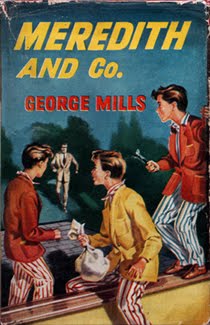
The final chapter of King Willow by George Mills is entitled "Eight Years Later," and it puts the finishing touches on the first two novels of Mills, including his very first, Meredith and Co.

The chapter begins: "It was late on a Wednesday afternoon, and the last day of the Oxford and Cambridge match at Lord's. The ground looked beautiful, the blue sky and green grass combining with the gay colours of the dresses in the crowded stands to make a wonderful splash of colour."

Oxford and Cambridge became the universities where the main schoolboy characters of Mills ended up.

After the match, the three main characters of King Willow—Pongo, Finch, and Falconer, better known as Hawk—end up in the car of Pongo, whom you may recall started as a timid and tearful young boy with a speech impediment at the beginning of Meredith and Co. They begin to discuss their former headmaster, "Peter" Stone, at fictional Leadham House School.

It is here we'll pick up Mill's narrative.


Shortly after the match, the three friends entered a large car that was waiting outside the pavilion. Pongo jumped into the driver's seat, while Finch and Hawk made themselves comfortable at the back. Pongo was on his way down to Sussex, to a small village where he now lived during vacation. He was going to drop the Hawk and Finch at their London hotels before going home…

There was a long traffic hold-up, and Pongo turned around.

'What about coming down and seeing Peter on Saturday? You know he's retired, and living quite near us, in the same village. You'd better come down to lunch, and we'll drop in to tea with Peter. By the way, Hawk, you've got to come see Uggles.'

'Uggles!' cried Finch. 'Is he still alive?'

'Yes,' answered Pongo, 'but he's very shaky on his pins, poor old chap! He'll go nearly mad when he sees the Hawk! There's quite a good train at 10.45 from Victoria. I'll meet you at the other end.'

As Pongo drove off from the traffic block, his mind went back some ten years, and he saw himself once again as a trembling new boy on his mother's arm, as he had waited for the train on the platform of Victoria Station. He addressed his two friends once more.

'I've not seen much of Peter yet, but I'll tell him we're coming. He'll probably give us tea in the garden. He's got a nice little place, and the last time I saw him he was very well.'

By this time the Hawk and Finch had reached their destinations, and Pongo dropped them off with a wave of his hand and a cheery 'Well, don't forget. The 10.45 from Victoria. I'll meet you.'


Longtime readers of this site will recall a message once received from Dr. Tom Houston of Windlesham House School, where George Mills had his first teaching job in 1925-1926. Let's review some of what Dr. Houston revealed about George.


G.R.A. Mills, BA Oxon, taught 4 terms at Windlesham House School [left] from Lent 1925 until Easter 1926, and maybe part or all of the summer, but his name was taken off the staff list by end of summer term 1926…

In 1925 Windlesham was at “Southern Cross”, Portslade, near Brighton; principal Mr Charles Scott Malden; headmaster Mr H D L Paterson; and the dog, Tubby.

In April George Mills married Miss Vera Beauclerc [sic]; they bought a house on Benfield Way, Portslade…

We have no record relating to his sudden (?) departure. He could, like a handful of other prep school masters, have been excited by the General Strike (that term)…

During summer 1935 he visited Mrs Charles [Malden], then in Springwells, Steyning, W. Sussex, and told her he had written a book “largely about Windlesham”, published by O.U.P. “He had been at 2 or 3 schools since, but is very faithful to Windlesham”, she said…

Uggles may have been related to Tubby, the Malden’s popular and heroic dog. The portrait of the headmaster Peter Stone has something of Christopher Malden, who had been in effect joint head for some years; he became principal in 1927. Mills evidently had a gift for befriending boys and learning their secrets; Meredith & Co. captures the idiom of pupils during the interwar period more accurately than any other novel.


There is certainly a wealth of information in those few paragraphs.

The excerpt from King Willow above notes that Pongo had a vacation home in a small village in Sussex. Mills, during the late 1920s and early 1930s was a rather itinerant teacher who had taught not only in Sussex, but in Windermere, London, and Glion, Switzerland, during the time. This home of Pongo's, used during vacations from school, could clearly have been based on Mills's own home in Portslade.

Despite Mills having left Sussex to continue to teach, he seems always to have kept ties there, which explains the repetitive nature of locations in Sussex continually cropping up in the later life of George Mills.

1935, incidentally, was the year during which Windlesham "moved to 60 acres in the Sussex downs north of Worthing," according to a more recent correspondence from Dr. Houston. That event may have occasioned some nostalgia on the part of Mills.

By the way, Charles Scott Malden, mentioned above, had died in 1896, the year of Mills's birth, and could not have been at Windlesham during George's tenure there, although the elder Malden still may have been a legend around campus.


However, it is the actual visit to Springwells, Steyning [right], that is of greater interest here. While what follows is not in any way a non-fiction account of that visit, the occasion must have meant a great deal to George Mills.


It was Saturday afternoon at about four o'clock, and three young men might have been seen walking slowly through the street of a beautiful little village in Sussex. They were arm-in-arm and talking excitedly.

'You know,' one of them was saying, 'Peter doesn't look much older. A bit grayer, that's all.'

The three young men went on talking until they reached a short drive entered by a wide gate that had been fixed against a post. They turned in through the gate and walked up the drive. Sitting outside the house, on a balcony, was Peter, with Mrs Stone. The tea things were laid, and Peter was on the look-out. When he saw his visitors he rose and hastened down the drive to meet them. He shook each hand cordially, his eyes sparkling with joy.

'Well, Falconer and Finch, this is a pleasure. Ogilvie [Pongo] told me you were coming down, and we were expecting you.'

The Hawk kept on looking at Peter. The grand old man had changed but slightly. He was as erect as ever, but perhaps somewhat more portly. He led the way up to the house, where Mrs Stone gave them all a very warm welcome.

Peter certainly had found a beautiful home. The house, an old farmstead, stood in a small but perfect garden. A little lawn stretched away from it, and a kitchen garden was at the back. Rose trees dotted about and well-kept flower-beds made the scene from the little balcony one of great beauty. Peter indicated some comfortable wicker chairs and Mrs Stone began to pour out the tea.

When the young men had settled themselves down, Peter talked about the match.

'I wish I had been there. That must have been a hot catch of yours, Falconer. The papers were full of it.'

'Oh, yes, sir,' laughed the Hawk. 'I told Finch that it was a bit of a fluke. He hit it straight at me, sir.'

During the serious business of tea there was little conversation. Peter kept glancing at the three boys, now grown to men, and he was very proud of them. Soon after tea Mrs Stone excused herself and left the men together. They produced their pipes and settled down to talking. They had eight years to bridge—eight years of ups and downs, of successes and failures at their public schools. Peter listened intently, allowing them to talk on.

After a while the conversation turned to the future and the careers they intended to adopt. The boys asked Peter's advice on all manner of subjects, and he did his best to answer them. Gradually, however, the as was only natural, the talk reverted to Leadham House, but this time Peter did not listen. As he sat back in his chair, blowing clouds of tobacco from his pipe, he was gazing into the future. He saw the three boys, now on the threshold of manhood, all making names for themselves and doing credit to their professions.

He knew their characters and feared nothing. He saw Finch destined for the Bar, a just and fearless judge, honoured by all men. Ogilvie, who was going into the army after his university career, Peter saw as a great soldier and administrator. But when he thought of Hawk, Peter smiled to himself. Falconer had been his favorite pupil, but Peter would not have admitted it to anybody. He knew that the hawk was to reach great heights, and he saw him as a priest in one of the poorest London parishes, cheerful and smiling, with a horde of ragged children clinging joyfully to the skirts of his cassock. He saw him in the midst of squalor and poverty going on his splendid way of radiating love and happiness. As he sat on the balcony that afternoon, entirely unconscious of the conversation going on around him, Peter's mind sped back through the years, and saw the Hawk, once more the grubby, laughing schoolboy devoted to sport and animals…


In this paragraph, filled with Peter's fictional reveries, we find some hidden real-life tributes.

First, Finch had earlier in the chapter been the batsman for Cambridge referred to by Falconer.

Finch is destined for the Bar out of Cambridge—much like the well-rounded mentor of George Mills at Warren Hill School in Eastbourne, Joshua Goodland [left]. While Goodland would never become a judge—Joshua would, in fact, pass away the next year while serving as vicar of the parish of Compton Dundon—it's probable that Goodland had shared with George the thought that if he'd stayed in his law career he might have at some point. After all, becoming a judge would have been the next logical step in his legal career. That step, however, was never taken: Goodland instead bought into Warren Hill School and eventually became owner and Headmaster. Perhaps it had been with regret that Goodland spoke of it with George.


And if this fictional visit to a village in Sussex reflects Mills's own visit there in 1935, it's interesting to note that 1935 was also the year in which Fr Basil Jellicoe, the noteworthy and charismatic reformer from the parish of St Pancras, had passed way from pneumonia at just 37 years of age—but most attributed his death to overwork on behalf of the London's poor children.

We've surmised there must have been a relationship between Jellicoe and Mills before, one that would have stemmed from George attending Oxford, where Jellicoe had run the Magdalen College Mission, which was manned by volunteer students from the university.

Once again, this indicates at the very least some admiration for Jellicoe [right] on the part of Mills, and even suggests that—given the intimacy that fictional Peter Stone exhibits in his knowledge Falconer above, as the latter graduates from Oxford—that the Mills and Jellicoe had been close friends.


Lastly, Peter envisions Pongo as an army officer who would make a "great soldier and administrator." Pongo as a timid young boy with a speech impediment (a lisp), as we know, was based on Mills himself.

So here we have a great clue: Pongo's character soon would be off to the army as an officer after of Oxford.
Mills, along with most others, must have seen war brewing in Europe. Soon after the publication of King Willow in 1938, George would be named an officer in the Royal Army Pay Corps out of the officer's reserve in 1940—interestingly, something Jellicoe had done following university, when he entered the navy as an officer during the First World War.


Spending WWII as a war substitute officer [left] certainly must have appealed to Mills. With the advent of hostilities in China and Europe signaling renewed global violence, a return to the military, this time as a officer, must have been on his mind.

So, here we have some evidence that Mills was already beginning to think that he might not spend the rest of his life writing books, especially as we can see that he was sending his most popular literary characters out into the world as adults.

George had been a failure in the Army Pay Corps during WWI, and in choosing Pongo for duty as an administrator in the army, he was—perhaps unknowingly—charting the same course for himself.


As we close things out at Who Is George Mills?, it seems natural that the examination of this chapter would fall close to the end of our work here. With that in mind, I'd like to finish it out to its end, as Peter sits among his billowing smoke, contemplating the future of the boys:


Then for no apparent reason he raised his eyes, and looked down the drive. What he saw made him sit up and smile.

'Ogilvie,' he asked suddenly, 'why didn't you bring Uggles to-day? I have not seen him for some time, and I was expecting him.'

Pongo laughed.

'Well, sir, he's rather weak on his legs these days, and he was so pleased at seeing the Hawk again that I thought it might be too much for him.'

Peter smiled expansively.

'He seems to have settled that point for himself. Here he comes!'

The three young men looked down the drive and rose to their feet. Uggles was labouriously coming towards them, puffing with his exertions, and Ogilvie laughingly called over to him.

'Come along, old chap, stir those stumps of yours!'

But the old bulldog found the pace altogether too hot for him. He was in extreme old age, but radiantly happy. Every few yards he lifted his head and looked up at his lord and master with devotion streaming from his eyes now growing dimmer. He ambled along slowly towards the spot where his friends were awaiting him, and snuffled as he went.


With that ending, King Willow closes with a paean both to the past and George's love of dogs, but with eyes focused clearly on the future.

George Mills was 42 years old when the book was published and surrounded by notes for his next two texts (which would both be published in 1939), but he was, himself, looking forward as well. Mills, who had known many more failures in his life than successes to that point, would begin to turn things around and make right many of the perceived wrongs he'd endured in his past.

This last scene, with a contemplative Peter wreathed in smoke and the worthy and loyal Uggles snuffling back to his friends, is the sort of sentimental tableau that Mills must have envisioned for himself at the end of his own life.

But before that could be, Mills had some unfinished business. First, his failed relationship with the military would need to be mended, leaving him with a point of pride there instead of a closeted shame.

We'll take a look at the ways in which Mills began to work steadily to vindicate what he perceived to be his failures next time.


Wednesday, July 27, 2011

Kipling, Nicholson, Dewey & Mills


Once in a while, I will thumb through the well-worn pages of the books of George Mills looking for clues. Clues to what, you ask? I'm really never sure, and I'm always uncertain as to what I may find.

Recently I noticed a slight difference between two editions of his first book, the 1933 and 1950 editions of Meredith and Co.

Absent from the 1933 edition are the following lines:

Give me a willow wand, and I
With hide and cork and twine,
From century to century,
Will gambol round thy shrine

                          —Kipling


The verse comes from a publication entitled An Almanac of Twelve Sports, published in 1898 by English woodblock printmaker William Nicholson, "with words by Rudyard Kipling." It is set up as a calendar of sorts:

January – Hunting; February – Coursing; March – Racing; April – Boating; May – Fishing; June – Cricket; July – Archery; August – Coaching; September – Shooting; October – Golf; November – Boxing; and December – Skating

An additional verse also appears within the actual text:

Cricket.

  Thank God who made the British Isles
       And taught me how to play,
     I do not worship crocodiles
       Or bow the knee to clay!

     Give me a willow wand and I,
       With hide and cork and twine,
     From century to century
       Will gambol round my Shrine.


While cricket plays an important part in both Meredith and Co. and it sequel, King Willow, football and track & field are featured as well.

The appearance of this Kipling verse, it seems, is about far more than cricket. This also seems the perfect time to examine it, immediately after entries regarding other features of Mills's first two novels, both of which feature the playing of the sport.


My hunch is that when George Mills attended school himself as a boy—he went to Parkfield in Haywards Heath and then Harrow—things would have been difficult for him. After all, he was slight of build with a speech impediment. How much of the discomfort he felt at school was attributable to any institution, and how much could have been ascribed to the nature of young boys in such an environment, is unknown.

When his first book about boys' preparatory schools, Meredith and Co., was published in 1933 it carried the subtitle: "The Story of a Modern Preparatory School."

In subtitling his text, Mills clearly draws a distinction between the schools he attended—not physically, but in their philosophy of handling and educating children—and the "modern" schools at which he'd taught in the late 1920s and early 1930s.

Mills taught in an era greatly influenced by educational reformer John Dewey [left]. Texts of Dewey's with which Mills may have been familiar were The School and Society (1900), The Child and the Curriculum (1902), and Democracy and Education (1916).

Of Dewey, Wikipedia states: "In his eyes, the purpose of education should not revolve around the acquisition of a pre-determined set of skills, but rather the realization of one’s full potential and the ability to use those skills for the greater good… Dewey advocated for an educational structure that strikes a balance between delivering knowledge while also taking into account the interests and experiences of the student."


The books of George Mills clearly illustrate exactly that sort of balance in many overt and subtle ways. While the settings in the books of Mills are traditional, as are the classroom management techniques, the overall focus on the development of the child as a whole is obvious.

In Joanna S. Hall's paper "John Dewey and Pragmatism in the Primary School: a thing of the past?" in the journal Curriculum Studies, Volume 4, Issue 1, 1996 , pp. 5-23, the author studies Dewey's influence on British education.

From the abstract we learn:

In 1906, J. J. Findlay, Professor of Education at Manchester, eased English readers into pragmatism's foreign beginnings by setting John Dewey alongside Pestalozzi, Herbart and Froebel. This paper investigates the interweavings of pragmatism in the years following the First World War, when it appeared in views of children, pedagogy and curriculum.


This is the time George Mills lived, seeing these developments first hand. What a shock it must have been, however, following World War II, when George returned to being a schoolmaster and discovered that his notion of that ideal, modern prep school had been greatly altered.

We read last time about some anonymous readers here discussing their experiences with public school education, circa 1950 – 1975: "I'm afraid that the Catholic school system, as you probably know, was infested for many years by paedophiles and ghastly sadists," and "In hindsight it was a hideous, sadistic and monsterous Dickensian nightmare of a school."

None of that could have coincided easily with what George considered a "modern" education.


Hence, the verse by Kipling [pictured, right] is found, not in the 1933 edition of Meredith and Co.—the first edition, published in a modern era during which Mills had great hope for education—but in the 1950 edition, and subsequently the 1957 edition, the latter printed at a time when Mills—aged 61—would have been jaded about preparatory institutions, their changing philosophies, and their often questionable practices.

This Kipling poem hearkens back to the time of Mills's boyhood, when reality had to struggle mightily to separate itself from a young boy's fantasies, and the simple joys of that time of life seemed as if they might last virtually forever—"From century to century…"


This nostalgic note in the final reprinting of Meredith and Co. is telling. Mills had seen the changes that had taken place in school teaching and education, but he never addressed them directly. No new titles or characters leapt from his pen—or typewriter.

In a subtle change to the original layout of his first novel, Mills inserted a simple verse that allowed himself to drift back, nostalgically, to a time that made far more sense: To reading Kipling in bed, to dewy cricket pitches warming in the sun, to Modern Preparatory Schools, and to the never ending innocence of youth.

While that verse seems to be about the sport cricket, it actually says so much more about the life, the teaching career, and the nostalgic thoughts of an aging George Mills.


Sunday, May 30, 2010

Gen. Hallam, Col. Dudley, and the Ten Missing Pages


Mail's in!

I've received parcels from England and Australia in the last couple of days, but they haven't quite lived up to the excitement of the arrival of the 1933 edition of Meredith and Co. last week.

A real disappointment came from Australia, whence I received a a partial copy of Col. Dudley A. Mills's significant publication, British Diplomacy in Canada: The Ashburton Treaty. It was published, not as a stand-alone piece of literature, but in United Empire: The Royal Colonial Institute Journal, New Series 2 (Oct 1911) on pages 681-712, and included the apparently definitive 'Mitchell Maps' [above, left].

Unfortunately, I've received only pages 681-702.

Dudley Mills is the uncle of George Mills, and spent his career traveling the world with the Corps of Royal Engineers. A brief biographical sketch on-line describes him in this way [my emphasis]:

"Dudley Acland Mills was born at Eastbourne in 1859. He appears on the 1861 census staying at Killerton House at Broadclist in Devon, the home of his grandfather Sir Thomas Dyke Acland. His parents were Agnes Lucy (née Acland) and Arthur Mills, the M.P. for Taunton from 1857 to 1865 and the M.P. for Exeter from 1873 to 1880.


Dudley Acland Mills joined the Royal Engineers as a Lieutenant in 1878, rising to the rank of Captain in 1889 and Major in 1897. In 1896 he married Ethel Joly de Lotbinière. They had one son and two daughters. Colonel Dudley Acland Mills died on 22 February 1938. According to his obituary in The Times (26 February 1938), he was 'an authority on things Chinese and early maps and a man of all-round culture and knowledge.'"

Researching the Ashburton Treaty is on my big "to do" list of all things Mills, but the journal United Empire itself describes Mills's well-researched document full of painstakingly reconstructed maps as "a valuable step towards clearing away misapprehensions which, in the past, have sometimes clouded the relations between Canadians and their Mother-land."

I'd like to think I could report on the entire article, but may only be able to survey through page 702, depending on the reply I receive from Serendipity Books in West Leederville WA, Australia, about the missing pages.

I also received printed material from Alton, Hants in the U.K.: A brand-new, apparently self- or privately-published edition of An Account of Stewardship: 1979-1984 by Major General Giles Hallam Mills, Resident Governor and Keeper of the Jewel House, Her Majesty's Tower of London [title page, right]. It has been implied that General Mills [not to be confused with the American cereal company] is a relative of George Mills and family, but I've been unable to verify that independently.

It's a thin, 41-page text, hand bound by E. A. Weeks and Son, London, and is comprised of nicely reproduced photocopies of typewritten pages, probably "pica" if I'm correctly recalling the days before word processors when a "font" was better known as a reservoir than as a typeface. It promises to be a very factual read.

How Hallam Mills is related to the Mills family of our interest isn't quite known, but I'll read the volume anyway. At least it arrived with all of the 41 pages intact.

Meanwhile, wish me luck in my quest to receive the missing pages 703 to 712!

It's a gorgeous, sunny, hot morning here in Florida, and I'm still basking in the glow of pitcher Roy Halladay's perfect game for my beloved Philadelphia Phillies last night in Miami [left]. It was only the 20th perfect game in the history of baseball, and the second this year. The last time there were two perfectos in a season was 1880, accomplished by pitchers from the Providence Grays and the Worcester Red Rubys—the first two perfect games ever thrown.

I'm not sure exactly how a perfect game might translate to cricket, but I have read exciting passages in the books of George Mills about bowlers striving for "hat tricks." My cricket knowledge is obviously not exactly what it should be.

I recently read about the triple-centuries in Test cricket, accomplished by only 20 different players since 1930. Would this be a similarly rare accomplishment?


Tuesday, March 16, 2010

Peeking at Warren Hill via Satellite


Hello! I’m back, and still wondering about the schools named in the dedication written by George Mills in Meredith and Co. Yesterday I came up with information regarding Windlesham House, courtesy of their alumni association. Today I thought I’d investigate Warren Hill School outside of beautiful Eastbourne [seen in the distance above], and I ended up doing much of it by... uh... virtual automobile, without ever leaving my desk here in Ocala, Florida!

On the Boys' Historical Clothing Web Page, there is a tidbit of useful information about the school: “[A photo] album contains a collection of photographs from the Warren Hill School in Eastbourne. It appears to have been a public school, meaning a private secondary boarding school. It may have been a prep school. In the photographs we note the boys look more prep school age than public school age. Only public schools would have had cadet programs. The photographs date from about 1885 to the early 1900s. Unfortunately we have been unable to find information about the school itself. It is not an active school, but we are unsure just when it closed.”

Access to this site is limited [Honestly, it costs money to see the actual photos, and I’m thinking carefully about how badly I want to spend it], so I have no photos to share right now. However, I think it’s safe to say that, given G.M.’s involvement at the school and the age level of the children in his books, it was a boys’ preparatory school.

Subsequently, in a “Sussex county-wide forum” from the website british-genealogy.com, I found a thread called “
Warren Hill School-Eastbourne”. One entry, posted from South Australia [!] and dated 02-05-2008 02:32 AM, reads in part:

While searching for yet another Martin Family member( will it never end?) I arrived at the 1901 census for an Eastbourne school, 'Warren Hill 'on "Beachy New Road". It had students from all over Britain. My possible was 11yrs. others on page were 12 + 13…

cheers wendy


Looking for a Mills makes me feel sympathetic to someone looking for a Martin. Good luck, Wendy! Anyway, given the above “address” of Beachy New Road, I put Google Maps to work and found what appeared to be “Warren Hill” itself [marked with a pink push-pin], just north of a “Beachy Head Road”:


Considering that a “South Australia” factor might be at work above in trying to determine the name of a road half the planet away, I decided it wise to start tracking Beachy Head Road. Here’s a view of the road sign seen as one approaches Beachy Head Road by car. Is this “Beachy Head Contryside Center” possibly where the school was located? I'll tell you why I think it might be...


The road turns south, traveling near the sea, and as it does, there are some obvious fields off to the east of a driver—some 200 feet west of the surf—that certainly look strange to my American eye:


Zooming in, they probably looked like cricket fields to my untrained eye, but what do I know?


So I did a search and came up with this, comparing baseball and cricket fields:


Yes, I guess even an American should be able to recognize what at least might once have been a cricket pitch! So, apparently some sort of cricket field is still to be found along Beachy Head Road, a thoroughfare that may be at or near the location of what was Warren Hill School. Please correct me if I'm wrong!


The school must’ve had some spectacular views. Here’s a screen capture from a Google Street View, taken while I was “driving” south along Beachy Head Road, looking east over what would be the cricket fields down below the crest of the hill [you may be able to just see benches that are angled to look down on them] and at the amazing flourish of sky, light, and sea out over the English Channel. In the inset, you can see the fields.


It’s interesting to speculate that these are the same pitches upon which Mills could have watched youths play, eventually leading to a book like his King Willow. As an American, it’s even more surprising to me that they’re still there—here in the States, it would seem uncanny that they hadn’t been overly industrialized or completely rearranged to accommodate high-profit tourism for decades now. It's all overwhelmingly beautiful, and if you're viewing this from the U.K., none of this must seem like any sort of big deal. To me, though, it's all breathtaking and meaningful.


Anyway, as of yesterday, it was still unclear whether or not Mills might’ve played there as a lad or had been present there as a master. But that's all come into remarkable focus based on information I’ve received today from the Windlesham House Association.

And, boy, am I excited about the news!