Showing posts with label anglican. Show all posts

Tuesday, August 30, 2011

Summarizing George Mills: A Final Perspective


Much of our story here involving George Mills has revolved to a great degree around one thing lately: Religion. However, there certainly are many threads running through his story, and in this—oddly my 300th and hopefully not my final post— we'll begin to summarize, to some degree, what we have learned about George's life.


The Mills Family and Catholicism

It seems odd, at least to an American viewing it from the vantage point of the 20th century, that George's father, the Revd Barton R. V. Mills, converted to Roman Catholicism while attending Oxford around 1883 and then took a series of positions as an Anglican vicar afterwards, eventually ending up as assistant chaplain at the Chapel Royal of the Savoy in London, and doing a segment of Queen Victoria's funeral service. No one else seems surprised or very much cares save one man: The current chaplain of the Savoy, Peter Galloway, who simply chooses to disbelieve, preferring the strange point of view that the public record of the conversion of Mills must be in error.

I guess that's why they call it "faith."

In fact, I recently wrote to a Church of England vicar of today to ask about the relations among the Anglican Church, the High Church, the Low Church, Anglo-Catholicism, and Roman Catholicism. I let him know that some very learned people in the U.K. have expressed directly to me that there's really not much difference at all, especially today, and that it's unlikely anyone cared very much back then, either—hence the vicarages and the chaplaincy to the Savoy being awarded to Mills.

Like most people I've contacted who are involved with the Church, that vicar never bothered to reply to a collegial request for research assistance from an educator. (Just an aside: When clerics contact scholars, do they expect assistance in their own research? If so, that would be quite hypocritical!)

In lieu of that learned opinion, the difference between the Anglican Church and Roman Catholicism seems, however, to have been a big enough deal for some people actually to make the effort to convert from the Church of England to Roman Catholicism, and to form specific religious societies, and publishing houses, and the like, especially when converting was 'of the moment' in the early 20th century.

I think it might a bigger surprise that George Mills was friendly with Roman Catholic converts, frequenting their haunts, publishing with their publishers, and basically living a very Roman Catholic life, all the way through to his funeral service at the Catholic Church of St. Peter's in Budleigh Salterton (as opposed to the St. Peter's C of E there), than it is that he might've been gay, for example, as we recently heard discussed.

Given the overtly Catholic nature of many of George's friends, religion seems to have been the windmill at which Mills tilted most as the son of an Anglican vicar—even if his father also had been a closet Roman Catholic—in an extended family involved fully in Church of England. His sexuality would seem to have been secondary.

Having moved away from the Church of England also seems to be an explanation why distant relatives living today simply don't know the "Barton R. V. Mills" twig on their branch of the family tree exists, let alone anything about any of the Mills family. Honestly, except for a few recollections by a few ancient relatives of George's Uncle Dudley Acland Mills, now living in Canada who do know, but apparently are not interested in the Mills family at all!


A Childless and Forgotten Family

It didn't help that all four of the Rev. Barton Mills's children died childless (unless George's brother, Arthur, had late-in-life offspring I can't locate), but there's something more to the fact that virtually no one knows or cares who these people are or that they even existed.

Except, to some degree, for the women who married into the Mills family.

In the case of Vera Beauclerk (Mrs. George Mills), her family today bviously knows about her, and she's easy to trace—being descended from William the Conqueror.

Considering Edith Ramsay (Mrs. Barton Mills, George's mother), her surviving family today knows of her, but not very much, even to the point of having documented her Christian name incorrectly [as Elizabeth]. It's as if she dropped off the very face of the Earth when she left her nuclear family after marrying Barton Mills and moving to Kensington, just blocks from Buckingham Palace. Of Edith's parents, much is known today, including the possession of a great deal of ephemera, much of which has appeared among these pages. Of Edith herself: Nothing, save the image of her as a toddler in the montage at left.

The last in-law, Lady Dorothy Mills (née Walpole, Arthur's first wife), maintained a high profile of her own as an author/explorer until a horrific car accident drove her into retirement, despite the fact that her family quite literally disowned her for marrying a soldier. They divorced in 1933. Also childless, she has been allowed to fade into obscurity since her death in 1959.

Her onetime husband, George's half-brother Arthur, apparently barely acknowledged his family, and is the best-kept secret of all the Mills siblings.


Something is amiss in all of that.

George, Arthur, and their spinster sisters—Agnes and Violet; very athletic girls, into the Girl Guides and scouting, who never found mates at all and were devoted to George, and he them—were an entire little family all of whom, sadly, had failed to reproduce to continue the family name.

Still: Why does almost no one recall that these people ever were?


George Mills at School

George had been in a great deal of pain in his life and not all of it could have been addressed with an aspirin or two. Physically slight of build, with varicose veins as a boy, and saddled with a speech impediment [possibly a lisp like his sister Aggie's, causing an unclear voice], I can see why he would've preferred sensitivity in the people around him—but boys at school probably tormented him. He basically washed out as a young scholar, spending a brief two years at Harrow. He would not have excelled at something he always loved: Sport, especially cricket. Stronger, more confident, less sensitive boys would have made his life miserable in a variety of ways, even unknowingly.

George had stockpiled many regrets based on his own preparatory schooling.


George Mills during World War I

I don't see Mills's life having been much better as a "Grade III" army recruit (unfit for most military duties) in the service during the First World War. Except for his time in the Army Pay Corps, the corps where the friend and fellow B-III, Egerton Clarke, was also assigned, the slightly built and sensitive Mills must have faced similar torments to those he'd known at school.

The army was another place where Mills would have been a failure: He was a washout as a soldier, a washout as a APC clerk, and a fellow who had been determined fit only to be a "fatigue man"—the lowest form of military life, with virtually no hope of promotion. And things, as we've seen, got worse for him after his friend Egerton was hospitalized and demobilised, leaving George in Winchester alone.


George Mills at Oxford

After having been demobilised himself, George attended Oxford for three years or so and managed to leave without having taken a degree or a single examination to earn one. The academic and social discipline required by an institution like Oxon would have been a struggle for Mills, who had lived a sheltered life, especially in regard to having been allowed to 'quit' when the going got tough, as they say, during his preparatory schooling.

Without that degree, gaining a career in which he could have been a success—and make his father (twice an Oxford graduate) proud—would prove then to be difficult.


George Mills As a Non-Author

As a youth grown into a man, George Mills had been the only male member of his immediate family who had not published a book, from his paternal grandfather on down! While that may never had been said to him directly, when the men all were discussing their books and their publishers, George had to know he was the only one just listening.


George Mills, Schoolmaster, 1926 – 1933

Failed as a schoolboy and scholar and failed in the military, by 1933 we know George also failed to hold down a regular teaching job for very long. He had moved from school to school as a teacher between 1924 and 1933 (one assignment being as far afield as Switzerland) in search of a situation. This presumably meant time spent away from his family, and even his wife.

Something during this time, however, 'clicked' for Mills.

It seems to have been spurred by his relationship with Joshua Goodland at Warren Hill School in Meads, Eastbourne [below, left]. Although Goodland had managed to take two degrees during his seven years at Cambridge, he never fully settled into a career. Goodland was an occupational nomad, veering from a career in teaching to becoming an architect, and following that, a career in law. He then returned to teaching and became Head Master at Warren Hill before eventually turning to his final vocation, serving as a vicar in the Church of England.

Goodland was a diminutive but passionate man, older than George, who had traveled around the world and possessed a myriad of skills and talents, but who lacked a sort of stick-to-it-ness (as we say in the States) that would have inspired the erratic young Mills to find success in his own life in a similar way: Not necessarily along a single, direct career path, but divergently.


In 1932, Barton Mills, George's father, passed away. This simultaneous event, a tragedy, also seems to have been a catalyst and clearly a pivotal point in George's life.


Vindication of His Failures

Mills tackled his lifelong failure issues seemingly one at a time, and began to assemble a future. Whether or not this was consciously done, we cannot tell.

He seems to have gained a great deal from his time spent at Oxford, even if he didn't earn a degree. He met and had been exposed to a sensitive class of fellows who, rather than hurting George, seem to have understood him—perhaps that was something he'd never experienced within his own family—and those well-educated men even liked and cared about him. He learned about himself as a person, as well as receiving reinforcement regarding his faith in Catholicism.

His university experience planted many seeds that would later begin to flourish.


George Mills Returns to Prep School

Some success and popularity at Oxford led Mills to do something that many children-grown-into-teachers do: Return to the scene of previous educational 'crimes' against him and others like him, intent on 'righting' many wrongs that had been perpetrated upon him while at school.

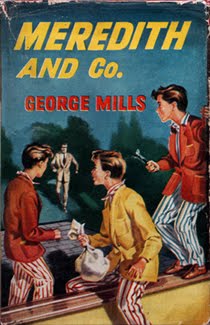
During the late 1920s and early 1930s, under the auspices of progress and enlightenment in education, he then spent time teaching in schools and being the sort of schoolmaster he'd wanted to have, I suppose: His first book is fully titled Meredith and Co.: The Story of a Modern Preparatory School.

Key word: Modern. Things now were finally different in the world of British education, and George had returned to become a part of it all.

Much of what he wanted as a schoolmaster likely was acceptance within some educational institution more than any sort of abstract revenge: During his time in the classroom he was liked and appreciated by faculty, staff, and students, all within a milieu in which he was once considered a failure.


George Mills Finds Success as an Author

After he was unable to hold onto one job for long as the world moved into a severe global economic depression, George then wrote books about his fledgling teaching career—a vocation that he may not have returned to, as far as we know. (There's no evidence he taught more than a single term after WW2.)

This process of writing and being published, in a family of both distinguished scholars and popular authors, enabled him to raise his esteem, I'm sure, in the eyes of his family, as well as in his own. We find that yet another area in which he was dismal failure could be checked off his metaphorical list, and not just barely: His books became popular and were unique in having captured much of the behavior, slang, and idiom of British Schoolboys between the wars, becoming the forerunners of a literary genre that would later flourish.

Once Mills published his third and fourth book in 1939, the label "author" could clearly and permanently be attached to him. Clouds were gathering darkly over a Europe increasingly held in the steely embrace of fascism, however.


George Mills and the Royal Army Pay Corps

There were not many failures left to vindicate, but next came George's lack of any sort of success in the military in general, and within the Army Pay Corps in particular. George had been summarily and permanently sent packing from the APC during his dismal service there during the Great War, so I understand why, while enjoying success as a writer at 43 years of age, all of that was cast suddenly aside. He obviously had put his name into the Officer's Reserve pool as a War Substitute (probably claiming to have the Oxon degree he'd falsely told his prep schools that he had earned) at the onset of the Second World War.

We find that Mills soon ended up back in the Royal Army Pay Corps in 1940, and it must have been all the sweeter when he walked in this time wearing the uniform of a 2nd Lieutenant. George then would have been walking on metaphorical air when he eventually was promoted to full Lieutenant in 1942! Check 'success' in that area off of his 'vindication list'—although it would be short-lived.

Never what we'd call a "finisher," Mills relinquished his commission as an officer in 1943, after just two years, due to "ill-health." He was awarded the honorary rank of Lieutenant.

George's life had been bombarded by loss during this time period, and he would suffer more by the end of the war—the deaths of friends (Terence Hadow, Egerton Clarke), colleagues (Capt. Wm. Mocatta, Joshua Goodland), and loved ones (his wife, Vera, and his mother, Edith), all between 1939 and 1945—which is something he admittedly had in common with the rest of the British Empire during that time frame. It is distinctly possible Mills then suffered from terrible depression.

As we know, George's "ill health" didn't permanently debilitate him, which is fortunate because George had one more item to be dealt with on his 'checklist' of youthful failures, and it would be the one that took the longest time for him to get around to vindicating.


George Mills and Sport

Where Mills was and what he was doing between the end of the war and the late 1950s is unknown: They are George's Missing Years.

By the late 1950s, however, he was playing competitive croquet out of Budleigh Salterton and had quickly and respectably shaved down his beginner's handicap. George went on to win a number of tournaments along the south coast of England before he played his last match in 1970 at 76 years of age.

It's unlikely that athletic competition was something the slight Mills had ever felt good about before the age of 60, and though I imagine his trophies could not have been described as huge, I believe they must have been treasured by him as if they had been colossal!


George Mills and Catholicism

In a world that so recently had been fought over quite violently by Fascists and Communists, there is circumstantial evidence that Mills may have had Socialist leanings during the time. Toss in the lifelong struggles George had had along the way with religion, discussed above, and Mills always seemed to have had something on his philosophical plate!

Mills attended the local Catholic church in Budleigh, where he lived his last years with his spinster sisters, Agnes and Violet, at Grey Friars on Westfield Road, next to the croquet club. With his allegedly Anglican father no longer living, and with no close relatives nearby to embarrass (Arthur had died in New Forest in 1955), he finally could be comfortable and public worshipping in his chosen faith.

One does wonder about his relationship with croquet's Maurice Reckitt, the renowned Christian socialist author who, however, was "terribly anti-Roman Catholic," according to fellow player, Dr. William Ormerod. Did they ever speak of it?


The Social George Mills

From the time of George's first teaching appointment at Windlesham House School in 1926, to his obituary written in 1973 by Lt.-Col. G. E. Cave for the Croquet Gazette, George Mills was seen as a very social man. He has been described as "sociable," exuberant," "lovable," and that "He made people laugh, a lot."

He once was also so keen on children, and was so able to become part of their world in his prep schools that he could write unprecedented and insightful books about the world of his students, books that looked far beneath the veneer of the prep school classes, curricula, and discipline and saw the inner child.

One wonders, then, why so very few people remember George.

His physician in Budleigh does, but except for a few patent comments, Dr. Evans of Budleigh isn't saying much.

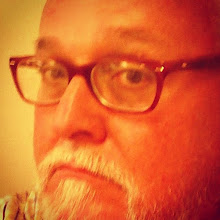
Barry McAleenan, a great friend of this site, knew of Mills as a child, but only really recalled that he likely was a user of snuff. (Barry, by the way, possesses the best photograph of George Mills known publicly, and it is seen at the top of this page.)

Joanna Healing and Judy Perry remember many of the characters during that era of croquet, and while Agnes and Violet Mills are more easily recollected (especially Agnes), George Mills really is not. Not at all.

A clue arrived recently via Martin Granger-Brown, who recalled George's sister "Aggie was very haughty and posh and used to look down on people," something that could have affected public perception of George as he chose to live the final years of his life in her company.

Another clue may be found in the recollections of Dr. William Ormerod. Upon hearing George described as "exuberant," "loveable," and "enthusiastic," he replied, "Those are words I would use to describe Gerald Cave himself."

Given the speech impediment of Mills, Mills may have been extremely uncomfortable with strangers. He may also have been somewhat of a chameleon, reflecting the positive qualities of those he was with, so as to keep himself in harmony with situations that could have caused him a geat deal of social anxiety.

Perhaps Mills was "exuberant," "loveable," and "enthusiastic" with those who, themselves, acted exuberantly, lovingly, and enthusiastically with him. And it follows that those who were cold or unaware of him always would remain so, as he likely would have called no attention to himself.

This would also explain why so many were unaware, during the final years of Mills's life, of his past success as an author.


Summary

Why is a man—George Mills—who was known to be so sociable, so amusing, so full of life and laughter, and a man who not only enjoyed children but seemingly understood them as well, remembered by so very few?

The life of George Mills seems to have been divided in to two halves: Failure and Success—or at least noteworthy degrees of each.

It took fifty years, but George finally vindicated himself regarding the aspects of his life in which he felt like a failure.

It doesn't appear that he ever struggled to survive financially, and that he was a relatively popular, stylish gentleman through the end. He left us childless, as did his siblings, so there are no stories of Uncle or Grandfather George at Christmas, Baptisms, funerals, or on holidays. No stories told by him were repeated to a subsequent generations of children. No one remains, then, to recall the way he spoke, smoked, or laughed.

He ended a man about whom, following his death, very few would ever think again.


The following quote recently entered my e-mail box as part of the signature of a sender, and it immediately struck me:

To laugh often and much; to win the respect of intelligent people and the affection of children; to earn the appreciation of honest critics and endure the betrayal of false friends; to appreciate beauty, to find the best in others; to leave the world a little better; whether by a healthy child, a garden patch or a redeemed social condition; to know even one life has breathed easier because you have lived. This is the meaning of success.
———————————————————————————————————————————————Ralph Waldo Emerson


Those are hopeful words by which we any of us might assess the true value of our lives.

Emerson's words summarize the impact that George Mills—now seemingly forgotten—had on the world. Whether or not he is remembered widely doesn't lessen any of the impact he did, indeed, have—especially on me.

Still, it's nice for someone, anyone, to be remembered, and that's what Who Is George Mills? has always been about.

Unless new information comes to light (as, I'm grateful to say, so often has happened here over the past year or more), unless I'm contacted by a relative, friend, or acquaintance who remembers George and his family, unless we receive a copy (or scan, or photocopy) of his last children's book, or unless we discover his letters or other ephemera that would help us know more in answer to the question, "Who Is George Mills?" then my work here is essentially done.

And I've enjoyed it all. Thank you so much: Everyone.


Goodbye for now, George.


Monday, July 25, 2011

Egerton Clarke: A Final Look at the Man and his Work


After a month of almost full-time study, I feel as if Egerton Arthur Crossman Clarke—orphan, scholar, soldier, poet, librarian, and art director—has become a part of me.

While I can appreciate and enjoy Clarke's poetry, I'll admit to being far more of a "free verse" sort of fellow, the Chilean poet Pablo Neruda being my one of my favourites, along with American Langston Hughes. Egerton's early work in couplets and quatrains simply doesn't move me the way I am certain he would have preferred, and any critique I could offer, save a dim "I like it," would be embarrassingly uninformed.

To the rescue comes friend of the website Jennifer M., an English Literature major from prestigious Gettysburg College in Pennsylvania. Over the past few weeks of my obsession with Egerton Clarke, I've shared information and his poetry with her, and she has generously consented to share with us her thoughts on our subject.

The real beauty of what she has written is found in being able to follow her along the linear path of her thinking about Egerton Clarke, his life, and his work. Flavoring it along the way with thoughts of the poetry she's read, as well as some personal experience and the influence of outside readings she has done, makes the result a commentary, rooted in informed speculation, on the life and times of Clarke, and to a degree, George Mills.

Mostly regarding Clarke's text, Kezil and Other Poems, and presented in her own words, here it is, interrupted only an occasional note answering any questions she had along the way. You can also click HERE to read the poems in a different window as she discusses them.


Sunday, June 26, 2011 11:49 AM

What really interests me is the dedication. Ernest "opened the door for me," Gerald "opened my eyes once and for all," and the mysterious "Kezil" who inspired so much. My first thought is that Egerton was gay, and he's subtly paying tribute to friends/lovers who helped him come out in some small way. The poem refers to Kezil as a "she" but of course that could have been just for cover.

It's an interesting coincidence that you would send me this now, because I just added Wilfred Owens' poetry [Owen is pictured, right] to my Amazon wish list, and Clarke's book was written around the same time. I know I had read "Dulce et Decorum Est" in high school or college at some point; when I read it again just recently I appreciated it on a whole new level, and I decided I would like to read more of his poetry. Clarke's poetry is different, of course, not all about the horrors of war.

I often prefer "old fashioned" poets like Clarke or Owens; I can understand what they're trying to say, and because they don't use the surrealistic or outlandish imagery of later poets, the ideas can really sink in more easily.

I like "Kezil." It's very romantic in a mysterious, "Far East" kind of way. The imagery of all the red and the sun and the feast on the lawn reminds me of some of the imagery of Maugham's stories. I imagine a landscape hot, maybe in the desert, the sky is shades of red, orange and gold, and lying about as the heat starts to increase as the sun rises, remembering the lovemaking of the night before as "poems of his body's memory/Carved upon the lawn." Clarke is remembering all this from a long time ago, and it was so wonderful he thinks it may have been "but a garden dream." The poem is "writ/But as yet unread," maybe because Clarke never told "Kezil" of his feelings for her/him?

Feel free to tell me I'm way off base, if I am. But I have a feeling I'm pretty close.

I loved "Shadows" because the imagery is of a time that I enjoy reading and watching movies about: a graceful old England, tea in the garden but not a simple picnic, no, we have a table with lace cloth and the good china things brought out to the garden by the servants. It reminds me of some reading I've done about the British Raj, where these people in India would go on an outing and take half a dozen donkeys with tents, furniture, household utensils, and loads of other things just to spend the day outdoors, but in
comfort and with as much style as they would have at home. I was just out on my balcony cooling off before coming in to write this, and while I just have my little folding chair, it is nice to sit outside, away from TV and music and internet, and just laze around with a book on my lap, or just look around me at the trees, thinking my thoughts.


Monday, June 27, 2011 7:30 PM


It occurred to me yesterday after I sent you my thoughts about Egs that maybe I was viewing him through "Maugham colored glasses," so to speak. I've read most of Maugham's works and two biographies of him (the best by far is The Secret Lives of Somerset Maugham by Selina Hastings). He was gay, but for most of his life homosexuality was illegal in England, so he constantly had to hide who he was. He traveled all over the world, where in some places it was more tolerated, and retired to France. He had two long term relationships (Gerald Haxton and Alan Searle) and a number of other lovers, as well as a wife (Syrie) for cover, who bore him a daughter (Liza). The caption under the first picture of him is "a lonely child, guarded and withdrawn." People who knew him guessed that having to hide his sexuality went a long way towards making him a guarded and private person in general, who often had little tolerance for other people's foolishness. His stories are brilliant, his travel writing also fascinating, yet most people who knew him felt they didn't really know him. There is one *ahem* remarkable picture in the book of Maugham and some male friends sunbathing nude. So on their private estates they could let their hair down a little, but they also had to be careful who was around.

Anyway, I realized that I was applying many of these standards to Egs, and assuming he was gay. And they could all be true, or none of them true. But that dedication sticks with me. I'd be curious to see the dedications in his other books. I think the one in Kezil is one of the longest I've seen in any book. Do you have any idea who Gerald Crow and Ernest Duggan were? (And I agree with Egs that deciding who to dedicate your first book to would be a difficult choice, which makes his selection of Gerald and Ernest all the more significant.)

[Crow was an influential poet at Oxford during the time. Duggan did not attend Oxford, and there is not enough information about him to identify him from among the many Ernest Duggans of the era.]

I was thinking too about George, and your comments in your croquet article that there was really no trace of him after WWII, except for the croquet results. I imagine it would be hard for him, serving as an Army paymaster but not serving in the Army itself, handing out pay to men he knew might never come home. That could mess with your head. Do you know how George and Egs met? Was it in the Army?

[As we know, Egerton served almost exclusively with the Army Pay Corps in Winchester, Hampshire, where he became acquainted with George Mills, during his months in the military.]

After living through WWII, with Nazi rockets slamming right into your house, I can see how one would want to retire and just play croquet for the rest of your life. After something like that, maybe stories about boys' schools didn't seem so consequential anymore. I'm sure a lot of things that seemed important wouldn't matter much anymore after an experience like that. Perhaps some of the real boys he based the characters on died in the war.

So, back to the poems (in no particular order).

Envy: Well, I saw a whole bunch of "the love that dare not speak its name" in this poem. Making of evidence a lie, he dares taste only the seeds, coward comforts, nought is real before the eye, and in spite of all this make-believe, contented he would be. Of course, if the poem turns out to be something else entirely, I'm gonna feel like a goof. But the more I read them over the more I'm convinced he's talking about something he can't really talk about. Do you know what year he was married? I would be interested to see if it was before or after this book was published.

[Clarke married Teresa Kelly at Winchester, Hampshire, in 1926, and they had three children together.]

Reverie: This one made me sad, because I can relate to his feeling of going back to the places of your childhood and realizing that those days are gone forever. I, too, "understand the present lack of all the half-remembered moods." The places where you were a child may not have changed, but you, the person, surely have. "Is irretrievable the time/When afternoons meant nurse and walk?" Sadly, when you're a grown-up, they do seem to be.

In Hospital: This one brought to mind some of Wilfred Owens' poems. This one is a good portrayal of someone in pain in the hospital, not really aware of their surroundings, but everything makes them uncomfortable and they just want to sleep…

Was Egs in WWI, and was he wounded?

[Exclusive of his first few days under the Colours, Egerton served only in Winchester, Hampshire, in England. He easily could have come in contact with casualties receiving treatment for combat wounds, though.

By the way, is it a mere coincidence that his service and his marriage both occurred in Winchester? Might Teresa even have been one of his nurses?]


Sunday, July 03, 2011 7:31 AM

I've been rethinking my sweeping assertion that Egs and Gerald were gay. I was reminded yesterday of a book by Sharon Marcus called Between Women: Friendship, Desire and Marriage in Victorian England. I've never read it, but I've heard it referenced elsewhere.

In this persuasively argued, provocative book, Marcus makes the case that women in late 19th-century England engaged in intimate friendships—which "the Victorians... believed cultivated the feminine virtues of sympathy and altruism"—that often had a sexual component of visual objectification and even sexual intimacy.

The history of gender and sexuality becomes much more interesting, difficult, and subtle after [reading] Between Women. Reading the love and affection of nineteenth-century women now requires a new level of care and historical self-consciousness that may be painful to possess, as it will remind us of our own losses--of the affection, eroticism, attachment, encouragement, and tremendous fun between the ordinary women--real and fictional--Marcus has so valiantly re-imagined, recovered, and recorded.

I think both men and women can form deep attachments to members of the same gender without it having be a gay or lesbian romantic relationship. I think that's what I was missing when I was looking over Eg's and Gerald's poems. Today people don't generally express such deep emotions so openly. Also taking into account that these men served in WWI, a horrific experience, which would probably bind them closer to their comrades then ordinary friendships. So I withdraw my assertion that I'm certain one or any of them are gay. I just don't know, and there's really no way of knowing, now.

I'm planning to read through Kezil again so I'm sure I'll have more to say about some other of the poems.


Sunday, July 03, 2011 7:40 PM

I've read this poem over several times in a row now, and I'm still not sure what to make of it. On the surface, it's about two people sitting up all night with a friend's body. From reading I know that used to be a custom in many places, that relatives would sit up all night with the dead the first night after they died.

And yet little phrases come in and kind of skew the meaning, and make me think there's something else behind it:

Customary vigil kept
Yet gave no thought to the dead

Knowing Convention had bought
Our silence, we were afraid

But never a thought we took,
For the pale and shuttered eyes

Each thinking the other's thought,
With never a thought for him,

We knew how Custom had bought
Our love for a dead man's whim

So these two people are sitting up with their dead friend, but why aren't they thinking about him? What thought are they sharing? Seeing phrases like "convention has bought our silence" makes me drift back to the idea that Egs was gay, but I'm trying to steer myself away from that, to be open to other interpretations. Whatever is going on between him and the other mourner, it's eating at them both, and they can't think of anything else, and they don't want anyone else to know about it. Something that happened in battle, in WWI? Or they're sitting up with the dead person out of custom, but that don't really want to, it's a "dead man's whim"? I just can't get a handle on that this poem is trying to say, or rather, trying not to say.


Saturday, July 23, 2011 1:33 PM

You know, I'm really starting to second guess myself on the whole "Egs is gay" thing. I was so sure at first, but the more I learn about him from all the research you did, I'm kind of changing my mind. I think he and George were very close friends, sure, but I'm no longer convinced it was anything more than that. I think friendships between people, women or men, were different and sometimes more intense "back in the day," and I was trying to apply that using today's standards. I mean, maybe I was right, but we'll never know for sure.


Saturday, July 23, 2011 7:29 PM

Reading [this] all over, I don't think I really have a summing up to write... Just that Egs was a good poet, and maybe we're not meant to know for sure, much more about him than that.


This missive arouses a notion that has crossed my once in a while during my time researching George Mills: Could George have been gay?

Egerton's dedication, if nothing else, certainly plants the seeds for wondering something like that. He and George had been friends in the Army Pay Corps and likely also at Oxford, although they studied at different colleges: Mills at Christ Church and Clarke at Keble.

They both were extremely sensitive individuals who probably never fit into the regimentation of the military, and perhaps not even into the institutional discipline required for success at Oxon. It seems they may have relied upon one another to make their way through those experiences, although it seems as if Mills may have been more reliant on the Clarke, who ostensibly had been an orphan and already must have had ample experience taking care of himself under the auspices of an institution, St Edmund's School [left].

George's 1925 marriage to Vera Beauclerk, indeed, could have been a cover for his romantic preference. That would explain in part his childlessness, as well as providing a possible reason that Vera was residing away, in such an unusual place—Minehead—at the time of her death early in 1942.

Still, not a bit of that means, or even really suggests in the least, that he was homosexual.

It seems far more likely that George's dirty little secret as a young man—something his family knew but most others would not—was that he, like his father, was a closet Roman Catholic in a land brimming with Anglicans, of both the Low and High Churches.

It's quite possible that his faith in Catholicism might have rubbed family members the wrong way. There must be, after all, a reason why his relations today are often unaware of the existence of Georges entire branch of the family. It is possible that his mother, Elizabeth Edith Ramsay Mills, may have found herself distanced from her own family when, after they believed she was marrying an Anglican vicar, it turned out she had married a secretly devout Roman Catholic. As much as I am told it really didn't—and doesn't—matter, something certainly 'mattered' that managed to erase Revd Barton Mills and his progeny from all of his in-laws' family trees.

I find it difficult to believe that, by chance alone, they all simply happened to be entirely forgotten by everyone.


There have been other suggestions along the way here that things with Mills may not have always been what they seem. The sentence, "I'm afraid that the Catholic school system, as you probably know, was infested for many years by paedophiles and ghastly sadists," once shared by a friend of the site, springs immediately to mind. It regarded why, in the end, George [pictured, right, at Ladycross School in 1956] may have been disappointed by the union of his faith and his career in education, and eventually left teaching.

This is not to take a swipe at only Catholic prep schools regarding a problem common to many institutions. We recently received this message, attached to an entry regarding Parkfield School in Haywards Heath: "In hindsight it was a hideous, sadistic and monsterous Dickensian nightmare of a school."

There may, in fact, be some aspects of the story of George Mills that one might consider a bit on the dark side. Still, there's nothing in the evidence to verify or even indicate that George participated in any of it.


George Mills may simply have been a relatively bland fellow: A bit sickly, tall, slight of build, overly sensitive, with a speech impediment, a fine sense of humor, a keen eye for observation, and a proclivity for failing to finish what he started, especially regarding any of his careers. There may be a part of us that would like some sensational quality upon which to hang our metaphorical hat regarding George Mills. We are, after all, often privy these days to many of the controversial secrets of those in the public eye, and we have almost come to the point as a society where it's not a matter of 'if they exist,' but 'when they will be revealed.'

But that does not seem to be the case right now with our George Mills.

Returning in conclusion to Jennifer's implication of some Higher Power overseeing all of this, or with at least the sure and steady hand of fate writing out this script, she sums up everything succinctly above: "Maybe we're not meant to know for sure much more about him than that."


Friday, July 15, 2011

Mr. Egerton Clarke: Meet the Parents


Moving along to other matters, we come to Mr. Egerton Clarke. Clarke may be the most closely related person to George Mills we've examined for a while. Sometimes, this research can go far afield in an effort to provide context for the life of Mills, but in this case, the two men must have been friends, perhaps close friends.

In order to fully understand Egerton and relate him to Mills, we first have to examine his family of origin and that's what we'll be doing today.

Egerton Arthur Crossman Clarke was born in Canterbury, Kent, in 1899, the son of Percy Carmichael Clarke (1842 – 1902), then Chaplain in Dinard, Ille-et-Vilaine, Bretagne, France, who was the son of London stock broker John Jeffkins Clarke, who was born in Islington, and Fanny Jane Crossman, of Exmouth, Devon.

Percy Clarke was baptised on 12 January 1843, and the document lists his birth date as 4 May 1842 (Other records indicate his birth date was 22 May). His father's occupation is listed as "Gent."

The 1861 census lists Percy's parents' ages as John, 44, and Fanny, 40, in that year.

Percy attended Cambridge [above, left] and his entry in Cambridge University Alumni, 1261-1900 reads:

Percy Carmichael Clarke. College: TRINITY HALL Entered: Michs. 1860 More Information: Adm. pens. (age 18) at TRINITY HALL, July 26, 1860. S. of J. J. C., Esq. Matric. Michs. 1860. Ord. deacon, 1871; priest (Chichester) 1872; V. of Stapleford, Sussex, 1875-84. R. of St Michael-at-Plea, Norwich, 1886-95. Chaplain at Dinard, 1895-1902. Disappears from Crockford, 1903.

On 30 January 1868, at the age of 25, Percy married Sophia Austen, daughter of foreign merchant Henry Rains, at All Souls, Langham Place, Westminster. The marriage Bann [right] only lists Percy Carmichael Clarke as being "of full age," with his profession being "gentleman" residing in that parish in the county of Middlesex.

The ceremony was witnessed by Sophia's father, her elder brother Rupert Rains, her elder half-sister Ann Sarah Rains, and Percy's brothers, Arthur Doveton Clarke and Egerton Harry John Clarke. Their signatures are all legible on the document.

Sophia Rains Austen Clarke was presumably a widow and older than Percy by 11 years. She appears on the 1871 census [below, left], living at home with her "foreign warehouserman" father, Henry, her mother, and her sisters. She was 38 at the time of that census, making 1833 her approximate birth year. She also was living with her daughter, Florence L. Austen, then aged 8 years.

Percy's new wife came with an instant family, and one of international pedigree. Sophia apparently was born in India, but there are no records to substantiate that. Little Florence was, indeed, born in Paddington, New South Wales, to her mother and her father, Benjamin Rupert Austen, gentleman, in 1863. Benjamin and Sophia had been married in London on 19 March 1861. Benjamin died in Paddington, NSW, in 1865, and Sophia had returned to England with their child.

Newlywed Percy doesn't appear in the 1871 census (according to ancestry.com). Sophia and Florence were living with her father, Henry, in that year, during which Percy was ordained a deacon.

In 1881 [right], however, we do find him living with his wife, Sophia, and stepdaughter, Florence, at the Vicarage in Staplefield, Sussex, in the Parish of Cuckfield, where he was "Vicar of St. Marks Staplefield." They had no children of their own at this time.

Sophia Clarke passed away in Norwich, Norfolk, on 7 October 1887 at the age of 54.

Her will was probated on 21 December. The notice reads: "21 December. The Will of Sophia Clarke (Wife of Percy Carmichael Clarke, Clerk) formerly of Cliffdown-grange-road Eastbourne in the county of Sussex, but late of St. Michael –at-Plea Norwich in the County of Norfolk who died 7 October 1887 at the Rectory St. Michael-at-Plea was proved at the Principal Registry by Rubert [sic] Rains of 25 Sylvester–road Hackney in the County of Middlesex Manufacturer the Brother and the said reverend Percy Carmichael Clarke of St. Michael-at-Plea the Executors."

Sophia's personal estate was proved at £1,807 5s. 11d., and resworn in December 1888 at £2,688 15s. 7 d.

Now here's an oddity based on the above information:

In 1887 or late in the spring (April-May-June) of 1888 (ancestry.com lists both years, but I only have seen the actual record for 1888), Clarke married Emma Anna Piper, daughter of farmer Francis Caton Piper and Hannah Parsey, who woked 130 acres at Hare Street Village, Royston, Hertfordshire (or Great Hormead, Hertfordshire in 1887). Clarke recently had moved to the living at St. Michael-at-Plea in Norwich, Norfolk [below, left] in 1886.

One way or the other, it didn't take Percy long to climb back into the marital saddle again, as they say.

Marriage records for Emma Piper cite the same pair of 1887 and 1888 dates for her nuptials. Given Sophia Clarke's death in October 1887, the 1888 date may seem more likely—but is it possible there was a quick ceremony late in 1887 that wasn't registered until 1888, or a wedding that was quickly annulled for being too soon after Sophia's death, with a ceremony then performed and consummated in 1888?

The only record of the birth of an "Emma Anna Piper" is in late 1856, and that was in Royston, Herts, where Percy and Emma were married in 1887 or 1888. She would have been about 31 years of age.

Either way, according to census records, 1891 would find 47-year-old Percy living with his young wife, Emma, 33, in Lowestoft, Sussex, along with their two-year-old daughter, Dorothy M. Clarke, and a nurse/domestic servant named Emily Mead. Little Dorothy Mary's place of birth is listed as Norfolk, Norwich, where she was born in spring of 1889. Percy's occupation is cited as "Clerk in Holy Order Rector at St. Michaels at Plea Norwich."

Percy would serve as rector at St Michael-at-Plea until 1895. Perhaps they were on a holiday there in Sussex at the time of the census, 5 April 1891.

After his time at Norwich, however, Percy would be named Chaplain of the église anglicane at Dinard, France, in 1895 [below, right].

Percy Carmichael Clarke passed away in 1902 in Dinard and a window was apparently dedicated to him. An inscription upon it reads:

The window is placed by the English and American colony of Dinard to The Glory of God and the affectionate remembrance of Percy Carmichael Clarke for 7 years the Chaplain who entered into his rest 13th April 1902. When I wake up after thy [sic] likeness I shall be satisfied with it.


I can find only one reference to Mrs. Emma Anna Clarke, that being in the year 2000, in the Bulletin et mémoires (Vol. 103) of the Société archéologique du département d'Ille-et-Vilaine. Unfortunately (for me), it is written in French:

Portrait de Mme Clarke, qu'évoque Lawrence lorsqu'il se rend chez elle, villa Staplefield rue des Bains aujourd'hui rue Georges Clémenceau (la première villa à droite de la photographie).

Mme Clarke née Emma Anna Piper le 1 1 décembre 1857 à Beithingford, Angleterre, semble être une grande amie de la mère du jeune homme. Lawrence évoque cette dame en ces termes : "Je pars pour voir Mme Clarke et peut- être le frère Fabel» et encore «Je suis allé chez Mme Clarke et ai porté mon linge en lui donnant une liste» et enfin «Elle vous offre toute sa maison et


That is the entire fragment available to me. Using the Google's on-line translator, I found it roughly means:

Portrait of Mrs. Clarke, Lawrence evokes when he goes home, villa Staplefield now rue des Bains St. Georges Clemenceau (the first house on the right of the photograph).

Mrs. Clarke was born Emma Anna Piper 1 1 December 1857 to Beithingford, England, seems to be a great friend of the young man's mother. Lawrence refers to this lady in these words: "I'm going to see Mrs. Clarke and perhaps the brother Fabel" and even "I went to Mrs. Clarke and I wore my clothes by giving a list" and finally "It gives you all his house and...


My hunch is that the translation is none too perfect, so I will refrain from adding anything here. (Assistance from Francophones would be greatly appreciated!)


Egerton Arthur Crossman Clarke had been born in Canterbury, England, in July 1899 to Percy and Emma. His sister, Dorothy, would have been about 11 years old. His father would have been about 57 and his mother—quickly widowed when Egerton was just three years old—would have given birth to him when she was around 43. He also was baptized there on 18 October 1899 despite his father having been employed at Dinard [below, left, circa 1900].

Egerton was born to older parents and without a sibling close in age or of the same sex with whom to bond. His household obviously would have been a religious one, and at the point in Percy's life at which Egerton was born, it was likely to have been quite devout: Percy had taken his family abroad to France in search of a congregation at a time when many men may have been thinking about settling down into retirement.

Of course, Percy had young children to support, so it may have been practical and economic decision. And, while there is no evidence, there may have been some scandal, or at least an irregularity, in Norwich, leading to Reverend Clarke becoming ensconced in Dinard. That would have been a very practical solution to such a problem: Get him out of England.

Remember that Clarke's tenure at St. Michael-at-Plea virtually began with the death of an aging wife and an almost immediate marriage to a very young one

No matter what, it was unlikely that Percy Carmichael Clarke took over as Chaplain in France as a promotion from St. Michael-at-Plea, or simply as part of some mid-life crisis. And we know the family, after all, never cut ties with England even a little—Egerton was born and baptised there, not in France.

Young Egerton does not appear on the 1901 UK census, likely because he was in France, the very young son of older parents, with no siblings, alone in a country in which everyone spoke a language different from the one used by his parents at home when they conversed, and with a congregation of transient vacationers on holiday, arriving for the mild climate... and the casino.

On top of all that, Egerton soon would be fatherless.

We don't know what happened to the family at that point, but an 11-year-old Egerton Clarke soon shows up in a summary for the 1911 UK census in an "institution" (presumably a school) in the village of Blean near Canterbury, Kent. The family still had ties to the area.

Pictured, right, are children from the Blean School in 1910. 11-year-old Egerton is very likely one of the boys in the middle row, if this was, indeed, the "institution" he was attending in 1911. One hopes that Egerton had escaped the infamous workhouse there, but only greater access to the 1911 UK census would provide an answer..

[Note: It is actually unlikely that any of these children are Egerton; according to his family he did, indeed, attend St Edmund's School in Canterbury, Kent. (08-17-11)]


Let's fast forward, however, to the part of young Egerton's life during which he lost his mother. He was 31 years old when she passed away.

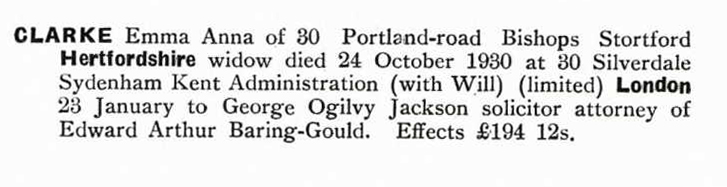
According to probate records, Egerton's mother, Emma Anna Clarke, would pass away on 24 October 1930. She had been living at 30 Portland-road, Bishops Stortford, Hertfordshire, but passed away at "Silverdale Sydenham Kent Administration (with Will)." Despite having at least one living child, the will was cited as "Limited" and probated on 23 January 1931 to George Ogilvy Jackson, solicitor attorney of Edward Arthur Baring-Gould,. Her effects were £194 12s [below, left].

This was not a rich woman. Percy Clarke may have left her a nice sum upon which to live—there are no probate records after his death—but we can see there was little left by 1930, if there ever was much. Even at that, it appears her legacy in 1931 went to solicitors, not family.


[Note: Boy, was I wrong! Solicitor Baring-Gould was married to Emma's daughter Dorothy, sister of Egerton Clarke. From Janine, Egerton's granddaughter: "Dorothy married a Baring Gould. He was referred to as Uncle Ted - so Edward Arthur Baring Gould - was one and the same." So, her probate was, indeed, handled by family. (08-17-11)]


It's likely that Egerton was raised by a mother who didn't have a great deal to spare. It’s possible his schooling may have been attended by his namesake uncle, Egerton Harry John Clarke, who had taken to the profession of young Egerton's grandfather, John Jeffkins Clarke: Stock Broker.

In retirement, when Uncle Egerton Harry John died in 1927, his probate left £18,525 17s. 3d. to his widow. We may need to look no further as to how young Egerton Arthur Crossman's education may have been funded, at least in part.

Next time we'll take a look at the results of that education, Egerton's time spent in the military during the First World War, and his relationship with George Mills.

Stay tuned…


Wednesday, June 22, 2011

Discussing Maurice Benington Reckitt


It seems a natural segue to point out here that, at the bottom of The Jellicoe Blog, there is the following statement and link: "We are grateful for financial support for our work from MB Reckitt Trust."

Imagine my surprise when I spotted the name of one of the croquet cronies of George, Agnes, and Violet Mills at the bottom of a blog about the work of Fr. Basil Jellicoe, the subject of our last two entries!

Do coincidences ever cease around here?

Maurice Benington Reckitt (19 May 1888 – 11 January 1980) is described in Wikipedia as "a leading British Anglo-Catholic and Christian Socialist writer. He edited Christendom, A Journal of Christian Sociology from 1931 to 1950. Earlier he was a supporter of guild socialism and a founder of the National Guilds League."

In addition, it includes this information: "Reckitt was a leading player and croquet administrator winning the Men's Championship twice (1935 and 1946). Reckitt was President of the Croquet Association between 1967 and 1975."


We know that Reckitt [pictured, right, by artist John Prince, versus Charles Colman, whose mustard company had merged with Reckitt's family firm] took to the lawns with the Mills siblings on several occasions, and in tournament play, the database of the Croquet Association shows that Agnes went 0-3 against Reckitt, although she went 2-1 against Maurice's wife, Aimee. Violet Mills was 0-1 against Maurice.

The database shows no records for George Mills, but the erratic London Times search engine does give the results of a single match, played on 10 July 1965 in the second round of Handicap Doubles at Budleigh Salterton, in which George paired with Maurice in a loss to Mrs. R. B. N. Smartt and Miss J. Cooper, (-4). Mills and Reckitt presumably had played together and won in the first round.

I admit to being clueless as to how doubles partners were arranged in croquet at that level, and so have no idea if this indicates if the men were close, or if chance happened to make them partners.

Reckitt was born into the fortune of the family business, Reckitt & Sons, now Reckitt Benckiser. It only took a few moments for me to locate several of their products beneath our kitchen sink, in the laundry, or within the refrigerator here in Ocala: Brasso, Cling Free, Frank's Red Hot, Resolve, Old English, Lime-A-Way, Spray 'n Wash, Easy Off, and French's Mustard.

Maurice was not really involved much in the family business, however.

It is not my purpose to write a biography of Reckitt—that's been done. In 1941, at the age of approximately 53 Reckitt wrote an autobiography entitled As It Happened: An Autobiography. He was also the subject of the 1988 biography Maurice B. Reckitt by John S. Peart-Binns.

Ample material regarding his life and the founding of "The MB Reckitt Trust" (originally "The Christendom Trust" before 2005) can also be found at http://www.mbreckitttrust.org/history.html.

Nor is it merely my purpose to point out the next (now almost expected) coincidence regarding the fact that George Mills seems to have been a bystander (and perhaps and acquaintance, or even friend) while two British men of great social and spiritual import—Reckitt and Jellicoe—fought on behalf of Christian social causes. Long after the death of both men, their names are linked by the association of Reckitt's trust with the Jellicoe Community.

The following is an excerpt from information on the history of the trust at the website mentioned above:

Reckitt was brought up as an Anglo-Catholic, and as a young man became involved with guild socialism and various Christian social movements. During the First World War, he joined the Labour Research Department, and in 1923 became Chairman of the League of the Kingdom of God. His most enduring achievement was Christendom, a quarterly journal of ‘Christian sociology’ which he edited (and largely subsidized) from 1931 to 1950. His vocation, in the words of his biographer, John Peart-Binns, ‘was to be available’. He spent most of his life ‘co-ordinating and leavening the thinking of small groups together with such people as T. S. Eliot, Dorothy L. Sayers, T. M. Heron, Philip Mairet and many priests’. He authored and edited numerous books on Christian social issues, of which the most readable and best-known is his account of the social movement in the Church of England, From Maurice to Temple (1947).


Author Martin Jarrett-Kerr continues elsewhere in that website:

Maurice Reckitt [right] was a comparatively wealthy layman, married but with no children. The Reckitt family derived its wealth from ‘Reckitt’s Blue’ in North East Yorkshire. Maurice was educated privately until university, when he went to St John’s College, Oxford, where he got a good degree in history.

He was brought up as a traditional ‘Anglo-Catholic’, but as a youth he soon became worried by the gap, even contradiction, between his faith and the human and social life around him. As a schoolboy he came under the influence of the fine historian Fr John Neville Figgis, C.R., who was not a typical ‘Christian socialist’ so much as a scholar who saw, and taught others to see, the significance of ordinary ‘worldly’ life in the light of the Christian gospel. After university Reckitt became involved in lively and intelligent groups concerned with social ordering…

When Reckitt went up to Oxford ‘I became’, he said, ‘a Socialist in 1908, and I shall always think that, for my generation, a Socialist was a very good thing to have been.’ But he was disillusioned with the ‘Fabian atmosphere’ of Oxford socialism, and found the Church Socialist League more congenial. His practical work in 1916 was as an assistant in London of the ‘Labour Research Department’: his task was to read, mark and index the trade union press. (This is interesting, as disproving the picture of Reckitt as a rich dilettante talking about egalitarianism in comfortable surroundings.)

Later, in 1923, the Church Socialist League ‘was reborn, not without travail, as the League of the Kingdom of God’. One of its members, Sir Henry Slessor, explained that ‘we came to see that our objective was not the promotion of Socialism, but the advent of the Will of God as expressed in His Kingdom on Earth. A society pledged to forward this purpose, sacramental in doctrine, composed solely of communicants, seemed far nearer to our desires than one pledged to Socialism, in part supported by modernists and persons only sub-Christian in belief.’


Interestingly, the change from "Christendom" to "MB Reckitt" in the actual name of the trust in 2005 was based strictly on practical matters, according to the fund's website: "The change of name was decided upon because the Trustees considered that the term ‘Christendom’ nowadays carries connotations that have nothing to do with either the origins or the focus of the Trust, and which could mislead the public. By using the name of the benefactor who endowed the Trust, continuity with the honourable past of the Trust is maintained."


How the term Christendom (which was also the name of a quarterly journal subsidized and published by Reckitt from 1931 to 1950) came to be used for the trust is exemplified here in this passage written by theologian Duncan B. Forrester:

It has become conventional to assert that we now live in a post-Christendom situation, and to look back patronizingly to the attempts to revive a rather romanticized version of medieval society on the part of Maurice Reckitt, V. A. Demant and the Christendom Group, or even T. S. Eliot in his The Idea of a Christian Society, with its ringing pronouncement that ‘The Christian can be satisfied with nothing less than a Christian organization of society – which is not the same thing as a society consisting exclusively of devout Christians. It would be a society in which the natural end of man – virtue and well-being in community – is acknowledged for all, and the supernatural – beatitude – for those who have the eyes to see it . . .’ But if that kind of political theology has had its day with the recognition that Christendom has passed away beyond recall, there remains an urgent need for a post-Christendom beyond theology.

Reckitt's vision, however, probaby is summed up better in what is essentially a mission statement for The MB Reckitt Trust: "Being and building communities that are diverse and cohesive, in order to bring about a stronger society."

The Mills family, notably George's father, the Revd Barton R. V. Mills, struggled with at least some aspects of religion. The elder Mills converted to Roman Catholicism during his time at Christ Church, Oxford, but spent virtually the rest of his life as an Anglican vicar, chaplain, and cleric, even having been an assistant chaplain at the Chapel Royal of the Savoy, in which one of his first services was during the funeral of Queen Victoria.

Barton Mills was an erudite man, a lover of history, chess, and debate, and a scholar whose translations and interpretations of the work of Bernard of Clairvaux are still cited today. He also gave of himself, serving as an Acting Chaplain to the Forces during the First World War, in which sons Arthur and George served, and as an officer of the Associated Societies for the Protection of Women and Children, and as founder of the Association for Improving the Status of the Unbeneficed Clergy.

Mills seemed to share the belief of Fr. Jellicoe, as explained by the current Archbishop of Canterbury, that: "[H]e had no problem at all in coming to preach in a church part of which was reserved for the service of Christ in the form of his poor."

For the Reverend Mills, this was all about career choices, subjugating personal belief and allowing himself opportunities to do the work to which he felt called, while also being able to support his wife and children. Roman Catholicism was a matter of personal devotion; the Anglican Church provided his public pulpit, as well as his bread and butter.

It would be stunning to me to find out that these theological and deeply personal matters of faith had not been discussed with George, especially just before Barton's death in 1932. This is corroborated by the fact that George's funeral service was held in the Catholic Church of St Peter, Prince of the Apostles [left], at Budleigh Salterton in 1972.

No, the Catholicism of Barton Mills was not a secret taken to his grave.

Reckitt had an Anglo-Catholic upbringing, but his lifetime of work as a Christian socialist seems to have transcended denominational barriers as well.

A 1958 manifest from a ship called the Rangtiki documents it sailing into England from New Zealand with Maurice and his wife, Evelyn Aimee, aboard. Their address is given as "157 St. James Court, Buckingham Gate, London SW1."

While this address is a bit closer to The Guards Museum than the London stomping grounds of the Mills family just to the west of Buckingham Palace Gardens, it would have been within extremely familiar territory to George Mills.

The men also shared a common Oxford background (although Mills did not earn his degree) and likely many similar lifelong beliefs on social and religious subjects. One does not doubt they had their differences regarding how exactly those beliefs should be acted upon, perhaps even assertively expressed over cocktails at the bar in the clubhouse at Budleigh, but their similar backgrounds of privilege, with some devotion to helping those in need, no doubt gave them a wide berth of common ground upon which to stand.

Reckitt's wife, Aimee, was as we know a competitive tennis player in the second decade of the 20th century [Wimbledon 1923, 1925, 1927; pictured, above, in 1927 with Lili Alvarez, Aimee at left], but was apparently not a particularly healthy woman overall. She passed away in 1968.

We also know this from the trust's website:

Miss [Dorothy] Howell-Thomas compiled a ‘Bibliography of Maurice B. Reckitt’s published work, for his ninetieth birthday’ (1978); and this was revised and enlarged in 1980. She also helped the archivist of the University of Sussex to sort out the Reckitt archives deposited there, along with other related material, especially that associated with Reckitt’s friend and colleague, Philip Mairet, sometime editor of The New English Weekly to which Reckitt frequently contributed.


Reckitt lived to the age of 91, and was still active in matters regarding his trust until his death in 1980. His bibliography is vast, and the amount of archival material related to Reckitt's life and work held at the University of Sussex is, to me, astonishing.

In addition to his work on Guilds and Christian social issues and philosophies, Reckitt also penned the text Croquet Today, and as we know, was an avid player of championship caliber, as well as a successful administrator for the Croquet Association, giving him yet another interest in common with George and the spinster Mills sisters.

But Reckitt's legacy is his trust, and its requirement that the projects which it endows should not simply be charities, but institutions and organizations that… well, let Mr. Jarrett-Kerr explain:

From time to time, before his death in 1980, Reckitt protested that the Trust was still behaving in too theoretical a manner. He submitted a ‘Statement’ to be read and discussed at the Trust meeting of 6 May 1973, which emphasized the clauses in the Trust Deed that the Trust is ‘charged with promotion of research into the application of Christian social Thinking’ and with obtaining expert advice ‘upon the form and feasability [sic] of research projects and the areas where they could best be affected’. He feared that the Trust had neglected its duty in this respect – the duty ‘to initiate, seek out and further enquiry into what we may judge to be the vital aspects of modern economic and industrial disorder’. Instead it was ‘tending to confine itself to doing exactly what it began by repudiating – distributing its resources (on) purely charitable gifts.’


Reckitt's trust apparently has stayed true to his vision of not simply bandaging the ills of society, but endowing those who would work to prevent society's wounds from manifesting themselves at all.