Saturday, March 20, 2010

Minor and Major Arrives via Royal Mail!


Many thanks to Heather at Peakirk Books in Nr Fakenham, Norfolk, not only for the information she provided me earlier via e-mail, but for the edition of Minor and Major by George Mills that arrived today!

While the first edition, illustrated by John Harris, in the British Library is dated 1939, this edition predictably carries no date nor the name of the illustrator(s). Once again, exactly as in my edition of King Willow by Mills, we find it was published by Spring Books, Spring House, Spring Place, London NW5, and printed in Czechoslovakia.

The title page and dust jacket proclaim it to be part of the "Fanfare Series", and many other titles in the series—including King Willow—are listed. Among them are: The Clue in the Castle, The Missing Speed Ace, Backstage with Peggy, The Rawhide Kid, The Savages on Gale Island, The Rivals of Rookwood, The Island Mystery, The Secret of the Study, Holiday Adventure, The Riddle of the Blue Moon, and Speed Dermot.
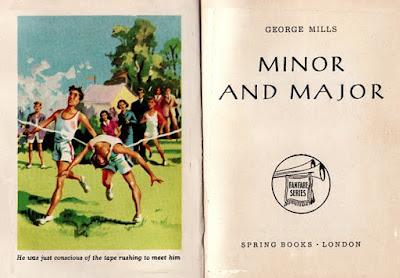
This edition has 240 pages, a full-colour, unsigned frontispiece [the lustre of which is diminished by having been printed on matte paper] and four black-and-white illustrations throughout. The unsigned full-colour illustration on the dust jacket is not the same one found inside the text.

The dimensions of the book, exactly the same as Fanfare Series companion King Willow, may have been conceived by one Benedict Thomas—something we'll examine in a subsequent post!

I have a copy of Meredith and Co., already noted as being part of something called the "Viscount Series" and having been published by a house suspiciously similar in all ways to "Spring Books". That edition is also undated, but has a gift inscription written by the original owner apparently dating it as at least having been purchased 1957.

The other two nearly identical editions suggest they have been modified from Meredith's slightly larger format. That also suggests they are both more recent than 1957—moving their publication dates into my own lifetime, having been born in 1958.

King Willow and Minor and Major, even more so than Meredith and Co., have an appearance similar to vintage 1946-1965 [5th format] editions of the Hardy Boys mystery series I'd seen and read in the 1960s.

Using 1958 as a target date, selected for both its proximity to 1957's Meredith and Co. reprint and it being the year of my birth, let's say Mills was paid directly for the rights to also reprint King Willow and Minor and Major. Unless the books were published posthumously, he'd have been earning an income from his 1930's written work virtually through 1960—assuming they had stayed available on booksellers' shelves for a year or two.

This is all suppostion, but we'd have to imagine George Mills, at this point in our investigation still a self-proclaimed Preparatory School Master, likely living somewhere in the U.K., in his early sixties [61 years old on 18 August, 1958, my own birth date] and still trading on his years teaching at prep schools during the worldwide Great Depression.

Or is it merely the heirs of George Mills who're reaping the benefits from these reprints, or perhaps his wife, Vera?

New information that was delayed by an incorrect spelling provides more insight into the answer to the above question…


Friday, March 19, 2010

Mills Arrives at Harrow


On Wednesday, March 17, 2010 10:18 AM, I received the e-mail message below from Luke Meadows, an information officer of the Harrow Association of Harrow School, following a request for information about George Mills.

Here's what Harrow knows about Mills:

Dear Mr Williams,

Thank you for your message, I am able to tell you that George Mills did attend Harrow and the initials R.A stand for Ramsay Acland. George came to the school in 1910 and left in 1912. We know that he was in the Rifle Brigade and then transferred to the Royal Army Service Corps (R.A.S.C.) during the First World War between 1916-1919. After the War was over he went onto study at Oxford between 1919-1921. The only other thing I am able to tell you is that we have his occupation as being a Preparatory School Master.

Georges Father, Rev. Barton Mills was also at Harrow. He entered the school in 1870 and left in 1871. He obtained a BA at Oxford in 1880 and an MA in 1883. he then became Chaplin at san Remo 1886-7, then Vicar of Poughill, Cornwall 1887-9 then of Bude, Cornwall 1891-1901 and was also Assistant Chaplin at the Savoy 1901-8.

Unfortunately I cannot find anything about a brother by the name of D. Mills but I will pass this message onto our school Archivist who might be able to give you some more information on the Mills family!

Good luck with your research,

Kind Regards,

Luke Meadows

Information Officer Harrow Development Trust and Harrow Association

5a High Street Harrow on the Hill Middlesex HA1

So! Not only are we incrementally gathering information about Mills, but his family history is gradually coming into focus as well. Tracking the movements of the family during Mills's lifetime, we find him born in 1896 in Cornwall. In 1901, however, Barton R. V. Mills moves to "the Savoy" [right], presumably the "Great Hospital of St Bernard de Monte Jovis in Savoy" run by the Congregation of Canons of the Great Saint Bernard.

And as we saw in an illustration in a prior post, St. Bernard becomes a huge point of academic interest for George's father—more on that another time.

We learn that G.M. transferred from the Rifle Brigade to the Royal Army Service Corps during his time in the military, which we find ended in 1919.

It's noted that Mills "went on to study at Oxford between 1919-1921", but I find that less than definitive. How loosely is the word "at" used here? At Oxford, the place, or at Oxford, the university, one wonders? If Mr. Meadows simply means Oxford as a location, it likely means that Mills first attended Christ Church, one of the colleges at Oxford in 1919, matriculating to the Final Honours School in 1921?

That seems especially likely given that Ms. Peacock has already informed us that Mills "was exempted from taking Responsions (preliminary examinations for entry) and the examinations of the First Public Examination, under a decree of 9 March 1920." Mills would not have been exempt from examinations yet had he entered the university in 1919. His studies during the years Mr. Meadows mentions must have been at Christ Church.

In addition, it's interesting to note that Mills, at some point, informs Harrow that his occupation is Preparatory School Master. What I wonder is: Could Mills have attained that title legitimately at any other prep school without the "B.A. Oxon" he claimed to have at Windlesham House?

Anyway, on my time line of George Mills, his life and career, let's go ahead assume he finally entered the prestigious Universitas Oxoniensis itself in 1921. How long did he remain there? It's hard to say.

As we know, the dedication to 1933's Meredith and Co. reads: "To MR. J. GOODLAND, sometime Head Master of Warren Hill, Eastbourne; to the STAFF AND BOYS OF THE SAME SCHOOL, and to those of WINDLESHAM HOUSE, BRIGHTON." Is this sequence intended to imply that he taught at Warren Hill before Windlesham House. Or is it simply sequenced to move an individual, J. Goodland, to the top of the list?

Dr. Houston, in a prior post, cites Mills as having taught at Warren Hill after Windlesham. This makes it possible for Mills to have spent all or some of 1921-1924 at Oxford. Or was something else fitted into those years?

And that still leaves another set of four years—1912 through 1916—unaccounted for. What happened during those "missing years"? Where was Mills between his departure from Harrow at 16 and the onset of his hitch in the military that began in 1916, when he was 20? And is it at all unusual he started as a private? Why would it have occurred to me that the grandson of an M.P. and the son of a Master's Degree holder from Oxford might've started on a higher rung?

As always, if you have information, or even some intriguing speculation, please let me know!


"Nothing is so difficult as not deceiving oneself" -- Wittgenstein


On Tuesday morning, I replied to Annabel Peacock at Oxford seeking more specifics about the fact that George Mills apparently had never actually earned an Oxon B.A. Here's the message I sent:

Ms. Peacock, thank you so much for taking the time to send me this information so promptly. I really do appreciate your effort, and I now have so many paths to follow that I hardly know where to begin!

Incidentally, the first employer of Mills listed him as "BA, Oxon" when he taught 'English or English subjects' there in 1925-1926. What is your professional opinion of the fact that he may have, um, told an untruth in that case? Is there any record of when Mills might have finished taking his last class at Oxford? What would have been his 'major', if any? Would there have been a chance that he finished his degree elsewhere, but continued to use his knowledge of Oxford and the university's name to open doors for him? Has it ever happened?

I know these must seem like hopelessly stupid questions, but I hope you'll continue to bear with me and take a moment to reply!

Thanks once again and best regards,

Sam W.

Her reply arrived early the next morning:

From: Oxford University Archives [enquiries@oua.ox.ac.uk]

Sent: Wednesday, March 17, 2010 5:45 AM

To: Williams, Harry (Sam)

Subject: Re: Enquiry: George R. A. Mills

Dear Sam

Thank you for your email. As we have no record of Mills passing any examinations in the Final Honours School or obtaining a degree, it appears that he was not telling the truth about his academic background.We have come across cases before of people without Oxford degrees using the University's name to help open doors. However, often they have no link at all with Oxford whereas Mills had actually matriculated from the University. It was not usually possible to transfer your status toanother university in order to complete a degree course. Members of Oxford were able to 'incorporate' at Cambridge University, which enabled them to move there and maintain the same rank, status or degree as they had held at Oxford. However, this seems unlikely with Mills, especially as he claimed his BA was from Oxford. I have been unable to find any record of the subjects Mills studied during his time at the University.

The colleges in Oxford maintain their own archives and it is possible that Christ Church may hold some additional information about Mills. They may be able to give you more details of when he left the University. Should you wish to contact them, enquiries should be directed to Judith Curthoys, the College Archivist, at archives@chch.ox.ac.uk.

Best wishes

Annabel


So, it's off to Christ Church for information. It looks like Mills was trading on his Oxford experiences by at least leading potential employers to conclude he'd been awarded a degree. It seems that might've been a reason he'd been offered a "junior appointment" at Windlesham House, and may have factored into his "sudden (?) departure" from there in 1926.

And let's not forget, that seemed a place he probably had intended to stay for a while: He'd married and purchased a home in the neighborhood! Those aren't behaviors I'd associate with a man who's uncertain about his immediate.

It was suggested in an earlier post that Mills disappeared because junior appointments were "seldom held for long" or that Mills may have been involved in "the General Strike (that term)", but neither seems to completely resonate with the fact that he was a new husband and homeowner.

One could make the case, however, that fabricating a degree from Oxford wasn't exactly the safest thing for him to do in his situation either.

It's possible Mills did just drift away as apparently junior appojntments are wont to do. Perhaps he had simply become overly excited and went out on strike [pictured, left], never to return. Or, perhaps because he was apparently a good egg and well thought of in Portslade, he was allowed to depart amicably even after it was determined he in fact didn't hold any degree after all.

Are there any other possibilities I am overlooking?

Meanwhile, I'd sent a request to Harrow School for anything they might know about George Mills.

We'll take a look at the word from Harrow next time.


Thursday, March 18, 2010

Until the peacock led him in...


Just a couple of hours after I'd sent off an e-mail to the Oxford University Archives requesting information on George R. A. Mills, I was impressed that I'd already received an reply. Despite the fact that in the United States we like to think of ourselves as an "instant gratification" society, I have to admit that if I'd sent an e-mail at 10:33 AM requesting information into my own school district here in Florida, I'd be quite pleased if I finally had a response by the end of the day. And I sent an information request to Keele University on February 21 and I wonder when I might receive a reply—if I ever do at all.

In this case, however, I had a detailed reply from an archivist at arguably the most prestigious institution of higher learning in the world waiting for me in my in-box by 1:07 PM.
Quite impressive!

As you may recall from yesterday's post, George Mills had found his missing middle initials, his wife, his university, his brief but inspirational tenure at Windlesham House, and the colleagues [and pets] who had inspired many characters from the books he'd go on to write several years later.

This is what the Archives at Oxford added to the mix [my emphasis]:


Dear Mr Williams


Thank you for your email enquiry. I have searched our card index of those who matriculated (ie were admitted to the University) between 1891 and 1932 and have found an entry for George Ramsay Acland Mills. This records that he matriculated from Christ Church on 16 October 1919. According to the form that he completed at his matriculation Mills was born on 1 October 1896 in Bude, Cornwall. He was the second son of Barton Reginald Vaughan Mills, a cleric in holy orders and a scholar [see illustration, right], of 7 Mawson Place, Queens Gate. Before attending Oxford Mills had been educated at Harrow School.

I have also found Mills' entry in the undergraduate register. This records that he was exempted from taking Responsions (preliminary examinations for entry) and the examinations of the First Public Examination,under a decree of 9 March 1920. This decree stipulated that until the end of Trinity Term 1923 any member of the University who had been engaged in military service for twelve months or more before his matriculation, was permitted to offer himself for examination in any Final Honours School, despite not having met the statutory conditions for admission to that School. This was on condition that he had obtained permission from the Vice Chancellor and the proctors; that he had entered upon the third term and had not exceeded the twelfth term following his matriculation; and that he had paid the fee for admission to the examinations the decree excused him from. Mills' entry in the undergraduate register records that he paid the fee of £5 2s on 21 May 1921. However, I have been unable to find any record that Mills went onto pass any examinations in the Final Honours School or that he obtained a degree.

I have also checked the 'Oxford University Roll of Service', a printed register of members of the University who served in the First World War. This records that Mills commenced military service on 16 June 1916. He was a Private in the Royal Army Service Corps. His highest acting rank was that of Lance Corporal.

I have been able to find evidence that Mills' father, Barton Reginald Vaughan, was also an Oxford graduate. He appears in Joseph Foster's 'Alumni Oxonienses', a printed register of those who matriculated between 1715 and 1886. This records that he matriculated from Christ Church on 13 October 1876, aged 18. He was the first son of Arthur, armiger (ie esquire), of London. He was awarded second class honours in History in 1880. The degree of BA was conferred in 1880, and that of MA (which at this time required no further study or residence) in 1883. He was rector of Poughill in 1887. I regret that without names and dates I am unable to search our records for any other relatives of Mills who may have attended the University.

I hope you find this information helpful.

Yours sincerely
Annabel Peacock
Archives Assistant

~~~~~~~~~~~~~~~~~~~~~~~~~~~~~~~
Oxford University Archives
Bodleian Library
Oxford OX1 3BG
web:
www.oua.ox.ac.uk
~~~~~~~~~~~~~~~~~~~~~~~~~~~~~~~

Ms. Peacock, you are amazing! I simply can't thank you enough, not only for your prompt assistance, but for leaving me simply awash in total "Millsness"!

So, let me see if I have this time line correct thus far [and, British readers, please check my educational suppositions for accuracy]:

George Ramsay Acland Mills was born in Bude, Cornwall in 1896, the second son of a holy cleric and Oxford grad, Barton R. V. Mills who had been a rector in Cornwall. It's believed that George attended Parkfield, a school in Haywards Heath as a boy. After then attending Harrow School [pictured, left] in London and apparently living with the family in Queen's Gate, he joined the army in 1916 and fought in the First World War, reaching the rank of Lance Corporal.

After the war, Mills apparently attended Christ Church and from there matriculated to Oxford in 1919, where as a veteran he was exempted from Responsions, and finally paid his required fee for them 1921 without receiving a degree.

In 1925, he and his
"B.A. Oxon" are engaged as a junior appointment at Windlesham House, the same year he married Vera Beauclerc and purchased a home near the school in Portslade. His name seems to disappear suddenly from the staff list by the end of the summer term in 1926 after having spent the year teaching the boys English or "English subjects" and having been involved in extracurricular music and drama.

Meredith and Co. is published by Oxford University Press in 1933, and is dedicated to boys and staff at Windlesham House, Warren Hill School in Eastbourne, The Craig in Windersmere, and the English Preparatory School in Glion, presumably in Switzerland, among whom he
"spent many happy years."

In 1935, Mills visited the wife of his old headmaster at Windlesham, telling here he'd written a book "largely about Windlesham" and that he'd
"been at 2 or 3 schools since."

He then published a sequel to Meredith and Co. in 1938 [King Willow], and two more in 1939, Minor and Major [also about prep schools] and St. Thomas of Canterbury, the latter being a text in which Mills is listed in the British Library as author along with St. Thomas himself [pictured, right].


That's where the trail goes absolutely cold: 1939. After the most prolofic 1-2 year span of his life as an author.

It's actually been far easier to work backward into his family's past than it's been to turn up any clues about them after the onset of the Second World War.

Next time, though, let's take a peek at the fact that Mills supposedly earned a "B.A. Oxon"—something the facts don't seem to corroborate.


Wednesday, March 17, 2010

Houston, We Have Lift Off!


Imagine my excitement when I opened up my mailbox first thing yesterday morning and found this message from Dr. Tom Houston, Secretary to the Windlesham House Association, stamped just three hours before on Tuesday, March 16, 2010, at 4:32 AM:


G.R.A. Mills, BA Oxon, taught 4 terms at Windlesham House School from Lent 1925 until Easter 1926, and maybe part or all of the summer, but his name was taken off the staff list by end of summer term 1926. As acknowledged in the dedication to Meredith & Co he taught at three other schools probably after Windlesham; viz; at Warren Hall, Eastbourne (a 19th century school closed in 1930s or 1940s); at The Craig, Windermere (founded 1899); and at the English Preparatory, GLION.

In 1925 Windlesham was at “Southern Cross”, Portslade, near Brighton; principal Mr Charles Scott Malden; headmaster Mr H D L Paterson; and the dog, Tubby.

In April George Mills married Miss Vera Beauclerc; they bought a house on Benfield Way, Portslade.

During summer term he may have contributed to a pastoral play featuring Boadicea, Julius Caesar and a Brontosaurus done by the A.A.A. (Amateur Acting Association).

In the Michaelmas term 1925 he wrote pieces (a prologue and songs) for a staff concert, and wrote that up in the magazine. He made people laugh, a lot.

He might have had a hand in the AAA production in summer 26 called “Spanish Courtesy” or “A Knife between the Shoulder Blades”. We have no record relating to his sudden (?) departure. He could, like a handful of other prep school masters, have been excited by the General Strike (that term).

During summer 1935 he visited Mrs Charles, then in Springwells, Steyning, W. Sussex, and told her he had written a book “largely about Windlesham”, published by O.U.P. “He had been at 2 or 3 schools since, but is very faithful to Windlesham”, she said.

His novel drew upon both Windlesham and Warren Hill. The unfortunate maths master, Lloyd, was almost certainly drawn from J.G. Drummond (WH 1923-35), who took his own life shortly after leaving in disgrace. Uggles may have been related to Tubby, the Malden’s popular and heroic dog. The portrait of the headmaster Peter Stone has something of Christopher Malden, who had been in effect joint head for some years; he became principal in 1927. Mills evidently had a gift for befriending boys and learning their secrets; Meredith & Co. captures the idiom of pupils during the interwar period more accurately than any other novel.

My guess is that Mills came to the school soon after leaving university to teach English or “English subjects”; that was a junior appointment, seldom held for long.

That is about it. Sorry we have no more.

Tom H.

After receiving seemingly an avalanche of information, I was simply overwhelmed by it all. I had the middle initials I'd been so desperate for! I had a university and a degree! I had a date of employment! I had a wife, Vera, for cryin' out loud, and a house, and an extracurricular life: plays, songs, concerts, and typing up articles for the magazine. Somehow, I'd even ended up with an extremely unexpected brontosaurus!

And I found a real, apparently well-liked man who'd "made people laugh, a lot" …

All morning long, this mysterious George Mills seemed to have some of his obscurity steadily ebb away for me.

Of the characters in his wonderful first book, Meredith and Co., we find thumbnail sketches of the living individuals that Mills crafted into the staunch headmaster Howell Stone, known to his charges as "Peter", Mrs. Stone [No first name given!], Uggles, and the now regrettably tragic figure of Mr. Lloyd, the brilliant but somewhat misanthropic master of maths.

Sorry not to have more? Thank you so much, Dr. Houston—What an absolute treasure trove this message was for me. I could hardly fall sleep last night, as strange as that may sound: George Mills had suddenly become very real!

I immediately contacted Oxford's [Oxon's] Archives, and my heart raced when, amazingly, I was deluged with even more information within an hour or two.

And some of it came as quite a surprise…


Tuesday, March 16, 2010

Peeking at Warren Hill via Satellite


Hello! I’m back, and still wondering about the schools named in the dedication written by George Mills in Meredith and Co. Yesterday I came up with information regarding Windlesham House, courtesy of their alumni association. Today I thought I’d investigate Warren Hill School outside of beautiful Eastbourne [seen in the distance above], and I ended up doing much of it by... uh... virtual automobile, without ever leaving my desk here in Ocala, Florida!

On the Boys' Historical Clothing Web Page, there is a tidbit of useful information about the school: “[A photo] album contains a collection of photographs from the Warren Hill School in Eastbourne. It appears to have been a public school, meaning a private secondary boarding school. It may have been a prep school. In the photographs we note the boys look more prep school age than public school age. Only public schools would have had cadet programs. The photographs date from about 1885 to the early 1900s. Unfortunately we have been unable to find information about the school itself. It is not an active school, but we are unsure just when it closed.”

Access to this site is limited [Honestly, it costs money to see the actual photos, and I’m thinking carefully about how badly I want to spend it], so I have no photos to share right now. However, I think it’s safe to say that, given G.M.’s involvement at the school and the age level of the children in his books, it was a boys’ preparatory school.

Subsequently, in a “Sussex county-wide forum” from the website british-genealogy.com, I found a thread called “
Warren Hill School-Eastbourne”. One entry, posted from South Australia [!] and dated 02-05-2008 02:32 AM, reads in part:

While searching for yet another Martin Family member( will it never end?) I arrived at the 1901 census for an Eastbourne school, 'Warren Hill 'on "Beachy New Road". It had students from all over Britain. My possible was 11yrs. others on page were 12 + 13…

cheers wendy


Looking for a Mills makes me feel sympathetic to someone looking for a Martin. Good luck, Wendy! Anyway, given the above “address” of Beachy New Road, I put Google Maps to work and found what appeared to be “Warren Hill” itself [marked with a pink push-pin], just north of a “Beachy Head Road”:


Considering that a “South Australia” factor might be at work above in trying to determine the name of a road half the planet away, I decided it wise to start tracking Beachy Head Road. Here’s a view of the road sign seen as one approaches Beachy Head Road by car. Is this “Beachy Head Contryside Center” possibly where the school was located? I'll tell you why I think it might be...


The road turns south, traveling near the sea, and as it does, there are some obvious fields off to the east of a driver—some 200 feet west of the surf—that certainly look strange to my American eye:


Zooming in, they probably looked like cricket fields to my untrained eye, but what do I know?


So I did a search and came up with this, comparing baseball and cricket fields:


Yes, I guess even an American should be able to recognize what at least might once have been a cricket pitch! So, apparently some sort of cricket field is still to be found along Beachy Head Road, a thoroughfare that may be at or near the location of what was Warren Hill School. Please correct me if I'm wrong!


The school must’ve had some spectacular views. Here’s a screen capture from a Google Street View, taken while I was “driving” south along Beachy Head Road, looking east over what would be the cricket fields down below the crest of the hill [you may be able to just see benches that are angled to look down on them] and at the amazing flourish of sky, light, and sea out over the English Channel. In the inset, you can see the fields.


It’s interesting to speculate that these are the same pitches upon which Mills could have watched youths play, eventually leading to a book like his King Willow. As an American, it’s even more surprising to me that they’re still there—here in the States, it would seem uncanny that they hadn’t been overly industrialized or completely rearranged to accommodate high-profit tourism for decades now. It's all overwhelmingly beautiful, and if you're viewing this from the U.K., none of this must seem like any sort of big deal. To me, though, it's all breathtaking and meaningful.


Anyway, as of yesterday, it was still unclear whether or not Mills might’ve played there as a lad or had been present there as a master. But that's all come into remarkable focus based on information I’ve received today from the Windlesham House Association.

And, boy, am I excited about the news!


Monday, March 15, 2010

Word from Windlesham School!


Yesterday, on a balmy and breezy Sunday afternoon here in central Florida, I tried to do a little internet sleuthing. In my newly-arrived copy of Meredith and Co., the dedication reads as follows [And, yes, I know you can see it, left]:

To MR. J. GOODLAND, sometime Head Master of Warren Hill, Eastbourne; to the STAFF AND BOYS OF THE SAME SCHOOL, and to those of WINDLESHAM HOUSE, BRIGHTON, THE CRAIG, WINDERMERE, and the ENGLISH PREPARATORY SCHOOL, GLION, among whom I spent many happy years, this book is affectionately dedicated.

In trying to track down information on George Mills, I contacted the prestigious and impressive Windlesham School, Washington, Pulborough, RH20 4AY, via an e-mail form at their website, http://www.windlesham.com/. This morning, stamped Monday, March 15, 2010 7:36 AM, I received the cordial and extremely engaging reply below:


Dear Mr Williams,

Thank you for your message which is a most intriguing one. This is so not least as I suspect that I may well have read one of George Mills books in my youth, my father and I both being passionate cricketers. I have subsequently gone onto your 'Who is George Mills?' website, which made for fascinating further reading.

You are correct, I'm sure, in ascribing the dedication as being to this Windlesham House. The school was until 1913 located in the heart of Brighton and then moved out to the suburbs until 1934. Since that time it has been at its present home a short distance away in the heart of the West Sussex part of the South Downs.

A satisfactory answer to your question as to why the dedication should be as you describe it is less easy to establish. There were certainly two brothers and a cousin with the surname Mills at Windlesham in the late 1890s, though none had George anywhere in their names. Equally the school history 1837-1937 makes no mention of a teacher by the name of Mills, but interestingly we are still in contact with a Patrick Mills who left here in 1942, possibly a son?

However, the resources at my disposal are far short of the total archival material that may provide an answer. My role is that of Secretary to the Windlesham House Association, the alumni body. What I will do is to copy into this correspondence Dr Tom Houston, the school historian, a very near contemporary of Patrick Mills. He is currently engaged on an update of the school history and may well have something that can shed further light on the connection.

I very much look forward to his response. I do hope that we can help you resolve a little more about George Mills.

Every good wish.
Richard Martin

An article on the school’s 2010 centenary from Attain, the official magazine of the Independent Association of Prep Schools [IAPS], also describes the school’s history from the its origins: “Windlesham House School originates from a school set up for a dozen or so pupils by Reverend Worsley at Newport on the Isle of Wight in 1826. It was bought by the Malden family in 1837, initially for the children of naval officers, and was moved to Brighton in 1837. In 1913, the School moved to Portslade and in 1934 went to its present site at Washington.”

Right now, we really have no way of knowing how old Mills was when he wrote his books, all published between 1933 and 1939, but is there a clue in Meredith and Co.’s dedication?

When Mills refers to the staff and boys of “WINDLESHAM HOUSE, BRIGHTON”, could he be dedicating his novel to the staff and boys of a school he’d been familiar with as a boy?

A previous posting suggests that Mills attended a school called Parkfield in Haywards Heath. Checking Google Maps, it appears that Haywards Heath may be just 15 or 20 km due north of Brighton, up A273 or B2112, depending which side of Burgess Hill one would be skirting.

If Mills attended Parkfield at a time when he might’ve been acquainted with staff and boys from Windlesham House while it was still in Brighton, the very youngest he could’ve been in 1913 would be about 13 years old. That would have made him around 33 years old when his first book, Meredith and Co., was published, and near 39 when both Minor and Major and St. Thomas of Canterbury went to press. However, he could also have been much older.

Of course, when Windlesham House moved to Portslade in 1934, the school might still have been commonly referred to as being located at Brighton, while meaning the city’s suburbs. That could make Mills at least somewhat younger than a man nearing middle age in 1939.

This would also make sense if Mills served in the military during World War II. Here’s some insight into the climate regarding war with Germany in the late 1930s from historyonthenet.com:
When war broke out in September 1939, some men volunteered to join the armed services, but Britain could still only raise 875,000 men. Other European countries had kept conscription between the wars and were able to raise much larger armies than Britain. In October 1939 the British government announced that all men aged between 18 and 41 who were not working in 'reserved occupations' could be called to join the armed services if required.

With a conscription possibly reaching to age 41, and with Nazi “hit and run” bombers working the southeastern coast of England from 1940 on, you don't have to be Hercule Poirot to know it seems likely that the war in some way might have uprooted Mills—or at the very least thrown him off of his usual writing/teaching routines—no matter what age he might have been at the time.

From 1942 to 1943, the heaviest bombing on the south coast was in Eastbourne, home of another locale in Mills’s dedication above. And that’s where we’ll go in our next post.

Meanwhile, as always, please let me know if you have any information about George Mills, his life, his career, or his relationship to 'WINDLESHAM HOUSE, BRIGHTON'!


Sunday, March 14, 2010

An Overwhelming Sense of Millsness...


Ironically, one huge roadblock in trying to search the internet for "George Mills" is the myriad of references to Stanley Elkin's 1982 book entitled George Mills that are strewn along the path. As if there weren't already a seemingly endless array of George Millses festooning the worldwide web, every bookseller has a page for the award-winning book, and some for the author, Elkin, as well, adding to the cacophony of on-line G.M. references.

On the George Mills page at amazon.com, Elkins's book is described: "An ambitious‚ digressive‚ and endlessly entertaining account of the thousand-year history of the George Millses‚ GEORGE MILLS is the antithesis to the typical Horatio Alger story. Since the First Crusade‚ there has always been a George Mills‚ who—despite his best efforts—is unable to improve his position in life or that of his descendants... But the latest in the long line of George Millses may also be the last‚ as he obsesses about his family’s history and determines that he will be the one to break this doomed cycle."

So, it appears that I've actually decided to winnow out the proverbial needle in a haystack: An unknown man whose only identifiable characteristic—his name, George Mills—makes him one of a litany of the indistinguishable so lengthy that it's become the gold standard of anonymity, at least according to Elkin!

Elkin won the 1982
National Book Critics Circle Award for George Mills. In that same year, the New York Times book review by Leslie Epstein asks the same question of Elkins's book that we focus on here: "WHO, then, is this George Mills?"

The review continues, with my emphasis: "By the middle of the book… we know this much about him: He is married, childless, fiftyish, employed by a company that specializes in dispossessing ghetto blacks… What distinguishes him, at least in his own eyes, is, first, his conviction that he is saved, and then his overwhelming sense of 'Millsness,' the burden of his family history, which hangs over his head like a curse."

Apparently what I'm now trying to work around is this 'overwhelming sense of Millsness', which in 1982 had to have been more of a sensibility than a fact that internet search engines can now confirm. I mean George Mills is found on far more websites than that paradigm of ultimate anonymity, John Doe, according to altavista.com's search engine [
142,000,000 results to 31,900,000 results .

Yes, trying to tease one, single George Mills out of the boundless fabric of the internet won't be easy—even a Mills who's actually a published, 20th century author with four volumes residing on the shelves of the British Library alongside the Magna Charta and the Lindisfarne Gospels, for cryin' out loud!

Now that's anonymity! Still, I intend to continue to try to unravel the answer to the seemingly impenetrable question: "WHO, then, is this George Mills?"


Saturday, March 13, 2010

Meredith and Co. Arrives Par Avion!


Meredith and Co. by George Mills arrived today via Royal Mail [par avion] from Chapter House Books in Shelbourne, Dorset, in the U.K. Here are the details on this edition:

Sales Order No.: 68472860

Bookseller: Chapter House Books (Member of the PBFA)

Payment Processed By: Abebooks

Estimated Delivery Date: May 26, 2010


Author: George Mills

Title: Meredith and Co

Bookseller Book No.: 5685

Book Description: The Viscount Series. Fair in fair, well worn, torn and plastic protected d/w. Spine cocked, cloth crinkled, edge of boards faded and bumped, corners bumped, owner's inscription (dated 1957) on fep, front hinge weak, pages browned, spotting to endpapers, gatherings strained.

Date Processed: March 3, 2010

*** Your special instructions to the bookseller:
Thank you! Also, if there is anything you can tell me about the author, George Mills, I would very much appreciate knowing it. Biographical information on the internet has been difficult to find.

In an email time-stamped that same day, Wednesday, March 03, 2010, 4:15 PM, Claire Porter of Chapter House Books [pictured, right] responded to my request for info, and flatlined my search for information about G.M., at least from her direction:

Sam

Thank you for your prompt response, the book went in the post today. I am afraid that I haven't been able to find anything out about the author, sorry.

Many thanks for the order

Regards
Claire

That's okay, Claire. It can't always be 84 Charing Cross Road, you know. The book you've sold me itself has some peculiar clues in it that I'll try to unravel in another posting here.

Meanwhile, let's look at some basics. This edition is from the "Viscount Series" intended "For Boys and Girls", published by Andrew Dakers Ltd., Spring House, Spring Place, London NW5, although it was "Printed in Czechoslovakia". Other titles in the series are listed as Ace Carew, The Black Ghost, Dangerous Road, Mystery at Gull's Nest, Shy Girl at Southdown, Jenny's Exciting Term, and Jenny of the Fourth. It has 232 pages, one full-color frontispiece printed on glossy paper opposite the title page, and three black & white illustrations.

My undated edition of King Willow was published by Spring Books, Spring House, Spring Place, London NW5, and also printed in Czechoslovakia. King Willow is listed as part of the "Fanfare Series" intended "for boys and girls". Other titles in the series include The Kestrels Plot Adventure, Tom Merry & Co. of St. Jim's, The Hoax of a Lifetime, The Mysterious Orchard, Judy's Triumph, The Secret of the Red Mill, and The Unknown Adventurer. It has 256 pages, one full-color plate opposite the title page, and three black & white illustrations. King Willow is ostensibly a sequel to Meredith and Co., with many of the same characters.

The overall quality of the printing is much better in King Willow than Meredith and Co., despite the fact that what appears to have been the same publisher printed both books in post-war Czechoslovakia.

The dust-jacket art for Meredith is simply a very poorly registered four-color copy of the color plate found inside the book. Willow features a full-color dust jacket with original art that is not found anywhere within the text.

The full-color art in King Willow is signed "Tom Thursby". The single full-color plate in Meredith and Co. is simply signed "Vernon". None of the black & white illustrations from either book are signed by the pen-and-ink artist.

It's difficult to tell if the total six B&W illustrations in both books were drawn by the same hand. The art in Meredith seems to be highly stylized to resemble woodcuts, while in Willow, the drawings are executed with far more modern and organic brush work executed along with the pen.

This 1957 edition of Meredith and Co. appears to be the same as that found in the collection of the British Library: Meredith and Co.; Andrew Dakers: London; printed in Czechoslovakia, 1957. Although there is no publication date, an owner's inscription reads: "to Mark with love from Paul. Xmas 1957". Or is that "7" perhaps a "4"...?


The most recent edition of King Willow on the shelves of the British Library is: King Willow (New edition); Oxford University Press: London, 1951. My copy is clearly not that edition, probably being an even newer "New edition".

So, circumstantial evidence seems to point to the fact that Andrew Dakers Ltd. and Spring Books may be the same publisher, sharing the same address in London and outsourcing printing to Czechoslovakia. Each sold a series of books "for boys and girls" by an array of authors, one called "Viscount" [emblazoned upon a crown], the other "Fanfare" [displayon a banner hanging from heraldic trumpets]. Both publishers neglected to date their publications. Are these publishers truly one and the same? If you have any information, I'd love to have it as well, please!

Regarding the illustrations, "Tom Thursby" handled color art for King Willow, and someone named "Vernon" did the color plate for the 1957 edition of Meredith and Co. Who, though, is "Vernon", and who did the six B&W illustrations for these texts? Have the B&W and/or color plates simply been re-used exactly as they were in the original editions of the two books, first published in the 1930s, or were they newly commisioned for these reprinted editions?

As always, if you have any information on "Vernon", or anything else, please leave it in the "comments" section of this entry, or e-mail it to me—and thanks!


Wednesday, March 10, 2010

Word from Heather at Peakirk Books, Norfolk


I’ve ordered Minor and Major from Peakirk Books in Norfolk, U.K., and have been getting great customer service from Heather Lawrence. Here’s my order info:

ITEMS ORDERED-------------

Item.........MILLS, George:, Minor and Major
Item Number..14155
Quantity.....1

Email: info@PeakirkBooks.com
Peakirk Books
Cherry Tree Lodge
Guist Bottom Road, Stibbard
Nr Fakenham, Norfolk NR21 0AQ
United Kingdom
Phone: 01328 829944

It's in transit, but cooler than simply sending me the book itself, Heather graciously consented to research George Mills. Apparently Peakirk is still in the process of moving its location and a “reference book on Boys school story authors” was in the old place. After retrieving it, here’s what she found out, from an e-mail stamped Wednesday, March 10, 2010; 5:57 AM [bold face and italic are mine]:

Hello again


Ref George Mills - I retrieved my book and it told me the following (unfortunately more about the books than the man).

G. M. taught for many years at a prep. School after himself being a pupil at one - Parkfield, in Haywards Heath) - so unsurprisingly his 3 school stories have a similar setting. Meredith & co was 1 of the first prep school stories of its kind, lighthearted & whimsical, a forerunner to the Jennings books of Anthony Buckeridge, in so far as it emphasizes the comical side of school life. However the importance of games & work are not forgotten.

The real hero for many is Uggles, a bulldog owned by 1 of the boys whose unexpected appearances cause havoc. King willow was equally a high spirited. Minor & Major was set in a different prep school. - even more whimsical than the previous 2.

Sorry not to have more useful information. The school he went to is located in Sussex, if you want to try and locate it - it may have some information on old pupils.

Kind regards

Heather

Thanks, Heather, for going above and beyond! So, we know that Mills apparently wasn’t primarily a writer, but a veteran teacher at a prep school after having attended one in West Sussex [Parkfield, in Haywards Heath] as a boy. Above, left, you can see a photograph of Haywards Heath [circa 1950] describing that location as “St Wilfrid's Church and the Schools.”

Does anyone have any information on “the Schools”? I'd be very much obliged...


Tuesday, March 9, 2010

George Mills in the British Library


These are titles attributed to George Mills held in the collection of the British Library. Mills is listed as a "Writer of Tales for Boys". Each title is listed exactly as it apears in their database, along with its year of publication and its shelfmark:

• King Willow, etc. , 1938 , 12821.bb.9

• King Willow. (New edition) , 1951, 12834.aa.28

• Meredith and Co. , 1957, X.990/4427

• Meredith and Co. The story of a modern preparatory school, etc. [With plates.] , 1933, 20053.ee.1

• Minor and Major ... Illustrated by John Harris. , 1939, 012807.ff.83

The next and final entry is actually listed under this author: MILLS, George, Thomas, à Becket, Saint, 1118?-1170 1939 to ----

• St. Thomas of Canterbury. , 1939, 20030.e.136

I find it odd that "Saint Thomas, à Becket" is listed as a co-author of that 1939 book, especially since his year of death is given as 1170. I'm not sure how the British Library figures that, except that the book may also contain excerpts of writing by St. Thomas himself, along with that of Mills.

What's even more peculiar is what a hard time I'm having
locating a copy of St. Thomas of Canterbury on the internet. Anyone with any ideas, or a copy to sell, please contact me--and thanks!


King Willow Arrives!


Besides finding information about this mysterious George Mills, I want to read all of his books. For a start, I've already received:

King Willow; Spring Books, London; printed in Czechoslovakia, Undated. [Illustrated by Tom Thursby]

I ordered it from Paperbackbookshop.co.uk Ltd., in Gloucestershire on 6 February, 2010, but it was shipped a prior from a P.O. box at the Brussels Airport in Belgium/Belgique/Belgie. My wife, Janet, ordered it for me, so I don’t actually know what it cost. It arrived on 25 February. The dust jacket lists it as a title in Spring Books' "Fanfare Series" for youths. It’s 256 pages and contains no copyright date.

This doesn’t appear to be a copy of either of the two editions of King Willow available on the shelves of the British Library. Those editions are:

King Willow, etc.; G. G. Harrap & Co.: London, 1938.

King Willow (New edition); Oxford University Press: London, 1951.

If anyone out there has any idea of the publication date of my undated 'Spring Books' edition, about the seemingly-defunct publisher [Spring Books], about Mills himself, or about the illustrator [Thursby], I certainly would appreciate the information!


Sunday, March 7, 2010

Who is George Mills? The Journey Begins...


One ordinary Saturday evening recently I was doing what I've done for years: Watching BBC comedies on public television. I once did have a life, so I've not always had time to watch them very regularly, but I've watched. And when there's a reference to something that, being in the States, I don't understand, I've always tried to look it up. That's far easier now with the advent of the internet than it ever used to be!

On February 6, 2010, I was watching an episode of Ever Decreasing Circles, a Britcom from the 1980s. It was called "
The Cricket Match" and originally aired in 1984 [Time flies, eh?]. One of the main characters, Paul Ryman [played by Peter Egan], spoke a line something to the effect of, "Who do you think you are? King Willow?"

As usual, I wanted to understand the reference there that provoked such a guffaw on the episode's "laugh track". I didn't have much luck, which surprised me. Typically search engines whisk me to my answer relatively quickly and painlessly.

Not so that evening. Try your own rudimentary search for
king willow [6,750,000 results] or king willow cricket [1,190,000 results] and you'll see what I mean! Bing.com did quickly turn up a 1929 silent film entitled Enter… King Willow, but I found it extraordinary that a dashing and thoroughly modern character like Paul Ryman, seemingly in his late thirties in 1984, could possibly have been making some sort of comedic baby-boomer/pop-cultural reference to a British Pathé film from before the era of sound!

Grinding through some Boolean inquiries after my initial searches, I finally decided the "King Willow" reference must be to an apparently largely forgotten book I bumped into, dated on the
amazon.com as published in 1951, and called King Willow. The author was listed as George Mills, and further investigation that evening turned up the fact that the novel was indeed, about the sport of cricket!

Try, however, entering George Mills into a search engine [left]. Google produced 7,220,000 initial results. Altavista.com gave me 35,400,000. That new Bing search engine—the one that narrows down results for you—produced 11,700,000.

That didn't really narrow anything down much at all, Bing: Who is George Mills?

I knew at that point it would be difficult to winnow that seemingly never-ending heap of "George Millses" very much without so much as a middle initial to work with. Little did I know how little I'd be able to find about a published author in one of the most historically and prolifically literate countries on the face of the planet…