Showing posts with label millsness. Show all posts

Monday, May 24, 2010

Seeking Mr. A. Bishop and Mr. H. E. Howell


As long as we are fishing for information in 1933's Meredith and Co., the first published work by George Mills, we might as well backtrack for a moment and take a peek at his preface to the volume. Some of it will relate to upcoming adventures at fictional Leadham House School, but other aspects will be germane to my last few posts, and to a thread that's been running through all of this "Millsness." This, then, would seem to be a good time to take look.


PREFACE

ALTHOUGH all the incidents in this book, with the exception of the 'bait charts,' are imaginary, the book gives an accurate impression of life in a Boys' Preparatory School.

I wish to acknowledge, with much gratitude, the help and encouragement received from many friends; particularly from Mr. A. Bishop, the Head Master of Magdalen College School, Brackley, and from my old friend, Mr. H. E. Howell, who have read the book in manuscript form. I am also very much indebted to that splendid specimen of boyhood, the British Schoolboy, who has given me such wonderful material.

------------------------------------------------------------------------ G.M.

The first paragraph above would seem to confirm that the events described by Mills in the 1933 text are an amalgam created using elements of many similar situations Mills had experienced in class-rooms between 1925 and 1933. That seemed evident as he described the first day of teaching—ever—of Mr. Mead.

Mead was idealized in that situation and able to perceive things that a nervous novice simply would not have been able to. Mills has idealized the first day of teaching, at least as far as its outcome might go. He may not have learned that "registering" laziness trick until years later, for example. Still, there is palpable anxiety regarding new routines and how a room full of children may react to a strange teacher. It's especially interesting regarding the grandstand play we saw Mr. Mead pull yesterday, ordering the time-wasting boys back for a Saturday night class. As he gathers up his books and stalked out of the classroom, we're privy to the reaction of the boys and immediately know it "worked." Mead, however, waited to have its success confirmed by Peter (Dr. Howell Stone), the Head Master.

Also of some interest are the two gentlemen named as having helped and encouraged Mills as he worked on the manuscript for Meredith and Co. With only initials to work with, it is difficult to track down individuals with the unremarkable surnames Bishop and Howell, especially since almost 80 years have intervened.

Magdalen College School and their 'Old Brackleians Society' failed to respond to an enquiry related to the identity of "Mr. A. Bishop." I'll prod them again today to see if I can turn up any information on someone who may not have been merely a sage proofreader of this text, but an older friend who may actually have helped steer the 29-year-old George Mills into taking a stab at the career in education we've been reading about the last few days.

Regarding Mr. H. E. Howell, I found a reference to such a person in the 1913 edition of The Devonian Yearbook, and a newspaper obituary regarding his attendance at a well-attended funeral. On 5 April of this year, I sent the following message to All Saints, Margaret Street:

Hello! I am an American researching a British author of children's books named George Ramsay Acland Mills. Two of his novels about preparatory schools acknowledged the help of a dear friend, Mr. H. E. Howell, and a main character was named "Howell" in both, I suspect in tribute.

In trying to discover the identity of the actual Mr. Howell, I happened upon a Times obituary from 26 August, 1935. In it, a "Mr. H. E. Howell" represented "All Saints', Margaret Street" at the funeral that was held for Revd J. B. L. Jellicoe.

While obviously not a reverend himself, did an H. E. Howell have any connection with All Saints, Margaret Street? Also, is there any way of knowing if the author, Mr. George R. A. Mills, was a member of the congregation? Mr. Mills was also a schoolmaster at Warren Hill School in Eastbourne and Eaton Gate Preparatory School in London during the 1930s.

Lastly, did Revd Barton R. V. Mills have any association with All Saints? Interestingly, the Revd Mills held the distinction of being a holy cleric in the Anglican Church while at the same time having converted to Roman Catholicism. That is what I would consider to be an unusual combination for a man who served as a vicar in Cornwall and served as an assistant chaplain in the Chapel Royal of the Savoy after his conversion. I found it particularly interesting when I read that your church is considered Anglican Catholic.

Revd Mills passed away in 1932. He was the father of George R. A. Mills, and he had daughters named Agnes Edith and Violet Eleanor.

Any small bit of information you may be able to provide may lead me to more, so may I please enlist your assistance? It would be greatly appreciated. Thank you very much for your time, patience, and consideration, and I look forward to hearing from you!

The next day I received this reply:

Dear Mr. Williams,

I will get our archivist on the trail of the people you mention. Fr. Basil Jellicoe was a famous at St. Mary's, Somers Town, next to Euston Station between the wars. He was a crusader for decent housing and started the housing association movement to provide it for the poor. He certainly had connections with All Saints.

with best wishes,

yours,
Fr. Alan Moses
Vicar

Once again, we find a connection between the ostensibly Anglican Mills family and Catholicism. Howell is described in Meredith and Co.'s preface as being an "old friend," so there is the implication that Mills was connected with Howell before the death of his father, Rev. Barton Mills. Knowing that Howell was so well-connected with All Saints Church that he represented that entire institution at the funeral of a well-known and heroic public figure, Fr. Basil Jellicoe [pictured, from left: Charles Eddington, Prince George, and Jellicoe], it's hard for me to believe that it was simply coincidental that Mills became a trusted friend of such an important church figure with no regard whatsoever given to either's faith.

And one wonders if uncertainty of faith isn't at least part of the reason that so many of the surviving relations of Mills and his nuclear family have been so distanced from Mills, et al, for so long that they no longer remember much about Barton, Edith, Arthur, George, Agnes, and Violet—despite the relative fame of some of them as authors—if they, indeed, even know them to have existed at all. They even seem to have been somewhat distanced from each other: Half-brother Arthur F. H. Mills, a published author himself, neither helped nor encouraged George with his 1933 manuscript.

And that's the odd part of all of this: Relatives of the nuclear Mills family of my interest here seem to have little interest in that same extinct little clan of their own relations headed by Barton R. V. Mills—again, that's if they even know who those people are. That's not necessarily a knock on the descendants I've found; it's just a fact. One does wonder why that's the case, though.

So I'll continue, at least for a while longer, poking at institutions that may have some bit of information about members of a family that have been cut adrift in time, culturally and genealogically.

I know I'd want someone—anyone—to posthumously look for and remember me if I were to end up in the same situation: Essentially forgotten. I guess that's why it will be so difficult on the day—and I believe it may be coming soon—that I finally decide to abandon the Mills family myself. Meanwhile, I'll still be trying to find what "A." And "H. E." stand for in the names above...


Wednesday, March 31, 2010

Riding Shotgun Down the Avalanche


It's been a couple of days now, and I've simply been awash in "Millsness", even to the point of being unable to really keep up here.

I've spent long hours researching [and quite successfully, I might add] the near and distant arms of the family of George Mills, including his half-brother's incredible wife, Lady Dorothy Rachel Melissa Walpole Mills, the world famous author and traveler [depicted in the lurid drawing, left]; her brilliant, horticulturalist half-sister, Lady Anne Sophia Walpole Palmer Berry [still alive and residing in Gisborne, New Zealand, by the way]; Lady Dorothy's cripplingly arthritic grandmother, Louisa, and tragically scandalized mother, Louise; her railroad tycoon grandfather, the driven and seemingly unfeeling American multimillionaire D. C. Corbin of Spokane, Washington; the adulterous divorce of Lady Dorothy and adventure/crime writer Arthur [F. H.] Mills; Lady Dorothy's morally bankrupt and cash poor, apparent lothario of a father, Robert Horace Walpole, the last earl of the extinct earldom of Orford; and an unfortunately fallen woman, Valerie Wiedemann, an erstwhile German-born governess who worked in 19th century Istanbul, Turkey, who very likely gave birth to Lady Dorothy's unknown and illegitimate brother!

Yes, it's been very interesting reading!

I've also found a street plan showing the exact shape location of George's Warren Hill School in Eastbourne, circa 1933, and the shape of the buildings and campus [pictured, left], a photo of Capt. Arthur Frederick Hobart Mills, George's author half-brother, a photo of George's uncle, Col. Dudley Acland Mills, as a schoolboy, and simply an avalanche of photographs of and taken by Lady Dorothy Mills, as well as a plethora of newspaper articles and features.

I believe I've found out that both sisters of George Mills, Agnes and Violet, remained unmarried, and also the locale where—surprisingly, at least to me—they passed away.

Finally, I've been contacted by someone who probably knows more about this family than perhaps anyone!

Hang in there! More soon…


Tuesday, March 23, 2010

Autograph!

How cool is this bit of "Millsness" that just arrived via Royal Mail from Leeds?


My greatly anticipated signature of George Mills arrived this afternoon with an entire book wrapped around it: Meredith and Co., published by the Oxford University Press, Amen House, E.C.4; Reprinted 1950.

It's simply a beautiful edition with gorgeous, creamy white pages and an illustrated dust jacket. The only illustration inside is a frontispiece printed on lovely, glossy paper. It's a pen-and-ink drawing, printed with a two-color separation, that's clearly signed "P. WHITE" and featuring an menacingly angry child [presumably "The Hawk"] looking very much like a young David Bowie, circa 1976, from The Man Who Fell to Earth.

I've read while surfing the web that 1933 first editions of this book have, at the very least, a cover illustration of Uggles, Pongo's beloved bulldog, by the famous illustrator C. E. Brock. I've never seen it, but would love to!

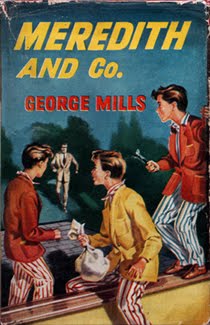
This edition's dust jacket, however, has oval-shaped exteriors of the fictional Leadham House. There's also a drawing of a boy on the spine that I'll quess is Muggs [Meredith], sans Co. The front cover's cameo is presumably the adventure in which three boys ratchet up a loose window and creep into the Master's Room to retrieve a sealed envelope filled with all of the sixth form's signatures, fingerprinted in their blood, swearing revenge on the often overly-severe Mr. Lloyd. Am I correct in assuming that when a book had been reprinted, acquiring the illustrations from a previous edition would have been a separate financial deal entirely—in this case a deal left unmade?

What made this edition special to me, however, was the author's signature, done with an extremely tired blue ball-point, on the first end paper. It's dated "July 1957". Now, I have no idea what month the undated Andrew Dakers Ltd. edition of Meredith and Co. was actually released and hit the booksellers' shelves, but everywhere I look, that year is recorded as 1957—everywhere except within the book itself, that is. My guess right now, though? It'd be in June or July of 1957.

Correct me if I'm wrong, but it seems to me that Mills was likely sitting at a promotional book signing soon after the release of the reprinted 1957 edition [then a distinguished 60 years old] when in must have strolled a long-time fan with a book—the copy that's right here next to me—asking to have his, although I guess I shouldn't be so quick to reject the fact that, even in 1957, it could have been her, older edition signed that day.

This Oxford University Press reprint is interesting. On the flyleaf, it lists the ages of potential readers as "Ages 9-12." Was it completely normal for a children's book, intended for a 9-year-old in 1950, to have 23 fewer illustrations than, say, the 1907 classic edition of Pride and Prejudice?

Meredith and Co.'s first edition in 1933, also published by O.U.P., is catalogued in the British Library and listed as containing "Plates". I won't assume they were all by the likely very expensive Brock, whose classic illustrations of the above-mentioned P&P proliferate to this day all over the internet, but it does imply more than simply a two-color frontispiece.

I've flipped through all of the 288 pages of this text and there's not an illustration to be found within. Does this reflect some post-WW II cost-cutting or simply a difference in children's publishing between 1933 and 1950? The former is my hunch, but the latter wouldn't surprise me given the changes the entire world had seen during those 17 often-bitter years.

Anyway, I'm simply delighted with this wonderful book that eerily smells so much like it was stored for years in a room full of freshly dried marijuana. Please take a moment to let me know if you have any insights into this edition, the illustrations [or lack thereof], the promotional book signings that must have taken place, or the climate of Great Britain in the early- to late-1950s, to provide me with some much-needed context.

Your input would, as always, be most welcome!


Thursday, March 18, 2010

Until the peacock led him in...


Just a couple of hours after I'd sent off an e-mail to the Oxford University Archives requesting information on George R. A. Mills, I was impressed that I'd already received an reply. Despite the fact that in the United States we like to think of ourselves as an "instant gratification" society, I have to admit that if I'd sent an e-mail at 10:33 AM requesting information into my own school district here in Florida, I'd be quite pleased if I finally had a response by the end of the day. And I sent an information request to Keele University on February 21 and I wonder when I might receive a reply—if I ever do at all.

In this case, however, I had a detailed reply from an archivist at arguably the most prestigious institution of higher learning in the world waiting for me in my in-box by 1:07 PM.
Quite impressive!

As you may recall from yesterday's post, George Mills had found his missing middle initials, his wife, his university, his brief but inspirational tenure at Windlesham House, and the colleagues [and pets] who had inspired many characters from the books he'd go on to write several years later.

This is what the Archives at Oxford added to the mix [my emphasis]:


Dear Mr Williams


Thank you for your email enquiry. I have searched our card index of those who matriculated (ie were admitted to the University) between 1891 and 1932 and have found an entry for George Ramsay Acland Mills. This records that he matriculated from Christ Church on 16 October 1919. According to the form that he completed at his matriculation Mills was born on 1 October 1896 in Bude, Cornwall. He was the second son of Barton Reginald Vaughan Mills, a cleric in holy orders and a scholar [see illustration, right], of 7 Mawson Place, Queens Gate. Before attending Oxford Mills had been educated at Harrow School.

I have also found Mills' entry in the undergraduate register. This records that he was exempted from taking Responsions (preliminary examinations for entry) and the examinations of the First Public Examination,under a decree of 9 March 1920. This decree stipulated that until the end of Trinity Term 1923 any member of the University who had been engaged in military service for twelve months or more before his matriculation, was permitted to offer himself for examination in any Final Honours School, despite not having met the statutory conditions for admission to that School. This was on condition that he had obtained permission from the Vice Chancellor and the proctors; that he had entered upon the third term and had not exceeded the twelfth term following his matriculation; and that he had paid the fee for admission to the examinations the decree excused him from. Mills' entry in the undergraduate register records that he paid the fee of £5 2s on 21 May 1921. However, I have been unable to find any record that Mills went onto pass any examinations in the Final Honours School or that he obtained a degree.

I have also checked the 'Oxford University Roll of Service', a printed register of members of the University who served in the First World War. This records that Mills commenced military service on 16 June 1916. He was a Private in the Royal Army Service Corps. His highest acting rank was that of Lance Corporal.

I have been able to find evidence that Mills' father, Barton Reginald Vaughan, was also an Oxford graduate. He appears in Joseph Foster's 'Alumni Oxonienses', a printed register of those who matriculated between 1715 and 1886. This records that he matriculated from Christ Church on 13 October 1876, aged 18. He was the first son of Arthur, armiger (ie esquire), of London. He was awarded second class honours in History in 1880. The degree of BA was conferred in 1880, and that of MA (which at this time required no further study or residence) in 1883. He was rector of Poughill in 1887. I regret that without names and dates I am unable to search our records for any other relatives of Mills who may have attended the University.

I hope you find this information helpful.

Yours sincerely
Annabel Peacock
Archives Assistant

~~~~~~~~~~~~~~~~~~~~~~~~~~~~~~~
Oxford University Archives
Bodleian Library
Oxford OX1 3BG
web:
www.oua.ox.ac.uk
~~~~~~~~~~~~~~~~~~~~~~~~~~~~~~~

Ms. Peacock, you are amazing! I simply can't thank you enough, not only for your prompt assistance, but for leaving me simply awash in total "Millsness"!

So, let me see if I have this time line correct thus far [and, British readers, please check my educational suppositions for accuracy]:

George Ramsay Acland Mills was born in Bude, Cornwall in 1896, the second son of a holy cleric and Oxford grad, Barton R. V. Mills who had been a rector in Cornwall. It's believed that George attended Parkfield, a school in Haywards Heath as a boy. After then attending Harrow School [pictured, left] in London and apparently living with the family in Queen's Gate, he joined the army in 1916 and fought in the First World War, reaching the rank of Lance Corporal.

After the war, Mills apparently attended Christ Church and from there matriculated to Oxford in 1919, where as a veteran he was exempted from Responsions, and finally paid his required fee for them 1921 without receiving a degree.

In 1925, he and his
"B.A. Oxon" are engaged as a junior appointment at Windlesham House, the same year he married Vera Beauclerc and purchased a home near the school in Portslade. His name seems to disappear suddenly from the staff list by the end of the summer term in 1926 after having spent the year teaching the boys English or "English subjects" and having been involved in extracurricular music and drama.

Meredith and Co. is published by Oxford University Press in 1933, and is dedicated to boys and staff at Windlesham House, Warren Hill School in Eastbourne, The Craig in Windersmere, and the English Preparatory School in Glion, presumably in Switzerland, among whom he
"spent many happy years."

In 1935, Mills visited the wife of his old headmaster at Windlesham, telling here he'd written a book "largely about Windlesham" and that he'd
"been at 2 or 3 schools since."

He then published a sequel to Meredith and Co. in 1938 [King Willow], and two more in 1939, Minor and Major [also about prep schools] and St. Thomas of Canterbury, the latter being a text in which Mills is listed in the British Library as author along with St. Thomas himself [pictured, right].


That's where the trail goes absolutely cold: 1939. After the most prolofic 1-2 year span of his life as an author.

It's actually been far easier to work backward into his family's past than it's been to turn up any clues about them after the onset of the Second World War.

Next time, though, let's take a peek at the fact that Mills supposedly earned a "B.A. Oxon"—something the facts don't seem to corroborate.


Sunday, March 14, 2010

An Overwhelming Sense of Millsness...


Ironically, one huge roadblock in trying to search the internet for "George Mills" is the myriad of references to Stanley Elkin's 1982 book entitled George Mills that are strewn along the path. As if there weren't already a seemingly endless array of George Millses festooning the worldwide web, every bookseller has a page for the award-winning book, and some for the author, Elkin, as well, adding to the cacophony of on-line G.M. references.

On the George Mills page at amazon.com, Elkins's book is described: "An ambitious‚ digressive‚ and endlessly entertaining account of the thousand-year history of the George Millses‚ GEORGE MILLS is the antithesis to the typical Horatio Alger story. Since the First Crusade‚ there has always been a George Mills‚ who—despite his best efforts—is unable to improve his position in life or that of his descendants... But the latest in the long line of George Millses may also be the last‚ as he obsesses about his family’s history and determines that he will be the one to break this doomed cycle."

So, it appears that I've actually decided to winnow out the proverbial needle in a haystack: An unknown man whose only identifiable characteristic—his name, George Mills—makes him one of a litany of the indistinguishable so lengthy that it's become the gold standard of anonymity, at least according to Elkin!

Elkin won the 1982
National Book Critics Circle Award for George Mills. In that same year, the New York Times book review by Leslie Epstein asks the same question of Elkins's book that we focus on here: "WHO, then, is this George Mills?"

The review continues, with my emphasis: "By the middle of the book… we know this much about him: He is married, childless, fiftyish, employed by a company that specializes in dispossessing ghetto blacks… What distinguishes him, at least in his own eyes, is, first, his conviction that he is saved, and then his overwhelming sense of 'Millsness,' the burden of his family history, which hangs over his head like a curse."

Apparently what I'm now trying to work around is this 'overwhelming sense of Millsness', which in 1982 had to have been more of a sensibility than a fact that internet search engines can now confirm. I mean George Mills is found on far more websites than that paradigm of ultimate anonymity, John Doe, according to altavista.com's search engine [
142,000,000 results to 31,900,000 results .

Yes, trying to tease one, single George Mills out of the boundless fabric of the internet won't be easy—even a Mills who's actually a published, 20th century author with four volumes residing on the shelves of the British Library alongside the Magna Charta and the Lindisfarne Gospels, for cryin' out loud!

Now that's anonymity! Still, I intend to continue to try to unravel the answer to the seemingly impenetrable question: "WHO, then, is this George Mills?"