skip to main |
skip to sidebar

Welcome back to the Court Channel, where it seems as if lately there's nothing but litigation going on, 24/7, in our investigation of the life of author George Mills. Admittedly, the breach of promise case Valerie Wiedemann brought against the Hon. Robert Horace Walpole doesn't affect George's life directly, but it must have deeply affected the life of his sister-in-law, Lady Dorothy Mills, the renowned female author, adventurer and daughter of Lord Walpole [pictured, left], and her marriage to George's half-brother, Arthur Mills. Their marriage ended in flames, and it's hard to say what effect that the dissolution of their relationship might or might not have had on Arthur's family, including George, and his spinster sisters, Agnes and Violet.
Anyway, Lady Dorothy's father, Robert, had a reputation for being tight with his money, although history shows he certainly spent enough to keep himself on the brink of solvency throughout his life. One simply needs to think of Charles Dickens's Bleak House to recall what lengthy litigation can do to one's nest egg. One wonders what Walpole spent to keep from settling out of court with Wiedemann. Had he done so—and one newspaper reported that it may have taken as little as £1000 to assuage Miss Wiedemann—one wonders how things may have turned out with his family, especially in their tragically fruitless production of an heir.
We've already read of rumors of the Countess of Orford, Louise Corbin Walpole, young bride of the future Earl, suffering from what modern wags might have termed a nervous breakdown after the first round of proceedings in the High Court under Baron Huddleston. It isn't hard to see how the scandalous trial would have been a malignancy on the couple's marriage, especially for young Louise, 12 years the junior of Walpole.
That said, Walpole and Wiedemann moved the proceedings forward, slugging it out over diaries of the plaintiff's that seemed to have existed once, but later vanished.
Here are the proceedings of two hearings pertaining to eight volumes of Miss Wiedemann's diaries, with precedents being thrown out faster than argumentative drunks at the local pub. My personal favorite: "Compagnie Financière du Pacifique v. Peruvian Guano Company."
Via the London Times of the 2nd of April and the 2nd of May, 1890, let's see exactly what occurred…
 2 April 1890
WIEDEMANN V. WALPOLE. This was an appeal by the plaintiff from an order of Mr. Justice Lawrence in Chambers upholding an order of the Master ordering plaintiff to produce at her solicitors' certain volumes of manuscript diaries, particularly those for the years 1880, 1881, 1882, and 1883. Defendant was further to be allowed to make copies of them at his own expense, and proceedings were to be stayed.
Mr. Israel Davis and Mr. Evans Austin were for the plaintiff; Mr. William Graham for the defendant.
Mr. Davis, on behalf of Miss Wiedemann, contended that the Court could not act on the affidavit on which defendant relied. It was a contentions affidavit, and under the rules of the High Court a party was bound to accept the sworn affidavits of his opponent. Under Rule 18, Order 31 there was no power to compel a plaintiff or defendant, as the case might be, to give inspection or make discovery of documents in the way defendant proposed. The learned counsel then proceeded to cite the following cases, which he retied on :—"Barnett v. Noble" (Jacob and Walker's Reports, 227), "Lyell v. Kennedy" (27 Ch. D., 19), "Gardner v. Irvin" (4 E'x. D., 53), "Mogul Steam-ship Company v. M'Gregor" (2 The Times Law Reports, 725), "Morris v. Edwards" (23 QB.D., 287), and "Jones v. Montevideo Gas Company" ; (5 Q.B.D., 556). The defendant's only way to get the plaintiff's diaries, if they existed, which he gravely doubted, was to subpoena her to produce them.
Mr. GRAHAM, for the defendant, contended that the cases cited were cases bearing on discovery and not on inspection law. The learned counsel having dealt with the cases cited at some length, Mr. Davis replied, and further cited "Pickering v. Pickering" (25 Ch D., 247), "Compagnie Financière du Pacifique v. Peruvian Guano Company" (11 Q.B.D., 55), and "Mattock v. Heath" (20 S.J.,54).
MR. BARON HUDDLESTON, in giving judgment, said,—This order must be supported, and the appeal dismissed with costs. There are no general rules which can be laid down as to questions of "inspection." It must be for the Court or Judge, before whom all the facts are, to use their discretion. Now, what are the facts before us? At the trial there was a verdict for the defendant, and since then ingenious counsel have persuaded a Divisional Court and the Court of Appeal to take the somewhat unusual course of granting a new trial to a party who acted under counsel's advice, no doubt, in taking the course the plaintiff took at the trial. What now follows? The plaintiff's affidavit of documents is dated August, 1888, and on February 3 last the plaintiff is present and conducting her case in person before a Commission at Constantinople, dealing with certain matters in this case. A witness named Osman Pasha is being examined as to certain dates on which it was suggested the plaintiff was stopping at his house. He seems to have been unable to answer, and he is re-examined by plaintiff herself on the matter. She then produced a manuscript book, and tried to get witness to fix the date from it. The defendant's counsel then asked the plaintiff what book she held in her hand, and she replied that it was a diary which she always kept, and that she had eight volumes of it. It is now contended that because 22 months ago the plaintiff did not disclose these volumes, she cannot now be made to produce them. The learned Baron then proceeded to deal with the various cases cited, and with the questions of law raised on either side. MR. JUSTICE VAUGHAN WILLIAMS followed, and, having commented on the practice in such cases under the Judicature Act, concurred in the judgment.
2 May 1890
 WIEDEMANN V. WALPOLE. This was an appeal against a decision of a Divisional Court, consisting of Mr. Baron Huddleston and Mr. Justice Vaughan Williams. The action was brought for breach of promise of marriage, and was tried before Mr. Baron Huddleston and a special jury. The plaintiff having declined to answer certain questions put to her, judgment was entered for the defendant. A new trial was granted and a commission was obtained to examine witnesses at Constantinople. The order against which an appeal was now brought called upon the plaintiff to produce certain diaries, and directed the action to be stayed until their production. The order was made on the affidavit of Mr. Woulfe, one of the defendant's solicitors, who deposed that during the examination of a witness named Osman Pasha at Constantinople he observed the plaintiff, who was present, referring to a book which she said was her diary, and of which she said she had eight volumes. On this affidavit the order for production was made by the Master at Chambers, and was affirmed by Mr. Justice Lawrence and by the Divisional Court. On the matter coming before the Court of Appeal Lords Justices Lindle an Bowen directed it to stand over for further affidavits, which were now filed on behalf of the plaintiff, denying that she had in her possession or control any such diaries as alleged, and contradicting Mr. Woulfe's affidavit. Mr. ISRAEL DAVIS,—for the plaintiff, contended that an order for production ought not to be made on a contentions affidavit. It could only be made on an admission in the affidavit of documents, the pleadings, or the answers to interrogatories. Mr. GRAHAM, for the defendant, said that he had always admitted that if the plaintiff said on affidavit that she had not got any such diaries the order for production would not be good, but on the materials before the Master, the Judge at Chambers, and the Divisional Court, the order was right. The COURT allowed the appeal. The MASTER of the ROLLS said that the question was whether the order for the production of these documents could stand. Without saying a word as to the law laid down by the Divisional Court, he was clearly of opinion that on the facts now before the Court, and which were not before the Divisional Court, the order could not be upheld. The plaintiff swore that she had not the books in her custody or control, and there was no reason for disbelieving her. LORD JUSTICE LOPES concurred.
Score one here for the Wiedemann camp. They never produced the volumes in question—diaries that may have contained more of the truth than any of the rhetoric ever aired during the proceedings on either side of this legal wrangling.
Next time: After luncheon on the 16th of June 1890, we'll take a seat in the rear of the High Court of Justice for the second courtroom collision between the Valerie Wiedemann and Robert Walpole.
 At the same time, the Wall Street Journal had published its first edition in New York. The Oklahoma Land Rush had just occurred, creating Oklahoma City overnight and giving birth to the nickname '89ers, and Pennsylvanians were still sifting through the devastation after the Johnstown Flood killed over 2000 people following the collapse of the South Fork Dam.
Adolf Hitler had just been born in Austria, the critics sneered as the Eiffel Tower debuted in Paris, and Sheffield United F.C. and Wimbledon F.C. came into existence after Preston had won the inaugural season of the Football League.
In Naples, a baker named Raffaele Esposito created Pizza Margherita, named after Margherita of Savoy, and during Wiedemann v. Walpole, part two, Vincent Van Gogh would spend June 1889 hard at work painting his masterpiece [right], The Starry Night.
See you next time, and, as always, if you have any ideas, information, or speculation regarding the trial, please let me know!

Yesterday we took a look into some of the context surrounding the Valerie Wiedemann v. Robert Horace Walpole trial of November 1888. It wasn't the first scandal involving England's upper crust in the 1880s, and certainly sent the decade out with a bang.
One case preceded it, however, is worth taking a slightly longer look at. We read last time that the Pall Mall Gazette had been "championing the application of Miss Wiedemann for a new trial in her case against Robert Horace Walpole, the heir to the Earl of Orford, for alleged seduction." The Gazette, as we know, was the organ that brought the Wiedemann affair into the public eye, notably the eye of Queen Victoria, who, upon hearing of Wiedemann's "misfortune," sent her 25 guineas.
This case follows a similar pattern to "The Langworthy Case," a proceeding that was still grinding its way through the High Court of Justice in August 1887.
Here are some more particulars of the Langworthy affair, presented here to provide once again some context for the Wiedemann v. Walpole case. It may even give some idea of what the expectations of the case might have been.
Here, first, is a summary of the case that appeared as noted:
THE LANGWORTHY CASE. Mr LANGWORTHY BROUGHT TO BOOK. HE PAYS ALL DAMAGES AND APOLOGISES.
Te Aroha News, Volume V, Issue 215, 13 August 1887, Page 4
A Reuters cable despatch received today announces that Mr. E. M. Langworthy, who has so long defied the English Courts, has at last been brought to book. The telegram is as follows:—
London, August 10. In the Langworthy case damages have been awarded to Mrs. Langworthy by consent. Mr. Langworthy apologises to the Court, and pays damages forthwith.
We assume that the damages referred to in this case are those for breach of promise of marriage. Mrs. Langworthy, after the marriage at Antwerp had been declared illegal, was advised by her solicitors to enter an action for breach of promise of marriage as the only way provided by law for punishing Langworthy for the fraud he had perpetrated upon her. The writ was served upon Mr. Langworthy in the Argentine Republic, but he treated it with the contempt he had shown to all the other orders of the Court. Judgment went against him, the amount of damages to be assessed in August before Baron Huddleston. Meanwhile the grip of the law, backed by a powerful public opinion, has been closing more firmly round the defiant Nabob. To protect himself against the judgments for alimony and costs, amounting to about £4,000 standing against him, Mr. Langworthy had got rid of £50,000 worth of property in England, and had suffered himself to be made bankrupt. But his troubles were not over. His sister, and his mother to whom the property had been transferred, were within reach of the Court and they were placed on the rack of examination. Mrs. Langworthy senior is a very old lady as well as very wealthy and she cannot take her property with her, and her beloved son would grieve above all things if it were left away from him. The suit commenced in the Argentine Courts had carried the war into his retreat. He was thus driven into a corner, and has collapsed. He has now humbly apoligised to the Court, and undertakes to pay all costs and damages forthwith. Justice is thus vindicated, and let us hope that a healthy public opinion in society will express itself unmistakably, and will show the man by sending him to Coventry that such offences as his cannot be atoned for by money wrung from him when resistance was of no further avail.
 That summary report from New Zealand in the Te Aroha News, however, merely whets one's appetite to know more about the details of the case itself, one that surely influenced percetions about the Wiedemann v. Walpole proceedings, especially since it was also overseen by Baron Huddleston. In another article that appeared in the Ashburton Guardian on 29 September 1887 [seen, right], we can easily see at least one way in which the proceedings of this case affected Wiedemann v. Walpole: £10,000 had been spurned by the solicitors of Miss Long/Mrs. Langworthy as a settlement with Edward Martin Langworthy. That figure was obviously became the amount that Miss Wiedemann indeed intended to accept.
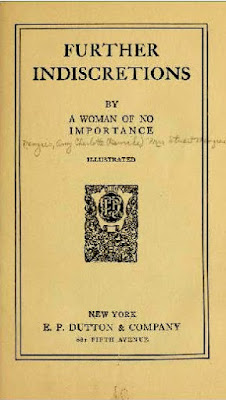
In a book entitled Further Indiscretions [Dutton: New York; 1918], written by "A Woman of No Importance," the anonymous author claims to have had the particulars of the affair related to her personally. Today, the website amazon.com credits Amy Charlotte Bewicke Menzies [also known as "Mrs. Stuart Menzies"] as the author. Assuming that's correct, here is the entire chilling and tragic scenario as framed in hindsight in that 1918 text by by Mrs. Menzies [with my emphases]:
Sensational trials are apparently very short lived in the public memory. Perhaps because they seldom have historical significance, although so full of human interest... The Langworthy case was remarkable chiefly as a record of villainy that to my mind seems almost unique, and leaves one dumbly wondering at the dark possibilities of cruelty that lie in the human heart.
It also shows the apparently anomalous case of a woman who first obtained a decree nisi with £1500 a year alimony from the Courts and subsequently £20,000 for breach of promise of marriage against the same man. The law is a wonderful institution.
The way I came to know so much about the case was through being asked by Dr. Godson, the great ladies' doctor of those days, if I would go and see a patient of his who was in great trouble and ill- health as well as practically penniless.
 Of course I went, and from Mrs. Langworthy's own lips heard her pitiful story, which as it appears to have been entirely forgotten, I relate briefly.
The Mrs. Langworthy of the case had been a Miss Long, the daughter of well-to-do people in Ireland, her father being estate agent at one time to the Marquess of Downshire and later to Lord O'Neile.
She was a tall, handsome girl and gifted, as was proved by her passing in 1873 as one of the senior candidates at the Dublin University, taking honours in French, Latin, Euclid and Algebra.
Her composition on English literature was chosen as good enough to be read aloud by Professor Dowden. Fired with her success she then went to Cambridge, where she shone in Latin, Divinity, etc.
About this time her father lost most of his money, and Miss Long decided she would cost him nothing more and went out as governess. During a visit to Paris with her brother, who was staying at that comfortable old-fashioned Hotel Bedford, she met the man who was to ruin her life, namely, the exceedingly rich and not ill-looking Mr. Langworthy, with great estates in South America, a magnificently appointed yacht, French chef and all the luxuries and comforts which usually surround men with large fortunes. At the time he became enamoured of Miss Long he was a widower. His first wife, Lady Alice, sister of the second or third Earl of Limerick, died at sea in 1876, under what circumstances I do not know.
Mr. Langworthy proved a devoted if somewhat dictatorial lover, and an engagement quickly followed on their first meeting, but Miss Long was told under no circumstances must his mother know anything about it as she might disinherit him; the engagement must be a secret.
During this time he persuaded Miss Long to go for a little cruise in his yacht, having provided a suitable ballast of chaperonage. They stayed at Cherbourg for a day or two, and while there he introduced his fiancee to a number of people, including the Hon. Cecil Cadogan, Mr. Dennison and others. While at Cowes Mr. and Mrs. Vereker invited them to dinner. All was comfortable and plain sailing. One day Mr. Langworthy while at Cherbourg asked Miss Long to go for a drive with him to Caen; they looked at the cathedral [pictured, below right] and then taking both her hands said, "I want you to marry me at once; I cannot wait any longer for you and have arranged everything." She was entirely taken by surprise and objected. While he pleaded she turned over in her mind all the circumstances, and feeling there could be nothing but love to influence him, as she was penniless except for her own earnings, consented, knowing nothing about French marriage law.
 The carriage was told to stop before a Catholic Church some miles out in the country from Caen. Here awaited them (all having evidently been arranged) a priest in a black cassock and a fat, disagreeable smile, who read some sort of a service in Latin. As a matter of fact the whole thing was a fraud; seemingly such things can be arranged where money and villainy are not wanting. There were many interesting features in the story at this time, much too lengthy and complicated to relate here, but various thoughts came to her mind making Miss Long doubtful about the legality of this marriage ceremony, and suggesting that she would be happier with a second ceremony.
Mr. Langworthy, having had the legal training of a barrister, knew how to turn his knowledge to account, said, certainly if she wanted another ceremony she should have one. This time the chaplain of the American Seaman's Mission at Antwerp performed it, the divine's name being the Rev. Doctor Potts, a member of the Presbyterian Church.
What Mr. Langworthy knew and his unfortunate dupe did not know was that only civil marriages are valid in Belgian law.
However, in all good faith she had taken part in two ceremonies, the one near Caen in September, 1882, the second in January, 1883, at Antwerp. After this latter Mr. Potts entered the following in his register: —
''Antwerp, January 10th, 1883.—Edward Langworthy, England, widower, 35 years old. Mildred Pallise Long, Belfast (Ireland), maiden, 27 years old. Marriage ceremony by Rev. Arthur Potts."
This was duly signed by the witnesses, one being Mrs. Potts, the other a Mrs. Bailey, whom I think was acting companion, chaperon or something of the kind, I have forgotten what.
A copy of the certificate was handed to Mrs. Langworthy, but it was taken away by her husband, who said he would send it to his solicitors for safe keeping, and he would mark it private and important. He then made his wife promise to keep the marriage secret for a year as he did not wish his mother to know anything about it.
A happy time followed in the yacht; Mr. Langworthy seemed to be deeply in love with his wife; it was all glorious and the days chased each other like some love poems under sunny skies
They stayed a few days at Lisbon, where Mr. Langworthy introduced his wife to Lady Ashton, Lord Francis Cecil and others (this is a point to bear in mind).
From Lisbon, if I remember correctly, they sailed for Buenos Ayres, where Mr. Langworthy owned property. During the voyage his wife told him she expected to become a mother. From this moment his manner entirely changed and, instead of expressing pleasure, exclaimed, "We must put the little beast out to nurse." By degrees he now became so brutal it was forced upon her he was hoping his treatment, drugs and starvation, would kill the child, and possibly the mother also.
Driven nearly mad by his treatment, one evening she got out of her bed and went in search of her husband, threw her arms round him and implored him to say why he had so changed. He then told her not to make a fool of herself, she knew perfectly well she was not his wife and the child would be illegitimate, and as this had happened she must leave the yacht on reaching Buenos Ayres and go home again at once; if the affair became known it would be his ruin.
Without allowing her to land at their destination, he put her on board a French tramp steamer without a deck house, that having been washed away on its last voyage, and of course without either a doctor or stewardess.
Mrs. Langworthy begged for some baby clothes, and was given a box containing a few yards of flannel and calico, and £50 in her pocket and sent off home!
So back to England she came full of misery and shame with nothing to prove the story she had to tell but her wedding ring and the baby. Her pride would not let her seek her people, whom she knew would wish to help her but could not afford it. To use Mrs. Langworthy's own words to me, "When I first arrived I tramped London trying to find some clergyman to take up my case for me and see me righted; I could get help from none. One told me he had heard stories like that before and was sorry he could do nothing for me." Another, living in some state in Grosvenor Square, who preached regularly in a fashionable chapel not far from Berkeley and Grosvenor Squares, was sitting one evening after dinner before a comfortable fire sipping coffee from delicate china and toying with a gold spoon, surrounded by expensive fur rugs, books and comforts of all sorts, when Mrs. Langworthy sought his help and told her story. He did not rise from his chair while the poor woman poured forth her tale and implored him to help her. It was a wet night and she was wet through, having tramped the streets all day in hopes of finding some one to help her, her boots were worn through in places and her teeth chattered from cold and want of food.
She eventually was told he did not believe a word of her story, it was too impossible, but if it was true she must "Have faith."
Poor soul! She asked how that was going to find food for her child and herself and turned bitterly away. She described to me her despair as she once more walked along the wet pavements and meditated drowning herself and her child.  Passing down Conduit Street [left] she noticed a brass plate on a door with the name of Lumley and Lumley, solicitors, printed on it. She had not tried them, but would do so first thing next morning. She had already tried several solicitors, but she was destitute, friendless, broken in health, the law and the Church refused to help her, justice was her only weapon, while the whole force of the Langworthy's immense wealth was thrown into the scale against her.
The treatment meted out to her by the Anglican divines is a black and lasting disgrace to their Church and the system that produced them.
Her husband's relations would not listen to her, and this is the plight she was in when she entered the offices of Messrs. Lumley and Lumley in Conduit Street. They listened to her story, gave her money to go on with, took the trouble to collect the necessary evidence to prove the ceremonies that had taken place and undertook to fight the case for her. Magnificently they did it through all the courts for four years. Mr. Robert Lumley I do not remember meeting, but Mr. Theodore Lumley I am glad to have known, for he did for this defenceless, broken-hearted woman what not one single shepherd of Christ's flock would do.
Another revolting feature about the treatment from which this unhappy woman suffered, was the attitude of her own sex, the lodging-house woman where she lodged turned her out on hearing she was not living with her husband! Others treated her as if she was one of the lowest of those who walk the streets for their living. Even had that been the case, they should have shown some humanity to a suffering sister.
I did what I could for her, and by degrees one after another helped her; but that she got justice in the end and her life made possible during the long years while the case was in the courts is entirely due to Messrs. Lumley and Lumley, the solicitors, and to The Pall Mall Gazette, who took her case up warmly, collected money for her, published special editions of their paper with all the details of the case as it unfolded itself from day to day.
They also brought out a little booklet or pamphlet, entitled A Romance of the Law Courts, Mrs. Langworthy's Trials and Triumphs. Anyone wishing to read all the particulars of this extraordinary case cannot do better than get a copy and read it, if there are any now to be had.
Mrs. Langworthy's troubles were, however, not yet over, though the learned judges held her marriage to be illegal, but a marriage "in fact" and granted her £1500 alimony. Mr. Langworthy had fled to America, refused to pay and was nowhere to be found.
His solicitors and counsel worked indefatigably to delay any steps taken by Mrs. Langworthy's solicitors to obtain the money for her.
The husband's wealth was a terrible weapon. I have been told great London papers even refused, through the influence of Mr. Langworthy's agents, to insert her lines in their agony columns.
Goods of his, seized to pay his debts to his wife, were instantly claimed by his mother as her property and therefore inviolate. While all this was taking place Mrs. Langworthy was often in great need, and but for the kindly help of The Pall Mall Gazette and Messrs. Lumley and Lumley would surely have gone mad.
Twenty thousand pounds on paper did not help her much. Her husband was made a bankrupt, but he had made his English property over to his mother. In the end the victim triumphed, having fought hard for her child, but there was no getting away from the fact that the strain had told upon her considerably. She was aged and broken down at the end of the four years almost beyond recognition.
The end of these people was as tragic as their lives. Mrs. Langworthy rejoined her husband and forgave him, she died suddenly when in Paris with him and he committed suicide next day.
It is impossible to picture the state of a man's mind who could be so systematically cruel to a woman who had done him no wrong.
As I congratulated Mrs. Langworthy on her victory I felt a lump come into my throat, but I remembered her as she was when I first saw her in the early days of her trouble and mentally compared her with what she was after four years' hard fighting. She had won the day, but the heart, health and spirit to enjoy her triumph had gone. In a measure it was Dead Sea fruit.
Ironically, it's with an eye toward the life of Lady Dorothy Mills that we examine this case—one that bears some similarities to that of the one in which her father and mother found themselves embroiled at the time of her birth. The irony is that Amy Charlotte Bewicke Menzies was the author of not just a trio of gossipy memoirs under the pseudonym "A Woman of No Importance" [presumably appropriated from Oscar Wilde's 1893 play], but writer of a 1913 book on hunting entitled Women in Hunting the Field. Lady Dorothy and her mother were both noted for their enjoyment of the outdoor sports of hunting and fishing, and the former in particular enjoyed a life of relative fame by continuing to do things that were usually done by men.
 And, casting one more glance at the world of 1888, in which we find the scandalous and painful legal wrangling between Valerie Wiedemann and Robert Walpole only beginning, let's find even more context.
Thomas Hardy, Herman Melville, Henry James, Jules Verne, H. Rider Haggard, Rudyard Kipling, Robert Louis Stevenson, and Oscar Wilde were all published during 1888, as was Richard Francis Burton's translation of A Thousand Nights and a Night.
Gilbert and Sullivan's The Yeomen of the Guard, or The Merryman and his Maid, began its run at the Savoy Theatre on 2 October 1888, Pyotr Ilyich Tchaikovsky opened both his ballet Sleeping Beauty and Symphony No. 5, and works by Edvard Grieg, Claude Debussy, Richard Strauss, Gustav Mahler, and Nikolai Rimsky-Korsakov also debuted.
Georges-Pierre Seurat completed the pointillist Post-Impressionist masterpiece Les Poseuses [seen at right, above] and Paul Gauguin painted Vision After the Sermon (Jacob Wrestling with the Angel), while an unknown Dutch artist named Vincent van Gogh painted his famous Cafe Terrace at Night, Le Café de nuit, and La Chambre à Arles, as well as beginning his landmark sunflower series.
Heinrich Rudolf Hertz discovered radio waves, the International Exhibition of Science, Art, and Industry was held in Glasgow, Scotland, and the global atmospheric temperature finally returned to normal, five years after the eruption of Krakatoa in 1883.
The Football League was formed, as well as the Lawn Tennis Association. The Local Government Act of 1888 gave women the right to vote in local elections and Annie Besant organized the London Matchgirls' Strike.
 And, finally, from 7 August through 9 November, the bodies of five prostitutes were found murdered, all attributed to the infamous "Jack the Ripper." The 'notorious districts' of London hadn't cornered the market on this sort of crime, however: On 2 October 1888, a box with the dismembered torso of a woman was found in a box inside of a relatively new vault beneath Scotland Yard, a crime dubbed "The Whitehall Mystery." None of the above crimes were ever solved.
Across England, the Reverend Barton R. V. Mills was vicar at Pouhghill in 1888, having just returned from San Remo after the devastating earthquake, and was raising his one-year-old son, Arthur Frederick Hobart, along with his first wife, Lady Catherine Hobart-Hampden.
And, also in 1888, Robert Horace Walpole had married Louise Melissa Corbin, daughter of an American multimillionaire, who was by the time of the November trial five or six months pregnant, carrying Arthur Frederick Hobart Mills's future wife, Dorothy Rachel Melissa Walpole.
That's where we find ourselves as we sit on the cusp of the second version of Wiedemann v. Walpole.
So, as American footballer Terrell "T.O." Owens would say, "Getcha popcorn ready." It's bound to be an interesting time…


 2 April 1890
 WIEDEMANN V. WALPOLE. This was an appeal against a decision of a Divisional Court, consisting of Mr. Baron Huddleston and Mr. Justice Vaughan Williams. The action was brought for breach of promise of marriage, and was tried before Mr. Baron Huddleston and a special jury. The plaintiff having declined to answer certain questions put to her, judgment was entered for the defendant. A new trial was granted and a commission was obtained to examine witnesses at Constantinople. The order against which an appeal was now brought called upon the plaintiff to produce certain diaries, and directed the action to be stayed until their production. The order was made on the affidavit of Mr. Woulfe, one of the defendant's solicitors, who deposed that during the examination of a witness named Osman Pasha at Constantinople he observed the plaintiff, who was present, referring to a book which she said was her diary, and of which she said she had eight volumes. On this affidavit the order for production was made by the Master at Chambers, and was affirmed by Mr. Justice Lawrence and by the Divisional Court. On the matter coming before the Court of Appeal Lords Justices Lindle an Bowen directed it to stand over for further affidavits, which were now filed on behalf of the plaintiff, denying that she had in her possession or control any such diaries as alleged, and contradicting Mr. Woulfe's affidavit. Mr. ISRAEL DAVIS,—for the plaintiff, contended that an order for production ought not to be made on a contentions affidavit. It could only be made on an admission in the affidavit of documents, the pleadings, or the answers to interrogatories. Mr. GRAHAM, for the defendant, said that he had always admitted that if the plaintiff said on affidavit that she had not got any such diaries the order for production would not be good, but on the materials before the Master, the Judge at Chambers, and the Divisional Court, the order was right. The COURT allowed the appeal. The MASTER of the ROLLS said that the question was whether the order for the production of these documents could stand. Without saying a word as to the law laid down by the Divisional Court, he was clearly of opinion that on the facts now before the Court, and which were not before the Divisional Court, the order could not be upheld. The plaintiff swore that she had not the books in her custody or control, and there was no reason for disbelieving her. LORD JUSTICE LOPES concurred.
 At the same time, the Wall Street Journal had published its first edition in New York. The Oklahoma Land Rush had just occurred, creating Oklahoma City overnight and giving birth to the nickname '89ers, and Pennsylvanians were still sifting through the devastation after the Johnstown Flood killed over 2000 people following the collapse of the South Fork Dam.