Showing posts with label speech. Show all posts

Tuesday, August 9, 2011

Croquet, Memories, and Dr. William Ormerod


Yesterday afternoon I had the distinct pleasure of an interview with croquet icon Dr. William P. Ormerod. To hint that I conducted the interview would be misleading: Dr. Ormerod has a wealth of information, anecdotes, and memories, and he was kind enough to take me on a quick tour of a by-gone era in the game's past.

In fact, Ormerod [seen, far left, in the 1969 photograph at left], born in 1937 in Bristol, continued his family's position as the longest line of physicians in Britain's history, starting in 1789, the year of the French Revolution, and continuing for, I believe, seven generations.

Of his roots in the sport of croquet, the charming Dr. Ormerod recalls, "My first tournament was in 1952 when aged 15 years, and my first opponent was at Parkstone [against] a lady, Miss Hedges. She was in fact Lady Barbarolli's aunt, and when she knew that I was also musical and played the 'cello, she said 'William, don't let's play this silly game; we should go inside and talk about music!'"

His initial involvement with the sport came at the suggestion of Kathleen Ault, a player of that era who was associated with croquet legend, author, and philanthropist Maurice Reckitt.

Ormerod recalls that Reckitt [right], as we know, was associated with the company Reckitt Colman, but the "directors paid him to stay away from the board meetings." He was a fine croquet player who first won a championship in 1935, and later wrote the text Croquet Today.

Reckitt was a noted Christian socialist, but also was known as a "champagne socialist," because of his belief that whether one won or lost at croquet, it was always best to follow play with champagne.

He and his wife, Aimee, loved dancing, an activity for which they were well known for some 40 years. Aimee was also an accomplished tennis player who had competed at Wimbledon in the 1920s, but Ormerod recalls that she played the 'cello as well. His recollection, however, is that she at last gave a recital during which something went awry, and she sadly never played in public again.


Dr. Ormerod also tells wonderful stories of some other noted personalities of the era.

He felt a kinship with Major Freddy Stone, a player who had begun playing at a young age as well, at 12 or 13 years old in 1912, and who "hit the ball like a bullet." Stone had a distinguished military career, but his most noteworthy service might have been in the British army's assistance during Turkey's Hakkari earthquake in 1930.

The Turks had been foes during the First World War, but afterwards the English provided such substantial help that Stone was told, "We will never fight against the British again!"


Of another player, legendary Daisy Lintern, who was also a noted manager of croquet tournaments, Ormerod recalls that, "as opposed to white, ladies at the time wore colorful silk dresses and hats to play."

Lintern apparently once had occasion to attend a funeral on the day of a match while wearing a hat festooned with flowers. Deciding her floral hat to be too much for the service, she quietly set it aside, out of sight. Much to her surprise, the casket was later brought out with the hat sitting on top, having been mistaken for a wreath!


Ormerod also has fond memories of Guy and Joan Warwick, with whom he stayed while in Budleigh Salterton, almost next door to the Mills siblings, George, Agnes, and Violet. His association with the Warwicks began even before Guy and Joan moved to Budleigh.

Brother and sister, the Warwicks [left] had lived, as we know, in a Victorian house in Peterborough, and while Dr. Ormerod was attending Cambridge in 1956, he would ride "from Cambridge to Peterborough by bus and play croquet all day long." During his time spent there, Guy, an architect, would drive Ormerod to Hunstanton, and "on the journey there, he would point out buildings he had designed, especially in the Georgian style."

Soon after that, the Warwicks had retired to Budleigh, which Dr. Ormerod recalls as being a "special" place: "When I was a boy Majors retired to Exmouth, Colonels to Sidmouth, and Brigadiers, Generals and Top Brass to Budleigh--all towns within 10 miles of each other !"

Joan Warwick was a noteworthy player of croquet, and Ormerod recollects her as powerful, and that while most women relied on some finesse, Joan was "not a very elegant player like some of the ladies, but she had a good eye for the ball," and consistently hit the ball quite hard!


Finally, of George, Agnes, and Violet Mills, Ormerod has a few memories.

He recalls the siblings were "well educated and had apparently come from a family that was well-connected," as well as having had enough money to live by their own means. He remembers visiting their home just once, when he was 19 years of age (it would have been 1956-1957), but has no real memories of the occasion.

Of Agnes [seated, right], Dr. Ormerod recalls that Aggie "was a great character," whose gait was unusual, waddling along with out-turned feet. (We've already been told that children in Budleigh were fascinated by Agnes's unusual appearance). He describes her as "very nice, highly educated... and very involved in croquet."

One other thing: Agnes apparently played with unusual equipment that apparently came from Burma!

Contrasted with her much larger sister, Violet Mills was "slim and ladylike, not as good a player as Agnes," but again, "a very nice person."

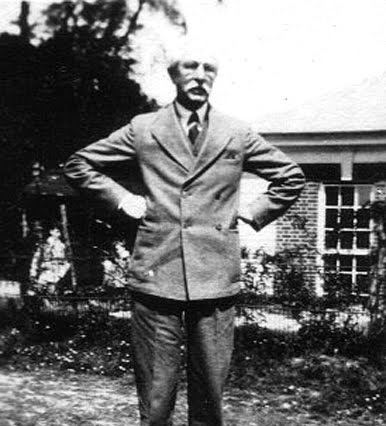
Of George Mills, Dr. Ormerod seems almost apologetic about his lack of remembrance. Aware today of Mills's status as a children's book author, he did not know then that Mills wrote, nor has he been able to find anyone else who knew that Mills had been a writer. "Even my mother did not, which surprises me," he explained, "as she was quite a literary person."

He recalls Mills [left] only as a player, but does remember that George had been "a smart, dapper chap, a great contrast to Aggie," the latter often having been rather careless about her appearance. It did not surprise Dr. Ormerod at all that George Mills had spent time at Harrow and Oxford, and he distinctly recalled that Mills had "an unclear voice, [and] a lisp."

Interestingly, when told that Lt.-Col. Gerald Cave of Budleigh had described George Mills as "exuberant," "loveable," and "enthusiastic," he replied, "Those are words I would use to describe Gerald Cave himself."


This past weekend Dr. Ormerod played croquet in the "Dorset Golf Croquet Champs. at Parkstone, where I played my first croquet tournament in 1952 aged 15 years."

He continues: "Talking about croquet players in the 1950's and playing croquet at present brings a wry smile to my face; all the financial markets continue to plummet and major problems in middle east and horn of Africa. But Sir Francis Drake still played Bowls as the Spanish Armada approached Plymouth in 1588 !"


Ironically, as we spoke that evening, four cities in England, including London, had concluded a day of frightening rioting and looting, reminding me that times have certainly changed since the Mills siblings took to the lawns.


The croquet resume of Dr. William P. Ormerod is stellar, and it includes the fact that he played on the MacRobertson series winning team in 1956 when at Cambridge University, aged 19 years, as well as in 1963, 1969, and 1974. In addition, he won the Delves-Broughton Open Golf Croquet Doubles Championship in 1954 when aged 17 years, partnering Brigadier A.E. Stokes-Roberts at Roehampton. Ormerod was winner of the Open Doubles Championship seven times (in 1960 partnering H.O.Hicks, and in 1971/2 1975/6 and 1977/8, partnering G.N.Aspinall). He was also winner of the Parkstone Dorset Salver Open Croquet event on nine occasions between 1956 and 2010—a remarkable 54 years between winning it for the first and the latest time!

Now Dr. Ormerod spends a great deal of time "coaching golf croquet at Swanage Croquet Club where I also belong."


Dr. Ormerod has played around the world. A more complete sketch of his career accomplishments in the sport of croquet can be found HERE. For his record in the database of the Croquet Association, between 1954 and 1984, click HERE.

It was great honor to have the opportunity to discuss the sport with the legendary Dr. Ormerod, and I am grateful for his kindness, his time, and his generosity.


[Update: Here's an update I received from Dr. Ormerod on Tuesday, August 23, 2011: "For the sake of accuracy here are just two further comments. It was Aggie Mills who had a marked lisp, not George(although he may have had one). Also I see you have mentioned Hakkari on the Turkey/Iran border as the site of the serious earthquake in 1930--certainly that was the site mentioned for 1930 quake in literature; however his comments re Turkey not fighting the British I well remember. This comment was also made by a patient of mine, Mr. Shillabeer, who served as a private under Major Freddie Stone and also helped at the earthquake. Mr Shillabeer died in the 1970's and was from Ermington, Devon, before moving to Parkstone in approx. 1968. (I was a GP in Parkstone 1965--1995 before retiring last year after 15 years as a government Tribunal Doctor working with the Judiciary)." Thank you once again, Dr. Ormerod, for your patience and your time. I remain extremely grateful for your kindness.]


Friday, June 10, 2011

Lt.-Col. G.E. Cave, Sir Leonard Daldry, and Bill Perry


One of the most rewarding aspects of doing this research is meeting (at least 'virtually') people from around the world and hearing about where they live (or lived) and what it was like in another time. I have to admit, we Americans are generally so provincial that I know people who traveled through Europe, for example, rarely eating anywhere but a McDonald's or drinking anything except Diet Coke! We like to see exotic places on HDTV, but in person, as a rule, most often think it far more convenient for other lands to be exactly like the United States!

My only time in England involved a three-hour layover at Heathrow, which I will assume may not be completely identical to the rest of the U.K., although it was a great deal like a small shopping mall in the U.S. That's why I love studying Great Britain here and learning so much about it that doesn't involve simply our American fascination with "Big Ben" jokes, stoic palace guards, A Christmas Carol parodies, Lady Diana, and the recent Royal Wedding.


For example, soon after hearing from Joanna Healing, I received the following e-mail:

Fascinated to read your Blog. I think I can help a bit, as when I was a child I spent a lot of time in Budleigh Salterton, from about 1948 onwards, and then in the 1960s my parents moved there permanently, so I have visited regularly all my life.

I remember Aggie and Violet, although I was not so aware of George, but I knew of his existence, and doubtless met him at "the club". Aggie I remember was rather a strange shape which as a child I found fascinating!


That's from Judy Perry. Regarding a couple of croquet players at the club in the era of the siblings, she relates:

Gerald Cave [seen in hat, right, with two unidentified croquet players--any ideas who they are?] was my Godfather and I have photgraphs of him and also of his mother with whom he lived, (the Mrs G Cave you mention). Late in life he did marry for a second time. He was divorced early in his life, and remained single for many many years.

His mother was definitely Geraldine, (and his father a High Court Judge), but whether or not she played croquet I am not sure. I don't remember her doing so, but then when I knew her she was quite old.

His first marriage was to an American, was very brief and the wife and daughter lived (returned?) to the USA. Much later on Gerald married Marjorie [and] my father Bill was best man at the wedding in London. Marjorie (don't know her surname) went to live in Budleigh and moved in with Gerald and his mother (which did not turn out to be a very happy arrangement as the two women did not get on!).

Just for your records Sir Leonard Daldry was definitely a member of Budleigh Salterton Croquet Club, and at one time also Chairman. His childless invalid wife died when he was in his late seventies, and he remarried a younger woman and promptly produced a son and a daughter, his first children. He didn't take much interest in croquet after that!


[Update: From Chris Williams of the Croquet Association on 29 June 2011: "I think that the player on the right in the photo with Gerald Cave (Friday June 10 article) is Humphrey Hicks." Thank you very much, Chris, and to the Fairlynch Museum in Budleigh for use of the undated image!]


Judy also attaches this far more personal note:

My father featured quite a lot in the Budleigh croquet club. He was Bill Perry (actually he was Bennett Gregory Perry, but he was always known as "Bill"). His wife, also "Vi", my mother, was Geraldine Cave's god daughter.

An Australian by birth he spent most of his life in England, and landed up playing croquet for England against Australia! Bill played croquet with all the characters you mention [Bill played on the 1974 MacRobertson Shield-winning team, although he is not seen in the team photograph, left], and was twice Chairman of the Budleigh Club. After my mother died he remarried and his second wife Diana (nee Barker). [She] is the Diana Perry mentioned on the Budleigh Salterton website as the author of the club history. Sadly she too is now dead.


Thank you so much, Judy, for getting in touch!

With Judy's insight and memories, we get a much a clearer image of what the close-knit world of Budleigh Salterton must have been like in the middle of the last century. Although Bill played most of the contemporaries of the Mills siblings, he never played George, Agnes, or Violet. Someday I hope to visit Budleigh Salterton and see where it all took place, but at the rate they've been cutting teachers' pay all around the U.S., the street views I access on Google Maps may have to suffice!

Finally, a word about George Mills.

George is quite a mysterious character. Known as a witty, abundantly clever, and very sociable man, it continues to surprise me that those who met him—or, as in Judy's case above, believe they must have met him—have little or no recollection of the man [seen below, right, possibly with one of the unidentified players pictured above].

Admittedly, most who would have known him then were children, and it is now 39 years since he passed away. Still, as an author of popular children's books and having spent years as a schoolmaster, one might have thought he would be among the more memorable characters around the club in Budleigh to local youths.

Did his speech impediment (perhaps the lisp with which he endowed the new boy, "Pongo," in his children's novels) preclude him socializing with people he didn't know very well? Pongo's impediment was brought on and made worse by anxiety, especially social anxiety, and perhaps that was something Mills also battled throughout his life.

Did years spent away from schools—after 1938-39, we are only sure he taught in the summer term of 1956—diminish his ability to relate to the young? He did serve in WWII as a paymaster, and perhaps he left the service and spent years as a civilian in a clerking/accounting capacity, in a small office or dreary cubicle, having his joie de vivre drained from him daily.

And, as a childless widower who had no known nieces or nephews, it's uncertain how much contact he might have even had with children after leaving Seaford in 1956 through his last days by the sea in Devon. Perhaps precious little.

For whatever reason, it still remains difficult for us to get to know George Mills, this agreeable and very social man no one can quite remember!

Anyway, Judy will be sorting through some items and may have photographs to share—something to which I will be looking forward. Until then, many thanks to everyone who has made it so pleasant to have asked the question: Who Is George Mills?


Friday, May 27, 2011

An Afternoon at Warren Hill with George Mills and Bertram de Glanville


After spending the morning in Meads at the now defunct Warren Hill School, it just feels right to spend the afternoon there as well. It seems I'm not ready to leave as of yet.

In the last entry, we saw that Warren Hill had the use of land to the north of the school, just south of Moira House Girls' School, along Carlisle Road. That land (now part of Eastbourne College), it seems, was owned by the school.

We know that business partners Joshua Goodland and F. R. Ebden dissolved their partnership as of 31 July 1931, with Goodland becoming sole owner of the school. From the 11 August 1931 issue of the London Gazette, we can see an entry in a section, containing the addresses and owners of land about to be registered, entitled "Freehold," which reads: "7. Warren Hill, Beachy Head Road, and land in Carlisle Road, Eastbourne, by Joshua Goodland, Warren Hill, Beachy Head Road, Eastbourne."

This "land in Carlisle Road" is, we now know, where the photograph we examined in depth last time was actually captured.

Although Goodland sold the school sometime thereafter, we can surmise when the sale may have occurred based on this research, shared by friend of this site Michael Ockenden on behalf of the Eastbourne Local History Society: "According to street directories, the principals in 1925 were M A North and F R Ebden; in 1929 they were F R Ebden and J Goodland; in 1932 Joshua Goodland is the sole principal; in 1933 the sole principal is H E Glanville. (I have not seen a directory for 1930 or 1931.)"


We know Glanville's exact name is Bertram G. de Glanville. The ELHS has also graciously provided a promotional leaflet created by de Glanville after assuming the reins at Warren Hill. It contains some interesting information, available nowhere else that I know of. Let's take a look at it!


Initially, we find that Warren Hill was founded in 1885, telling us that its demise came shortly after the celebration of its 50th anniversary. The first page continues, "The school stands on high ground at the edge of the South Downs on the western side of Eastbourne. It is within a few minutes [sic] walk of the sea and from the house and grounds there are fine views of the English Channel and the Downs."

This is noteworthy. In two novels of George Mills, Meredith and Co. (1933) and King Willow (1938), prep school boys venture out onto the nearby Downs to play and sometimes engage in perilous escapades. Wikipedia notes that Brighton and Hove are remarkable in their residential encroachment into the South Downs, and as we are not now exactly sure where Windlesham House School (another school at which Mills taught) was located when it was in Portslade at the time, it would appear that Warren Hill, not Windlesham, would have offered the easily walkable access to the Downs enjoyed by his books' schoolboy characters.

This page of the document also adds that "There is a capacious sick wing which has its own kitchens, bathrooms, etc., and can be completely isolated from the main building in case of need."

Might we assume that sick wing is adjacent to the main building, abutting it at the southwest corner, as seen on the 1930 map [below, left]? Or could it be the outlying rectangular building to the west, near Beachy Head Road?


The second page of the document continues: "In the grounds there is a large concrete playground, a gymnasium, five squash racquet courts, a miniature rifle range and a carpentry workshop."

On the 1930 map, it appears we can see what are likely the squash courts to the left of the main building. It's also likely that the concrete playground is in that area as well. Since the gymnasium is listed above as having been "in the grounds," we can reasonably assume it, too was some sort of outlying structure. Unless either the sick wing or the gymnasium had been constructed after 1930, we may well assume that they are the buildings to the left of the main structure.

In addition, it makes sense to have both the gym and the infirmary close to an area that included athletic pursuits engaged in upon concrete and amid gunfire.

In a private photograph previously provided by the ELHS [click HERE to view it], seemingly from this time, we can see a new building at the left that is not in older photographs of the school taken from the south. A game of cricket is being played on that field, and we can see no signs of squash courts or a rifle range from this angle, again leading us to believe those are enclosed in an area behind that new addition to the school at left.

Regarding the playing field in that image we learn: "The playing fields consist of a large level cricket field of over 2½ acres and two other fields adjoining the school."

The "two other fields" are obviously the ones we see next to Carlisle Road, over which Moira House Girls' School looks. They are divided by a wall that was once covered with ivy, and are now owned by Eastbourne College, as we can see in the image.

In an archival photograph taken from another angle, again provided by the ELHS, we see Warren Hill towering at left [click HERE for the image]. We learned from Ockenden at the time: "[This image] is probably from a postcard and shows the view looking up what is now Beachy Head Road with the school on the left. It's hard to date precisely but one can suppose that it is pre 1900. The masters' residence must be the house on the right. The girls walking down the hill are almost level with a group of flint cottages which still stand. One of these was rented during various summers by Arthur Conan Doyle."

It would be interesting to know on which side of the road that unknown number of "flint cottages" mentioned here actually rests.


Figuring that the building on the right hand side of the postcard image is, indeed, the master's residence, Goodland, we can see, owned quite a bit of land in Meads. If the cottages mentioned face Denton Road, behind the supposed masters' residence on Beach Head [as seen today, above], and it was all in possession of the principal of the school, Goodland was, indeed, quite a landholder. One wonders what that entire tract of land as a whole would be worth today!


I do wonder if the current building across from Warren Hill School's location [above] is the same one referred to above as the "residence" of the schoolmaster's. We can do a drive-by via Google today, but we again notice its adorning ivy is no longer in place. Does the ivy in that postcard image obscure some of what we would need to positively identify the currently standing structure as being the same as the one to the right-hand side of the postcard image from the ELHS?

I don't feel qualified, sitting here half a world away, to discern that.


Another aspect of Warren Hill School that figures into the books of George Mills is related in this excerpt from the third page of de Glanville's leaflet: "Unless parents specially desire it, pocket money is not issued regularly to the boys, as it is felt that this practise tends to lead the boys to spend money for the sake of spending and encouraging waste. Any money sent with, or to, the boys is put in a special boys' bank and they may draw upon it in reasonable amounts. It is suggested that the amount sent with or to a boy in any one term should not ordinarily exceed £1."

Hijinks involving the need, or simply the desire, for money from that "bank" figures in many chapters of the stories told by Mills. Whether or not Windlesham House had a similar arrangement at the time, withdrawals from which could only be made under the watchful and thrifty eye of the Head Master, is unknown, and we may reasonably conclude that the yarns Mills spins regarding it were given rise at Warren Hill.

The last sentence on that third page is pertinent to the novels of George Mills as well: "Accomodation is reserved to take the boys to and from Victoria Station at the end and beginning of term, and boys are met at and conveyed to that station."

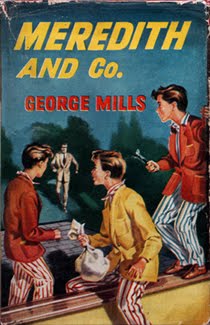
Not meaning to imply that Windlesham did not offer a similar service, we have no like ephemera or other evidence to conclude that they did. Warren Hill, however, offered such a convenience, and Mills used it to his advantage in designing his plots. Both Meredith and Co. and King Willow, begin at Victoria Station, and it is mentioned as the locale of the very first sentence Mills ever published in 1933:

"Percy Oliphant Naylor Gathorne Ogilvie, complete with a nurse, red hair, and freckles, stood with his mother on the platform at Victoria Station."

There is every reason to believe that Percy, who would soon be nicknamed "Pongo"—a spoilt, unattractive, sheltered nine-year-old—is autobiographically based on George Ramsay Acland Mills himself. Percy is described in this first lad-to-lad exchange after finally arriving at fictional Leadham House School by the Downs:

When his mother had gone, Percy felt the feeling of utter loneliness and physical emptiness which all new boys experience. He walked sadly into the school, and entered an empty form-room. Finding a convenient desk, he sat thereat and wept. He seemed to have sat there a long time, with his face in his hands, when he suddenly looked up and beheld, standing in front of him, the ugliest small boy on whom he had ever set eyes.

The new-comer was first to speak.

'Are you a new boy?'

Percy, who lisped when he was excited, answered, 'Yeth.'


This tender scene simply may reflect Mills's ability to observe and empathisize with young boys, but it more likely additionally reflects Mills own experience, to some degree, upon leaving home to attend Parkfield School in Haywards Heath around 1905.

Mills, as we know from his WWI records, suffered from a speech impediment, and the brief scene above may describe intimately Mills's first anxious experience talking to another child without the comfort and support of having members of his family nearby.

Small, tender, and genuine observations such as these are truly the strength of Mills's prose. Perhaps it's natural that a child so aware of his own language pathology would have painstakingly studied the oral language used by those around him, allowing him to replicate it in a way completely unique to the genre of children's literature of that era.


Returning to de Glanville's leaflet, we find on the last page a list of costs for boys attending Warren Hill.

A boy whose program included all of the extracurriculars offered would have accumulated a tab of over 70 guineas per term, payable in advance. Riding then cost an additional 8 shillings per lesson.

de Glanville acquired Warren Hill from Goodland around 1933, a year deep within the period known as the Great Depression. Michael O. of the ELHS weighs in with this insight:

The school was still in existence in Beachy Head Road in May 1934 because there's a reference to a scholarship in the Times of 29 May 1934.

The prevailing economic situation in the 1930s meant that private schools were having a hard time. Some were forced to close in Eastbourne and I guess this it could have been the reason for the demise of Warren Hill. However, the owner (headmaster) would have been sitting on some valuable real estate and would have been able to sell for a good sum.


Undoubtedly.

de Glanville's bankruptcy was the second one filed in Eastbourne in 1937, with all petitions entirely settled before the end of the calendar year. Given the value of the land, as mentioned, it seems unlikely that he had lost everything.

With this particular entry having grown to an almost unwieldy length, next time we'll take a look at some additional information on de Glanville gleaned by the ubiquitous Barry McAleenan. Don't miss it…


Monday, May 16, 2011

Considering the Relationship Between Joshua Goodland and George Mills


George Mills taught at Warren Hill School sometime in the late 1920s. Historians at Windlesham House School [left, now in Brighton, but then in Portslade] believe that Mills was in his first job as a schoolmaster when he spent over a year there, from Lent, 1925, through the end of the summer term in 1926.

Mills published his first novel, Meredith and Co.: The Story of a Modern Preparatory School, in 1933, and since we know from a promotional leaflet he was not on the staff at Warren Hill around 1930-1931, it's likely he would have been employed in Eastbourne sometime between 1926 and 1929. Mills also found himself teaching at The Craig School in Windermere and the English Preparatory School in Glion, Switzerland during those years, but it makes sense to surmise that he made a smaller move from Portslade to nearby Eastbourne before exploring career opportunities farther afield

George's Uncle Dudley Mills had been an officer in the Royal Engineers during George's childhood, and he had been quite a raconteur and world traveler. It's easy to imagine George and his siblings gathered around Uncle Dudley during one of his returns to England, listening intently to stories of faraway lands. For example, Dudley once apparently traveled around China dressed as in Chinese garb, speaking the language, and eating local delicacies.

It's also easy to imagine George sitting in the lounge at Warren Hill or having a pint in Meads at The Ship Inn, listening to Joshua Goodland's tales of travelling around the entire world, and his experiences as he had studied education, architecture, and law to that point in his life. Goodland was the holder of an M.B.E., had designed buildings, taught elementary school, tried important cases, hunted big game in Canada, hiked near the Arctic Circle in Sweden, golfed in Sussex, coached law at Cambridge, sailed around the world, saw San Francisco recovering from the 1906 earthquake, visited modernizing Japan and Czarist Russia before the revolution—well, it probably seemed to George that Goodland had done just about everything!

George's own schooling had taken him south to Haywards Heath and his military experience had led him to exotic Dover and Shropshire [below, left].

In Goodland, George may have seen some possibilities for himself and his future that were not apparent within his family of origin. George's father, Rev. Barton R. V. Mills, had been ticketed for university, and eventually a life as a cleric and scholar, while his brother, Dudley, went to military school. My supposition would be that many parents with a pair of sons at the time may have made similar decisions: An education for one, the military for the other.

During the early 20th century, George's father did indeed make a similar decision regarding his own two sons. Barton's elder boy, Arthur Frederick Hobart Mills, went from Wellington, to Sandhurst, to the Duke of Cornwall's Light Infantry as an officer. Young George was ticketed for Harrow, where his learned and degreed father and grandfather both had been schooled. It's even possible George ended up in an apprenticeship after he left Harrow in 1912.

We know from his records that the military simply didn't work out for George during World War I. After an initial and quite unofficial stint as a lance corporal, he was kept at the level of "fatigue man" for the duration of the war without any hope of promotion. George enjoyed none of the military success that his brother—who was decorated for heroism under fire—had found in the Great War. The younger Mills had washed out as a clerk. Perhaps he simply was not cut out for the military.

It's difficult to say how well George Mills did when he attended Oxford following his hitch in the military. We know he was there from 1919 through some time in 1922 at the very latest, but there are no records of what he might have studied and no record of him having taken any examinations.

Perhaps George simply was not cut out for academia, either. In a family that seems to have valued the dual career choices mentioned above, things must have looked grim for George Mills in regard to gaining and retaining the genuine respect of his family.

Both the military and institutes of higher learning would seem to organizations which have a great many rules to be followed, expectations to be met, and a fundamental duty to reshape their clients into something different—something better—than they had been upon entering. Routines, procedures, systematic progression, and an institutional socialization would have been de rigueur, and perhaps that aspect of military and academic life was what Mills had the most difficulty with in both.

George Mills was probably not considered an extremely able student when he left Harrow [right] after two years. He was tall, slightly built, and beset with both varicose veins on his lips and a speech impediment. His interaction with strangers—and upon entering Harrow, everyone there must have been a stranger—may have been difficult and painfully protracted by his impediment.

Under the pressure of other boys teasing him or stern schoolmasters demanding answers, he may have continually wilted, unable to effectively communicate, eventually becoming reticent even to try.

Humor would have been a marvelous coping mechanism for George as he grew to know some of the other boys and his masters, but one wonders if he could have made enough people laugh to have deflected what must have been a great deal of cruel teasing, and to achieve academically all he might have at Harrow. He may simply have been in survival mode most of the time (and actually may have spent time after his time at Harrow involved in the harrowing speech therapy and familial support of the day, as depicted at the beginning of The King's Speech [left]).

Things must not have gone much better for him in khaki, with orders being barked, snappy replies requested, and impatient superiors continually crying, "Spit it out, soldier!" Increased anxiety under pressure, and an inability to communicate clearly and efficiently in the midst of the most brutal conflict that had engulfed the entire planet, could not have been looked upon very favorably by anyone.

Ironically, however, Mills had a keen ear for language and an exceptional facility with its use in manuscript, despite his speech. The characters in his books are realistically articulate in both the King's English and the unique adolescent slang of the era.

Far from being perfect, the student characters in George's stories possess foibles and traits that often lead to trouble—sometimes a less-than-pleasant bout with the Head Master's tennis shoe or being ostracized by one's peers. Mills has insight into the mistakes boys make, but more so, he has insight into how adults could—and in his mind—should handle them.

It is no accident that his first novel bore the subtitle "The Story of a Modern Preparatory School [my emphasis]. "

George, in becoming an educator in the late 1920s, had for all intents and purposes returned to the scene of the metaphorical crime, or at least the very real schoolboy "crimes" that he felt had been perpetrated upon him. George, clearly a part of a new, humanistic, "modern" world of education, would right many of the wrongs that he'd experienced at his own schools decades before. And there is a good reason to believe that Joshua Goodland acted as the lynchpin in developing that goal and career choice.

Goodland was living at 144 Ashley Gardens in 1925, although it's difficult to tell exactly when he and his family vacated that address. Ashley Gardens is less than a mile from George's family's residence in Kensington at the time [24 Hans Road], and even closer to where his George's step-brother, author (and veteran of campiagns in France, China, and Palestine) Arthur F. H. Mills, was living with his wife, Lady Dorothy Mills, on nearby Ebury Street.

Given Goodland's proclivity to travel, and being a member of the Royal Geographical Society (also conveniently situated in Kensington), it's quite possible that Joshua was acquainted with George's globetrotting Uncle Dudley or Lady Dorothy. Lady D. already had begun traveling the world in the early 1920s, an activity that led her to become the era's foremost female travel writer/explorer. She published multiple monographs as a Fellow in the society (as well as a books and articles for mainstream periodicals) and was renowned throughout the United Kingdom and much of the world.

Lady Dorothy was the sister-in-law of George Mills, and a great deal of interesting activity—Lady Dorothy's travels, Goodland's own interest in travel, George's return home from Oxford and engagement to be married in 1925, and Goodland's waning interest in practicing law—were centered in less than a square mile of acreage in Kensington. George's fiancée and soon to be wife, Vera Beauclerk, was a granddaughter of legendary Sir Robert Hart and had herself been born on China! It's easy to surmise that the paths of George Mills and traveler Joshua Goodland must have crossed at some point.

George may have decided to try his hand at teaching just after Goodland had become a partner of F. R. Ebden [left] at Warren Hill, and Joshua actually may have been soliciting additional staff for the preparatory school in Eastbourne. At that time George, who was successfully engaged as in a junior appointment at nearby Windlesham, may immediately have sprung to mind. It's easy to imagine that George—then thirty years of age and gaining confidence as he taught—may have become more comfortable in his skin, and with his speech.

The Summer Term at Windlesham House this year (2011) runs from 1 May through 9 July. Assuming it was similar at the time, Mills would have been teaching at Windlesham through the Summer Term, July 1926. If Goodland had connected with Mills earlier in Kensington, it's possible that they became reacquainted during early 1926, possibly during cricket or football matches involving the boys at Windlesham and Warren Hill.

We have always assumed Mills left Windlesham against his will: Perhaps because of the General Strike, perhaps because he was found inadequate, or perhaps because it was discovered he had lied about his Oxon credentials.

Is it possible Mills left of his own accord, eschewing a newly purchased house in Portslade near Windlesham for the chance to work with Goodland in Meads? Mills might even have been lured by a bit more salary or the offer of a free residence, allowing Vera and him to sell their new home in Portslade.

George always had struggled in determining 'what he wanted to be when he grew up.' In Joshua Goodland, he'd have found a somewhat kindred spirit, a man who was had always been wanderer along a circuitous career path that included elementary school assistant, architect, law coach, barrister, schoolmaster, entrepreneur, and eventually, as we know, "sometime Head Master of Warren Hill School," all within a four decade span from 1891 to 1931.

Mills thought enough of Goodland [right] to make the "sometime Head Master" the only person singled out by name in the dedication of his first novel. It's likely the feeling was mutual. It is possible that Goodland saw something in Mills that might never have been noticed before. It is also possible that, even if George's potential had been recognized in the past, Goodland was the first to help him begin to realize it.

George never made it through Oxford, earning a degree, although that fact didn't stop him from telling potential employers that he had. It may be that he even told Goodland he was degreed. No matter, George suddenly saw possibilities—even the possibility of future success—despite having a made few career changes, and even if he had already turned thirty.

Joshua Goodland was short, gregarious, intelligent, and probably an energetic man with a wealth of talent, but it does seem he his ambition was accompanied by a lack of clear focus.

George Mills had his own set of talents, and a certain charm, wit, intelligence, and affability that eventually drew people to him. Both men were essentially social beings who obviously enjoyed teaching, and they were keen observers of people.

Mills, it seems, also shared Joshua's lack of focus.

The eminently successful Goodland must have been a larger-than-life image and role model to Mills, and it is no wonder George found himself gravitating to the man.

Why Mills soon departed Meads and ended up teaching in isolated and far flung locales like Windermere and Glion is unknown. For whatever reason, however, Goodland was still the only person mentioned by name in the dedication of George's first novel in 1933. It is difficult to believe the two men parted acrimoniously.

We don't know if Mills and Goodland remained close, but we do know that after Joshua's passing in 1939, Mills [left] never published another book despite living until 1972.

If Goodland had truly been an inspiration, and if subsequent texts continued to win Joshua's approval for George, Goodland's death may have been a real hurdle that Mills found it difficult to clear.

Mills had lost his own father in 1932, and it is possible that George—failed apprentice, failed soldier, failed academician, and a schoolmaster unable to hold the same teaching position for longer than a year or two—knew he had been a disappointment to his father. Goodland was 23 years older than Mills, and may have become an understanding and sympathetic father figure to George at a time when Mills realized he'd never lived up to his late father's expectations.

It may be a coincidence that George's most noteworthy success—1933's Meredith and Co.—was published on the heels of his father's passing in late 1932, the same year Joshua had lost his brother, Theodore. It may also be a mere coincidence that the book's dedication singled out the older Goodland for his influence on George at that critical point in his life. And it may be that the eventual demise of Joshua Goodland only coincidentally occurred in the very same year that saw the demise of George's career as an author.

But that would be too many coincidences for me to dismiss out of hand.

Mills closed the book (no pun intended at first) on his life as an author in 1939. War was imminent for Great Britain, with a resurgent emphasis on the realm's military. Having recently come to grips with finding a literary success that would have pleased his father—a scholar who had authored and edited texts of his own—Mills still had some unfinished business owing to his failings in the military..

After spending more than a decade as an schoolmaster and author, it was time for George to return to the scene of yet another crime against him: The Royal Army Pay Corps.

But that's a story we already know much of, at least pending access to his Second World War military files.

I'll have just a bit more on Joshua Goodland—a man I believe had as powerful an influence on George Mills as anyone—next time. Then, on to other topics!


Monday, March 14, 2011

1916: MEDICAL HISTORY.


It's a cool, crisp, clear morning here in Florida's horse country. The coffee is hot and strong, though, and it's time to dig into something I've been putting off for a while now. This, however, is where it "fits."

In our last post, we took a look at the situation in which George Mills found himself while serving the Army Pay Corps. Mills was born with some advantages—his father, Rev. Barton R. V. Mills, M.A. Oxon, had inherited a great deal of money upon the death of George's grandfather—and had received an education, as we've seen at Parkfield School in Haywards Heath and Harrow. The senior Mills served as an assistant chaplain in the Chapel Royal, had helped conduct the services for the late Queen Victoria, was a member at the Athenæum, and was a published author and respected biblical scholar.

The 1911 census has the Mills family living in London in a 20-room abode with seven servants and a governess for George's sister, Violet, at their 12 Cranleigh Gardens, S.W., home during the count. Rev. Mills, listed as a "Clergyman, Church of England," had sent his son, George, to Harrow at the time. George attended Harrow from 1910 – 1912, and lived for at least some of his time there in an arts & drama-oriented house called The Grove.

His breeding must have made Mills a polite, fairly intelligent boy, as evidenced by his proclivity for writing later in life, and he must have been a keen observer of people. None of those skills would have proven particularly useful when he landed in the Rifle Brigade, though, in 1916.

What was Mills like physically at the time? Would he have some advantage in that regard? Fortunately, we have Army Form B. 178., George's MEDICAL HISTORY, to examine.

Mills was examined at the Town Hall in Kensington in January of 1916. He stood 5 feet 10 inches tall—above average for the time—and weighed 131 lbs. His chest, as we've seen on another document, was 30 inches at rest and 33 when expanded, making him somewhat slight.

His "Physical Development" is described as merely "fair."

The record notes he'd been vaccinated in his infancy and had four resulting marks on his left arm.

His vision in each eye was a perfect 6/6. [Is it possible this was the reason he was originally assigned to the Rifle Brigade, which had been originally formed to provide sharpshooters?]

Now, this is where the form gets interesting. It is signed by two gentlemen, and if I am reading the signatures correctly, they were probably Drs. Waley and Draper. Well, presumably they were physicians. The handwriting of both is attendant in section "(b), Slight defects, but not enough to cause rejection."

It appears Draper examined Mills first and recorded the examination particulars mentioned above as well as the following in section (b): "Varicose veins both lips. Impediment in speech."

Mills then seems to have been passed on to Waley, who amended Draper's observations about George's varicose veins with "rather severe" and adding "left thigh." He also observed, "Some slight deformity both elbow joints."

Varicose veins, at the time at least, seemingly were not uncommon among military recruits. While statistics from the British army of the era are not readily available on-line, the book Army Anthropology: Based on Observations Made on Draft Recruits 1917-1918, released by the United States Surgeon-General's Office, recorded data from millions of WWI recruits.

The average American recruit (among the first million taken at the time) stood 5' 7 ½" tall and weighed approximately 141 ½ pounds. Their study of varicose veins sufferers among those recruits concluded that the affliction was most likely to occur in northern Europeans. They also note: "It appears at once that the population with varicose veins is characterized by great stature. There is a marked deficiency of men below modal stature and a marked excess of men above… enforcing the conclusion that men with varicose veins are those afflicted primarily because of their tall stature."

Mills, at 5' 10", would have been of "tall stature," at least in the American army. What is odd is that Mills, standing in the 1957 Devonshire Park group croquet photograph, does not appear to be unusually tall among the men on that upper riser. In fact, he appears to be of average size, at least among many of the era's croquet-playing British males.

The report also concludes that varicose veins are more common among men with greater girth, something that was clearly not the case with the slightly built Mills.

A 1919 Bulletin (Issue 11) from the U.S. Surgeon-General's Office describes recruitment guidelines regarding varicose veins at the time of George's enlistment in this way:


We can't see George's thigh, circa 1916, but I suppose we can assume, since it wasn't his lower leg that was affected, there also must not have been evidence of edema or ulceration for, despite the 'severity' of his varices, he was accepted.

Regarding George's lips, it seems that the varicose veins there must have been either hemangiomas or venous lakes. Neither of these contemporary terms seems particularly suitable: We see no evidence of hemangiomas in that same Devonshire Park photograph in which George, completely clean shaven, seems entirely unafflicted.

In fact 80-90% of all hemangiomas are resolved by natural involution by the age of nine, and most are found on female babies. Mills, however, was over 19 years of age and distinctly male when his were observed and recorded.

Venous lakes, then, may seem more likely as they occur in males in 95% of all cases, and have only been reported in adults. However, they are most common among men over 50 years of age. The average age of presentation of venous lakes is 65. The term "venous lake" is a relatively new one, though, having been first described as such in 1956. That means, for our purposes here, we'll have to look back in time a bit!

In a 1918 medical text, Surgery and Diseases of the Mouth and Jaws: A Practical Treatise on the Surgery and Diseases of the Mouth and Allied Structures, by Dr. Vilray Papin Blair, the author describes "venous and capillary angiomata."

In a section on page 539 called "Tumors of the Blood Vessels," the author writes: "Capillary nevi [lesions], similar to those seen on the skin, composed of a mass of dilated capillaries, occur on the tongue, cheeks, and lips… [Upon] the lip they may be continuous with a wine spot [hemangioma] upon the face. They are of a bluish color, darker than their surroundings, and at the periphery an interlacing of small vessels is visible. They may be single or multiple or may converge into the venous cavernous form of angioma."

Dr. Blair writes of those angiomata: "Parts of the lips, cheeks, and floor of the mouth and face may be converted into a soft, compressible tumor of a bluish color on its mucous surface and slightly more reddish on the external."

His suggestion for treatment: "As a general proposition, all angiomata should be destroyed or removed." I'll pass over some graphically disturbing methods of destroying some angiomata and continue as he relates: "[There] are three lines of treatment that may come within the domain of good surgical practice: (A) the ligation of vessels; (B) the destruction of the mass by acupuncture; and (C) the excision of the mass, either by dissecting it out or by cutting through the surrounding healthy tissue."

After much more graphic description of ligatures and excision, the author concludes his discussion with the sentence: "Small, and even large, nevi have been destroyed by the electric needle."

Are these angiomata what actually afflicted George's mouth? It certainly may have been the more specific diagnosis at the time, but we'll probably never know. It does seem extremely likely, however, that George Mills must have undergone treatment for those "varicose veins" upon his lips after the war, probably before his lavish wedding in 1925.

Regarding the "slight deformity" of his elbow joints, apparently the most common deformity would be either cubitus valgus [a turning in at the elbow of the 'carrying angle' of the arms] or cubitus varus [the opposite condition, turning out].

In a 1916 text from the Harvard Medical Library, Surgery: Its Principles and Practice, edited by William Williams Keen, M.D., the two deformities above are described thusly:


One cannot know if Mills was afflicted with either condition of the elbows, and whether it may have been the result of an injury or by possibly having contracted "rickets." Still, it was presumably so slight that it wasn't noted by the first examining physician.

Lastly, we find Mills had an "impediment in speech." That's of some contemporary interest as the film, The King's Speech, recently made away with a treasure trove of Academy Awards for its depiction of George VI's struggle with his speech impediment.

In an article in the Quarterly Journal of Public Speaking, vol. 3, 1917, "Correction of Speech defects in a Public School System" by Pauline B. Camp describes studies of 89,077 St. Louis, Missouri, school children and 4,862 Madison, Wisconsin, pupils discovered rates of speech impediments at 2.7% and 5.69% of those populations, respectively. The discrepancy was caused by the fact that the St. Louis study was done via written questionnaire, making the Wisconsin results apparently more reliable.

The impediment categories suggested in the studies were stutters, lispers, and those with 'miscellaneous defects.'

The author relates: "A child with a speech defect is not only held back in school because of his inability to express himself, but is also poorly adjusted to social and economic conditions when he is through with school." This was apparently true in the United States at the time, and while I am uncertain it was the same in Great Britain, I suspect it might have been. Please let me know.

The author quotes a Dr. Wile, then a member of the New York City Board of Education, as saying: "The more pronounced the effect, the more limited the field of activity… The importance of discouragement, anxiety, family distress, embarrassment, diffidence, and shyness upon the development of high moral character cannot be estimated."

Dr. Wiles goes on to discuss how "moral degeneration" is linked to speech pathology, and the author quotes Dr. James Sonnett Green of the National Teacher's Association: "'Living at the tips of one's nerves' through an impediment of speech tends to develop vicious circles of instability, resulting in an increase in criminals, prostitutes, and general failures."

Clearly, Mills was not a criminal or a prostitute, but this was apparently a relatively prevalent view at the time, at least in the United States. And it isn't a stretch to think that George would have been considered a "failure" during his tenure in the army during the First World War, especially as he was sent packing by the Army Pay Corps. It is extremely easy to visualize how "discouragement, anxiety, family distress, embarrassment, diffidence, and shyness" could combine in a young George to produce a soldier with little ability to make an impact while serving in uniform.

Add in the fact that his half-brother, Arthur Frederick Hobart Mills, had attended Sandhurst and was a decorated war hero, having been wounded as a platoon commander in France and Belgium during 1914. Arthur convalesced while writing at first newspaper and magazine articles about his war experiences, and then two popular books, With My Regiment: From the Aisne to La Bassée [Lippincott: Philadelphia, 1916] and Hospital Days [T. Fisher Unwin: London, 1916], seen right. In 1916, Arthiur also married the Lady Dorothy Walpole, daughter of the Earl of Orford before returning to continue serving the Colours in Palestine and China.

When it came to sibling rivalry, young George was simply unprepared to compete, especially in the armed forces. That certainly must have weighed on him.

We now know the adolescent George Mills who showed up at the Town hall in Kensington for his physical was tall in stature, but slight of build, with slightly deformed elbows, varicose veins on his covered thigh and his very much exposed lips, and with an unidentified speech impediment that very likely gave him tendencies to be shy, anxious, and easily discouraged.

A glance at the literature regarding the era's treatment of speech impediments ranges from letting a child outgrow the condition all the way to hypnosis. George and his family, much like the Royal Family in The King's Speech, must have been overwhelmed in trying to determine what, exactly, was the best course of treatment.

A note at the very top of Army Form B 178 reads: "Now Class C.I (One)," and is signed by a Lt. Ellis and dated 11 July 1916, some six months after George's initial examination. There is also a ghost of a Roman numeral 3 (III) beneath that inscription, as if it had been incompletely erased. Was this a prior classification as BIII? There is also a lighter script nearby, though in ink, that also seems to read: "Class. IV.a." followed by the circled word "No."

Whatever, Mills ended up being accepted into the service, classified as BIII, and assigned to the presumably combat-oriented Rifle Brigade, although there seems to have been some negotiating and/or revision before that was determined.

We now know more about George Mills and his physical condition as he entered the military, although, for example, exactly what affliction impeded his speech remains a mystery—unlike George VI's [dramatized, right]—at least until we can find someone who conversed with him.

We can also now surmise a great deal more about George and how he must have dealt with his military life from 1916 - 1919. It wouldn't be a leap to say that his experience must have left some metaphorical scars on him. We also don't know how much of all of it he shared with his family and how much he internalized in a stiff-upper-lip fashion, the latter of which may have psychologically made things worse.

The combination of his physical condition and his military experience had to color the rest of his life, and in some interesting ways. We'll speculate about that another time—this certainly has been a lot to absorb during one sitting!

More immediately, we recently left Mills as he was permananetly and compulsorily transferred out of the Army Pay Corps in September 1918. For any sort of happy ending to occur for George in terms of the military, he would need training—the acquisition of actual, useful skills.

We'll soon look at what those skills were. Stay tuned…